

Use a short structured ID, year plus series plus sequential number, and link every ID to one authoritative digital record. Two rules make the entire system work: the number must be unique across the whole collection, and it must always point to a single, current record that holds the artwork’s images, condition notes, and sale history. Everything below gives you copyable templates, labeling steps, and a migration path so legacy pieces get folded in without duplication.
TL;DR:
- Using a consistent numbering format like YYYY-SERIES-### or MEDIUM-#### ensures clarity and easy sorting but must be applied at the start to avoid chaos.
- Never reuse an inventory ID, and always map legacy numbers to new IDs in a dedicated field to maintain provenance and prevent data conflicts.
- Labels should be placed securely on physical works, with filenames, QR codes, and barcodes matching the digital record ID to avoid mismatches during cataloging.
- Regularly audit your master record, especially after migrations or studio moves, to ensure all IDs, dimensions, and provenance links remain accurate and intact.
- Cloud-based software like Artworksoft enforces unique IDs via structured fields, streamlining collection management and reducing manual errors in inventory systems.
Table of Contents
- Why Art Inventory Numbering Matters for Your Collection
- Recommended Numbering Formats You Can Copy Today
- Rules and Conventions That Prevent Numbering Chaos
- Labeling Physical Works and Linking Them to Digital Records
- Migrating Legacy IDs Without Losing Provenance
- Tools and Label Supplies That Actually Hold Up
- How Artworksoft Enforces Unique IDs Across a Collection
- What Most Numbering Guides Get Wrong
- Get Your Numbering System Running in Artworksoft
- Sources
- FAQ
Why Art Inventory Numbering Matters for Your Collection
A consistent numbering system does more than keep a studio tidy. It lets you identify an artwork’s location, acquisition date, and condition at a glance, which cuts the time spent hunting through folders or storage racks when a client asks about a specific piece. That speed matters most during the moments that decide a sale or a loan.
Inventory numbers also carry the weight of provenance. A gallery or collector reviewing a piece years from now needs a clean trail connecting the artwork to its exhibition history, its sale record, and the contacts tied to each transaction, and a well-structured ID makes that trail traceable instead of guesswork.
The failures show up fast when numbering is inconsistent. A piece gets relabeled during a studio move and the old ID lingers on an invoice. Two works get the same handwritten number because nobody checked a master list. A print edition ships without a code linking it back to the original plate. Each of these creates a gap that a future buyer, appraiser, or insurer will eventually notice.
An ID system built early protects against all of it:
- Provenance continuity: every owner change, loan, and exhibition ties back to one fixed reference.
- Sales accuracy: invoices and Certificates of Authenticity reference the exact same code as the physical piece.
- Insurance clarity: adjusters can match a claimed item to a documented record without ambiguity.
- Condition tracking: damage or restoration notes stay attached to the correct work over decades, not just years.
Recommended Numbering Formats You Can Copy Today
Pick one template and apply it to every new piece from day one. Consistency matters more than cleverness.
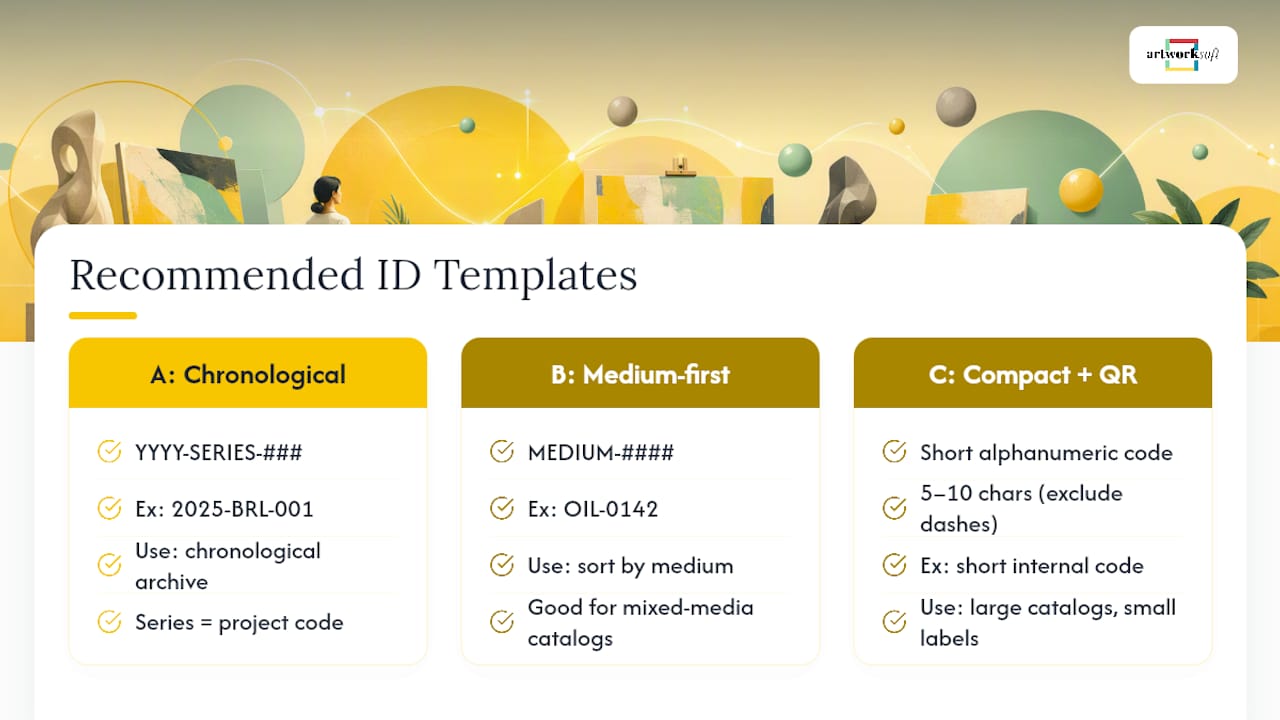
Template A: YYYY-SERIES-###
Best for solo artists building a chronological archive. A typical effective ID pairs a year or short date with a project code and sequential number, such as 2025-BRL-001, where BRL might stand for a series name like “Brushed Landscapes.”
Template B: MEDIUM-####
Useful for mixed-media catalogs where medium matters more than chronology. Example: OIL-0142 for an oil painting, or CER-0033 for a ceramic piece. This format sorts naturally by medium in a spreadsheet.
Template C: Compact alphanumeric with QR alias
For larger catalogs, a short internal code (5 to 10 characters excluding separators) paired with a scannable QR alias keeps physical labels small while the digital record carries the full detail.
Encoding editions and prints: append a fraction after the base ID, like OIL-0142.P/12.30, to show print number 12 of an edition of 30 without creating a separate record.
Pro Tip: Keep your ID length under 10 characters if you’re a solo studio. Longer institutional-style codes feel thorough but slow down handwriting on labels and invite transcription errors.
Rules and Conventions That Prevent Numbering Chaos
Reliability comes from constraints decided once, then never broken.
- Never reuse an ID, even after a piece is destroyed, lost, or reclassified. A retired number should stay retired permanently, with the record marked inactive rather than deleted.
- Map every legacy value to its new ID in a dedicated field rather than overwriting old catalog numbers outright.
- Fix your character set and separators up front. Decide once whether you use hyphens or periods, and whether letters are uppercase, then apply it without exception.
- Document your prefix scheme for medium, series, or location so a studio assistant five years from now can decode any ID without asking you directly.
- Record minimum required fields on every record: title, date, medium, dimensions, and current status (in studio, on loan, sold, or in storage).
Institutional collections often extend this with an item-type prefix ahead of the series code, and that layering supports easy sorting and filtering once a catalog passes a few hundred pieces.
Labeling Physical Works and Linking Them to Digital Records
The number on the piece and the number in your database have to match exactly, every time, with no exceptions.
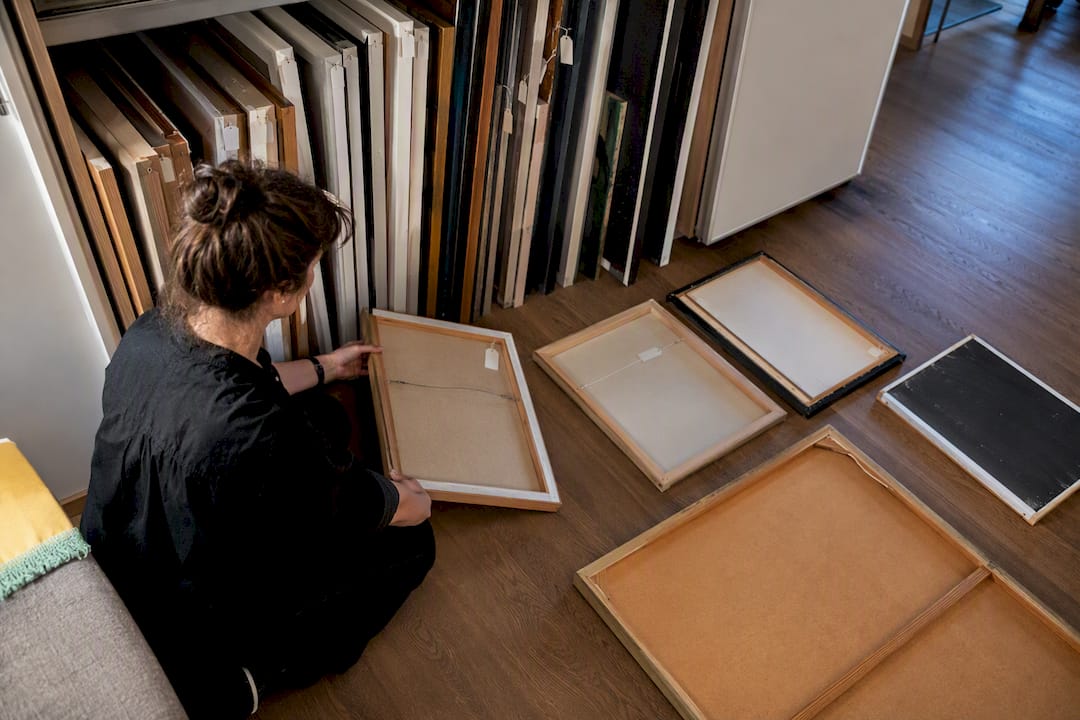
- Label placement: use removable adhesive labels on the back of stretcher bars or frames, and archival tags tied through eyelets for sculpture or unframed works.
- File naming: include the inventory ID directly in every image filename, such as OIL-0142_front.jpg, since pairing the ID with the record this way cuts lookup errors during exports or website uploads.
- QR and barcode generation: a code that resolves straight to the digital record speeds data capture and reduces manual entry mistakes compared to typing IDs by hand at every scan.
- One authoritative master record: whether it lives in a spreadsheet, a cloud database, or dedicated software, every party checking a piece’s status should be pointed to that single source.
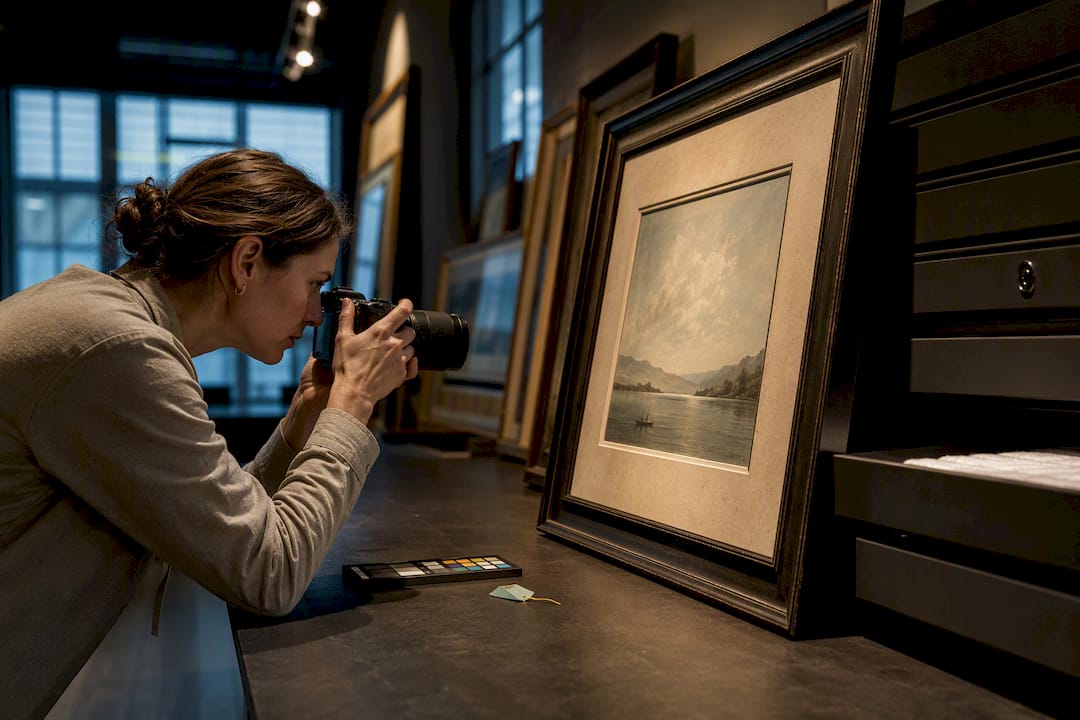
Photographing each work consistently at the time of labeling closes the loop between the physical object and its digital documentation, and pairing labels with a clear storage classification keeps physical placement and digital records aligned as a collection grows.
Migrating Legacy IDs Without Losing Provenance
Old catalogs rarely die cleanly. Most artists inherit a mix of handwritten numbers, gallery-assigned codes, and gaps where nothing was recorded at all.
- Assign each legacy piece a new standardized ID, then store the original number in a dedicated “legacy ID” field rather than discarding it.
- Run a sample audit on 10 to 15 migrated records, checking that dimensions, dates, and medium match the physical piece before trusting the full migration.
- Keep a written log of migration decisions and dates, since an audit trail protects you if a provenance question surfaces years later.
- Reusing an old number for a new piece creates data corruption that mapping strategies are specifically designed to prevent, so treat every retired legacy code as permanently off limits.
Pro Tip: Treat the migration mapping field as permanent, not temporary. Deleting old IDs after migration erases the paper trail buyers and appraisers may need later.
Tools and Label Supplies That Actually Hold Up
You don’t need enterprise software to start. You need materials that survive handling and a workflow you’ll actually keep using.
- Label materials: removable 6×4 bin labels work well for storage crates and tubs, while printable removable adhesive labels suit individual boxes and portfolio cases.
- Scanning tools: most smartphone camera apps read standard QR codes without extra hardware, making a dedicated scanner optional for small studios.
- Backups: export your master record to CSV monthly at minimum, and store a copy outside your primary device or studio location.
How Artworksoft Enforces Unique IDs Across a Collection
A single authoritative record is the goal every section above has been building toward, and it’s the core structure behind how Artworksoft organizes a collection. Every artwork profile links its images, Certificate of Authenticity, movement history, and sales data to one ID, so nobody is cross-referencing four separate files to answer a basic question.
Structured fields prevent the duplicate-ID problem directly:
- Prefix rules for medium, series, or location get locked into the field structure rather than left to memory.
- CSV import lets migrated legacy catalogs map into new IDs without manual re-entry.
- PDF generation produces a matching Certificate of Authenticity the moment an ID is assigned, keeping documentation and numbering in sync from the start.
What Most Numbering Guides Get Wrong
Most advice on this topic covers the format question well and stops there. Pick a template, apply it consistently, done. What gets skipped is the migration problem, which is the part that actually breaks collections. Nearly every working artist has some mix of handwritten numbers, gallery-assigned codes, and pieces with no ID at all sitting in a closet or a spreadsheet nobody trusts anymore.
The instinct is to wipe the slate and start fresh. That’s the mistake. A fresh start without a mapping field severs the connection between a new clean ID and whatever provenance the old number carried, even if that provenance was just a gallery invoice from a decade ago. Once that link is gone, it doesn’t come back.
The second gap is treating the ID as the finish line rather than the pointer. A number scrawled on a label is worthless the moment it stops resolving to a current, accurate record. Uniqueness prevents collisions. A linked authoritative record prevents the number from becoming decoration. Readers should build the mapping habit before they touch a label maker, because retrofitting provenance after the fact is far harder than preserving it the first time.
— Nealda
Get Your Numbering System Running in Artworksoft
Artworksoft gives you the authoritative record this entire system depends on, without the setup overhead of a homemade spreadsheet that eventually outgrows itself. Rather than juggling separate files for images, COAs, and sales history, you assign an ID once and every downstream document, invoice, and movement record stays linked to it automatically.

Start by creating a free account and adding your first artwork ID directly into the platform. If you’re migrating an existing catalog, the CSV import feature carries your legacy numbers over as a mapped field instead of forcing a manual rebuild. Generate a Certificate of Authenticity for that first entry, then test the full loop by scanning the resulting QR code to confirm it resolves straight to the correct record. It takes less time than reorganizing a single storage shelf.
Sources
- Creating a Collection Inventory Number System Step by Step – Watch and Gather
- How to Create an Artwork Inventory: A Step-by-Step Guide – FromLight2Art
- Large Storage Bin Labels, 50 Pack | MESS Brands
FAQ
What should an art inventory number include?
A solid ID includes a year or short date, a series or medium code, and a sequential number, such as 2025-BRL-001, kept short enough to write legibly on a physical label.
How do I inventory an entire art collection from scratch?
Start with one spreadsheet row per piece, assign each a unique ID under a single format, photograph the work, and record title, date, medium, dimensions, and status before moving anything into storage.
Are numbered prints worth anything?
A print’s number within its edition, such as 12/30, does not by itself increase value, but accurate documentation of edition size and print number supports authenticity and can affect resale confidence.
What is the 80/20 rule in art collecting?
Definitions vary across sources, and there’s no single agreed meaning tied specifically to inventory numbering, so treat any proportional claim in this context with caution rather than as an established rule.
How often should I audit my inventory numbers?
Review your master record at least once a year, and always audit immediately after a large migration, studio move, or batch of new acquisitions to catch mismatches early.
Can software prevent duplicate inventory numbers?
Yes. Structured fields in a platform like Artworksoft enforce uniqueness at the point of entry, which removes the manual double checking a spreadsheet requires.