
Coordinating inventory, provenance, and sales records across fragmented art management tools leads to errors and lost documentation. Most platforms limit advanced valuation, provenance tracking, or integrated sales and website functions to higher-tier plans or require manual export routines. Galleries, collectors, and artists can match an art inventory platform to their needs for valuation, provenance, and sales integration without trying multiple systems.
Table of Contents
Artworksoft
At a Glance
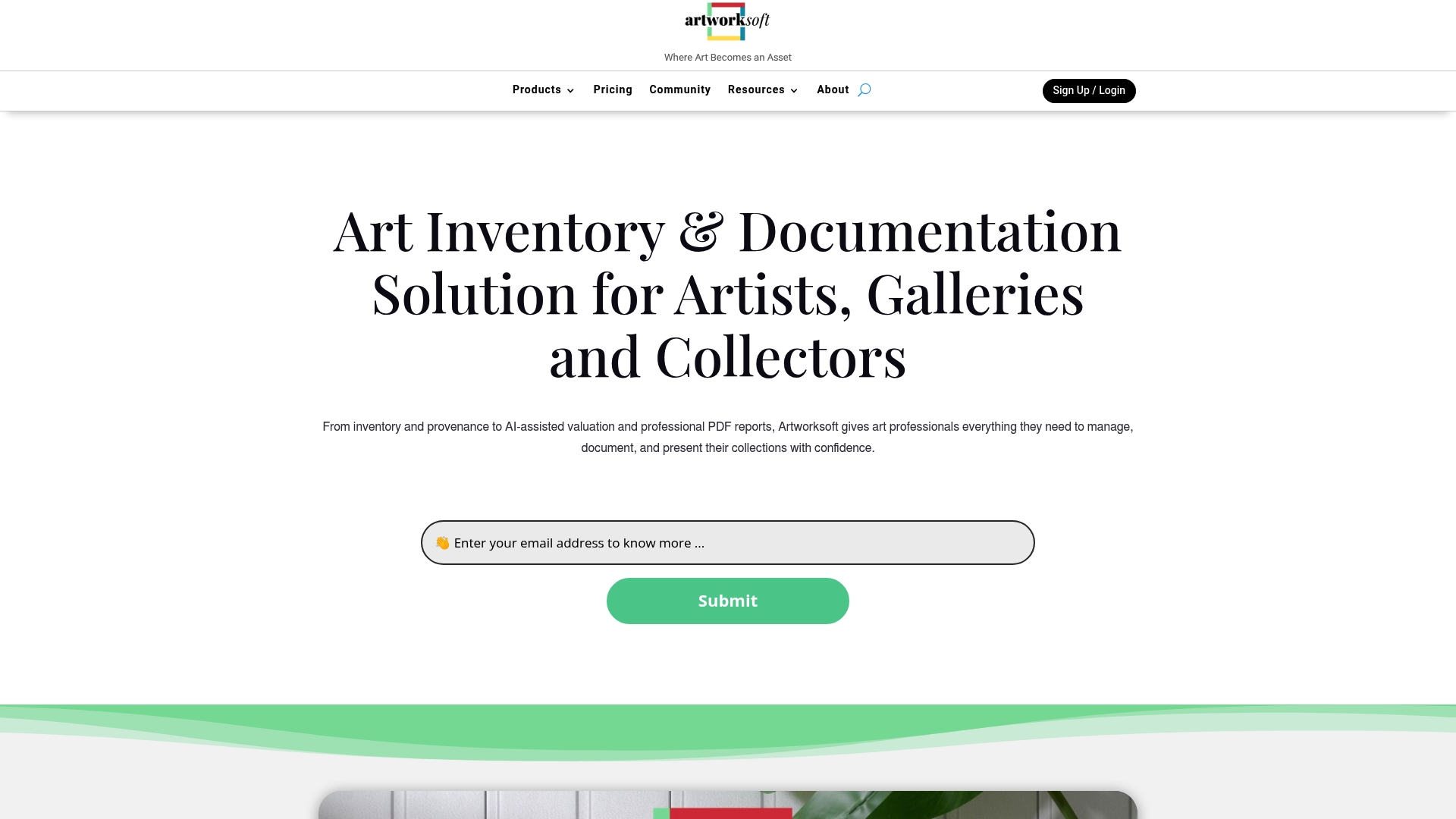
Artworksoft’s structured valuation formula removes much of the guesswork from pricing by codifying valuation inputs into a repeatable process. The platform pairs that formula with provenance documentation and movement records to support sales and insurance workflows. This combination targets galleries and collectors who need rigorous, auditable pricing and records.
Core Features
Artworksoft centralizes inventory into detailed artwork profiles linked to locations and transactions. It includes provenance tracking, AI-assisted valuation, and the generation of professional PDF reports and Certificates of Authenticity. Movement, logistics, and transfer tracking cover loans, sales, and internal transfers so records stay synchronized across the collection lifecycle.
Key Differentiator
Artworksoft’s defining strength is that it unites inventory, provenance tracking, AI valuation, and professional reporting in one integrated workflow. That integration keeps pricing, documentation, and transfer history consistent and exportable for clients, insurers, and auditors.
Pros
The platform consolidates inventory management, valuation, provenance, and reporting into a single system, reducing duplicate records across spreadsheets and folders. Professional outputs such as certificates and provenance reports support due diligence during sales and insurance processes. The inclusion of community features increases visibility for artists while the movement tracking preserves an auditable chain of custody for high-value works.
Cons
- Steep learning curve for new users unfamiliar with comprehensive asset management.
Who It’s For
Artworksoft fits galleries, collectors, artists, and institutions that require formal documentation and auditable valuation routines. It suits teams that manage loans, sales, and insurance claims where provenance and transfer history matter. Smaller artists with minimal inventory may find some features more than necessary.
Unique Value Proposition
The structured valuation formula plus integrated certificates lets galleries price and document works without exporting between systems. That reduces time spent reconciling valuation notes with provenance files and creates single-file PDFs suitable for client packets and insurer submissions. The result is a repeatable pricing workflow that supports professional sales and compliance needs.
Real World Use Case
A mid-size gallery catalogs a new estate in Artworksoft, attaching provenance scans and condition notes to each profile. The gallery runs the valuation routine to produce consistent price recommendations, then exports provenance reports and certificates for prospective buyers and insurers. Movement tracking records the loan to a museum and the subsequent return, preserving a clear ownership and location history.
Pricing
Subscription plans and detailed pricing are not listed publicly. Prospective customers must request pricing and plan details via the vendor’s contact channels on the website. Larger institutions should expect tiered plans or custom quotes that match advanced reporting and logistics needs.
Website: https://artworksoft.com
Artwork Archive
At a Glance
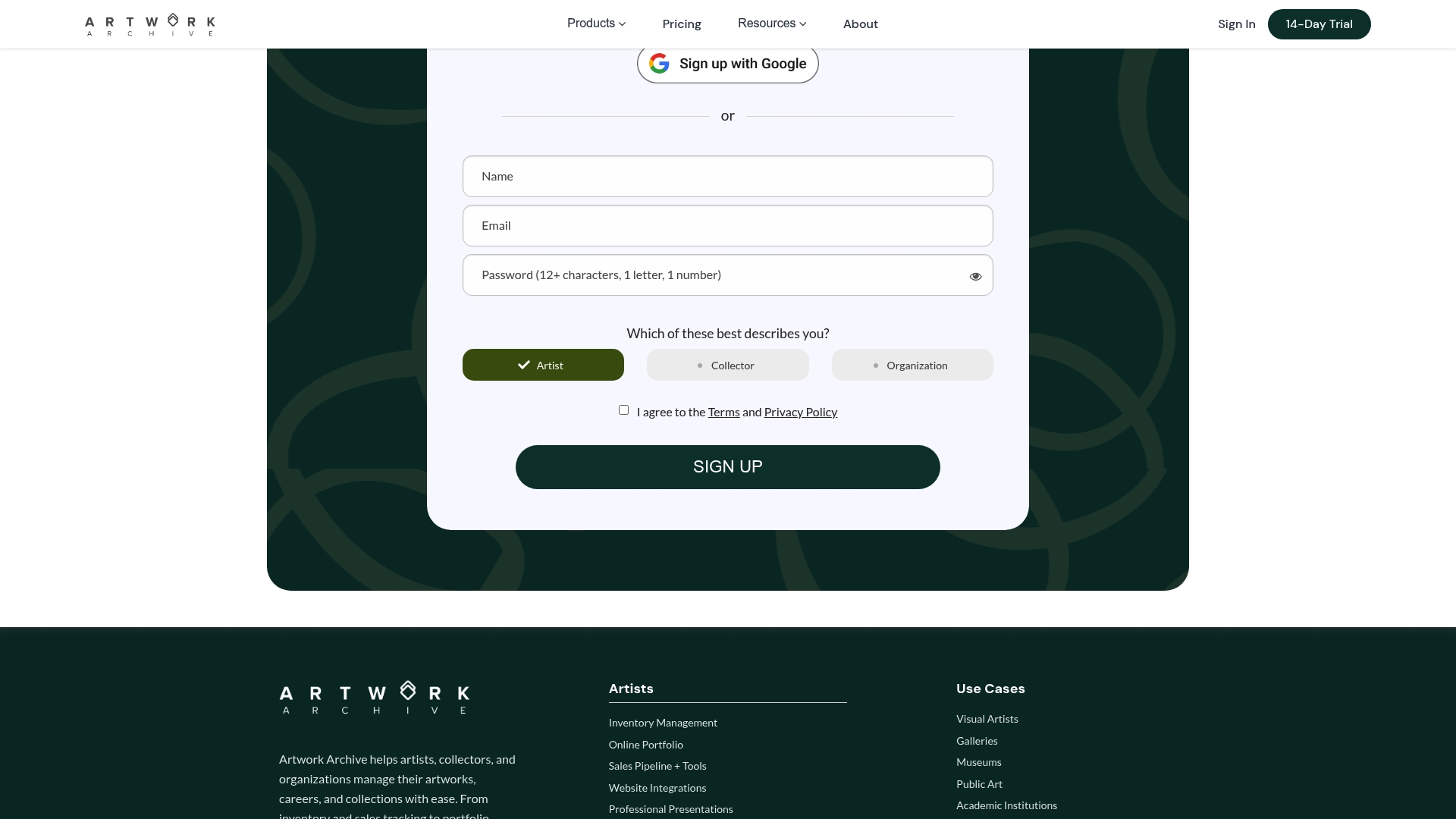
Data security, human support, and flexible integration options anchor Artwork Archive. The platform centralizes cataloging, exhibition logistics, and sales records for artists, collectors, and organizations. Users get both private collection pages and public profiles for online presentation.
Core Features
The product lets users track artwork and collections, produce professional reports, and build private or public online galleries. It supports exhibition planning, loan management, CRM for clients, and basic sales and invoice records. Users can export records and run reports for valuation, insurance, and tax needs.
Key Differentiator
The main distinction is a focus on collection workflows tailored to creative careers and institutions. Features align cataloging, provenance, sales tracking, and public presentation so a single record can carry exhibition, loan, and transaction history. This focus moves emphasis from general asset tracking to art specific records and provenance documentation.
Pros
The feature set covers cataloging, exhibition logistics, loan tracking, and CRM, which reduces the number of separate tools required. Plans scale from individual artists to larger organizations, and the vendor highlights strong backup and security practices plus responsive human support. Public profile and private collection options work for outreach and restricted access without extra hosting.
Cons
- Limited transparency about specific third party integrations. This may complicate workflows that rely on external tools.
- Pricing can be layered with plans and add ons, which may be complex to budget for.
- No explicit advanced AI or automation features are listed. That limits hands off cataloging or auto tagging workflows.
When It May Not Fit
Organizations that require deep third party integrations or automated tagging will find gaps. Large museums with bespoke ERP or finance systems may need custom connectors not described in the materials. Teams seeking heavy automation for ingestion or valuation should expect to add separate tools. Developers should verify API and connector options before committing.
Who It’s For
Artists, collectors, and arts organizations needing a secure place to catalog work will find this product relevant. Small galleries and independent artists benefit from built in CRM, invoicing, and public profile tools. Institutions that want tighter integration with existing finance systems should review connector options before committing.
Real World Use Case
A museum digitizes its holdings, centralizes loan records, and publishes virtual exhibitions for educators and visitors. Curators track provenance and condition reports in the same record used for display scheduling. Department staff use the CRM to manage lender contacts and invoice requests, which speeds administrative tasks.
Pricing
Pricing is tiered by plan and features. The structure includes add ons that affect final cost. See plans and pricing at https://www.artworkarchive.com/pricing
Website: https://artworkarchive.com
ArtCloud
At a Glance
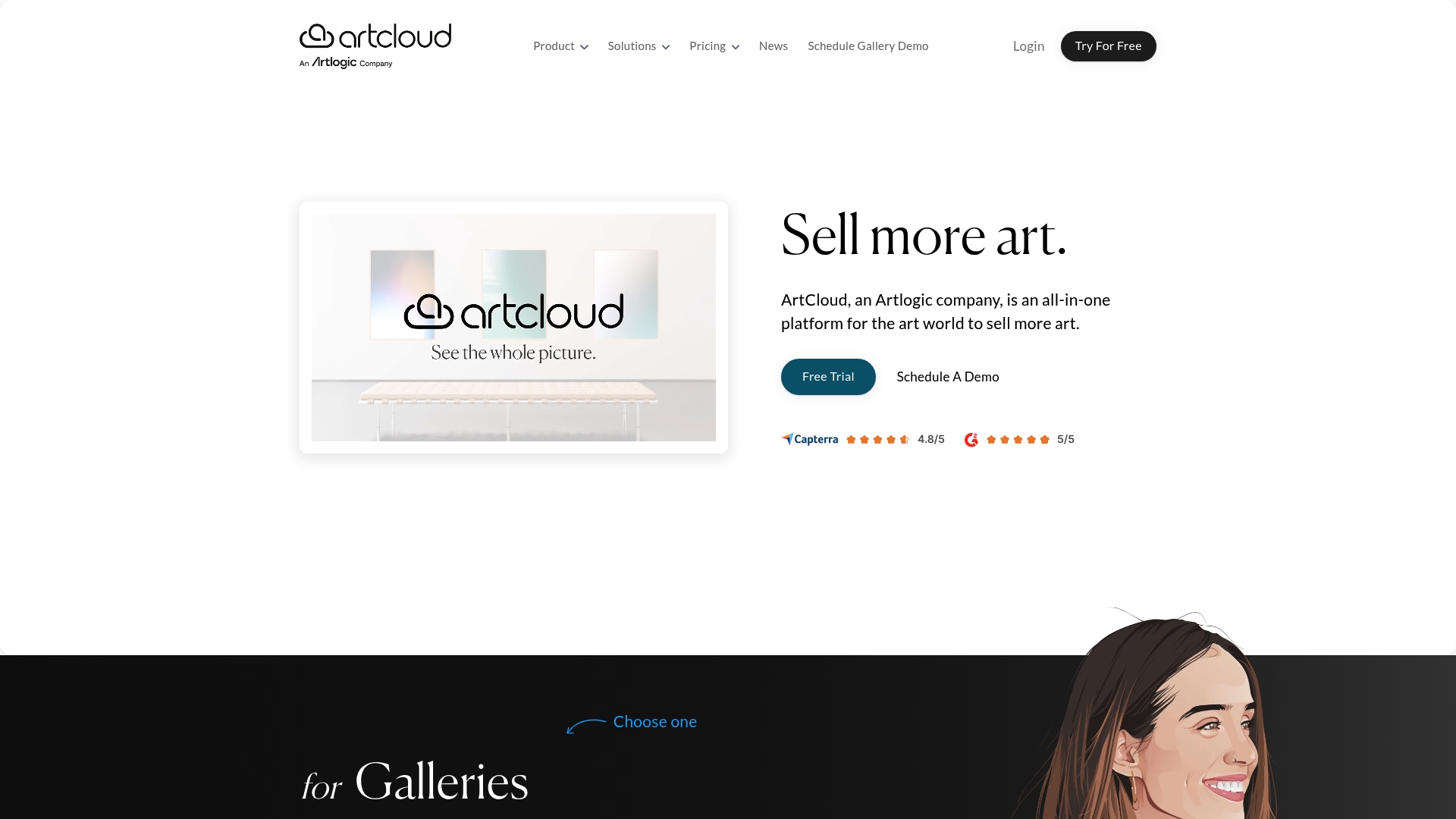
ArtCloud reports a community of thousands of users, including prominent galleries and artists. The platform bundles gallery and artist management with a drag and drop website builder and inventory migration tools. Vendors position it as an all-in-one suite for galleries, artists, and jewelry businesses that handle sales and marketing.
Core Features
ArtCloud centralizes gallery and artist records while offering inventory management and consignment tracking in the same interface. The product includes a drag and drop website builder with themed templates, plus e-commerce and in-person sales support. Marketing features cover email campaigns and CRM syncing, and reporting tools deliver sales and artist performance data.
Key Differentiator
ArtCloud combines management, website building, and sales functionality in a single package tailored to art businesses. That integrated approach reduces the need to glue together separate systems for listings, client records, and online checkout. The vendor frames this as a specialized stack for galleries and studios rather than a generic retail tool.
Pros
The suite targets gallery and artist workflows with modules for inventory, consignments, and exhibition organization in one place. The website builder makes publishing new works straightforward for teams without developer resources. Integration coverage and payment support give galleries options for online sales and marketing, and that user figure suggests broad market adoption and ongoing product updates.
Cons
- Complexity may overwhelm very small or solo practitioners who prefer a lighter tool.
- Pricing tiers may prove costly for emerging artists or micro galleries because the model is tier based.
- Public reviews contain limited detail on deep customization, which leaves unclear how the product scales for niche technical needs.
When It May Not Fit
ArtCloud may not fit a solo artist who wants a minimal, low-cost inventory tracker. It also may not match galleries that need highly bespoke integrations or custom transaction workflows. Teams that require granular developer APIs or white‑label backend control should verify specific capabilities before committing.
Notable Integrations
- Stripe for payments and checkout flows.
- Artsy and Instagram & Facebook for marketplace and social connections.
- Shippo for shipping, Google Analytics for site metrics, Mailchimp for campaigns, and Gmail and Office 365 for communications.
- The integrations array also lists a combined vendor string that includes 1stDibs, Pinterest, Arcual, Weglot, Apple Pay, and Avery.
Who It’s For
Galleries, mid sized studios, and jewelry businesses that want a unified platform for inventory, sales, and websites. Teams that run both online stores and in-person sales will find the mixed commerce support relevant. Organizations seeking an art-focused CRM and reporting set will gain the most immediate value.
Real World Use Case
A gallery uses ArtCloud to import inventory, assign consignment records, and publish a themed website without a dev team. The staff uses email campaigns to announce openings and to track client inquiries inside the platform. Sales and shipping data flow back into the gallery ledger for monthly reporting.
Pricing
ArtCloud lists subscription tiers, but specific fee details are not disclosed in public materials. Prospective buyers must request pricing or follow vendor links to view tier options and features. The model is tier based and likely varies by feature set and gallery size.
Website: https://artcloud.com
Comparison of alternatives
The distinct features and capabilities of art management platforms cater to varying needs of artists, galleries, and collectors. Identifying the most suitable option requires evaluating specific attributes and determining their alignment with individual organizational requirements.
Differentiated solutions for art management needs
“Artworksoft” offers a standardized valuation protocol employing AI mechanisms to generate pricing data, while integrating certificates and location tracking for artwork management. Conversely, “Artwork Archive” prioritizes data security, consistent support, and flexibility through user-centric reporting and online presence capabilities. “ArtCloud” excels by merging gallery-centric tools with website creation and marketing options for studios and art businesses that seek a consolidated operational solution. Each platform capitalizes on distinct strengths to address diverse client profiles.
Unique specialization among competitors
When prioritizing security and interactive support, “Artwork Archive” provides detailed guidance and strong data redundancy measures, appealing to institutions requiring highly secure digital systems. Meanwhile, “ArtCloud’s” accessibility tools and theme-based website creation target galleries aiming to broaden their market engagement. “Artworksoft,” however, integrates valuation, provenance, and reporting in one synchronized workflow, which benefits operations centered around compliance and auditability along with dynamic inventory management.
Best fit
- Mid-size galleries with frequent valuation demands and dependence on provenance documentation should use Artworksoft for operational synchronization.
- Institutions emphasizing data integrity and requiring responsive troubleshooting support may find “Artwork Archive” the most reliable solution.
- Galleries focused on expanding their online customer base and managing multi-channel marketing align well with “ArtCloud’s” bundled website-building and marketing toolkit.
Our pick
“Artworksoft” is ideal for users that rely on structured inventory approaches integrated with valuation analytics. Its unified platform distinctly complements sectors adhering to audit compliance and documentation precision. Emerging professionals or niche art studios might alternatively consider platforms offering narrower but specialized capabilities.
Comparing these platforms reveals distinctions in art inventory management, from integrated workflows to customization support.
| Platform | Core Feature | Key Differentiator | Best For | Pricing | Notable Limitation |
|---|---|---|---|---|---|
| Artworksoft | Provenance tracking and AI valuation | Integrated workflow for audits | Galleries and institutions | Price not published | Steep learning curve for new users |
| Artwork Archive | Exhibition logistics and sales records | Private and public gallery options | Artists and arts organizations | Tiered plans and add-ons | Limited transparency on third-party integration details |
| ArtCloud | Drag-and-drop website builder | Combined management and marketing | Galleries and mid-sized studios | Price not published | Complexity for small users; potential tier model cost for artists |
Challenges Galleries and Collectors Face When Choosing Yallery.com Alternatives
Selecting the right platform for managing art collections requires addressing valuation accuracy, provenance tracking, and documentation needs. Galleries, collectors, and artists often struggle with disconnected workflows and unclear pricing methods. Artworksoft stands out by applying a structured valuation formula that removes guesswork from pricing, linking artwork data with locations, sales, and professional certificates.
Artworksoft serves galleries and collectors who need consistent valuation, audit-ready provenance, and clear movement tracking. Features like Certificates of Authenticity and movement records support insurance and sales processes with documented proof. This reliable integration reduces duplicated records while enhancing artist visibility through community features.
Learn more about Artworksoft to evaluate artwork with precision and create professional documentation. Visit the site and connect your inventory, valuation, and provenance in one system designed for your collection management requirements.
FAQ
How does Artworksoft assist with art valuation?
Artworksoft generates consistent price recommendations through its structured valuation formula. This formula codifies valuation inputs into a repeatable process, making pricing more accurate and auditable. Users should expect an efficient way to price their art works without guesswork through this system.
What is the difference between Artworksoft and Artwork Archive?
Artwork Archive offers strong backup and security practices alongside responsive human support, which can be beneficial for users needing assistance with cataloging. Artworksoft, on the other hand, excels at integrating inventory management, provenance tracking, and professional reporting into a single workflow. This makes Artworksoft a better fit for galleries and collectors needing rigorous pricing and record-keeping.
Which platform offers inventory management specifically for artists?
Artworksoft centralizes art inventory management by linking detailed artwork profiles to locations and transactions. This allows artists and galleries to track their collections effectively while maintaining comprehensive provenance records. Consider starting with Artworksoft if you need a streamlined solution for managing art assets.
Can I track provenance effectively with Artworksoft?
Yes, Artworksoft includes provenance tracking, which facilitates clear documentation of ownership history. This feature supports the sales process and meets the requirements for insurance, ensuring that records are always synchronized across the collection lifecycle. Expect a reliable way to manage provenance records efficiently with Artworksoft.
How does Artworksoft’s reporting compare to other platforms?
Artworksoft generates professional PDF reports and Certificates of Authenticity, providing robust outputs that support due diligence during sales and insurance processes. This feature gives it an advantage over competitors that may not offer equally comprehensive reporting tools. Users can efficiently create documentation necessary for transactions and compliance.