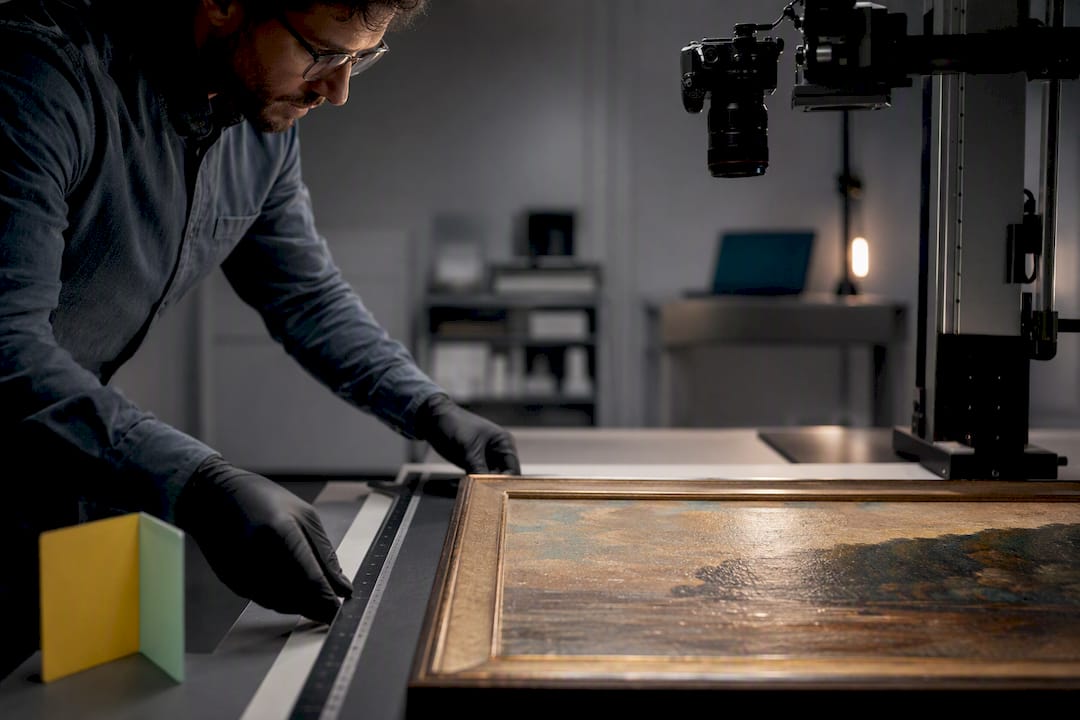

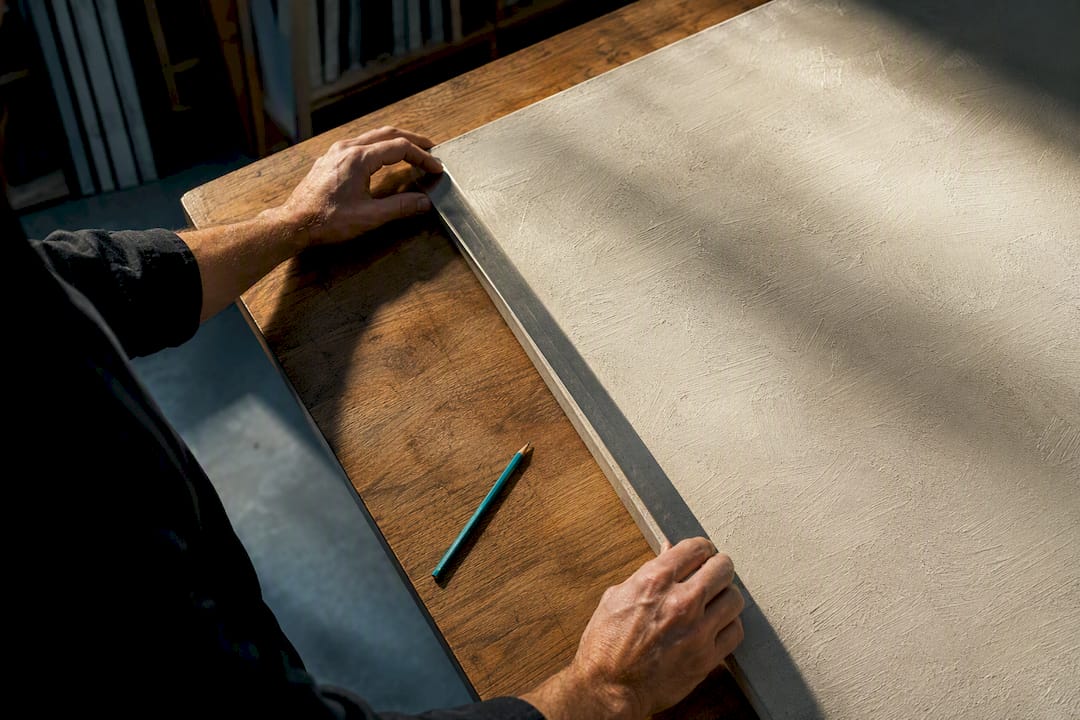
The price per square inch art formula is simple: multiply width by height in inches, then multiply that number by your chosen dollar rate. Emerging artists typically start at rates per square inch varying according to medium and experience. Materials, framing, labor, and gallery commissions get added on top of that base number, not folded into the rate itself.
TL;DR:
- The chosen rate per square inch should reflect your career stage, with beginners charging $0.50 to $1.50 and established artists exceeding $12.
- Adjust your rate for small artworks by applying a multiplier for detail density, and reduce it for large pieces to account for proportional completion time.
- Always include materials and labor costs separately to ensure your sale price covers actual expenses and prevents selling at a loss.
- Use comparisons with five similar artists to set a realistic rate, and validate your price with a calculator that accounts for size, adjustments, and additional costs.
- Maintaining a structured pricing formula across all channels prevents inconsistencies and builds buyer confidence over time.
Table of Contents
- How to Calculate Price Per Square Inch Art
- Choosing a Rate Tied to Career Stage and Market
- Adjusting Price Per Square Inch by Size
- Worked Examples: Calculating Real Prices
- Setting a Cost Floor With Materials and Labor
- Common Pricing Mistakes and How to Avoid Them
- What Working Artists Get Wrong About Formula Pricing
- Track Your Pricing Formula With Artworksoft
- Sources
How to Calculate Price Per Square Inch Art
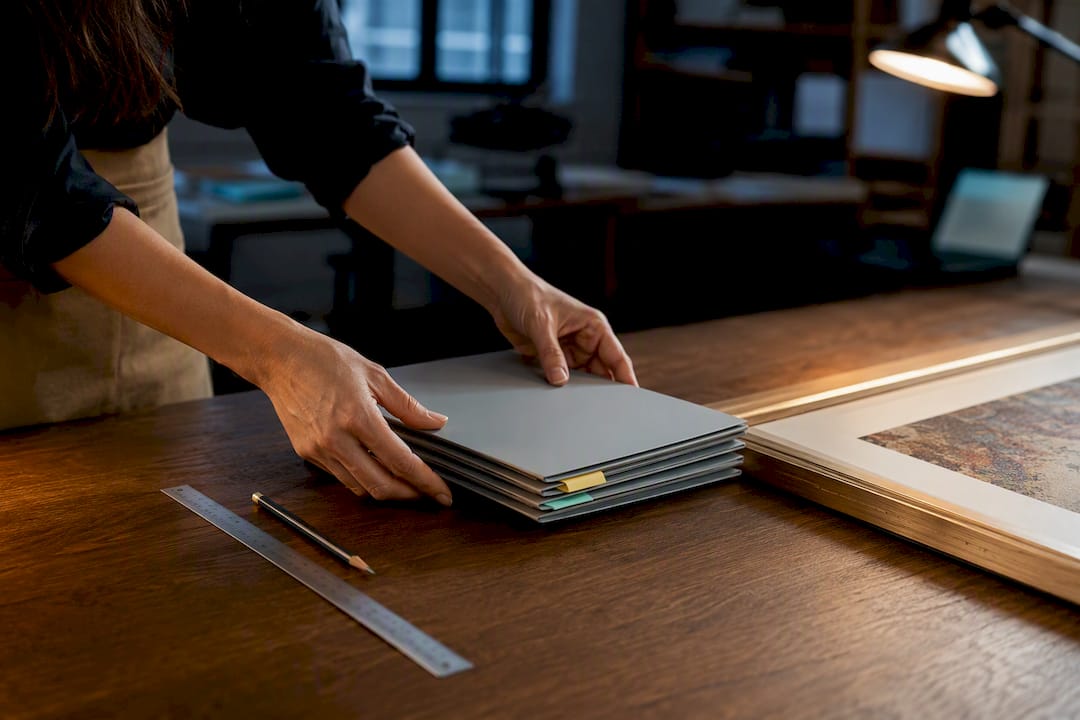
The math takes seconds once you know the inputs. Measure the artwork itself, not the frame, unless you’re selling it framed and want that cost reflected in the sale price. Most artists measure the canvas or paper edge to edge in inches, then decide separately whether framing gets billed as a line item.
Here’s the full sequence:
- Measure width and height in inches (round to the nearest quarter inch).
- Multiply width by height to get total square inches.
- Multiply square inches by your chosen dollar rate per square inch.
- Round the result to a clean number, either ending in .99 for a retail feel or a flat round figure like $450 for a gallery-facing price.
- Add materials, framing, and any documentation fees as separate line items.
A 16 by 20 inch canvas at a chosen rate per square inch runs the math as 320 square inches times that rate, landing at the corresponding price before materials. Artists Network outlines this same simple formula for pricing artwork, and it remains the most widely used shorthand in the field because it scales predictably as sizes change. The rounding step matters more than most artists realize. A price of $1,283.40 looks like a spreadsheet error to a buyer. A price of $1,275 or $1,299 looks intentional.
Choosing a Rate Tied to Career Stage and Market
Your dollar rate is the variable that does the heaviest lifting, and it should reflect where you actually stand, not where you hope to stand next year.
Rough benchmarks that most working artists recognize:
- Beginner / hobbyist: $0.50 to $1.50 per square inch, often used for first gallery submissions or online shop launches.
- Emerging artist: $2 to $6 per square inch, the range most commonly cited across pricing guides for artists with some sales history.
- Mid-career artist: $6 to $12 per square inch, reflecting a documented exhibition record and repeat collectors.
- Established artist: $12 and up, often set less by formula and more by auction results and gallery representation.
Medium changes the math too. Oil and acrylic paintings tend to command higher per-inch rates than works on paper, since materials and perceived permanence factor into buyer expectations. Complexity and technique also push rates up. A densely layered mixed-media piece that took sixty hours justifies a different rate than a loose watercolor sketch finished in two.
Pro Tip: Pull up five comparable artists at your career stage, in your medium, selling through similar venues, and average their per-inch price. That number is a far better anchor than a rate pulled from a general pricing article. Artistic Masterclass’s data-driven approach recommends this same five-peer comparison, adjusted with market coefficients for regional demand and venue premiums.
Adjusting Price Per Square Inch by Size
The straight formula breaks down at the extremes. Small paintings often take nearly as long to compose and finish as medium ones, so a flat rate punishes detail work on an 8 by 10 canvas. Large paintings, meanwhile, don’t take proportionally longer to fill; a 40 by 60 inch canvas rarely takes six times longer than a 16 by 20, even though it has six times the square inches.
Two practical adjustments handle this:
- Small-piece premium: Apply a moderate multiplier increase to your base rate for smaller artworks, since detail density per inch runs higher.
- Large-piece discount: Apply a reasonable reduction to your base rate for very large artworks, reflecting decreased production time per inch.
Quiet Canvas’s breakdown of pricing logic recommends sliding scales or index-number systems specifically to avoid this underpricing-small, overpricing-large trap. Some artists skip square inches entirely and price by linear inch (width plus height) instead, which flattens the curve further and works well for artists who paint across a wide range of sizes.
Pro Tip: Keep a simple tiered chart taped near your workspace: under 120 square inches, 120 to 1,500, and above 1,500, each with its own multiplier. Glancing at it takes less time than recalculating from scratch every time a buyer asks for a quote.
Worked Examples: Calculating Real Prices
Examples with a base rate illustrate how small artworks may have a premium multiplier increasing the effective rate, medium pieces use the base rate, and large artworks may receive a discount multiplier lowering the effective rate, resulting in prices scaled accordingly.
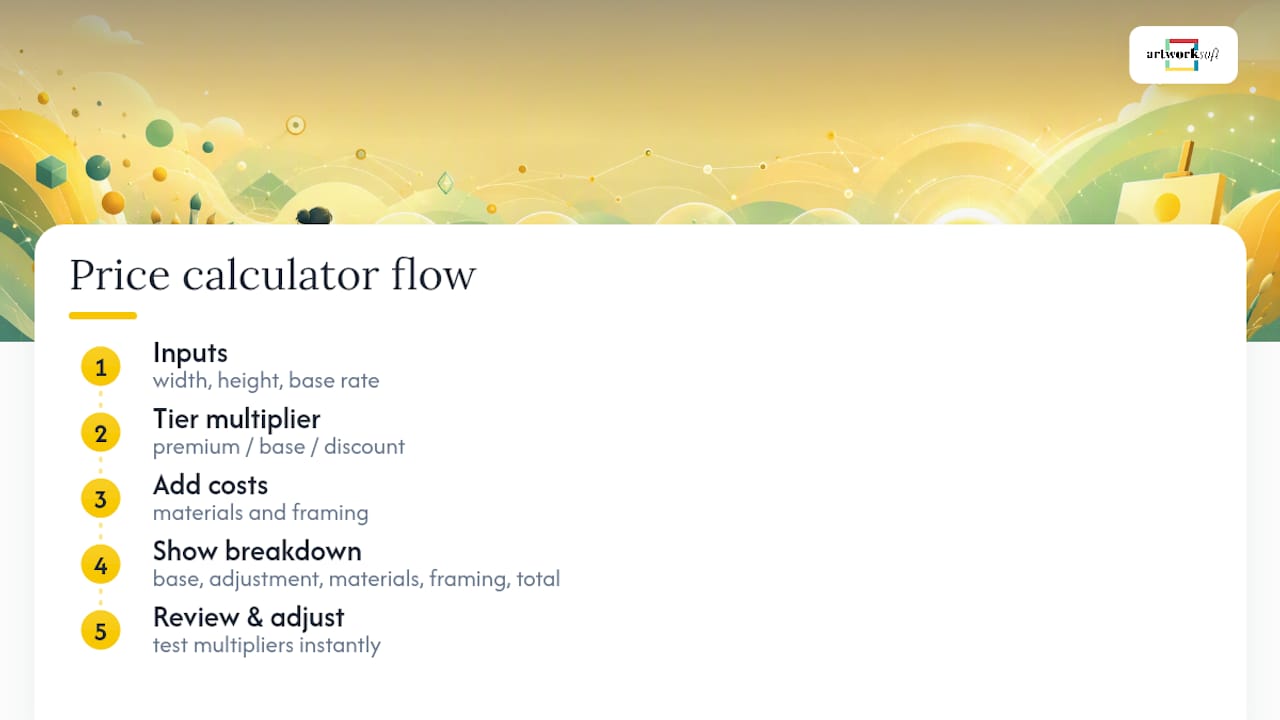
An art price calculator speeds this up by letting you enter dimensions and rate once, then testing adjustments instantly rather than reworking the arithmetic by hand each time. Enter width, height, base rate, then layer in your tier multiplier, materials cost, and framing cost as separate fields. The output should show a breakdown, not just a final number: base price, adjustment applied, materials, framing, and total. Buyers and galleries both respond better to a price they can see the logic behind than a single unexplained figure.
Setting a Cost Floor With Materials and Labor
The square-inch formula tells you what the market might bear. It doesn’t tell you whether that number covers what the piece actually cost you to make. That’s the job of a cost floor.
- Tally materials per piece (canvas, paint, panel, varnish) and either fold that total into your per-inch rate or list it as a separate line item on invoices.
- Set an hourly rate for your labor, estimate hours spent, and multiply the two to get a labor floor.
- Compare the formula price against materials plus labor. If the formula result falls below that combined floor, raise your rate or add a floor override rather than sell at a loss.
- For gallery consignment, model both the retail price and your net after a standard 50% commission split, then back-calculate the retail price needed to clear your floor.
If your floor is $600 and a gallery takes half, the retail price needs to hit $1,200 minimum, regardless of what the square-inch formula alone suggests.
Common Pricing Mistakes and How to Avoid Them
Three mistakes show up again and again: pricing differently across galleries and online shops, undercharging for small pieces because the formula alone doesn’t account for detail time, and forgetting to bill shipping or framing as separate costs.
- Keep one master price list and update every channel from it, since inconsistent pricing across venues undermines collector trust.
- Review your rate annually, not per sale, so pricing reflects your trajectory rather than a single transaction’s mood.
- Run the formula as a sanity check before every listing, even when a gallery suggests a different number.
Pro Tip: Before listing anything, run through a three-item checklist: does the price clear my labor and materials floor, does it match what I charged for the last comparable piece, and does it account for framing or shipping separately?
What Working Artists Get Wrong About Formula Pricing
Most guides treat the square-inch formula as gospel. It isn’t. It’s a consistency tool, useful precisely because it forces the same math on every canvas that crosses your studio, but it says nothing about whether a given piece took you six hours or sixty, or whether it uses gold leaf instead of acrylic.
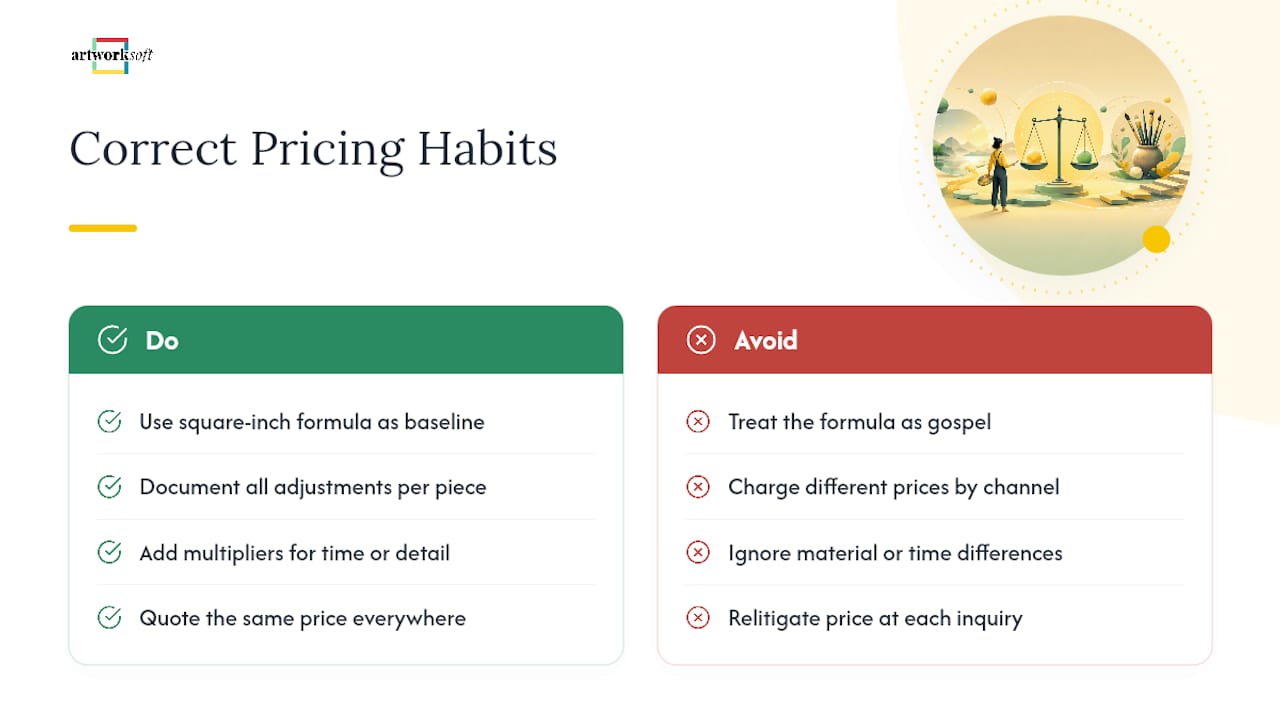
The real skill isn’t calculating the number. It’s knowing when to override it. A tiny, obsessively detailed ink drawing that took three weeks deserves a personal index multiplier layered on top of the base formula, not a straight per-inch price that treats it the same as a quick sketch. A structured valuation approach treats the formula as a starting point and lets artists layer documented adjustments on top, rather than forcing every piece through one flat calculation.
The artists who struggle most with pricing aren’t bad at math. They’re inconsistent. They quote one number at a fair, a different one online, and a third to a gallery, and every mismatch chips away at buyer confidence. Fix the formula once, document it, and stop relitigating it every time someone asks what a piece costs.
— Nealda
Track Your Pricing Formula With Artworksoft
Some art management systems provide a place to lock in your rate, your floor, and every adjustment so pricing stops living in scattered notes or memory. Instead of recalculating from scratch each time a buyer or gallery asks about a price, you attach your square-inch rate directly to each artwork record and let the structured valuation formula carry the math forward automatically.

A typical workflow looks like this: save your base rate and tier adjustments once, attach them to new artworks as you add them to your art inventory, and generate a price breakdown showing base price, materials, and framing whenever a collector or gallery asks for documentation. That breakdown doubles as the kind of price history that prevents inconsistent pricing across every channel you sell through.
If pricing has been a recalculate-every-time headache, start with Artworksoft’s free plan and set your formula up once.
Sources
- A simple formula for pricing artwork — Artists Network
- How to price your art — ArtConnect Magazine
- How artists price their work — Quiet Canvas
- How to price your art: Data-driven guide — Artistic Masterclass (2026)