

Comparable sales art pricing means finding recent, completed sales of similar works and adjusting them for differences in size, medium, date, condition, and venue until they converge on a realistic price. The immediate task is straightforward: gather five to twelve (recommended range) arms-length sold comps, apply consistent adjustments, and calculate a low, mid, and high estimate rather than one number. Sources like FindArtInfo and appraisal-grade comp methodology supply the raw data, and a system can document the process so the number holds up under scrutiny.
TL;DR:
- Comparable sales should be limited to five to twelve recent, arms-length transactions with matching artist, medium, size, and sale conditions for accurate valuation.
- Adjustments for size, medium, and date must be nonlinear and based on documented trends, with size elasticity typically between 0.3 and 0.8.
- Only sales from unrelated parties at auction or verified private transactions count; unsold lots or private family sales do not reflect market value.
- When market data is sparse, widen the comparable set to similar artists or use replacement cost estimates, and always document the reasoning for wider bands.
- Building a transparent, documented price range with adjustment notes supports credible negotiations and reduces valuation disputes.
Table of Contents
- What Counts As a True Comparable in Art Pricing
- How to Adjust Comparables for Size, Date, Medium, Condition, and Venue
- Where to Find Sold Comparables: Auction Records and Databases
- What to Do When the Market Is Thin or No Direct Comps Exist
- Building a Defensible Estimate Band From Your Comparables
- How Artworksoft’s Valuation Formula Supports Comparable-Sales Pricing
- Author Perspective: Practical Rules for Honest, Defensible Pricing
- Try Artworksoft to Document Your Comps and Export Evidence Packs
- Sources
- FAQ
What Counts As a True Comparable in Art Pricing
A comparable is only as good as its match on the details that actually move price. The sales comparison approach, the standard method appraisers use when a secondary market exists, rests on the principle of substitution: a buyer will pay roughly what similar works have recently sold for. That principle only holds if “similar” is defined narrowly.
Start with the artist and period. A 1962 canvas by a painter shouldn’t be priced against that same painter’s 1998 work if the market treats the two periods differently, which it often does for artists whose style or reputation shifted over time. When no direct match exists, widen to analog artists working in the same movement, region, or market tier, but flag that substitution clearly in your notes.
Several other factors determine whether a sale actually qualifies:
- Medium and edition status — an oil painting is not comparable to a giclée print of the same image, and a numbered edition print needs its edition size and number factored in separately.
- Size as surface area, not linear dimensions — a 24×36 canvas isn’t simply “bigger” than a 16×20; it’s roughly 2.7 times the area, and price does not scale linearly with that increase.
- Condition, signature, and provenance — a signed, exhibited work with a clean provenance chain routinely outsells an unsigned or undocumented equivalent by a wide margin.
- Sale venue and arms-length status — only completed transactions between unrelated parties count. A private sale between family members, or a work that passed in at auction unsold, tells you nothing about market value.
That last point deserves emphasis. Appraisers and valuation guides are consistent on this: asking prices and unsold lots are seller expectations, not market-clearing evidence. If it didn’t sell, it isn’t a comparable. It’s a guess.
How to Adjust Comparables for Size, Date, Medium, Condition, and Venue
Once you’ve gathered a set of qualifying comps, the real work starts: adjusting each one for the ways it differs from the piece you’re pricing. This is where hedonic regression, the statistical method that isolates how much each feature contributes to price, gives structure to what would otherwise be guesswork.
Size doesn’t scale one-to-one with price. Size elasticity typically falls between 0.3 and 0.8, meaning doubling the surface area might raise the price by 30% to 80%, not 100%.
Size and medium move price in predictable but non-linear ways. Doubling a canvas’s area tends to raise its price by 30% to 80%, not 100%, and switching from oil to a work on paper by the same artist can shave off a comparable percentage. Treat both as curved adjustments, not flat multipliers.
Medium carries its own hierarchy. Oil paintings generally command the highest prices for a given artist, with works on paper and prints trailing by tens of percentage points depending on the market.
Date and market trend matter when your best comp sold three years ago. If the artist’s market has moved since then, trend-adjust the older hammer price forward using recent auction results in the same category rather than applying a blanket inflation figure.
Apply these adjustments in sequence:
- Confirm venue and price convention first, so you’re comparing hammer price to hammer price or total price to total price, never mixing the two.
- Adjust for size using a curved, not linear, multiplier.
- Adjust for medium using observed discount or premium bands for that artist or category.
- Adjust for condition and provenance strength, using qualitative ranks (strong, average, weak) when hard data isn’t available.
- Trend-adjust for sale date if the comp is more than 18 to 24 months old.
Hammer price is what the auctioneer accepts as the winning bid; total price adds the buyer’s premium, which can run from roughly 15% to 25% depending on the house and price tier. Pick one convention, hammer or total, and apply it across every comp in your set. Mixing the two silently inflates or deflates your band without you noticing.
Where to Find Sold Comparables: Auction Records and Databases
Finding comps is a sourcing problem before it’s an analysis problem. Auction-house lot pages give you the most granular detail: hammer price, total price, provenance notes, condition reports, and often exhibition history for a single work. Aggregated databases trade some of that granularity for breadth, pulling recent sold comparables and market statistics across an entire artist’s auction history.
Here’s a practical sequence for building your comp set:
- Search the artist’s name plus medium across an auction database or aggregator like FindArtInfo, which converts records from a large pool of auction lots into per-artist value ranges and sell-through statistics.
- Filter for completed, sold lots only. Discard anything marked passed, bought in, or withdrawn.
- Pull the top 5 to 12 closest matches by artist, medium, size, and recency. Professional guidance favors this range because it’s large enough to smooth out anomalies but small enough to stay manageable.
- Capture the full record for each lot: hammer price, total price with buyer’s premium noted separately, sale date, venue, lot images, and any provenance or condition notes listed.
- Normalize the data. Convert everything to a single currency if comps span international houses, and decide up front whether you’re working in hammer or total price terms.
- Save screenshots or export PDFs of each lot page as you go. Rebuilding an evidence trail after the fact is far harder than capturing it during the search.
One caution worth carrying through this process: auction presale estimates are not sold prices. Sotheby’s own guidance on how estimates are set makes clear that presale ranges reflect specialist judgment and consignment incentives, not confirmed market outcomes. Use the hammer result, never the estimate range, as your comparable data point.
A documented evidence pack, screenshots, lot IDs, and an adjusted price table together, does more than support your number. It gives a buyer, gallery, or insurer something concrete to evaluate instead of asking them to take your word for it.
What to Do When the Market Is Thin or No Direct Comps Exist
Emerging artists and niche mediums often hit a wall: there simply aren’t enough sold comparables to build a band with confidence. This is common, and it has a defensible response rather than a shortcut.
- Widen to comparable artists working in a similar style, region, career stage, or subject matter, and write down explicitly why each one qualifies as an analog rather than a direct match.
- Use replacement cost as a floor, calculating materials and labor time to establish the minimum a piece could reasonably sell for, even absent market data.
- Weight weaker comps lower in your final calculation and widen your low-to-high band to reflect that added uncertainty rather than presenting false precision.
- Bring in private-sale intelligence where available, gallery sale records, studio sales, or consultant knowledge of recent transactions that never hit public auction data.
When comps are genuinely too thin to support a number you’d stand behind, that’s the signal to bring in a professional appraiser. Appraisers combine comparables with replacement-cost analysis and private-sale intelligence precisely for situations like this, presenting a value range instead of a single point estimate. Formal appraisal work also generally follows Uniform Standards of Professional Appraisal Practice, which matters if the valuation will support insurance, estate, or tax purposes.
Pro Tip: When you’re stuck at two or three weak comps, resist the urge to pad your evidence with unsold asking prices just to hit a bigger sample. A smaller set of honest, sold comparables with a wider band beats a padded set that looks confident but isn’t.
For artists specifically, a square-inch pricing formula built from five comparables can establish a workable cost floor while the broader market for your work develops.
Building a Defensible Estimate Band From Your Comparables
Reconciling your adjusted comps into a final band is where the analysis pays off. Skipping documentation at this stage is the single most common mistake collectors and emerging artists make.
- Document each comparable in full before adjusting anything: lot ID, image, hammer price, venue, and sale date. This record is what makes your later adjustments checkable by anyone reviewing your work.
- Apply adjustments consistently across every comp in the set, and write down the percentage or qualitative change applied for size, medium, date, and condition on each one. If you adjust one comp up 15% for larger size, the same logic needs to apply to every other comp with the same size difference.
- Calculate the median of your adjusted comp prices rather than the mean, since a single outlier sale can otherwise skew an average badly. A trimmed mean, dropping the highest and lowest values before averaging, offers a useful cross-check.
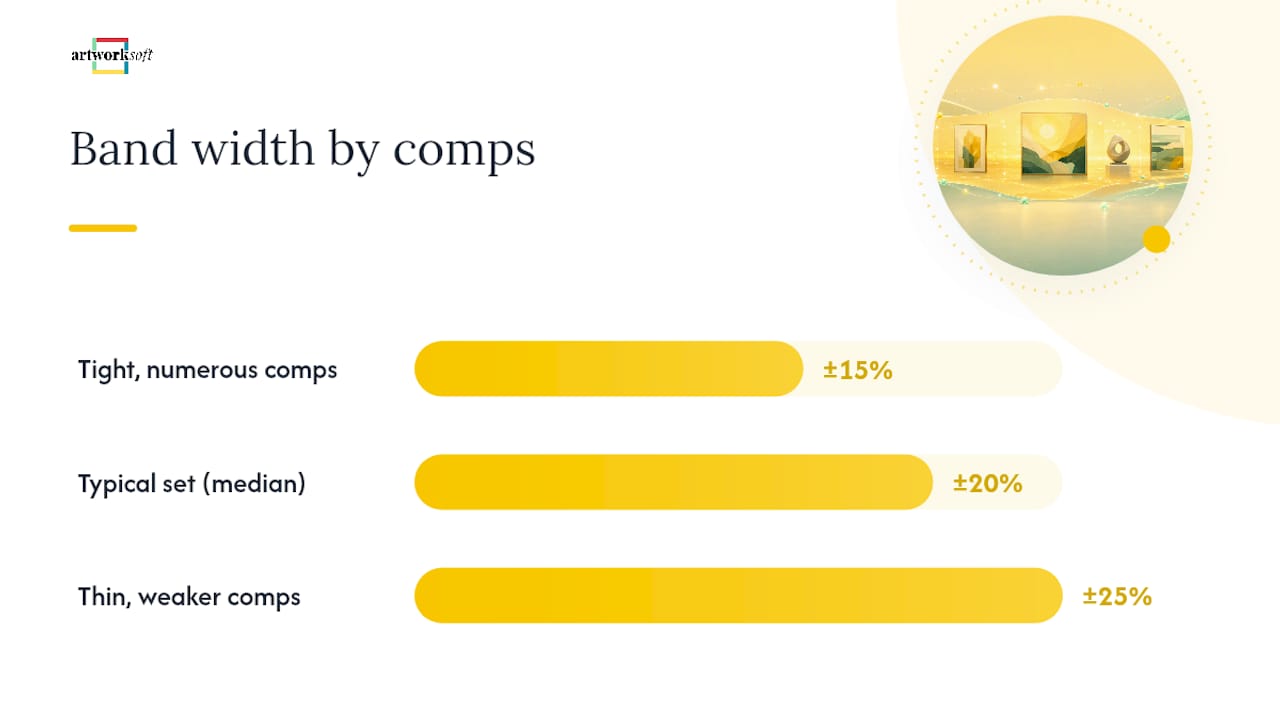
- Set your low, mid, and high band around that median, typically running 15% to 25% below and above depending on how tight your comp set is. Tighter, more numerous comps support a narrower band; a thin set with weaker matches justifies a wider one.
- Treat outliers carefully. A comp that sold well outside the range of the others usually reflects a bidding war, unusual provenance, or a data error, not a new baseline. Note it, but don’t let it pull your median.
A calculator-style formula makes this reconciliation explicit: adjusted value equals the median comparable price multiplied by combined condition, provenance, comparability, and demand multipliers. Running the math this way, rather than eyeballing a number, is what turns a price into evidence.
When you present this to a gallery, buyer, or for an insurance or tax conversation, the format matters. A clean table with lot images, adjusted prices, and your rationale for each adjustment reads as professional work. A single number with no backup reads as a guess, no matter how accurate it happens to be.
How Artworksoft’s Valuation Formula Supports Comparable-Sales Pricing
Artworksoft’s structured valuation formula maps directly onto the adjustment steps described above: it takes baseline comparable data and applies condition, provenance, and market factors to produce a working estimate, without requiring a spreadsheet built from scratch each time.
Because the platform tracks condition history, provenance, and full transaction records for each piece in a collection, the adjustments that usually live in scattered notes get attached directly to the artwork’s profile. That matters when a buyer or gallery asks how you arrived at a number months after the fact.
Practically, this looks like:
- Converting an adjusted median comp price into a listing price, with the adjustment trail preserved for reference.
- Modeling net proceeds after gallery commission or platform fees before a sale is finalized.
- Generating a Certificate of Authenticity or sales document that reflects the same valuation logic used to set the price.
That consistency between the number and its documentation is often what separates a price that holds up in negotiation from one that gets challenged.
Author Perspective: Practical Rules for Honest, Defensible Pricing
Evidence-first pricing beats confidence every time. The temptation with thin comps is to round up and hope; the better move is a wider, honest band with your adjustment notes attached. Price conservatively when your comp set is weak, and let strong sell-through data justify testing a higher number, not the other way around. Document everything as you go, because the adjustment you don’t write down is the one you’ll have to defend from memory later. For tools to build that documentation habit, see Artworksoft’s valuation methods overview.
— Nealda
Try Artworksoft to Document Your Comps and Export Evidence Packs
Building a price band by hand across spreadsheets and screenshots works, but it doesn’t scale past a handful of pieces, and it falls apart the moment someone asks you to walk them through your reasoning six months later. Artworksoft keeps the comparable data, adjustment notes, and resulting valuation attached directly to each artwork’s profile, so the evidence pack you build once stays usable for every future negotiation, insurance conversation, or sale.

That consistency is what reduces disputes. A buyer or gallery reviewing a price backed by a documented adjustment trail and a Certificate of Authenticity has far less room to push back than one facing a bare number. The platform also handles the sales and transaction tracking that follows once a price is agreed on, so the valuation and the deal live in the same record instead of scattered across email threads and separate files.
If you’re pricing your first piece or your fiftieth, start with the free plan and build your first evidence pack around a real comp set today.
Sources
- How appraisers use comps
- Comparable sales analysis for art: How appraisers build price estimates
- FindArtInfo — art valuation and auction records
- Artwork Value Calculator
FAQ
How Do You Price Your Art for Sale?
Gather five to twelve (recommended range) recent sold comparables matched on artist, medium, and size, adjust each for differences in size, condition, date, and venue, then set your price near the adjusted median with a reasonable band above and below it.
What Does the 80/20 Rule Mean in Art?
Like the 70/30 rule (typical gallery commission split), “80/20” typically describes a commission or revenue split arrangement between an artist and a gallery or platform rather than a pricing formula, and the exact ratio depends on the specific agreement.
What Is a Fair Price for an Art Commission?
A fair commission price accounts for materials, labor hours, the artist’s established market rate from past sold comparable pieces, and complexity, with many artists using a per-square-inch baseline adjusted upward for custom requests.
How Many Comparable Sales Should I Use to Price Art?
Five to twelve closely matched, recently sold comparables generally gives enough data to calculate a reliable median while remaining manageable to document and adjust.