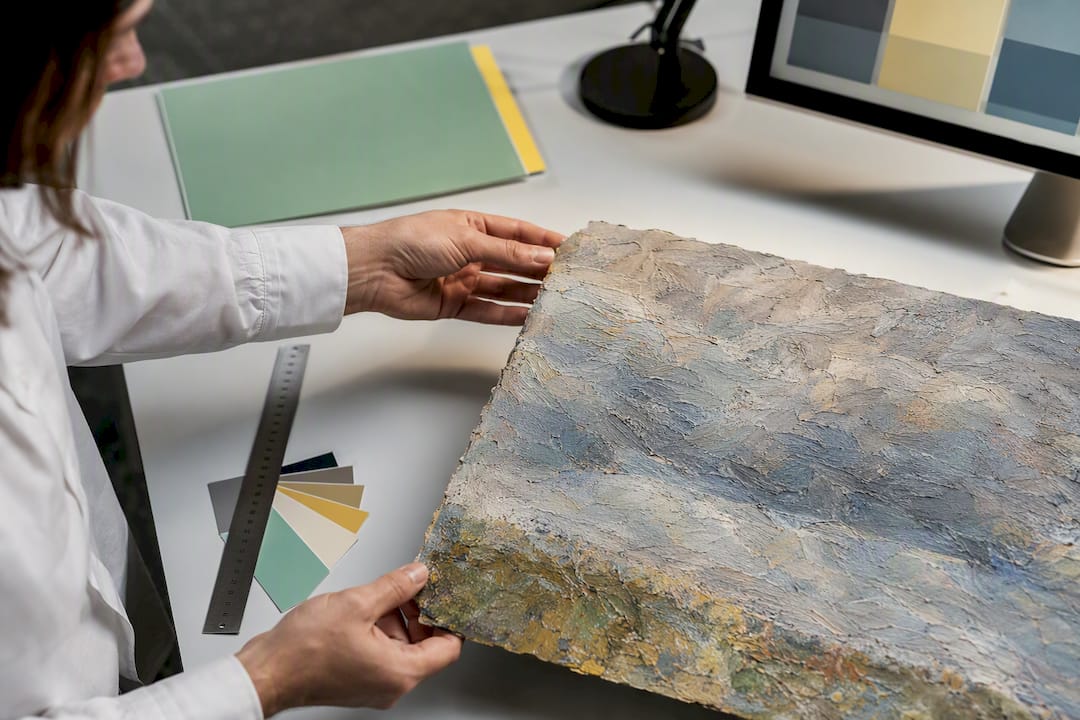
AI art valuation delivers a fast, data-backed price range and a confidence score, not a certified appraisal. It works well for market research, pre-sale pricing, and deciding where to list a piece. It should never stand alone for insurance claims, estate filings, tax reporting, or legal disputes, where a signed appraisal from a qualified professional remains the requirement.
TL;DR:
- AI art valuation provides a price range and confidence score, but it is not a certified appraisal for legal or tax purposes.
- Its accuracy depends heavily on metadata quality and comparable data, with private sales often missing from the models.
- AI tools are useful for rapid market research and pre-sale pricing but should be cross-checked against condition, provenance, and human appraisals for high-value or legal cases.
- Disclosing AI assistance and maintaining thorough provenance documentation help preserve an artwork’s value in an AI-skeptical market.
- Combining AI estimates with structured software and formal certificates creates a defensible record suitable for insurers, buyers, and legal needs.
Table of Contents
- How AI Art Valuation Works: Models, Inputs, and Outputs
- What Data and Comparables Power AI Estimates and Their Practical Limits
- Where AI Valuation Helps and Where It Fails
- How to Use an AI Estimate: From Research to Certified Appraisal
- How Artists and Collectors Can Preserve Value in an AI-Skeptical Market
- Operationalizing Defensible Estimates With Structured Software
- A Practical Recommendation for Collectors and Artists
- Get Structured Valuations and Documentation With Artworksoft
- Sources
How AI Art Valuation Works: Models, Inputs, and Outputs
An AI valuation model starts with the image itself. Computer vision algorithms extract visual features, color palette, composition, brushwork texture, subject matter, and style markers that can be matched against a database of previously sold works. That’s the pattern-recognition half of the process.
The other half runs on metadata. Artist name, medium, dimensions, creation date, exhibition history, and edition size all feed into the model alongside the image data. Missing or thin metadata weakens the estimate before the algorithm even gets to comparables.
From there, the system searches historical sales, primarily auction results and gallery records, for works that share enough characteristics to serve as pricing benchmarks. Industry reporting on AI valuation firms shows these companies typically blend public auction databases with private-sale datasets and expert review rather than relying on any single data source.
The output usually includes:
- A low/high price range rather than one fixed number
- A confidence score reflecting how much reliable comparable data exists
- A short list of comparable works used to justify the range
- Sometimes a narrative explanation of which factors moved the estimate up or down
That confidence score matters more than most buyers realize. Research on AI valuation transparency points to confidence scores, example comparables, and transparent data sourcing as the three elements that turn a raw number into something you can actually act on.
What Data and Comparables Power AI Estimates and Their Practical Limits
AI valuation tools draw from several overlapping sources, and the quality of the estimate depends heavily on how much of that data actually exists for a given artist or piece.
Common inputs include:
- Public auction results and price databases
- Gallery sales records where available
- Exhibition and show histories
- Image recognition databases used to find stylistically similar works
Private sales create a real blind spot. Most gallery-to-collector transactions never surface publicly, so models working from auction data alone are pricing against a fraction of the actual market. That gap widens for artists with thin sales histories or artists working in emergent media like generative or blockchain-linked digital art, where historical comparables are still sparse.
Market volume also shifts the picture. When a major stock-image platform began allowing AI-generated images, monthly sales on that platform jumped 80%, with overall sales rising 39% in the same period. That flood of new supply pushes prices down in commoditized image categories, a dynamic AI models pick up quickly but human sellers sometimes miss until it’s already affected their listing.
Where AI Valuation Helps and Where It Fails
AI’s biggest advantage is speed at scale. A model can scan thousands of auction records and image matches in seconds, something a human appraiser would need days to replicate manually. That scale is genuinely useful for narrowing a price range before you commission anything formal.
AI valuation struggles with:
- Physical condition (craquelure, restoration history, foxing on paper works)
- Provenance gaps that a database simply can’t fill in
- Subjective value drivers like an artist’s personal significance to a specific movement or moment
There’s also a perception problem that has nothing to do with model accuracy. A 2025 study found participants valued art labeled as AI-generated 62% lower than identical work labeled as human-made. Only 16% of collectors surveyed in a related 2024 report believed AI-generated art could ever reach price parity with traditionally created work. That bias is psychological, not technical, but it directly affects what a seller can realistically expect at market.
Pro Tip: Always cross-check a low confidence score against the number of comparables shown. A wide price range with only two or three cited comparables usually means the data pool is too thin to trust the estimate at face value.
How to Use an AI Estimate: From Research to Certified Appraisal
Treat an AI valuation as the first step in a sequence, not the final word.
- Get the AI estimate and read the confidence score. Note how many comparables support it and whether they’re genuinely similar in medium, size, and period.
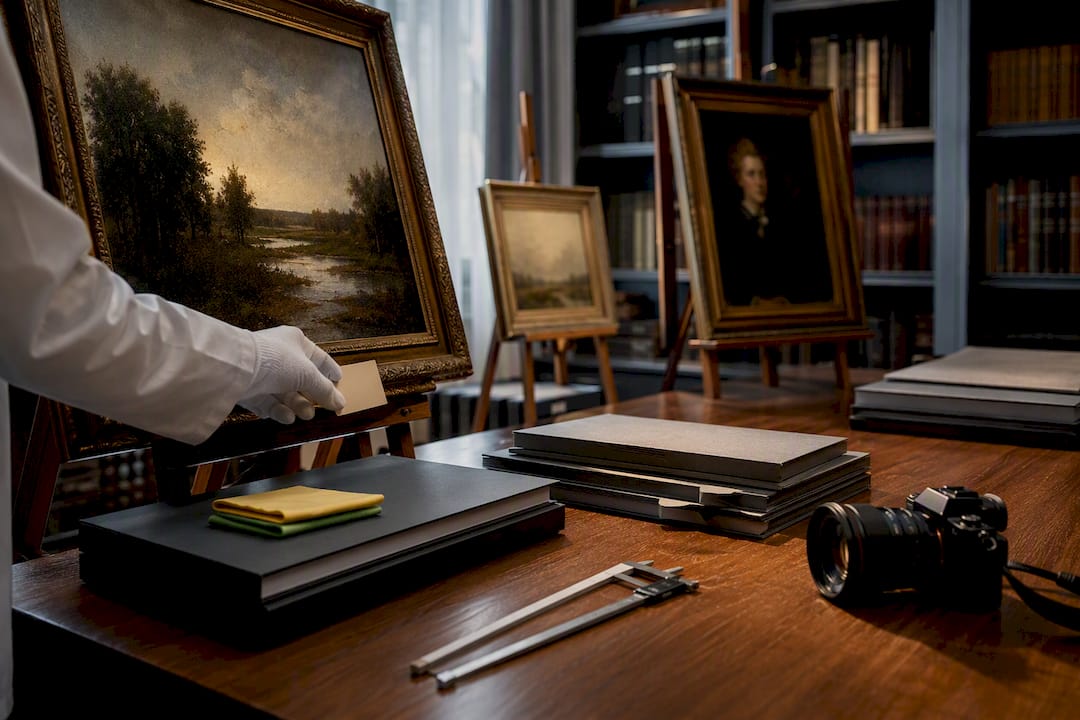
- Corroborate independently. Pull a condition report, verify provenance documents, and check recent sales by the same artist through galleries or auction houses.
- Match the action to the use case. A quick AI range is fine for setting an asking price or deciding whether to consign to auction or sell privately. It is not fine for insurance coverage, estate settlement, or tax filing.
Escalate to a certified, signed appraisal whenever the piece is valued above roughly $5,000 to $10,000, whenever the sale involves an estate or tax event, or whenever the outcome could end up in court or tied to a charitable donation. AI valuation outputs are indicative by design, and formal contexts require a qualified professional’s signature regardless of how confident the model’s score looks.
Pro Tip: If two AI tools give you meaningfully different ranges for the same piece, that disagreement itself is useful information. It usually signals a data gap worth flagging to a human appraiser before you price the work.
How Artists and Collectors Can Preserve Value in an AI-Skeptical Market
Given the documented discount against AI-labeled work, documentation becomes a value-preservation tool, not just paperwork.
- Keep sketches, time-lapse process footage, materials receipts, and written artist statements that establish human authorship and labor.
- Lead sales listings with provenance and exhibition history rather than burying them at the bottom of a description.
- Disclose AI assistance honestly when it was used in the process, but foreground the human decisions, editing, and craft that shaped the final piece.
- Choose sales channels carefully. Galleries and curated marketplaces that emphasize artist authentication and provenance tend to preserve perceived value better than high-volume commodity platforms flooded with AI-generated supply.
Pro Tip: A one-page provenance summary attached to a listing, showing chain of ownership and exhibition dates, often does more to justify a price than any additional AI comparable could.
Operationalizing Defensible Estimates With Structured Software
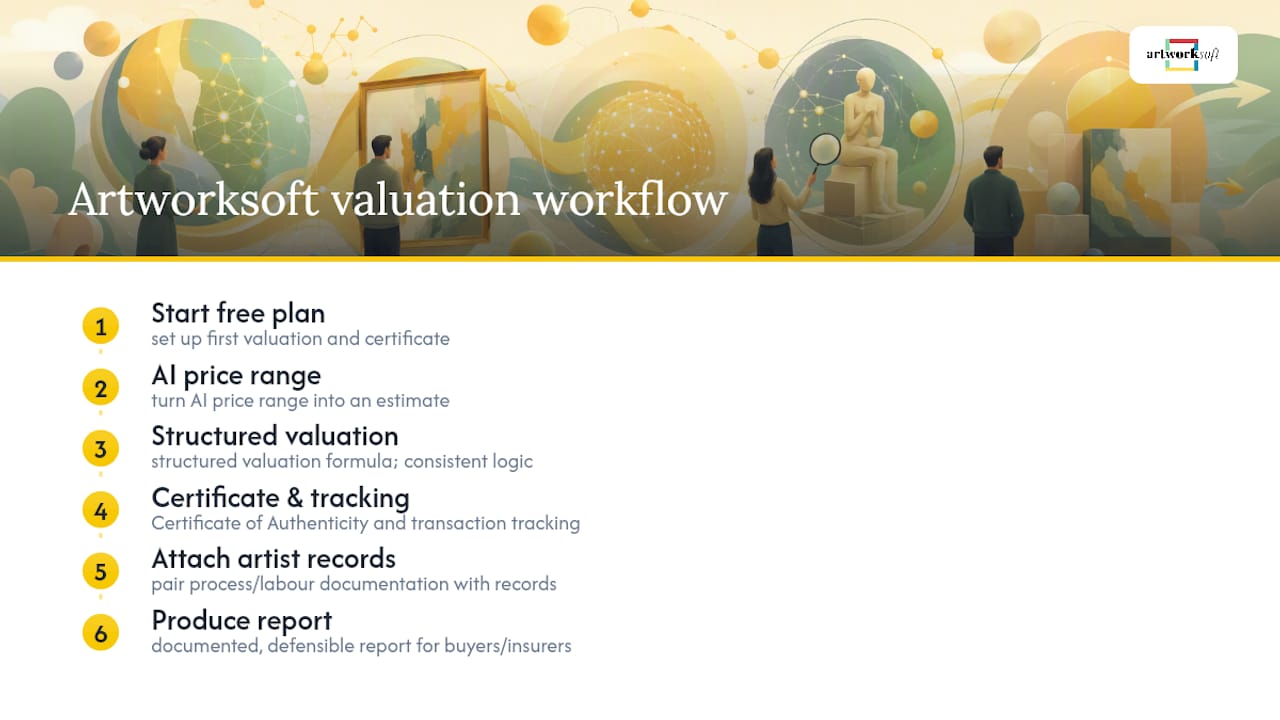
Turning an AI price range into something an insurer or buyer will actually accept requires structure most spreadsheets can’t provide. Artworksoft’s structured valuation formula applies a consistent methodology across a collection, replacing the guesswork that comes from valuing each piece with a different ad hoc approach.
The platform also lets users generate Certificates of Authenticity and track an artwork’s movement and transaction history in one record. That combination matters because blockchain-style provenance tracking is increasingly what separates a defensible valuation from a number nobody can verify.
- Structured valuation formula for consistent, repeatable pricing logic
- Certificate of Authenticity generation tied to each artwork record
- Movement and transaction tracking to support provenance claims
- Report generation for insurers, buyers, or estate documentation
Pairing an AI-generated range with this kind of documented evidence trail is what turns a research estimate into a report a professional can actually stand behind.
A Practical Recommendation for Collectors and Artists
AI valuation earns its place as a research tool, not a verdict. Use it to narrow a range, then check the confidence score and comparables before you trust the number. Provenance and condition still decide the final figure, and no algorithm replaces a qualified appraiser’s signature when money, taxes, or legal standing are on the line. The smartest collectors and artists treat AI and human expertise as a single workflow, not competing options.
— Nealda
Get Structured Valuations and Documentation With Artworksoft
Artworksoft gives collectors, artists, and galleries a way to turn an AI price range into a documented, defensible asset record, without hiring a separate appraiser for every routine check.

The platform’s structured valuation formula applies consistent logic across an entire collection, while built-in Certificate of Authenticity generation and transaction tracking keep provenance evidence attached to every piece. Artists documenting their process, following the labor-disclosure tactics covered above, can pair that material directly with their Artworksoft records, similar to how creative businesses in adjacent fields, like custom patch design studios using AI tools, document their own production choices for buyers.
Emerging artists building a first inventory, collectors preparing pieces for insurance, and galleries managing multiple client collections all use the same structured workflow to move from a rough estimate to a report worth showing a buyer or insurer. Start with the free plan at Artworksoft to set up your first valuation and certificate today.
Sources
This article draws on research from Columbia Business School, IEEE Spectrum, Observer, and ARTnews on AI art market dynamics and certified appraisal standards.
- Beyond the Machine: Why Human-Made Art Matters More in the Age of AI | Columbia Business School
- Inside the Emerging AI Art Market – IEEE Spectrum
- How A.I. Is Quietly Rewriting the Rules of Art Valuation | Observer