

An art movement is defined as a group of artists sharing a specific philosophy or set of goals, often rejecting previous traditions during a defined historical period. Major Western art movements span from the Renaissance in the 14th century through Contemporary Art, which began in 1946 and continues today. Understanding artwork movement history explained through this lens reveals that art history is not a simple progression of styles. Each movement represents a deliberate argument about what art should be, who it serves, and what it means. Students, collectors, and educators who grasp these arguments gain a far richer understanding of individual artworks and the broader cultural forces that shaped them.
What defines an artwork movement history and why does it matter?
An art movement is not simply a shared visual style. It is a collective intellectual position, a set of claims artists make about the purpose and method of art itself. The distinction matters because it changes how you read any artwork you encounter.
Movements function as arguments where artists reject prior art concepts to advance new philosophies. Baroque painters, for example, did not merely adopt a different look from Renaissance masters. They deliberately rejected the Renaissance ideal of calm, balanced composition to create emotional intensity through dramatic diagonal lines and sharp contrasts of light and shadow. That rejection was the point.

Expressionism offers another clear example. Expressionist artists prioritized emotional truth over accurate representation of the physical world. A distorted face in an Expressionist painting is not a failure of technique. It is a statement that inner experience matters more than outward appearance.
Key distinctions between style and argument include:
- Style refers to the visual characteristics of a work: brushwork, color palette, composition.
- Argument refers to the philosophical intent: what the artist believes art should do or say.
- Manifesto refers to a written declaration of intent, used by movements like Surrealism and Futurism to announce their positions publicly.
- Retrospective labeling refers to categories assigned by historians after the fact, which may not reflect how artists saw themselves.
Pro Tip: When you encounter an unfamiliar artwork, ask what the artist was arguing against, not just what they were creating. That question unlocks the movement’s logic far faster than memorizing dates.
Chronological overview of major Western art movements
The art movement timeline below maps the major periods in Western art history, their approximate dates, and their defining characteristics. Each period responded directly to what came before it.
| Movement | Approximate Dates | Core Characteristics |
|---|---|---|
| Renaissance | 14th–16th century | Humanism, classical proportion, perspective, naturalism |
| Baroque | 1600–1730 | Drama, emotional intensity, diagonal composition, chiaroscuro |
| Rococo | 1720–1780 | Ornate decoration, lightness, playful themes, pastel color |
| Romanticism | 1780–1850 | Emotion, nature, individualism, reaction against industrialization |
| Realism | 1840–1880 | Everyday subjects, rejection of idealization, social commentary |
| Impressionism | 1860–1886 | Loose brushwork, light and perception, outdoor painting |
| Post-Impressionism | 1886–1910 | Exaggerated color and form, personal expression, structural experimentation |
| Expressionism | 1905–1930 | Emotional distortion, psychological intensity, bold color |
| Modern Art | Late 19th–mid 20th century | Abstraction, rejection of tradition, experimentation with form |
| Contemporary Art | 1946–present | Pluralism, conceptual focus, cross-media practice |
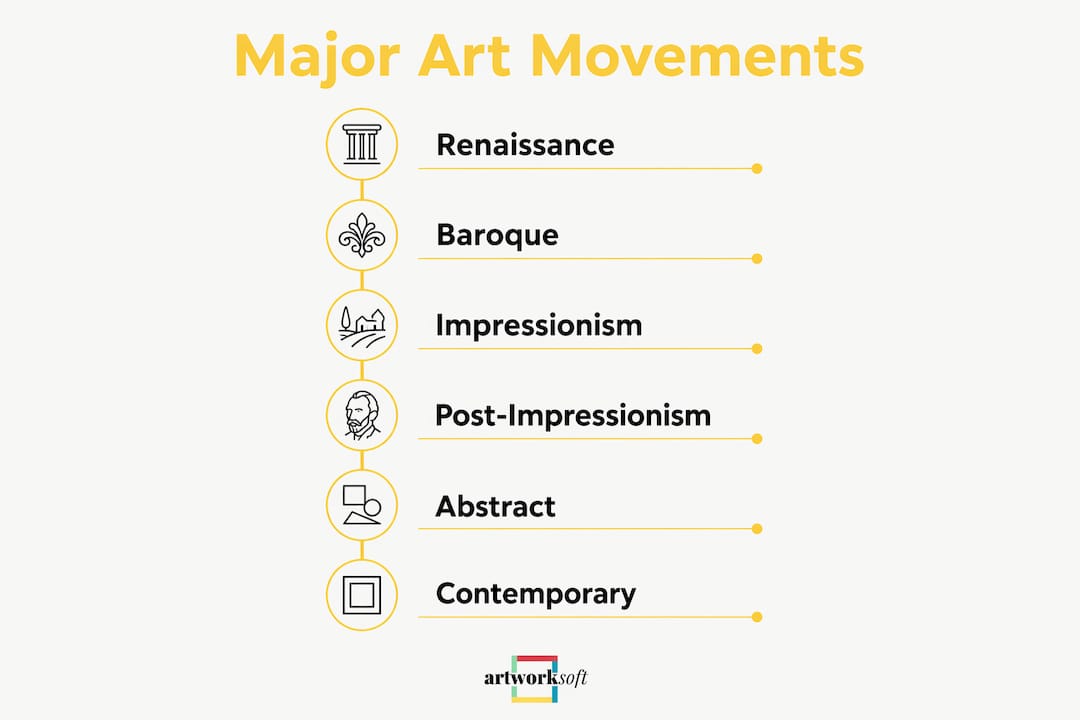
The Impressionists mark a particularly significant turning point. Impressionists shifted focus from depicting objects to capturing perception, using loose brushwork to record how light falls rather than what objects look like. That shift from object to experience opened the door for every abstract movement that followed.
Post-Impressionism extended that logic by exaggerating color and form for expressive effect. Artists like Paul Cézanne restructured space geometrically, directly influencing Cubism. Vincent van Gogh used color emotionally rather than descriptively. Each of these choices was a conscious argument, not a stylistic accident.
Societal, scientific, and philosophical changes drove the shift toward abstract art in the late 19th and early 20th centuries. The rise of photography freed painters from the obligation to record reality accurately. Industrialization and two world wars shattered confidence in rational progress. Abstract and Modern Art movements responded to those disruptions directly.
How do art historians study and classify art movements?
Art historical research follows a defined methodology. Art historians analyze attribution, authentication, dating, influence, and provenance to understand both individual artworks and the movements they belong to. Each of these concerns serves a specific function.
The standard research process follows these steps:
- Formal analysis. Examine the physical properties of the work: scale, color, light, composition, and content. These visual features place a work within a stylistic tradition.
- Attribution. Determine who made the work. Attribution can be historically fluid. A work long credited to one artist may be reassigned based on new research, changing historical narratives entirely.
- Dating. Establish when the work was made. Dating situates the work within a specific movement’s active period and helps identify influences.
- Provenance research. Trace the ownership and exhibition history of the work. Provenance tracking is as vital as stylistic analysis for historical classification. A documented chain of ownership supports both authentication and valuation.
- Influence analysis. Identify which earlier works or movements the artist responded to, and which later artists the work influenced.
- Contextual framing. Apply the 5 Ws framework — Who, What, When, Where, and Why — to place the work within its social, political, and cultural moment.
Art documentation and traceability practices follow this same logic for collectors and galleries managing physical collections. The methodology that art historians use in academic research applies directly to professional collection management.
How does understanding art movements improve your reading of art?
Knowledge of art movements changes what you see when you look at a painting. Without context, a Caravaggio canvas looks dramatic. With context, you understand that the dramatic lighting is a deliberate argument against the serene idealism of the High Renaissance. The painting becomes a position, not just a picture.
Understanding movements reveals how societal, scientific, and philosophical changes shaped art styles and goals across centuries. That understanding applies to contemporary art as much as historical work. Street art, digital art, and installation art all position themselves in relation to prior movements, even when they reject the museum context entirely.
Common misconceptions about art history include:
- Art history is linear progress. Art does not improve over time the way technology does. Each movement redefines what “good” means rather than building toward a fixed goal.
- Movements are tightly bounded. Artists frequently worked across movement boundaries. Édouard Manet is claimed by both Realism and Impressionism, and he resisted both labels.
- Labels reflect artists’ own views. Movement labels are often retrospective and may oversimplify complex individual motivations. Many artists rejected the categories critics assigned to them.
- Contemporary art has no movements. Contemporary art contains many overlapping movements, including Neo-Expressionism, Conceptualism, and New Media Art, though they resist easy definition.
Pro Tip: Use the 5 Ws framework as a starting point with any unfamiliar artwork. Who made it, when, where, why, and for whom? Those five questions place any work within its movement faster than any art history textbook.
Understanding why artwork context increases perceived value is not just an academic concern. For collectors, knowing a work’s movement history directly affects how it is appraised, sold, and insured.
Key Takeaways
Art history is best understood as a sequence of philosophical arguments, not a progression of styles, and each major movement gains meaning only in relation to what it rejected.
| Point | Details |
|---|---|
| Movements are arguments | Each art movement rejects prior traditions to advance a specific philosophical position about art’s purpose. |
| Timeline spans centuries | Western art movements run from the Renaissance in the 14th century through Contemporary Art, which continues today. |
| Provenance is critical | Ownership history and documentation are as important as visual analysis for classifying and valuing artworks. |
| Labels are often retrospective | Many movement categories were assigned by historians after the fact and may not reflect artists’ own intentions. |
| Context drives interpretation | Applying the 5 Ws framework — Who, What, When, Where, Why — unlocks the meaning behind any artwork’s movement context. |
Why I think we misread art movements more often than we admit
Art movements get taught as neat boxes, and that is the first problem. The Renaissance ends, the Baroque begins, and students memorize the dates. What gets lost is the argument. Baroque painters were not simply doing something new. They were doing something deliberately contrary, and that friction is where the meaning lives.
The second issue is that movement labels are often imposed retrospectively and may oversimplify what were actually messy, contested, individual positions. Monet did not wake up one morning and decide to be an Impressionist. A critic used the word as an insult, and it stuck. That origin story matters because it tells you the label describes how others saw the work, not necessarily how the artist understood it.
The tension between collective movements and individual uniqueness is the most underappreciated problem in art history. Every movement contains artists who fit the label poorly. Cézanne is called a Post-Impressionist, but his work points so directly toward Cubism and abstraction that the label barely contains him. Postmodern and contemporary art make this problem worse, not better. The plurality of current practice resists any single framework.
My honest position: learn the movements as arguments, not as styles. Know what each one was pushing against. Then look at the individual artist and ask where they agreed, where they diverged, and what that divergence tells you. That approach produces real understanding. Memorizing dates produces trivia.
— Nealda
Artworksoft and the practical side of art history documentation
Knowing an artwork’s movement history is only useful if that knowledge is recorded and accessible. For collectors, galleries, and educators, the challenge is not learning the history. It is keeping it organized and attached to the right work.

Artworksoft provides a free art inventory system built to store exactly this kind of contextual information alongside each artwork profile. Users can record provenance, movement classification, exhibition history, and ownership records in one place. The platform’s artwork profile management tools connect historical data directly to valuation and transaction records, so movement context informs every decision from acquisition to sale. For anyone managing a collection with serious historical depth, Artworksoft removes the documentation burden that typically falls through the cracks.
FAQ
What is an art movement in simple terms?
An art movement is a group of artists who share a specific philosophy or set of goals during a defined period, often rejecting the traditions that came before them.
How many major Western art movements are there?
Major Western art movements span from the Renaissance in the 14th century through Contemporary Art, covering roughly ten distinct periods, each with its own defining characteristics and philosophical position.
Why are art movement labels sometimes inaccurate?
Movement categories are frequently assigned retrospectively by historians and critics, meaning they reflect how others classified the work rather than how the artists themselves understood their practice.
What is the 5 Ws framework in art history?
The 5 Ws framework asks Who made the artwork, What it depicts, When it was created, Where it originated, and Why it was made. These five questions place any artwork within its historical and movement context.
How does provenance connect to art movement classification?
Provenance research traces the ownership and exhibition history of a work, which supports both authentication and movement classification by confirming where and when a work entered the historical record.