
Artwork context is defined as the full set of conditions surrounding a piece, including its provenance, the artist’s intent, cultural background, and display environment, that collectively determine how viewers assign meaning and monetary worth. Context is not a secondary consideration in art valuation. It is the primary driver. Collectors increasingly buy meaning and identity rather than aesthetics alone, making contextual documentation a decisive factor in long-term value. A 2026 study confirmed that missing or incomplete provenance causes “identity degradation” and measurably reduces resale prices. Understanding why artwork context increases perceived value is the foundation of sound collection strategy and effective artist communication.
What elements of context most strongly affect artwork value perception?
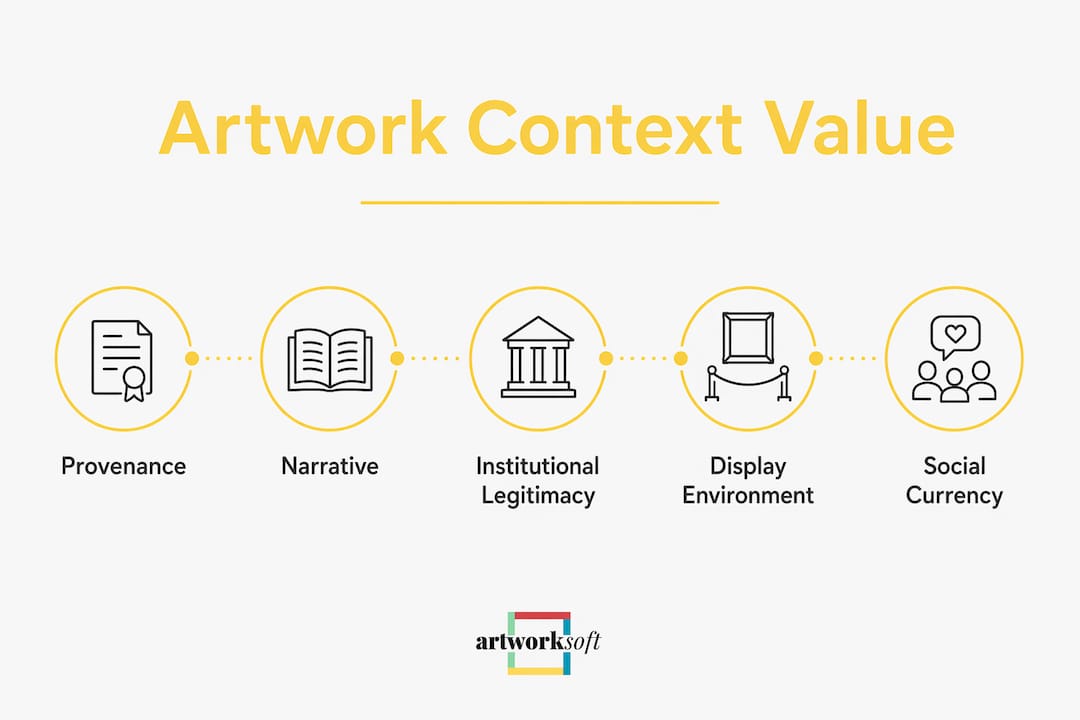
Artwork value perception is shaped by several distinct contextual layers, each adding a different kind of meaning. The most influential are provenance, artist narrative, cultural framing, and exhibition environment. Research analyzing 500+ figurative paintings found that aesthetic structural elements combined with contextual framing positively correlate with auction hammer prices. That finding confirms that visual quality alone does not determine price. Context multiplies it.
The key contextual elements that drive artwork value perception include:
- Provenance. A detailed ownership and exhibition history adds trust and prestige. Collectors treat provenance as evidence of authenticity and cultural legitimacy.
- Artist’s personal story. The creative process, biography, and stated intent create emotional connection. Buyers pay more for work they feel they understand.
- Cultural and historical background. Situating a piece within a recognized historical moment or movement gives it narrative weight that transcends the object itself.
- Exhibition environment. The physical and institutional setting psychologically primes viewers before they even look at the work. A gallery wall in a respected institution signals significance.
- Documentation quality. Certificates of Authenticity, condition reports, and exhibition records form the paper trail that supports every claim about a work’s history.
Pro Tip: When building a collection or preparing work for sale, treat provenance documentation as a living record. Update it after every exhibition, loan, or ownership transfer. Gaps in the chain reduce buyer confidence and resale price.
How does storytelling about an artwork’s creation and journey enhance perceived value?
Contextual storytelling in art is the practice of communicating the human decisions, struggles, and intentions behind a work’s creation. It is not marketing copy. It is evidence of meaning. A Q1 2026 study found that authentic creation stories increase consumer willingness to pay by up to 2,700% compared to AI-generated art presented without narrative. That figure reflects the “effort heuristic,” a cognitive principle where buyers assign higher value to work they perceive as requiring significant human effort and intention.
The most effective storytelling frameworks for artists and collectors follow a clear structure:
- Origin. Where did the idea come from? What problem, emotion, or observation prompted the work?
- Process. What materials, techniques, or decisions shaped the final piece? Specificity builds credibility.
- Obstacles. What did the artist overcome? Difficulty signals commitment and raises perceived effort.
- Resolution. What does the finished work mean to the artist? This anchors the viewer’s interpretation.
- Journey. Where has the work been since completion? Exhibitions, publications, and collections add chapters to the story.
“Narrative depth often outweighs aesthetic quality as a driver of perceived value. Artworks with detailed and authentic creator stories supply social currency, enabling collectors to share status and meaning easily.”
The social currency dimension is particularly significant for collector relationships. When a collector can articulate the story behind a work, they gain a social asset. They can share it, explain it, and use it to signal taste and knowledge. That dynamic makes narrative depth a financial asset, not just an emotional one. The 2023 sale of Gustav Klimt’s “Lady with a Fan” for £85.3 million at Sotheby’s London demonstrated this directly. The work’s documented history and cultural narrative drove bidding far beyond its aesthetic qualities alone.
Why does environment and display context influence how viewers perceive artwork value?
The location where an artwork is displayed functions as a psychological framing device. Galleries and museums act as what researchers call a “symbolic field,” a social and institutional context that grants legitimacy before a viewer forms any personal opinion. Artworks in respected galleries command higher prices because the environment itself signals that the work deserves serious attention. That is not irrational behavior. It is a predictable response to institutional trust.

| Display context | Psychological effect | Impact on perceived value |
|---|---|---|
| Major auction house | Signals scarcity and competitive demand | High price anchoring |
| Respected gallery | Grants institutional legitimacy | Elevated trust and prestige |
| Museum loan or exhibition | Confirms cultural significance | Long-term value increase |
| Uncontextualized online listing | Removes symbolic framing | Reduced buyer confidence |
| Artist’s studio presentation | Adds authenticity and process insight | Moderate value enhancement |
Neuroaesthetic research adds a precise layer to this understanding. Contextual information such as labels and pre-viewing explanations actively change how the brain processes visual information. A viewer who reads a wall label before looking at a painting attends to different features than one who approaches it cold. That shift in attention changes the aesthetic experience and, by extension, the value assigned to it.
The risk runs in both direction. Over-explaining a work can constrain interpretation and reduce the viewer’s sense of personal discovery. Under-explaining removes the scaffolding that allows meaning to form. The most effective display contexts provide enough information to orient the viewer without closing down their response.
Pro Tip: For gallery presentations, place concise artist statements and provenance summaries near the work rather than in a separate catalog. Proximity increases the likelihood that viewers read the context before forming their first impression.
How can artists and collectors practically use context to increase artwork value?
The contextual impact on art price is not passive. Artists and collectors can actively build and preserve the conditions that drive value. The following practices form a reliable framework for doing so.
- Create and maintain a provenance record from day one. Document every exhibition, sale, loan, and publication. Use art identification and traceability systems to keep records searchable and transferable.
- Write a formal artist statement for each significant work. Include the concept, materials, process, and intended meaning. Update it when the work is shown in new contexts.
- Select exhibition environments deliberately. Placement in a recognized institution or curated group show adds a permanent chapter to the work’s history. That chapter has monetary value.
- Use digital archiving to preserve contextual data over time. Physical documents degrade. Digital records, when properly structured, survive ownership transfers and remain accessible to future buyers.
- Communicate narrative at the point of sale. Buyers who receive a documented story alongside a work are more likely to maintain and extend that documentation. That continuity protects resale value.
- Avoid stripping context from acquired works. Removing a work from its original frame, separating it from its documentation, or reattributing it without evidence causes the kind of identity degradation that reduces long-term price.
The most common mistake collectors make is treating documentation as an afterthought. Provenance built retroactively is always weaker than provenance built in real time. The art market rewards collectors who treat every acquisition as the beginning of a documented history, not just a transaction.
Key Takeaways
Artwork context increases perceived value because it transforms a physical object into a documented, meaningful, and socially communicable asset.
| Point | Details |
|---|---|
| Provenance drives price | Detailed ownership and exhibition history builds trust and directly supports higher resale values. |
| Storytelling multiplies willingness to pay | Authentic creation narratives activate the effort heuristic, significantly increasing what buyers will offer. |
| Environment primes perception | Institutional display settings grant legitimacy and anchor price expectations before a viewer forms an opinion. |
| Documentation prevents value loss | Incomplete or missing contextual records cause identity degradation and measurable price reductions. |
| Context must be built in real time | Retroactive provenance is weaker than records created at the moment of creation, exhibition, or sale. |
Context is the asset most collectors overlook
I have spent years watching collectors focus almost entirely on visual quality and artist reputation when making acquisition decisions. Both matter. Neither is sufficient. The works that hold value across decades, and the ones that appreciate most reliably, are almost always the ones with the richest documented histories.
What strikes me most about recent market data is how quantifiable this has become. The idea that a creation story can increase willingness to pay by thousands of percent is not a soft claim about emotion. It is a measurable market outcome. The art world has always known that context matters. Now there is data to confirm exactly how much.
The warning I give most often is about what I call the “clean slate” instinct. Some collectors remove works from their original frames, discard exhibition labels, or separate pieces from their documentation because they want a fresh presentation. That instinct costs money. Every piece of original context that gets discarded is a reduction in the work’s future value. Experts describe this as the amputation of art, and the term is accurate. You are not simplifying the work. You are removing part of it.
For artists, the practical implication is clear. Storytelling is not a promotional activity separate from the work. It is part of the work’s permanent record. The artist who documents their process, states their intent, and maintains that record through every sale and exhibition is building a financial asset alongside a creative one.
— Nealda
Artworksoft: built for the full context of every artwork
Artists and collectors who understand the importance of art context need tools that match that understanding. Artworksoft provides structured systems for capturing provenance, documenting artist intent, and maintaining the contextual record that protects and grows artwork value over time.

Artworksoft’s artwork profile management system stores provenance chains, exhibition histories, condition reports, and artist narratives in one place. Every record transfers with the work through each ownership change. The platform also supports digital archiving to preserve contextual data in formats that remain accessible and credible for future buyers. Collectors who use structured documentation consistently report greater buyer confidence and stronger resale outcomes. Start building the full context of your collection with a free art inventory system from Artworksoft.
FAQ
Why does artwork context increase perceived value?
Context adds provenance, narrative, and institutional legitimacy to a work, all of which buyers treat as evidence of authenticity and cultural significance. Research confirms that documented context directly supports higher auction prices and collector willingness to pay.
What is the effort heuristic in art valuation?
The effort heuristic is a cognitive principle where buyers assign higher value to work they perceive as requiring significant human effort and intention. A 2026 study found authentic creation stories increase willingness to pay by up to 2,700% compared to art presented without narrative.
How does provenance affect an artwork’s price?
Provenance provides a verifiable ownership and exhibition history that builds buyer trust and supports price premiums. Incomplete provenance causes identity degradation, which measurably reduces resale value according to current market research.
Does gallery location change how much an artwork is worth?
Gallery location functions as a symbolic field that psychologically primes buyers to assign higher value before they form a personal opinion. Artworks displayed in respected institutions consistently command higher prices than identical works shown in uncontextualized settings.
How can artists preserve context for future sales?
Artists should document provenance, process, and intent from the moment of creation and update those records after every exhibition or ownership transfer. Digital archiving systems ensure that contextual data remains accessible and credible through multiple future sales.