Data driven art pricing means using market records, comparable sales, and statistical models rather than intuition to set a fair price for an artwork, whether for sale, insurance, or tax purposes. The practical starting point for almost every artist, collector, or gallery is the sales-comparison method: find completed sales of similar work, document each adjustment, and build a defensible range. More complex cases, high-value works, thin sales histories, or formal tax filings, call for hedonic regression, AI-assisted models, or a qualified appraiser.
TL;DR:
- Data-driven art pricing heavily relies on recent comparable sales from the artwork’s most common market, ideally documentation from completed, arm’s-length transactions.
- Software tools and models, such as hedonic regression and neural networks, enhance predictive accuracy but require sufficient sales data and clear market context.
- Emerging artists should be valued using peer-group comparisons and prior-sale averages, with estimates presented as ranges to reflect high uncertainty.
- Fair market value suits tax and sale purposes, while replacement cost applies for insurance, and liquidation value is used in forced-sale scenarios, requiring different documentation standards.
- Market conditions and economic shifts necessitate regular updates to pricing models, especially when comparables are older than three years or market segments diverge.
Table of Contents
- 1. The core quantitative methods behind defensible prices
- 2. Build a defensible price: a step by step workflow
- 3. Pricing emerging artists when sales data runs thin
- 5. Tax, insurance, and appraisal: choosing the right value
- 6. How market trends and economic shifts move the numbers
- 7. What practitioners get wrong when presenting data-driven prices
- 8. Artworksoft: structured pricing with built-in documentation
- Sources
- FAQ
1. The core quantitative methods behind defensible prices
Four approaches dominate serious art valuation, and each suits a different situation.
Sales-comparison starts with identifying an artwork’s most common market, whether that is regional auction houses, major auction salesrooms, or private dealer sales, and selecting completed, arm’s-length transactions within that market. ISA’s fair market value guidance recommends keeping comparables inside the most common market and explaining any adjustment for size, medium, date, condition, or provenance in writing. Mixing gallery asking prices with auction hammer prices without a stated discount weakens the result.
Hedonic regression treats a price as the sum of weighted characteristics, size, medium, subject matter, date of creation, and provenance strength, and estimates each variable’s contribution from a dataset of past sales. A 2018 econometric study found that combining hedonic models with repeat-sales information through model averaging improved predictive accuracy in a Canadian auction dataset, particularly when artist-specific data existed.
Repeat-sales analysis tracks the same artwork across multiple transactions over time, offering a clean read on appreciation, but most pieces sell only once, so usable pairs are sparse.
Neural-network and visual-feature models add another layer. A Berkeley study of roughly 1.1 million auction lots from 2008 through 2015 found that neural networks using both visual and non-visual characteristics predicted prices substantially better than standard hedonic models out of sample, especially where price uncertainty was high.
- Sales-comparison works best with abundant, similar comparables and clear documentation.
- Hedonic and model-averaging approaches help when artist-level sales data accumulate.
- Repeat-sales analysis is precise but rarely available for a single piece.
- Neural-network models add predictive power in uncertain, high-variance cases but still need market context.
2. Build a defensible price: a step by step workflow
A repeatable sequence keeps every estimate auditable, whether the output goes to a buyer, an insurer, or a tax preparer.
- Define the purpose first. A sale price, an insurance replacement cost, and a fair market value for tax filing are three different numbers, and the method changes accordingly.
- Gather comparables from the artwork’s most common market, favoring completed, arm’s-length sales over asking prices.
- Document selection criteria in writing: why each comparable qualifies and why others were excluded.
- Apply an adjustment checklist covering sale date, size, medium, condition, provenance, and venue, noting each adjustment’s direction and rough magnitude.
- Run a hedonic or regression model when enough data points exist, and incorporate repeat-sales information or model averaging if the artist has multiple tracked transactions.
- Reconcile the outputs into a single estimate or a range, and write a short sensitivity note explaining what would move the number up or down.
- Preserve every image, invoice, and data source used, since IRS appraisal guidance and standard appraisal practice both expect a traceable audit trail.
Galleries managing inventory often benefit from evidence-backed comparable sales methods that formalize this sequence rather than rebuilding it for every piece.
Pro Tip: Keep a dated screenshot or PDF of every comparable sale at the moment you use it, since auction listings and dealer prices change or disappear.
3. Pricing emerging artists when sales data runs thin
Emerging painters and sculptors rarely have enough sales history for a reliable regression model, so the workflow has to lean on structured heuristics instead of raw statistics.

Close peer groups, other artists at a similar career stage, medium, and regional market, substitute for an individual sales history, but ISA guidance still requires that any parallel-market comparable come with a documented rationale and, typically, a conservative discount rather than a direct price match.
A 2024 study of 34,200 auction records found that market and social signals, including the average of an artist’s prior ten sales, correlated at roughly 50% with the next sale price, often outperforming image-based visual features in predictive power, according to research published in Scientific Reports. For artists with even three or four tracked sales, that prior-sale average carries more weight than most heuristics.
- Use peer-group comparables only when no direct sales history exists, and label them as parallel-market estimates.
- Apply a stated discount, often modest, when substituting parallel-market data for direct history.
- Prior-sale averages, even from a handful of transactions, tend to outperform generic per-size rules.
- Simple formulas like a per-square-inch pricing rule remain useful as a floor, not a final answer, until enough sales accumulate.
Showing a range rather than a single figure, and stating the uncertainty behind it, keeps a thin-data estimate honest.
5. Tax, insurance, and appraisal: choosing the right value
Fair market value, replacement cost, and liquidation value answer different questions, and using the wrong one creates problems later. Fair market value fits tax filings and most sale scenarios. Replacement cost, generally higher, fits insurance coverage since it reflects what a comparable piece would cost to acquire today. Liquidation value, usually the lowest of the three, applies to forced or rapid sales.
The IRS Art Appraisal Services program uses fair market value methodology and commonly refers items of substantial claimed value for review through a Statement of Value process, expecting professional-quality photographs and documented comparables. IRS Publication 561 sets documentation thresholds for donated property, requiring a qualified appraisal and Form 8283 for deductions above certain reporting levels.
- Use fair market value for tax filings and most private sales.
- Use replacement cost for insurance scheduling.
- Commission a qualified appraiser, rather than a database estimate alone, for any donation or estate filing likely to draw IRS review.
- Keep photographs, provenance records, and comparable sales data on file regardless of which value applies.
Readers navigating donation thresholds specifically may find Artworksoft’s overview of art donation appraisal rules a useful next step before filing.
6. How market trends and economic shifts move the numbers
A pricing model built on last year’s comparables can drift out of date quickly, because art markets do not move as one block. The Art Basel and UBS Art Market report documents uneven performance across sales channels and price bands, meaning a strong year for blue-chip auction lots can coincide with a flat or declining year for mid-market gallery sales.
Interest rates, broader investment sentiment, and currency strength all influence how much buyers are willing to commit to a discretionary purchase like art, though the effect size varies by segment and is rarely uniform across an entire market. A model trained on comparables from a strong economic period can overstate value when conditions tighten, and the reverse holds when a model trained during a downturn gets applied to a recovering market.
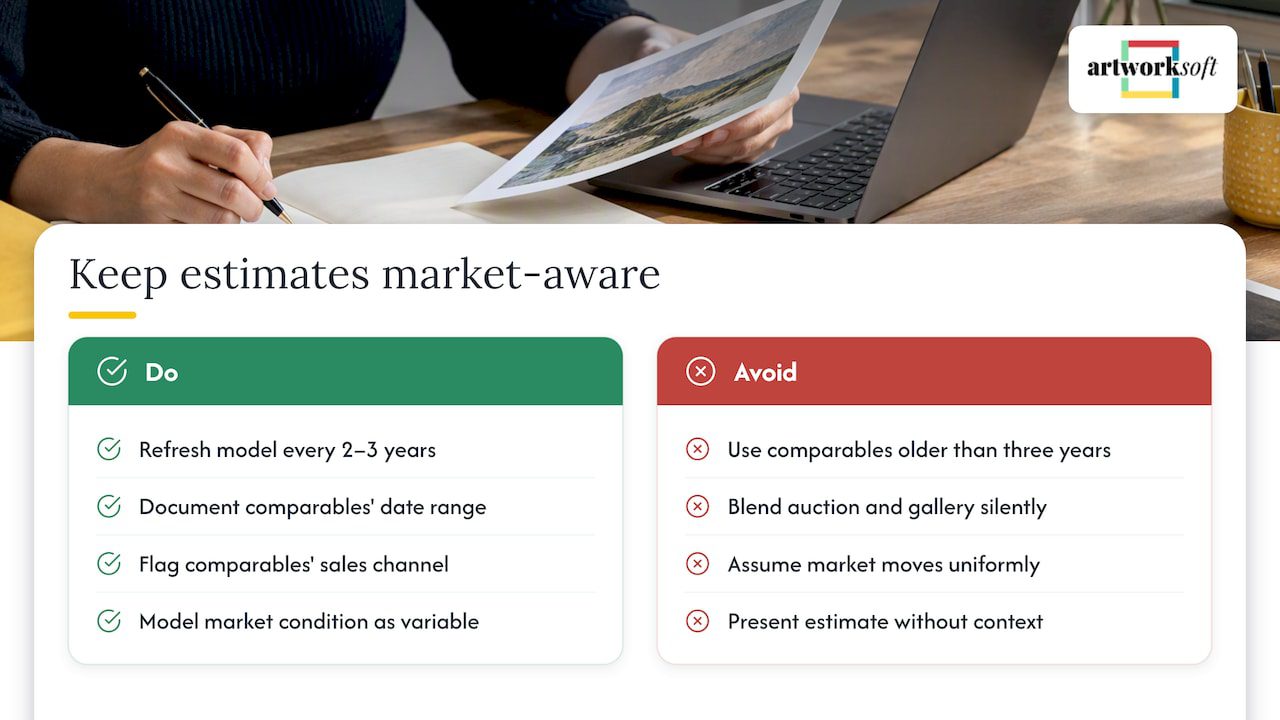
Practically, this means a pricing model needs a refresh cycle rather than a one-time calibration. Comparables older than two or three years deserve a second look, especially in fast-moving segments, and any estimate presented to a buyer or insurer should note the date range of the comparables used. Channel matters too: an estimate built entirely from auction results may not translate directly to a private gallery sale, and a model should flag which channel its comparables came from rather than blending them silently.
Treating market condition as a variable to document, not an afterthought, keeps a data-driven estimate honest when the broader market shifts underneath it.
7. What practitioners get wrong when presenting data-driven prices
Galleries and collectors generally prefer a price range with two or three supporting comparables over a single confident number. The most common mistake is mixing marketplaces, auction results with gallery asking prices, without stating a discount, which quietly inflates the estimate. A close second is treating a thin-data estimate as precise when it should carry a visible range. Provenance gets overlooked too often, even though it can shift a comparable’s relevance more than size or medium.
— Nealda
8. Artworksoft: structured pricing with built-in documentation
A system can turn the sales-comparison and documentation workflow described above into a repeatable process rather than a spreadsheet rebuilt for every piece. A structured valuation formula applies adjustable weighting for size, medium, and provenance, and each valuation keeps its comparables and images attached, so the reasoning behind a number stays visible later.

The Free Plan suits artists and small collections getting comparables and documentation organized for the first time, while the Provenance Plan, from $5 per month, adds the features collections need as inventory and sales history grow. Galleries assembling larger collections can also draw on Onboarding and Collection Management services to get records structured correctly from the start.
Software estimates, including Artworksoft’s AI-assisted valuation, support research and sales preparation. Formal tax appraisals and donation filings still require a qualified, independent appraiser. Start with the Free Plan at Artworksoft to see how a structured formula and documented comparables apply to an actual collection.
Sources
Reliable pricing depends on where the comparables come from and what the software does with them once gathered.
Auction house databases offer the most consistent public record of completed sales, though coverage skews toward higher-value work and established artists. Dealer and private-sale records fill some gaps but are rarely public, and market reports such as the Art Basel and UBS Art Market report show that performance diverges sharply across sales channels and price bands, so a single market-wide trend rarely applies evenly to every segment.
Software built for this task should do more than store numbers. It needs comparable search across stored sales records, image storage tied to each artwork and each comparable, an adjustable valuation formula that lets a user weight size, medium, and provenance, and a versioned document trail that shows what inputs produced a given estimate.
- Part III: Fair Market Value Guidance List (ISA)
- Econometric fine art valuation by combining hedonic and repeat-sales information (2018)
- Neural-network valuation study (Berkeley)
- Scientific Reports: market signals vs visual features (2024)
- Art appraisal services | Internal Revenue Service
For pricing strategy more broadly, Nectar’s overview of dynamic pricing approaches offers a useful parallel on how data-driven adjustment works outside the art market, a reminder that the underlying logic, comparables, weighting, and continuous recalibration, applies across pricing disciplines.
FAQ
What is data driven art pricing in simple terms?
It is the practice of setting an artwork’s price using documented comparable sales, market data, and statistical models instead of a flat estimate. The approach ranges from a straightforward sales-comparison method to hedonic regression or neural-network models, depending on how much sales history exists, as described in ISA’s valuation guidance.
How do I choose comparables for an artwork with no sales history?
Use close peer artists at a similar career stage, medium, and market, and document why each one qualifies as a reasonable parallel. ISA guidance recommends applying a conservative discount when substituting parallel-market comparables for direct sales history.
When does an estimate require a qualified appraiser instead of software?
Any donation, estate filing, or tax deduction likely to draw review needs a qualified appraiser, since the IRS commonly refers high-value claimed items for a Statement of Value review. Software-based estimates, including AI-assisted tools, work well for research and sales preparation but are not a substitute for that formal process.
Does Artworksoft’s valuation count as an official appraisal?
No. Artworksoft’s AI-assisted valuation and structured formula are designed for research and sales preparation, giving artists, collectors, and galleries a documented starting estimate. Formal tax or insurance appraisals still require an independent, qualified appraiser.
How often should a data-driven price estimate be updated?
Comparables older than two or three years deserve a fresh review, especially in fast-moving market segments. The Art Basel and UBS Art Market report shows that performance varies across channels and price bands, so an estimate should note the date range of its comparables.