Branded art documents are white-label, professional records such as Certificates of Authenticity, provenance reports, invoices, labels, and movement logs that carry a gallery’s, collector’s, or artist’s own identity rather than a generic template. They give every transaction a verifiable paper trail that supports provenance, insurance, and institutional trust. We build our platform around this principle, aligning document fields with collections stewardship standards set by the American Alliance of Museums.
TL;DR:
- A Certificate of Authenticity should include the artwork ID, artist, medium, dimensions, provenance summary, dated signatory, stored image, and a verification link or QR code.
- Provenance reports need an ownership timeline, primary source citations, and notes on gaps; movement logs record each location, handler, date, and condition on receipt.
- A verification URL or QR code should link each certificate to its inventory entry and movement history, with the signatory’s name, title, and signing date.
- Collections should archive prior versions when attribution changes or new provenance research emerges, with approval required before print or digital export.
- Artworksoft’s Free Plan supports inventory records, while branded documentation starts with the Provenance Plan at $5 per month for collections needing branded files.
Table of Contents
- What belongs in branded art documents: types and required fields
- Standards and verification: provenance models and audit-ready records
- How to create professional, white-label branded documents
- Template and fields checklist for certificates, invoices, and labels
- Why branded documents protect value and trust
- Generate branded, verifiable documents with Artworksoft
- FAQ
- Sources
What belongs in branded art documents: types and required fields
Every collection, whether held by a gallery, a private collector, or an individual artist, depends on a small set of document types that work together. Each one serves a distinct purpose, but they all draw from the same underlying record of the artwork.
- Certificate of Authenticity: confirms artist, title, medium, dimensions, and date, paired with a provenance summary and signatory details.
- Provenance report: documents the chronological ownership history, supported by primary-source references where available.
- Invoice or receipt: records the sale terms, price, currency, and parties involved in a transaction.
- Consignment record: tracks terms between an owner and a gallery or dealer handling a sale.
- Gallery label: identifies the work for display, usually with a short version of the core data.
- Movement log: tracks where a piece has traveled, including loan and storage history.
The collections stewardship standards published by the American Alliance of Museums list the fields that should anchor these documents: acquisition history (source, price, date), physical description, condition, location, and movement records. These fields are not administrative extras. They determine whether a collection can be insured accurately, appraised fairly, loaned responsibly, or defended in a legal dispute over ownership.
Standards and verification: provenance models and audit-ready records
Professional documentation only works if it holds up to scrutiny, which is why standards exist before templates do. The American Alliance of Museums maintains a baseline through its collections management forms, covering accession records, condition reports, and loan agreements that institutions adapt for their own use.
Beyond static forms, the Art Tracks provenance model from the Carnegie Museum of Art introduces a structured, machine-readable approach to provenance, built around distinct levels of certainty rather than a single narrative paragraph. This model is designed to work alongside traditional provenance text, not replace it, and it points toward a future where ownership history can be searched and compared across institutions.
Industry data shows that art-management platforms commonly include PDF generation for Certificates, invoices, QR labels, and inventory-linked documents, which reduces the administrative time galleries spend assembling records by hand.
Turning any document into something verifiable takes a few concrete features:
- A persistent verification URL that confirms a certificate’s authenticity without relying on the paper copy alone.
- A QR code printed on the PDF that links directly to that verification record.
- An audit trail connecting the certificate to the artwork’s inventory entry and movement history.
- Clear signatory metadata, including name, title, and date of signing.
How to create professional, white-label branded documents
Producing a branded document that holds up under scrutiny is a workflow, not a one-time design task. We recommend a sequence that starts with the artwork record and ends with a reviewed, distributable file.
- Build a single source of truth. Start with a complete inventory record for each piece, including high-resolution images and standardized metadata such as medium, dimensions, and condition.
- Design the template structure. Decide which fields populate automatically from the inventory record, where the logo and legal footer sit, and where the verification QR code appears.
- Link documents to transactions. Record who signed each document, when, and any condition notes at the time of sale, loan, or transfer.
- Preserve version history. When an attribution changes or new provenance research surfaces, archive the prior version rather than overwriting it.
- Set review and export rules. Establish who approves a document before release and whether it exports for print, digital delivery, or both.
Our branded Certificate of Authenticity feature follows this exact structure, tying each certificate to the underlying inventory record so that updates to an artwork’s status carry through automatically.
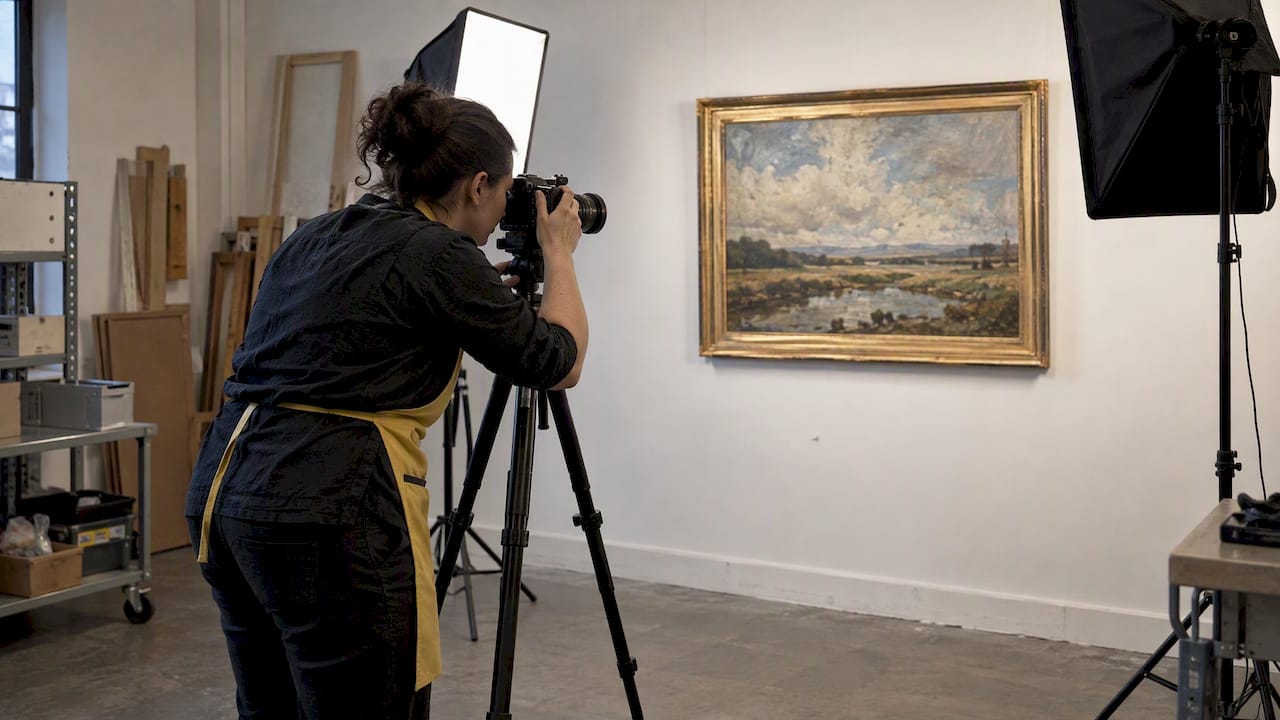
Pro Tip: Photograph every artwork under consistent lighting before you build a template, since inconsistent image quality is one of the most common reasons certificates look unprofessional even when the data is accurate.
Template and fields checklist for certificates, invoices, and labels
A template is only as reliable as the fields it forces you to complete. Use the following as a baseline across document types, adjusting for the specifics of a given collection.
- Certificate of Authenticity: artwork ID, artist, dimensions, medium, date, provenance summary, signatory name and title, signature date, verification URL or QR code, and a stored high-resolution image.
- Provenance report: chronological ownership timeline, citations to primary sources such as bills of sale or letters, export and import documentation where relevant, and notes on any gaps in the record.
- Invoice or transaction record: seller and buyer names and contacts, date, sale terms, price and currency, payment method, tax or tax-exempt status, and a unique invoice ID.
- Label and movement log: location code, movement date, handler, transport conditions, condition on receipt, and links to related documentation.
| Document type | Core fields | Primary use |
|---|---|---|
| Certificate of Authenticity | Artist, medium, dimensions, provenance summary, signature, QR verification | Sale, resale, insurance |
| Provenance report | Ownership timeline, source citations, noted gaps | Legal review, institutional loan |
| Invoice | Parties, price, currency, payment terms, invoice ID | Transaction record, tax filing |
| Movement log | Location, handler, condition, transport notes | Loan tracking, insurance claims |
Readers assembling insurance documentation alongside these checklists may find it useful to review what collectors must document for coverage, since insurers typically expect the same acquisition and condition details that belong in a well-built certificate.
Why branded documents protect value and trust
Collectors and galleries often treat documentation as a formality completed after a sale closes, but the order should run the other way. A certificate or provenance report built with complete, verifiable fields becomes part of what makes a work sellable, insurable, and defensible years later, when the person requesting proof may not be the original buyer.
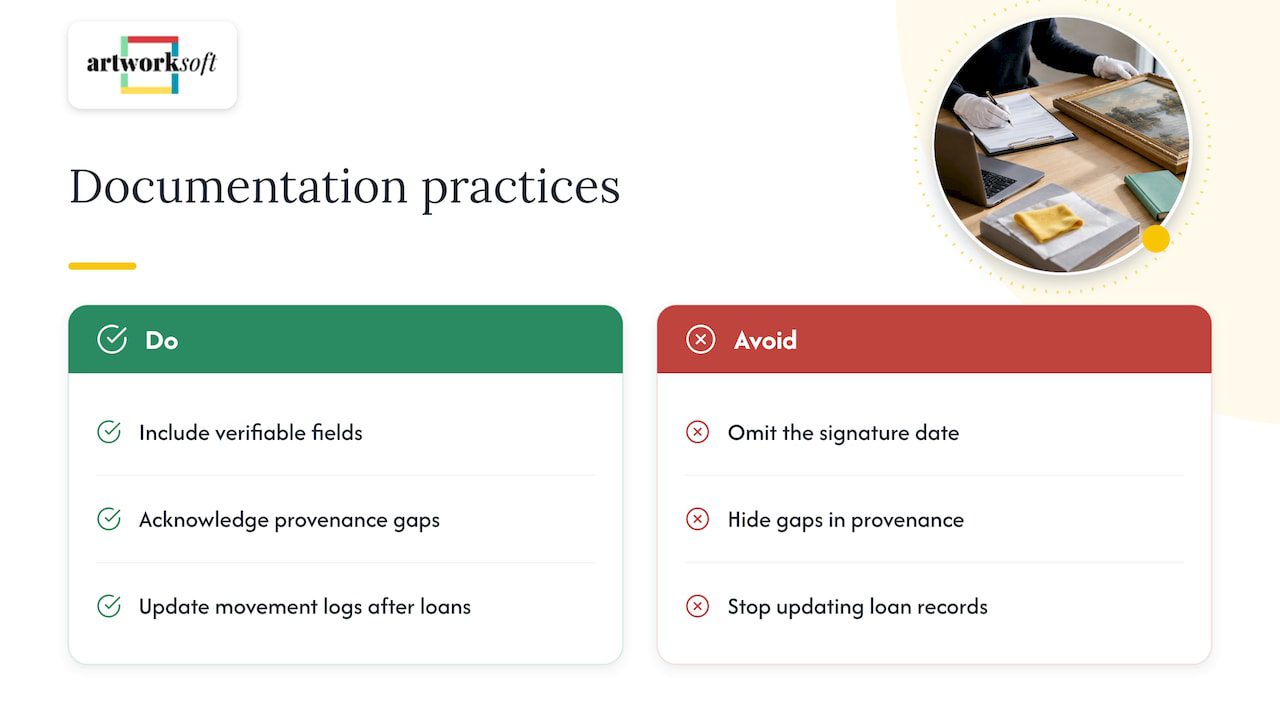
The most common failure we see is not fraud. It is incompleteness: a certificate missing a signature date, a provenance report with no acknowledgment of its own gaps, a movement log that stops updating after the first loan. These gaps compound over decades, and by the time a work changes hands again, reconstructing the missing history costs far more than recording it correctly the first time would have.
Treating documentation as part of collections stewardship, rather than paperwork, is the discipline that protects a collection’s value over the long term.
— Nealda
Generate branded, verifiable documents with Artworksoft
We built our platform so that galleries, collectors, and artists can produce Certificates of Authenticity, provenance reports, invoices, and movement logs directly from a single inventory record, with no separate design software required. Every document generated through our system links back to the artwork’s inventory record, so a change in location or ownership status carries forward automatically instead of requiring a manual update across multiple files.

- Branded Certificates of Authenticity with verification links and signatory tracking.
- Provenance reports and movement logs tied to the same artwork record.
- Invoices generated directly from sale and consignment data.
Our Free Plan lets you start building inventory records today, and our Provenance Plan adds branded documentation from 5 USD per month. For collections that need hands-on setup, our onboarding and collection management services can configure templates and migrate existing records on your behalf. Start with our art inventory system and build your first branded certificate this week.
FAQ
What makes a Certificate of Authenticity “branded” rather than generic?
A branded certificate carries the issuing gallery’s, collector’s, or artist’s own logo, layout, and verification link rather than a generic fillable template. It should also include a persistent URL or QR code that confirms the certificate’s authenticity independent of the physical document.
Which fields do professional art documents need at minimum?
At minimum, a professional document needs artist, title, medium, dimensions, date, acquisition history, and condition, following the baseline set by AAM collections stewardship standards. Provenance reports add a chronological ownership timeline and source citations where they exist.
How do movement logs connect to provenance reports?
A movement log records each physical relocation of an artwork, including loans, storage transfers, and sales, while a provenance report compiles that same history into a chronological ownership narrative. Keeping both linked to the same inventory record prevents the two documents from drifting out of sync.
Can digital verification features prevent certificate fraud?
Persistent verification URLs and QR codes make it possible for a buyer or insurer to confirm a certificate against its original record rather than relying on the paper alone, which reduces opportunities for forged or altered copies to pass unnoticed. These features work best when paired with an audit trail tying the certificate to the artwork’s inventory and movement history.
Does Artworksoft generate these documents automatically?
Our platform generates branded Certificates of Authenticity, provenance reports, invoices, and movement logs directly from each artwork’s inventory record, so the same data populates every document type without manual re-entry. Pricing for branded documentation starts with our Provenance Plan at 5 USD per month.
Sources
Consult these primary references before finalizing your own document templates.
- Collections stewardship standards – American Alliance of Museums
- Museum provenance standard / Art Tracks reference
- Best art gallery software (Capterra)