
Every gallery invoice needs nine core elements: artist and gallery contact details, a unique invoice number, the invoice date, itemized artwork descriptions, the gross sale price, the commission split, the net amount due, and clear payment terms. The single habit that prevents most payment disputes is reconciling each invoice against the actual bank deposit and keeping the supporting paperwork on file for tax purposes.
TL;DR:
- Show the gross price, commission percentage and dollar amount, separate reimbursable costs, and net due; sales tax responsibility varies by state and sale setting.
- Consignment galleries may pay monthly or quarterly rather than per sale, so confirm the settlement calendar and whether processing fees reduce commission or proceeds.
- For commissioned work, request partial payment upfront or shorter terms, and confirm any change to standard terms with the gallery in writing.
- Match each invoice to its bank deposit within seven days of expected payment, and retain invoices, receipts, deposit slips, canceled checks, and Forms 1099.
- Send a polite reminder 7 to 10 days after an invoice becomes overdue, then a firmer notice once it passes 30 days, documenting each contact.
Table of Contents
- Essential invoice fields and how to format them for gallery sales
- Pricing, commission splits, and showing the math
- Payment terms, timing, and common billing cycles galleries use
- Supporting documents and recordkeeping for tax and audit readiness
- How to send, track, and follow up on gallery invoices
- Sample invoice checklist and quick template fields
- How Artworksoft automates invoice fields and gallery settlement tracking
- One habit that prevents most invoice problems
- Put your gallery invoicing on autopilot
- FAQ
- Sources
- Authoritative resources and templates
Essential invoice fields and how to format them for gallery sales
A gallery invoice works as both a payment request and a tax record, so each field has to do double duty. Missing or vague entries slow down settlements and create gaps that are hard to fill in months later when a bookkeeper or the IRS asks for support.
We recommend structuring every invoice around these fields:
- Artist or seller information: business name, legal name if different, mailing address, email, phone, and a tax identifier (EIN or SSN) when used for business filings.
- Gallery or buyer information: the legal gallery name, a named contact person, the gallery address, and any consignment or reference number tied to the piece.
- Invoice identifier: a unique invoice number and issue date, plus the sale or settlement date if it differs from the invoice date.
- Artwork details: title, medium, dimensions, edition number and size where relevant, an inventory or lot number, unit price, quantity, and the line subtotal.
- Financial breakdown: gross sale price, the gallery’s commission shown as both a percentage and a dollar figure, reimbursable costs such as shipping or framing, and the net amount payable to the artist.
- Payment instructions: accepted methods, wire or ACH details (or a remit-to address for checks), and a contact for billing questions.
- Terms: a due date (Net 30, for example), an optional late fee policy, and a reference back to the governing contract or consignment agreement.
Each of these fields maps to something a gallery’s accounting team, or an auditor reviewing your own records, will want to verify without asking you for clarification.
Pricing, commission splits, and showing the math
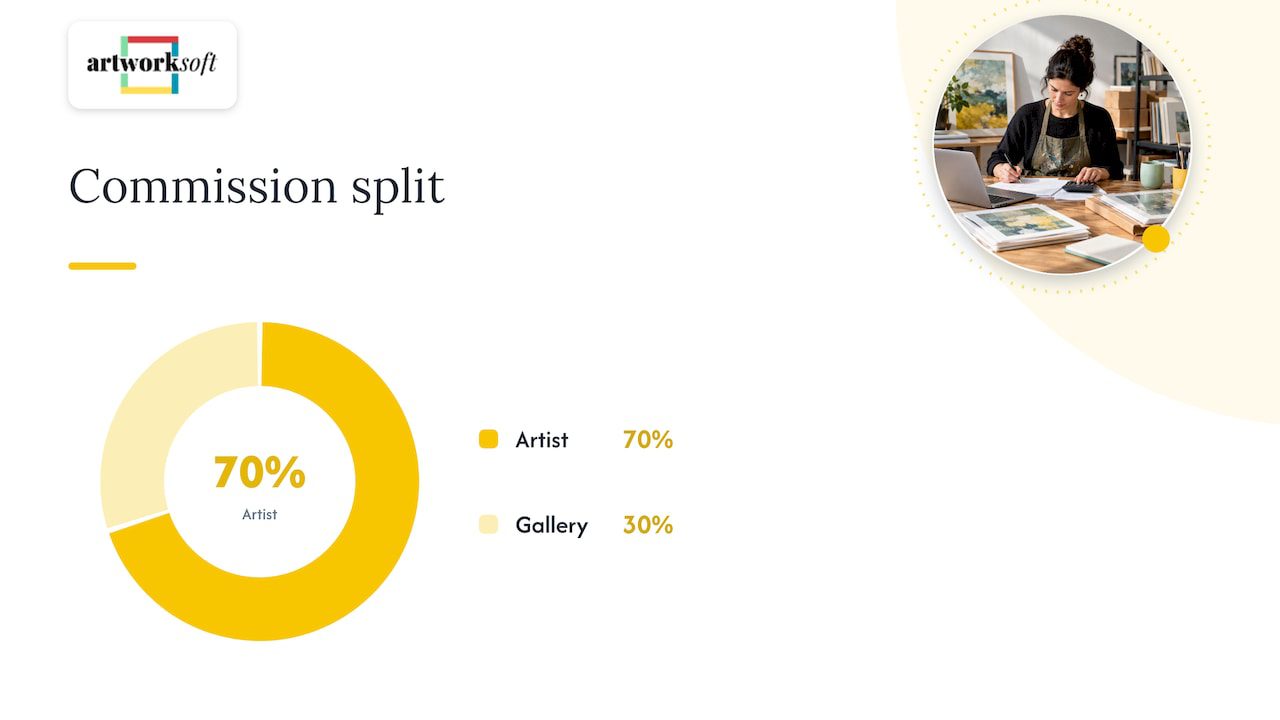
Commission splits only cause disputes when the math isn’t visible on the page.
Show the calculation in order so the gallery’s bookkeeper can check it at a glance:
- State the gross sale price for the artwork.
- Apply the commission percentage to get the commission amount in dollars.
- Subtract any reimbursable costs, such as shipping or framing, listed as separate line items.
- Arrive at the net amount payable to the artist.
A 70/30 split on a sale means 70% goes to the artist and 30% to the gallery as commission, before any reimbursable costs are added back in. This example is illustrative. Sales tax, when applicable, is typically collected and remitted by the gallery as the seller of record, though responsibility varies by state and by whether the sale happens at a fair, online, or in the gallery itself. List reimbursable expenses as their own line rather than folding them into the commission calculation, since mixing the two makes it harder for either side to verify the final number.
Payment terms, timing, and common billing cycles galleries use
Payment terms set expectations before a sale happens, not after. Net 30 means payment is due 30 days from the invoice date, Net 45 extends that window, and payment on receipt means the gallery pays as soon as the invoice arrives, which is less common for consignment arrangements. Consignment sales typically settle on a monthly or quarterly cadence, where a gallery bundles several sales into a single settlement run and issues one remittance covering all of them for that period.
- Confirm whether credit-card or platform processing fees are deducted before or after the commission is calculated.
- Ask the gallery to document any fee deductions as a separate line rather than absorbing them into the commission percentage.
- For commissioned pieces, request partial payment upfront or shorter terms, and get any change to standard terms confirmed in writing.
- Keep a copy of the consignment agreement alongside each invoice so the agreed terms are easy to reference later.
Pro Tip: Ask galleries for their standard settlement calendar before consigning work, so you know whether to expect monthly or quarterly remittances rather than per-sale payments.
Supporting documents and recordkeeping for tax and audit readiness
The IRS lists invoices, sales receipts, deposit slips, canceled checks, and Forms 1099 as the core documents that support entries on a tax return. None of these need a specific format, but they need to exist and to match each other.
- File documents by year and transaction type so a given sale’s paperwork is easy to pull together.
- Use a consistent naming convention for invoice PDFs to make searching and reconciliation faster.
- Reconcile each invoice to its corresponding bank deposit on a monthly basis rather than waiting until tax season.
- Keep exhibition fees and non-cash benefits separate from sales revenue, since they’re accounted for differently in a budget or contract.
Organized records make the difference between a quick tax filing and a stressful one: discrepancies between invoices and deposits are exactly what can draw a closer look during a tax review. Once your sales volume grows, a bookkeeper or CPA can catch mismatches that are easy to miss when everything is tracked manually, and software that syncs invoices to deposits removes much of the transcription error that creates those mismatches in the first place.
How to send, track, and follow up on gallery invoices
A repeatable workflow keeps invoicing from becoming a source of stress every time a sale happens.
- Prepare: export the invoice as a searchable PDF with a consistent filename, such as Invoice_artistname_YYYYMMDD_invoicenumber.
- Send: use the gallery’s portal if one exists, or email the named contact directly, with the invoice number and sale description in the subject line.
- Track: log the invoice number, issue date, due date, expected payment date, and any follow-up schedule in a ledger or tracking system.
- Follow up: send a polite reminder at 7 to 10 days past due, and a firmer notice once an invoice passes 30 days, keeping a written record of each communication in case a dispute arises later.
This sequence takes a few minutes per invoice but removes most of the guesswork around which payments are outstanding and when to escalate.
Sample invoice checklist and quick template fields
Before sending any gallery invoice, run through this list:
- Artist contact information and tax identifier if applicable.
- Gallery contact information and any consignment reference number.
- Invoice number and invoice date.
- Sale or settlement date, if different from the invoice date.
- Artwork line items: title, medium, dimensions, unit price, and subtotal.
- Gross sale price.
- Commission percentage and the calculated commission amount.
- Reimbursable costs listed separately.
- Sales tax, if applicable to the transaction.
- Net amount payable to the artist.
- Payment instructions and accepted methods.
- Payment terms and due date.
Export each invoice as a text-searchable PDF rather than a scanned image, and keep filenames consistent so a reconciliation search turns up the right document immediately. Our art invoice format guide covers field-by-field formatting in more detail for artists building their own template.
How Artworksoft automates invoice fields and gallery settlement tracking
We built our platform to carry artwork details, such as dimensions, medium, and pricing, directly from an artist’s inventory into invoice generation, which removes the retyping that causes mismatched figures between a gallery’s records and an artist’s own books. Batch upload handles multiple consigned works at once, and sales-tracking dashboards show which invoices are outstanding, settled, or overdue at a glance.
Because the same records feed provenance documentation, an invoice generated through our system stays connected to the artwork’s full history rather than existing as a standalone file. That connection matters when a gallery, collector, or accountant asks for supporting paperwork months after a sale closes.
One habit that prevents most invoice problems
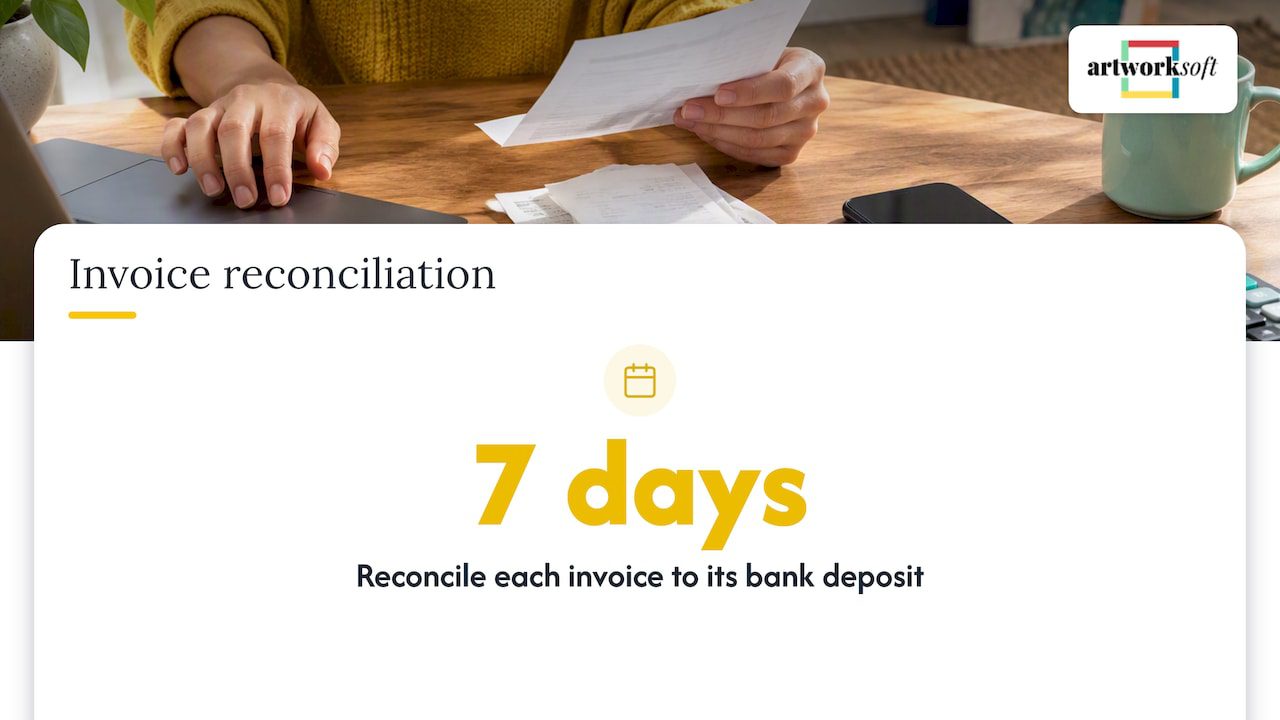
If there’s one practice worth adopting above all others, it’s reconciling each invoice to its bank deposit within seven days of expected payment. Waiting until tax season to match invoices against deposits turns a five-minute check into a multi-day reconstruction project.
Pair that habit with consistent templates and naming conventions across every invoice you send. Galleries process paperwork from many artists at once, and a predictable format reduces the back-and-forth that slows down settlements and creates room for disputes.
— Nealda
Put your gallery invoicing on autopilot
Manually rebuilding invoices for every consigned piece invites the kind of transcription errors that delay payment and complicate tax time. Our platform pulls artwork details straight from your inventory into professional invoices and tracks each one through to settlement, so the checklist above becomes a built-in part of recording a sale rather than a separate task.

- Generate invoices directly from your existing artwork records instead of re-entering details by hand.
- Track outstanding, settled, and overdue invoices across every gallery relationship in one dashboard.
- Keep provenance documentation linked to each sale for audit-ready recordkeeping.
Start with our Free Plan to see how invoice generation and sales tracking work together, or review our onboarding and collection management services if you’d rather have support setting up your inventory from the start.
FAQ
What is the 70/30 rule in art?
Commission splits vary depending on the gallery and the working relationship.
How do I prepare an invoice for services rendered?
A services invoice should include your contact information, the client’s details, a unique invoice number and date, a description of the work performed, the amount due, and your payment terms. For gallery sales specifically, that same structure expands to include itemized artwork details and the commission breakdown rather than a flat service fee.
What are the three types of galleries?
Gallery types are generally grouped as commercial galleries, which sell work for profit and typically take a commission; nonprofit or artist-run spaces, which may charge exhibition fees rather than commission; and museum or institutional galleries, which often focus on exhibition rather than direct sales. Payment structures differ across each type, so confirming the model in writing before consigning work helps set the right invoicing expectations.
Do I legally have to provide an invoice?
There’s no single federal requirement that mandates a specific invoice format for art sales, but the IRS requires businesses to keep records that substantiate income, and an invoice is typically the primary document that does so. Check with a tax professional or your state’s requirements if you’re uncertain about your own obligations as a seller.
Sources
- Publication 334 (Tax Guide for Small Business)
- What kind of records should I keep | Internal Revenue Service
- Manage your finances | U.S. Small Business Administration
- Exhibition payment guide | Artists Now
Authoritative resources and templates
For readers who want to go deeper on recordkeeping and payment standards referenced throughout this guide, these primary sources and related resources cover the details directly:
- Publication 334 (Tax Guide for Small Business)
- What kind of records should I keep | Internal Revenue Service
- Manage your finances | U.S. Small Business Administration
- Exhibition payment guide | Artists Now
- 5 Art Invoice Format Fields That Get Artists Paid Faster