


An art conservator is a trained professional who examines, treats, documents, and helps prevent damage to paintings, objects, textiles, and other cultural artifacts. In the United States, the profession’s recognized credential is a master’s degree from a specialized graduate conservation program, though early-career paths through internships and technician work do exist. The American Institute for Conservation (AIC) sets the standard for training and ethics, and institutions like the Art Institute of Chicago’s Conservation and Science department show what the work looks like at scale.
You need one specifically when:
- Damage is active — water, fire, mold, flaking paint, or structural instability.
- You own a piece with real financial or sentimental value that needs a professional condition assessment.
- A work is traveling, going on loan, or entering an exhibition.
- You need a documented, authoritative condition report for insurance or sale.
Key Takeaways
Becoming an art conservator requires a master’s-level credential and years of hands-on training, while hiring one hinges on recognizing damage early and demanding documented, justified treatment.
| Point | Details |
|---|---|
| Credential standard | A master’s degree from an accredited conservation graduate program is the field’s recognized entry point. |
| Hiring triggers | Active damage, upcoming travel or exhibition, and insurance or sale needs all justify calling a professional. |
| Vet before you hire | Use AIC’s Find a Professional tool and confirm written treatment proposals and reports before work begins. |
| Prevention beats repair | Controlling light, humidity, temperature, and pests reduces how often interventive treatment is needed. |
| Documentation habits | Structured digital records through Artworksoft make condition history and provenance easy to hand a conservator. |
Table of Contents
- What Does an Art Conservator Actually Do?
- How Do You Become an Art Conservator?
- What Skills and Ethics Guide Conservation Work?
- What Do Conservators Earn, and Where Do They Work?
- When Should You Hire a Conservator, and How Do You Find One?
- How Documentation and Prevention Cut Long-Term Risk
- Sources
What Does an Art Conservator Actually Do?
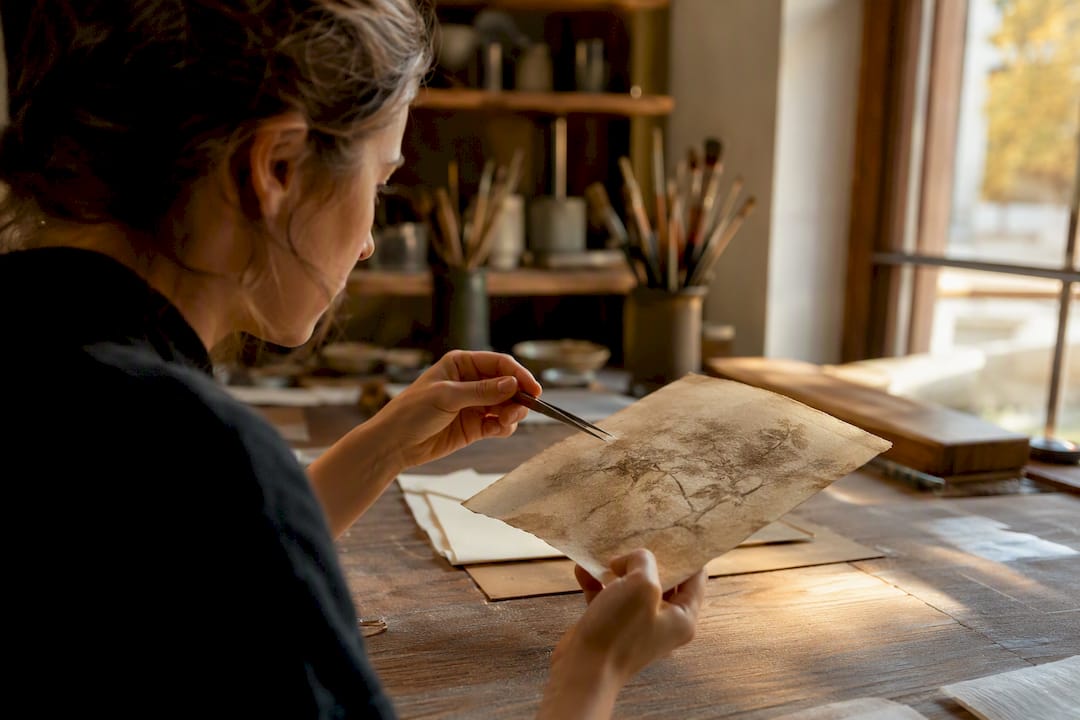
The job splits into four core activities: examination, diagnosis, treatment, and documentation, plus ongoing preventive advice to keep pieces stable long term. A conservator working on a 19th-century oil painting might spend more time under a microscope and running solvent tests than actually painting anything.
Specializations map to material type. Paintings conservators handle canvas, panel, and varnish issues. Objects conservators work on sculpture, ceramics, and metalwork. Paper and book conservators deal with foxing, tears, and binding failure. Textile conservators stabilize fibers and dyes. Preventive conservation specialists focus on environment rather than repair, and a growing niche in new media conservation now deals with video art, software-based installations, and digital files that degrade in their own strange ways.
Work happens across several settings:
- Museum conservation departments, which manage large permanent collections and publish treatment case studies.
- Private practice, serving individual collectors and dealers directly.
- Contract labs that handle overflow work for institutions.
- Auction house consultancies, evaluating condition before sale.
The technical toolkit includes microscopy, X-ray fluorescence (XRF) for pigment analysis, and infrared, ultraviolet, and X-ray imaging to see beneath the visible surface, alongside climate-controlled workspaces built to prevent further deterioration during treatment.
How Do You Become an Art Conservator?
The path is longer than most creative careers and shorter than a medical degree, typically several years from a standing start to full qualification.
- Build the prerequisite foundation. Coursework in chemistry, studio art, and art history, combined with volunteer hours or internships at a museum or conservation lab.
- Accumulate pre-program hours. Most graduate programs expect hundreds of hours of hands-on experience before they’ll even consider an application, according to AIC’s guidance for aspiring conservators.
- Complete a graduate conservation program. These run two to four years and combine conservation science theory with supervised treatment work.
- Pursue a post-graduate fellowship. Most new conservators spend one to three years in a fellowship at a museum or private lab before working independently.
- Stay current through continuing education. Workshops and short courses keep specialists sharp on new materials and techniques.
Notable programs worth researching include the Cooperstown Graduate Program at SUNY Oneonta and the Conservation Center at NYU’s Institute of Fine Arts, where faculty like Dianne Modestini integrate technical analysis, such as SEM-EDS and multi-band imaging, directly into treatment training.
Pro Tip: Structure your pre-program experience around a specific specialty. A generalist volunteer log is fine, but 200 hours logged specifically in paper conservation, with a small portfolio of before-and-after documentation you helped produce, tells an admissions committee exactly what you’re aiming for.
What Skills and Ethics Guide Conservation Work?
Technical competence only gets a conservator halfway there. The rest is judgment.
On the technical side: materials science fundamentals, microscopy and imaging interpretation, safe handling and packing, and controlled use of solvents and adhesives. On the nontechnical side: art-historical context, precise documentation, clear communication with owners or curators, and the project management skill to sequence a multi-month treatment without losing track of what’s reversible and what isn’t.
- Preventive conservation (environment, handling, storage) versus interventive conservation (direct treatment) is the field’s central distinction.
- Every intervention needs a documented justification, not just a rationale for why it works.
- Materials used in treatment must be distinguishable from the original, on record, for future conservators.
Conservation work is governed by justification, not instinct: an intervention is only appropriate when it’s documented, reasoned, and, wherever possible, reversible. That principle sits at the core of the AIC Code of Ethics, and it’s what separates a conservator from a restorer working on gut feeling.
Pro Tip: If a conservator can’t explain why a treatment is reversible, or can’t produce a written treatment proposal before starting, that’s a red flag worth pausing on.
What Do Conservators Earn, and Where Do They Work?
Career paths branch in a few predictable directions: staff conservator at a museum, private practice serving collectors directly, freelance consulting, academic or research positions, or conservation science roles focused on materials analysis rather than hands-on treatment.
Each setting demands something different. Museum roles, like those in the Art Institute of Chicago’s department, require institutional workflows, committee sign-off, and rigorous case documentation. Private practice demands the opposite skill set: client management, pricing transparency, and the ability to explain technical decisions to someone with no conservation background.
Pay varies widely by specialty, region, and employer type. Entry-level museum and lab positions tend to sit at the lower end of the professional salary range, while established private practitioners with a strong specialty and client base can earn considerably more. Geography matters too. Conservators in major metro areas with dense museum and gallery infrastructure typically see stronger demand than those in smaller markets.
- AIC’s job board and Emerging Conservation Professionals Network are useful starting points for job searching and mentorship.
- Museum career portals list institutional openings directly.
- Professional membership itself, through AIC, functions as a networking tool since peer review is part of how the field vets practitioners.
When Should You Hire a Conservator, and How Do You Find One?
Certain conditions call for a professional, not a DIY fix. Active water or fire damage, structural instability (a cracking panel, a tearing canvas), significant discoloration, or a piece scheduled for travel or exhibition all warrant a call. So does anything you’re planning to insure or sell, since a documented condition report carries real weight in both processes.
The hiring process generally follows this sequence:
- Initial inquiry describing the piece and the concern.
- A condition report from the conservator, assessing damage and risk.
- A written treatment proposal outlining the approach, timeline, and cost.
- Your written consent before any work begins.
- A final treatment report documenting exactly what was done.
Before signing off on anyone, ask:
- What’s your specialty, and do you have credentials or membership through AIC?
- Can you show before-and-after examples of comparable work?
- Do you carry insurance and liability coverage for the piece while it’s in your care?
- Will I receive a full written treatment report at completion?
For finding a vetted professional, AIC’s Find a Professional tool searches members by specialty and region, and members go through a peer-reviewed application process to get listed. It’s worth noting that major museum conservation departments generally don’t treat private collections. Their staff are there for the institution’s holdings, so they’ll typically point private owners toward AIC’s registry instead.
Cost depends on complexity, materials required, lab time, and travel, and most reputable conservators won’t quote a firm price until they’ve done a hands-on condition assessment.
How Documentation and Prevention Cut Long-Term Risk
Good records do as much for a piece’s longevity as good treatment. Photodocumentation, condition reports, and provenance files create a paper trail that protects both value and future treatment decisions, and preventive conservation, controlling light, humidity, temperature, and pests, remains the most sustainable way to keep a collection stable.
- Dated condition photos, taken consistently under the same lighting.
- Environmental logs tracking humidity and temperature swings.
- Written treatment proposals and reports for every intervention.
Pro Tip: Photograph a piece under the same light source and angle every time. Inconsistent lighting between condition photos is the single biggest reason comparison shots are useless later.
Owners who keep structured digital records of their collection, not just paper folders in a drawer, tend to have faster, smoother intake conversations when a conservator gets involved, since the condition history directly affects an artwork’s valuation down the line.

Is a Conservation Career Worth It?
Conservation rewards patience and cross-disciplinary curiosity more than ambition. Funding is limited, and full-time positions are competitive, but the intellectual payoff, chemistry, art history, and craft in one job, is real. It suits detail-oriented, ethically minded people who don’t need fast results.
Keep Every Piece’s Story Straight Before the Conservator Arrives
Handing a conservator a scattered pile of receipts and old photos slows everything down. Artworksoft gives collectors and galleries a single, structured record for each piece: condition history, provenance, past treatment notes, and movement logs, all in one place instead of buried across emails and file folders.

That structure pays off the moment you need outside help. A conservator can review a clean condition history and prior documentation in minutes instead of reconstructing it from scratch, which speeds up the initial assessment and often the cost estimate too. It also strengthens your hand later, whether you’re insuring the piece, planning a loan, or preparing it for sale. If your collection’s records currently live in a mix of spreadsheets and photo folders, start organizing them properly at Artworksoft before the next condition issue forces the question.
Sources
- Find a Professional — American Institute for Conservation
- Preventive Conservation — Smithsonian Museum Conservation Institute (MCI)
- Conservation and Science — Art Institute of Chicago











