


The single most important action for any collector is this: create a complete, standardized record for every work you own, then secure that record with backups. That record needs the artist’s name, title, date, materials, dimensions, and any inscriptions. Photograph the front, back, and any damage or signature detail, and write a baseline condition report the day you acquire the piece. Store the invoice, certificate of authenticity, and any appraisals with that record, and keep a copy somewhere other than your living room shelf. A digital collection management workflow, such as the one Artworksoft provides, makes this repeatable instead of a one time scramble.
Key Takeaways
Disciplined, standardized records are the single biggest factor separating collections that protect their value from those that lose it to gaps and disputes.
| Point | Details |
|---|---|
| Standardize your fields | Use one field set (artist, title, medium, dimensions, inscriptions) for every work, no exceptions. |
| Photograph and report at intake | Shoot front, back, and detail views, then write a baseline condition report immediately. |
| Reappraise on a schedule | Update replacement value appraisals roughly every five years to keep insurance coverage accurate. |
| Track every movement | Log location changes and loan terms in writing to protect condition and provenance history. |
| Use Artworksoft to run the workflow | Artworksoft implements valuation, COA generation, and movement tracking in one connected system. |
Documenting and Cataloging Each Work: Fields, Photos, and File Organization
Art collections management starts with a data standard, not a spreadsheet you improvise as you go. Museums treat collections documentation as a formal discipline for good reason: inconsistent fields are the number one cause of records that fail you later, whether during an insurance claim or a sale negotiation.
Every object record should include:
- Artist or maker, title, and date (or date range if unknown)
- Medium and materials (oil on canvas, bronze cast, archival pigment print)
- Dimensions, unframed and framed where relevant
- Accession or inventory number unique to your collection
- Inscriptions, labels, or signatures, transcribed exactly as they appear
Photography needs a system, not a phone snapshot. Shoot the front straight on, the back (labels and stretcher bars matter), and close details of any signature or damage. Include a color and scale reference in at least one shot, then follow a consistent file naming convention like artistlastname_title_year_view.tiff so files stay searchable years later.
Attach the supporting paperwork to the record itself: purchase invoices, certificates of authenticity, exhibition catalogues, and bibliographic references. Standard checklists recommend keeping high resolution TIFF or JPEG images alongside PDF documents, backed up locally and in an encrypted cloud copy with version history. A digital archiving system removes the guesswork from that backup routine.
How Do You Write a Baseline Condition Report?
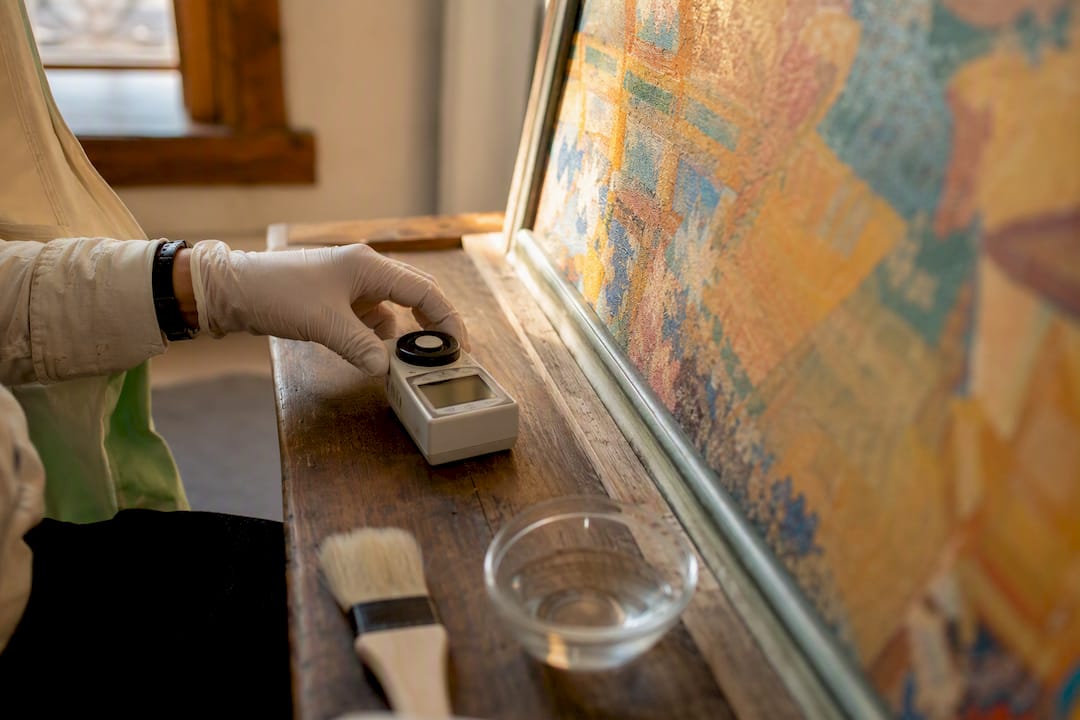
A baseline condition report is the reference point everything else gets measured against, and you write it once, at intake, before anything changes. Skip this step and you have no way to prove a crack, a fade, or a tear happened after you owned the piece rather than before.
Your report should cover:
- Surface condition — cracking, flaking, discoloration, foxing, or craquelure
- Support and structure — canvas tension, panel warping, frame stability, mounts
- Measurements, confirmed against the catalog record
- Annotated photographs marking any existing flaws directly on the image
Recheck cadence depends on risk. A stable oil painting in a climate controlled room might need only an annual glance. A textile, a work on paper, or anything traveling for a loan needs a spot check before and after every move. Conservation fundamentals call for full rechecks whenever a piece changes hands or location, with any conservator treatment documented and attached directly to the object record.
Pro Tip: Keep relative humidity in the 45 to 55 percent range and light exposure low for works on paper. If you notice a change between scheduled checks, don’t wait for the next cycle. Call a conservator and document what you see immediately, with photos, before touching anything.
What Provenance and Appraisal Records Do You Need?
Provenance is what turns a painting into an asset a buyer, insurer, or lender will trust. A gap in ownership history doesn’t just look sloppy. It can knock real money off a sale price or stall a loan approval entirely, because provenance and exhibition history directly shape how the market perceives authenticity.
Keep these on file for every work:
- Chain of ownership, from the artist or first collector to you
- Exhibition history, including venue, dates, and catalog references
- Bibliographic mentions in books, reviews, or exhibition catalogs
- Prior appraisals and conservation reports, filed with the object record
Appraisals come in two distinct flavors, and confusing them is a common, costly mistake. Fair market value appraisals matter for tax filings, gifts, and estate planning. Replacement value appraisals, almost always higher, are what your insurer needs to set coverage. Collections management checklists commonly recommend reappraisal roughly every five years, since market values shift and a decade old number can leave you badly underinsured. Insurers and loan reviewers both move faster when your appraisal, invoice, and provenance file arrive as one clean package rather than scattered documents you have to hunt down.
How Do You Track Movement, Loans, and Storage Logistics?
Every work needs a permanent location field in its record, updated the moment it moves, whether to a new wall, a storage facility, or a borrowing institution. A movement and location tracking system turns “where is that piece right now” from a guessing game into a two second lookup.
A workable loan and logistics process runs like this:
- Condition sign off before the work leaves your custody, matched against the baseline report
- Loan agreement and insurance terms confirmed in writing, not verbally
- Vetted transport and packing vendors, with written condition and insurance terms attached to the shipment record
- Return inspection against the pre-loan condition report, flagging any discrepancy immediately
Multi-site collectors should reconcile inventory monthly or quarterly. A piece that’s “probably at the lake house” isn’t a location. It’s a liability waiting for an insurance dispute.
What Features Should a Collection Management System Have?
Match your workflow needs to specific software features, and you’ll avoid paying for a bloated system or outgrowing a bare bones one within a year. Cataloging needs customizable fields. Condition reporting needs solid image handling. Provenance and insurance work need document generation. Movement tracking needs a location log that updates in real time.
The must haves, regardless of which platform you pick, are:
- Secure cloud backups with version history
- Multi location support for collections spread across homes, storage, and galleries
- User permissions if more than one person touches the records
- An audit trail showing who changed what, and when
Artworksoft was built around this exact mapping. Its structured valuation formula removes guesswork from pricing, its certificate of authenticity generation turns a record into a client-ready document in minutes, and its movement tracking tools keep location history attached to each work automatically.
Pro Tip: Don’t migrate your whole collection on day one. Import ten representative pieces first, standardize your field names, test how documents export, and train one person on the workflow before rolling it out to the full inventory.
What Should Your Annual Collection Review Checklist Include?
Break the work into three tiers so nothing falls through the cracks:
- Immediate: create a record for every work, photograph it, attach the invoice and certificate of authenticity, and back everything up.
- Quarterly: spot check higher risk pieces, reconcile storage locations, and update any active loans.
- Annual: review insurance coverage, schedule reappraisals where due, and run a full inventory spot check.
Know who to call before you need them: a conservator for treatment, a certified appraiser for value, and an attorney for estate or loan documentation.
What Legal and Ethical Issues Should Collectors Know About?
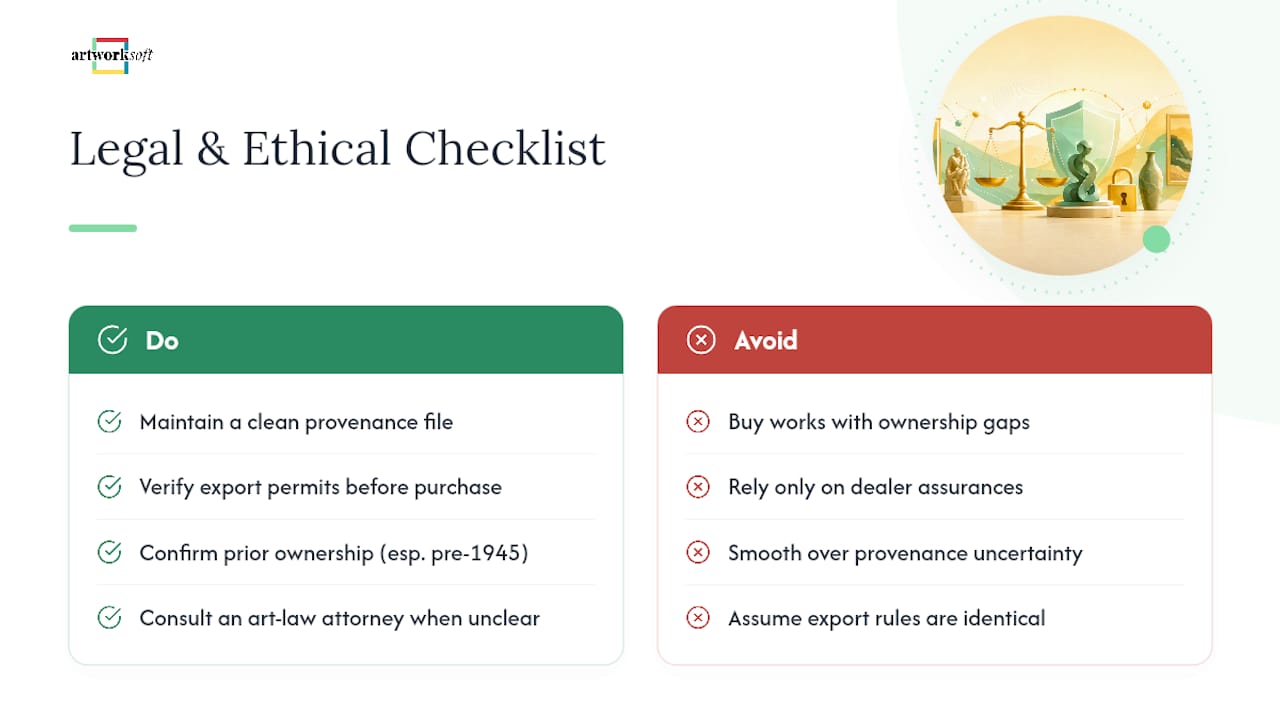
Ownership disputes and cultural heritage claims are the two legal risks that catch collectors off guard most often, usually because they surface years after a purchase, not at the point of sale. A clean provenance file is your first line of defense against both.
Works with gaps in ownership history, especially pieces that changed hands during wartime periods or came from regions with active cultural property claims, carry real legal risk. A collector who cannot show continuous, documented ownership may find a title challenged decades later, sometimes by a foreign government or an heir asserting a restitution claim. This is not a hypothetical for anyone holding pre-1945 European works, antiquities, or items with unclear export histories. Verify export permits and prior ownership before you buy, not after.
Cultural heritage laws vary significantly by country of origin and by category of object, and they can restrict resale, export, or even continued private ownership of certain items. Archaeological material and cultural patrimony pieces face the strictest scrutiny. Where a piece’s legal status is unclear, consult an attorney who specializes in art law rather than relying on a dealer’s assurance.
Ethically, documenting provenance honestly, including any gaps, protects you more than smoothing over uncertainty. A dealer or auction house doing due diligence will find the gap eventually. Better it comes from your own thorough records than from someone else’s discovery.
A collector’s perspective: common mistakes and quick wins
The collectors who struggle most aren’t disorganized. They’re inconsistent: one field for one piece, a different format for the next, invoices scattered across email folders. The fix is almost boring in its simplicity. Pick one field set, one photo routine, one backup schedule. Repeat it every time.
Start Managing Your Collection With Artworksoft Today
Artworksoft turns every practice covered above into an actual workflow instead of a set of good intentions. The structured valuation formula handles pricing without the back and forth guessing that plagues informal appraisals. Certificate of authenticity generation takes a cataloged record and produces a client-ready PDF in minutes. Movement tracking logs every transfer automatically, and cloud backups mean your records survive a hard drive failure or a house fire.

If you’re still managing your collection in scattered spreadsheets and email attachments, the fastest fix is importing a handful of pieces into a system built for this exact job. Start a free trial, import five or ten representative works, and generate your first certificate of authenticity to see how the full record, from provenance to valuation, comes together in one place.
Frequently Asked Questions
How often should I reappraise my art collection?
Most collections management checklists recommend reappraising works roughly every five years, or sooner if the market for a particular artist shifts significantly or you plan a sale, loan, or estate transfer.
What’s the difference between fair market value and replacement value?
Fair market value reflects what a work would sell for between a willing buyer and seller, used for tax and gift purposes. Replacement value, typically higher, reflects the cost to replace the work and is what insurers use to set coverage.
Do I need a conservator for every condition check?
No. Routine baseline reports and periodic photo comparisons can be done yourself. Call a conservator when you notice an actual change, before a loan, or when treatment is being considered.
Can I manage a small collection without dedicated software?
You can, but inconsistent spreadsheets and scattered email attachments are the most common source of missing invoices and unusable photos. A structured system like Artworksoft keeps the same fields, documents, and backups applied every time, no matter the collection’s size.
Sources
For institutional depth, review the Smithsonian’s records management guidance, the MFA’s collections management overview, and printable checklists like the Collection Management First Steps PDF.
- Collections Management
- Collection Management: First Steps (checklist PDF)
- Fundamentals of Conservation (archive)











