

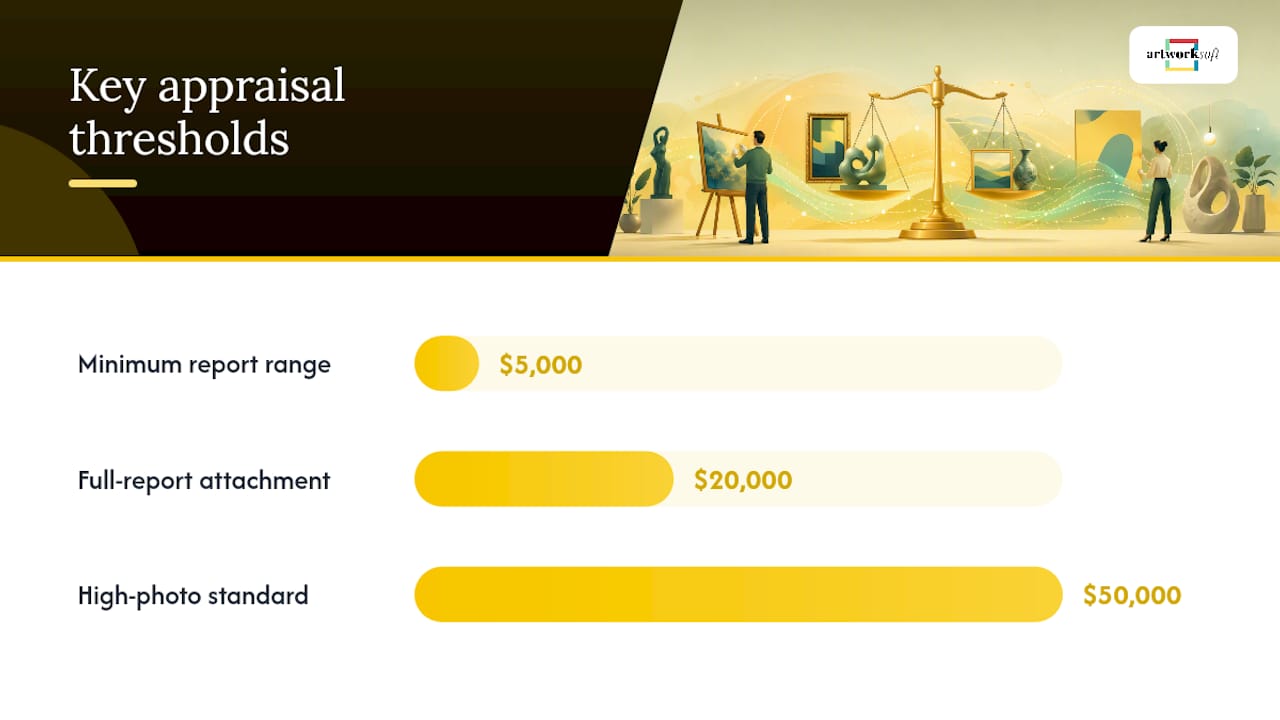
If you claim a deduction of more than $5,000 for donated art, the IRS requires a qualified appraisal and Form 8283 Section B. If the claimed deduction reaches $20,000 or more, you must attach the full appraisal to your return. If the claimed deduction reaches $50,000 or more, you may request a Statement of Value from the IRS before filing your return. Every appraisal must be signed no earlier than 60 days before the donation and completed by a qualified appraiser paid a flat or hourly fee, never a percentage of the claimed value.
TL;DR:
- Appraisals over $5,000 require a qualified appraiser’s report signed within 60 days before donation and a completed Form 8283 Section B.
- Donations valued at $20,000 or more mandate attaching the full appraisal to the tax return, while values above $50,000 allow requesting a binding IRS Statement of Value before filing.
- The appraisal must contain detailed descriptions, provenance, comparable sales, photographs, and appraiser credentials; weak comparables often trigger IRS audits.
- The appraiser’s fee cannot be percentage-based, and it must be a flat or hourly fee to qualify, ensuring independence and reducing the risk of valuation inflation.
- Proper timing, documentation, and early engagement of qualified experts and institutional acceptance significantly lower the risk of IRS scrutiny or deduction rejection.
Table of Contents
- Art Donation Appraisal Rules: Thresholds, Forms, and Definitions
- What a Qualified Appraisal Must Contain
- Who Qualifies as an Appraiser, and Why the Fee Structure Matters
- Timing Rules, Form 8283, and Filing Mechanics
- Statement of Value: High-Value Donations and AAS Review
- Documentation Checklist and Records to Keep
- A Practical Workflow for an Appraisal-Ready Donation
- Common Mistakes That Trigger IRS Scrutiny
- How Advisors Should Sequence an Art Donation
- Prepare Documentation That Meets IRS Expectations With Artworksoft
- Where to Verify These Art Donation Appraisal Rules Directly
- Sources
Art Donation Appraisal Rules: Thresholds, Forms, and Definitions
A “qualified appraisal” is a specific legal term, not a general description of a professional valuation. Under 26 CFR 1.170A-17, it means a report prepared by a qualified appraiser, consistent with generally accepted appraisal standards such as the Uniform Standards of Professional Appraisal Practice (USPAP), and completed within the specific time window the regulation sets. Publication 561 and Treasury Regulation 1.170A-17 are the two anchors that govern almost every art donation appraisal rule discussed in this guide, and both use language far more precise than most donors expect.
The dollar thresholds determine how much documentation you need, and each one carries a different consequence if you get it wrong.
- Over $5,000: A qualified appraisal is required, and you must complete Form 8283 Section B, with a separate Form 8283 required for each item or donee where the rules call for it.
- $20,000 or more: Publication 561 requires you to attach the complete appraisal document to your tax return, not just the summary.
- $50,000 or more: You become eligible to request an IRS Statement of Value (SOV) under Revenue Procedure 96-15, an advance review that can settle valuation disputes before they start.
- Below $5,000: A qualified appraisal is not required, though you still need enough documentation to support the claimed value if the IRS asks.
Form 8283 itself is worth understanding on its own terms. It functions as an appraisal summary, not the appraisal itself. The full appraisal report stays in your files (and gets attached to the return when the value crosses $20,000), while the form condenses the key facts, the appraiser’s signature, and the donee’s acknowledgment into a standardized format the IRS can process quickly. Confusing the two is one of the more common ways donors and even some advisors stumble on this issue: the form is not a substitute for a real, narrative appraisal, and the IRS treats it as an entirely separate obligation.
None of these rules are unique to paintings or sculpture. They apply to donated prints, photography, decorative arts, and design objects with the same rigor, which is why advisors handling a mixed collection need a single compliance framework rather than a case-by-case approach.
What a Qualified Appraisal Must Contain
An appraisal that satisfies the IRS is a document built to survive scrutiny, not a one-page letter with a number at the bottom. The regulation and AAS guidance together define roughly a dozen elements that need to appear, and missing even one can undermine the entire deduction if the return is examined.
A qualifying appraisal report generally needs:
- A detailed description of the object — artist, title, medium, dimensions, date of creation, and a signature or mark description.
- Provenance history — prior owners, dates of transfer, and how the donor acquired the piece.
- Exhibition history, if any, including venue names and dates.
- Catalogue raisonné citations where the artist’s work has been cataloged, since AAS treats this as strong corroborating evidence.
- Condition and restoration notes, describing any damage, repair, cleaning, or conservation work that could affect value.
- The valuation method used, with the appraiser explaining why that method fits the object.
- Specific comparable sales, including auction results or private sale data, with an explanation of why each comparable was chosen and what adjustments were made for condition or market timing.
- The appraiser’s signature, credentials, and Taxpayer Identification Number.
- The valuation effective date, which should align closely with the contribution date.
- Photographs that meet the format and resolution expectations for the object’s value tier.
The comparables section deserves particular attention because it is where weak appraisals fall apart under examination. Publication 561 notes that a defensible valuation ties the number to specific comparable sales and explains why each one is relevant, factoring in condition differences, sale venue, and timing. An appraiser who writes “comparable works have sold for similar amounts” without naming a single sale has produced a document that reads more like an opinion than an appraisal.
Statistic Callout: Publication 561 sets a hard attachment line at $20,000, meaning any single work of art donated at or above that value requires the full appraisal report, not the summary, to accompany the return. There is no partial compliance option once that threshold is crossed.
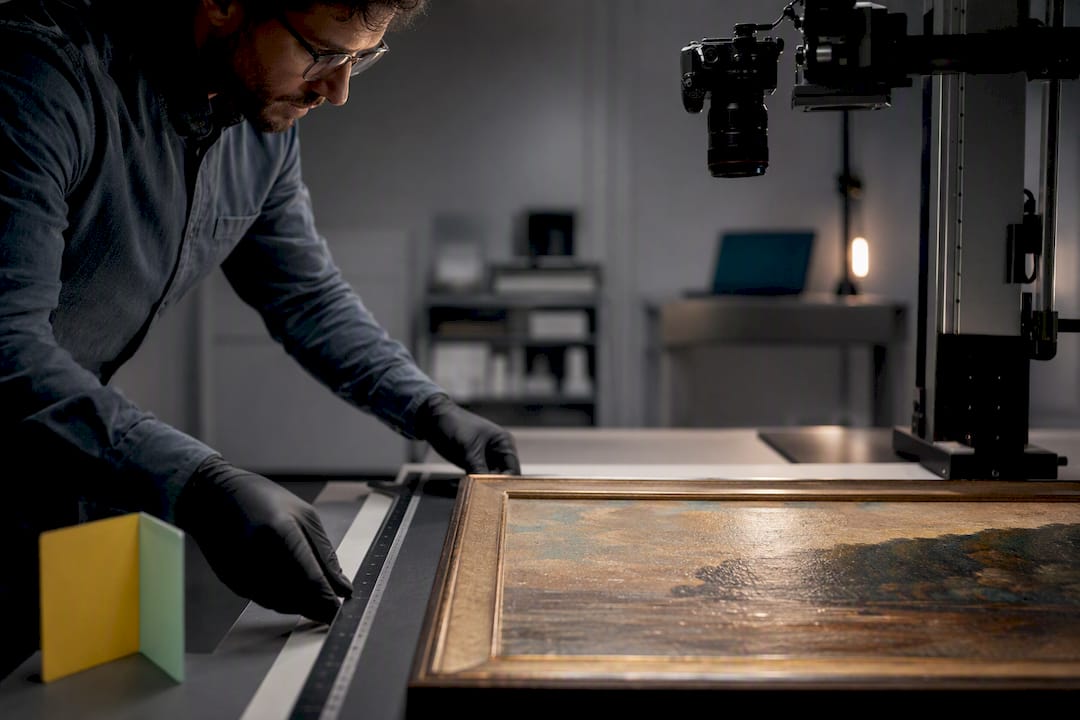
Photograph requirements scale with value. For lower-value items, a clear image showing the front of the piece is usually sufficient. For works appraised near or above the $50,000 mark, AAS guidance expects photographs in specific formats, often covering multiple angles, signature details, and any condition issues visible on the surface. A donor photographing a canvas with a phone camera under uneven lighting is taking on unnecessary risk when a properly photographed inventory image would hold up far better if AAS asks for a resubmission.
The valuation effective date matters more than most donors realize. It should reflect the fair market value as of the contribution date, not the date the appraiser happens to write the report. A gap of several months between the two, without explanation, is exactly the kind of inconsistency that draws IRS attention during an examination.
Who Qualifies as an Appraiser, and Why the Fee Structure Matters
The IRS defines a qualified appraiser narrowly, and the definition exists specifically to prevent inflated valuations from friendly or financially motivated sources. An appraiser needs verifiable education and experience in valuing the type of property being appraised, a regular practice of performing appraisals for a fee, and no disqualifying relationship to the donor or the receiving charity.
An appraiser generally needs to demonstrate:
- Formal education or training in appraising the specific category of art or object involved.
- A track record of appraisals performed regularly, not as an occasional favor.
- Credentials from a recognized body such as the American Society of Appraisers (ASA), the Appraisers Association of America (AAA), or the International Society of Appraisers (ISA).
- Demonstrated USPAP compliance, typically shown through continuing education records and adherence statements within the report itself.
- No financial stake in the outcome of the appraisal beyond the flat or hourly fee charged for the work.
- Independence from the donee organization. The appraiser cannot be the museum’s own curator valuing a piece it is about to receive, for instance, without raising an obvious conflict.
Fee structure is where donors most often trip up without realizing it. The IRS explicitly disallows appraisals where the appraiser’s fee is calculated as a percentage of the claimed value, because that arrangement creates a direct financial incentive to inflate the number. Publication 526 confirms that appraisal fees themselves are not deductible as part of the charitable contribution, and a percentage-based fee can disqualify the appraisal entirely for tax purposes, regardless of how accurate the underlying number turns out to be.
Pro Tip: Ask every prospective appraiser for a written fee agreement before the engagement starts, and confirm in writing that the fee is flat or hourly. A verbal assurance is not documentation, and if the IRS ever questions the fee structure, you want a dated letter or invoice in your file, not a memory of a phone call.
Documenting the appraiser’s independence is just as important as documenting their credentials. If there is any prior relationship between the appraiser and the donor or donee, even something as minor as a past consulting engagement, disclose it in the appraisal itself. Silence on a disclosable relationship reads far worse under audit than a disclosed one that turns out to be immaterial.
Timing Rules, Form 8283, and Filing Mechanics
The 60-day rule is the single most missed deadline in this entire process. Under 26 CFR 1.170A-17, the appraiser must sign and date the report no earlier than 60 days before the contribution date, and the donor must receive that appraisal before the due date of the return on which the deduction is first claimed, including any extensions. An appraisal signed eight months before the donation, or one commissioned only after the return is already filed, fails this rule regardless of how accurate the valuation turns out to be.
Filing sequence that satisfies the timing rule:
- Commission the appraisal within roughly 60 days of the planned donation date, not months in advance.
- Confirm the appraiser dates and signs the report before, or shortly after, the actual transfer.
- Receive the completed report well before your filing deadline, leaving room to review it and request corrections if needed.
- File Form 8283 with the return, attaching the full appraisal if the claimed value is $20,000 or more.
- If you request a filing extension, the same 60-day and pre-filing rules still apply relative to the extended due date.
Form 8283 itself splits into two sections, and mixing them up is a common error. Section A covers noncash donations valued at $5,000 or less and requires no appraisal. Section B applies once you cross that threshold, and it asks for the donee’s acknowledgment signature, the appraiser’s signature and identifying number, and a summary of the appraisal’s key findings. The instructions for Form 8283 also require a separate form for each item or donee when the value rules trigger that treatment, so a donor giving three separate paintings to two different institutions may need multiple forms rather than one consolidated filing.
| Claimed Value | Appraisal Required | Form 8283 Section | Attach Full Appraisal |
|---|---|---|---|
| $5,000 or less | No | Section A | No |
| Over $5,000, under $20,000 | Yes | Section B | No, retain in files |
| $20,000 or more | Yes | Section B | Yes |
| $50,000 or more | Yes | Section B | Yes, plus SOV option |
If your circumstances change after filing, such as new information about the artist’s authentication status or an amended appraisal from the same expert, you generally need to file an amended return along with a corrected Form 8283 and an explanation of what changed. Waiting for an audit notice to correct a known error rarely goes well; a proactive amendment, filed with clear documentation of why the value shifted, is the more defensible path.
Statement of Value: High-Value Donations and AAS Review
Donations appraised at $50,000 or more sit in a different category entirely, because the IRS offers a mechanism to resolve valuation questions before you ever file a return. The Statement of Value (SOV), authorized under Revenue Procedure 96-15, lets a donor submit the appraisal to the IRS Art Appraisal Services unit for advance review, in exchange for a user fee, and receive a binding determination of value that both sides can rely on.
- Submit the request before filing. The SOV process only works as a pre-filing tool. Once the return is filed and the deduction claimed, the advance review option is no longer available for that donation.
- Expect close scrutiny of object identification. AAS reviews photographs, provenance documentation, and comparable sales data with a level of detail most appraisers do not encounter in private-market work. A preferred object identification format exists specifically to standardize what AAS expects to see, and appraisals that follow it move through review faster.
- Budget for the user fee and processing time. The fee schedule and expected turnaround are published with each SOV request cycle, and donors should plan their filing timeline around that processing window rather than assuming a quick turnaround.
- Respond promptly if AAS requests more information. A common outcome is a follow-up request for additional photographs, a missing catalogue raisonné citation, or clarification of a comparable sale. Treat this as routine, not alarming, and respond within the window AAS provides.
- Weigh the fee against the certainty it buys. For a single high-value work with a genuinely uncertain valuation, the SOV fee is often worth paying simply to eliminate the risk of a contested deduction years later during an examination.
The Art Appraisal Services unit and the Art Advisory Panel it supports exist because art valuation resists the kind of formulaic approach that works for publicly traded securities or standardized real estate. Two qualified appraisers can reach different numbers for the same painting, and the SOV process gives donors a way to test their valuation against IRS reviewers before the number becomes a line item an examiner might challenge two or three years later.
Documentation Checklist and Records to Keep
The single best predictor of how an art donation survives IRS review is not the quality of the appraisal alone. It is whether the donor kept everything else that supports it, in a form that can be produced quickly if requested.
Assemble and retain, at minimum: see the Tax Appointment Checklist for Individuals and Small Businesses to ensure you gather all necessary documentation securely.
- The signed Form 8283, with donee acknowledgment and appraiser signature.
- The complete qualified appraisal report, not just the summary that goes on the form.
- Photographs matching the format expectations for the object’s value tier.
- Provenance and acquisition records, including the original purchase invoice or gift documentation showing how and when you acquired the piece.
- Correspondence with the appraiser and the donee organization, especially anything discussing valuation, condition, or authentication.
- Records of the original acquisition cost, which matters if the IRS questions the relationship between purchase price and claimed fair market value years later.
Retain these records for at least the length of the standard statute of limitations on the return, generally three years, though many advisors recommend keeping art donation files for six years or longer given how long valuation disputes can take to surface. Keep both digital and physical backups; a single hard drive failure should never be the reason a decade-old donation record disappears.
Pro Tip: Separate what you attach to the return from what you keep in your own file. The IRS only needs the appraisal attached once you cross $20,000. Everything else, correspondence, extra photographs, prior valuation history, stays in your records and only comes out if requested. Sending more than required rarely helps and can invite questions you didn’t need to answer.
Partial-interest and fractional gifts of art carry an added documentation burden worth flagging here. When a donor gives a percentage interest in a work rather than the whole piece, the appraisal needs to address the value of that fractional interest specifically, not simply prorate the full-object value, and subsequent gifts of additional fractions require their own updated appraisals tied to the value at each transfer date.
A Practical Workflow for an Appraisal-Ready Donation
Most donation problems trace back to sequencing, not ignorance of the rules. Donors often contact an appraiser too late, gather photographs after the report is already drafted, or approach the receiving institution only after the valuation is finalized, and end up scrambling to reconcile mismatched dates and details.
A workflow that keeps every deadline aligned:
- 60 to 75 days before the planned donation, contact the receiving institution to confirm acceptance and get any donee-specific documentation requirements in writing.
- Simultaneously, engage a qualified appraiser with relevant category experience, and confirm a flat or hourly fee arrangement in writing before work begins.
- Within the following two weeks, gather and organize object records: provenance documents, prior sale receipts, exhibition history, and any catalogue raisonné citations.
- Photograph the piece to the resolution and angle standards AAS expects for its value tier, well before the appraiser’s site visit if possible.
- Let the appraiser complete the report, signed no earlier than 60 days before the contribution date, and review it for consistency against your own provenance records before the donation transfers.
- Complete the donation and secure donee acknowledgment promptly, since Form 8283 requires that signature.
- File Form 8283 with the return, attaching the full appraisal if the value is $20,000 or more, well ahead of the deadline rather than at the last moment.
Packaging photographs, provenance, and comparables coherently is where a lot of donors lose time they don’t need to lose. An art management system built around documentation can centralize object records, generate the object-identification detail an appraiser needs, and export a clean PDF that mirrors the structure AAS prefers to review, rather than a donor reconstructing acquisition history from scattered emails and old invoices the week before a filing deadline.
Escalate to tax counsel or the donee’s acceptance committee when:
- The claimed value approaches or exceeds $50,000 and an SOV request is under consideration.
- Authentication or attribution is disputed or uncertain.
- The gift involves a fractional or partial interest, or a promised future gift structure.
- The donor’s overall estate plan includes the art collection in ways that intersect with lifetime giving strategy.
Common Mistakes That Trigger IRS Scrutiny
Most denied or delayed art donation deductions share a small set of root causes, and nearly all of them are avoidable with earlier attention to detail.
- Percentage-based appraiser fees. This single arrangement can disqualify an otherwise well-written appraisal outright, since it creates a direct incentive to inflate the number.
- Late-signed appraisals. A report signed outside the 60-day window before the contribution, or received after the filing deadline, fails the timing rule regardless of quality.
- Thin comparables. An appraisal that asserts a value without naming specific comparable sales and explaining the adjustments made reads as an opinion, not a defensible valuation.
- Gaps in provenance. Missing acquisition records or an unexplained ownership gap invites questions about authenticity that can undermine the entire valuation.
- Photographs that don’t meet AAS expectations. For higher-value works, submitting casual images instead of the formats AAS prefers routinely leads to delayed processing or a request for resubmission.
- Inconsistent dates. A valuation effective date that doesn’t align with the actual contribution date, without explanation, is an easy flag for an examiner to catch.
Mitigations worth building into every donation over $20,000:
- Get a second, independent opinion on valuation when the number feels aggressive relative to recent market activity.
- When uncertain whether to attach the full appraisal, attach it anyway. Over-disclosure rarely causes problems; under-disclosure often does.
- Keep dated correspondence with the appraiser and the donee at every stage, since a documented timeline is your best defense if the sequence of events is ever questioned.
For estate and gift tax purposes, the same qualified appraisal standard generally applies when art is transferred by bequest or as a lifetime gift outside the charitable context, though the valuation date and the identity of the qualified appraiser may differ from a straightforward charitable donation. Advisors coordinating a donor’s broader estate plan should treat the art appraisal as one component of a larger valuation strategy, not an isolated tax form, particularly when a collection includes pieces the donor may eventually will to heirs rather than donate outright.
How Advisors Should Sequence an Art Donation
The biggest planning mistake is treating appraisal and documentation as something to handle after the donation decision is made. Sequence matters here as much as substance.
Procure the appraisal first, before the donee acceptance conversation goes too far, so the valuation isn’t shaped by expectations already set with the institution. Documentation capture, provenance, photographs, condition notes, should happen in parallel with the appraiser’s work, not after the report is drafted, because an appraiser who receives complete records upfront produces a stronger, more specific report than one working from a donor’s incomplete recollection.
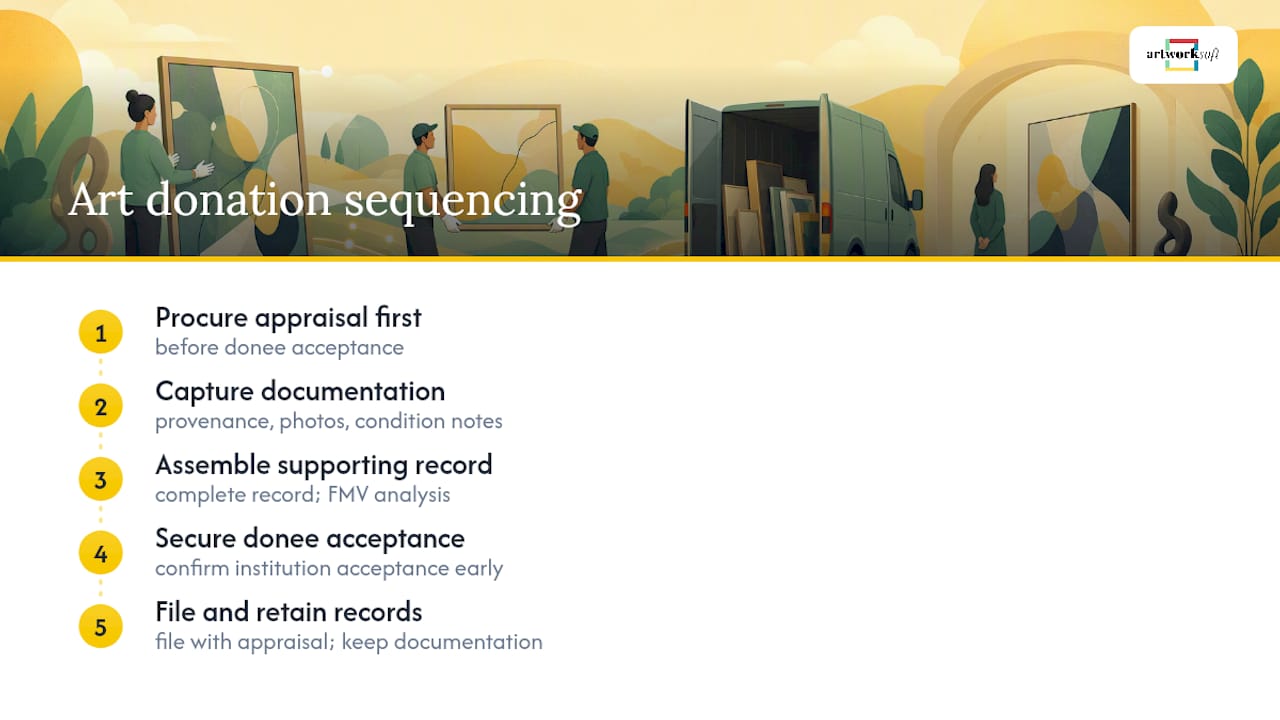
There is a real trade-off between speed and documentation completeness, and advisors should be honest with clients about it. A donor eager to close a gift before year-end sometimes wants to skip straight to filing, but rushing the provenance and photography steps is exactly what produces the thin files that struggle under later review. A few extra weeks spent assembling a complete object record, using structured valuation methods and a proper fair market value analysis, is a better trade than a fast filing that leaves gaps an examiner could later exploit.
The donee acceptance step should never be an afterthought squeezed in after the appraisal is final. Museums and other institutions often have their own acceptance committee timelines, and a donor who lines up institutional acceptance early avoids the awkward situation of a completed appraisal sitting unused because the intended recipient ultimately declines the gift.
— Nealda
Prepare Documentation That Meets IRS Expectations With Artworksoft
Art management software gives donors and advisors a structured way to organize the object records an appraisal actually requires, instead of reconstructing provenance and condition history from scattered files right before a filing deadline. It centralizes each artwork’s object identification, image history, and provenance in one profile, so the details an appraiser needs, medium, dimensions, exhibition history, prior ownership, are already assembled rather than assembled under time pressure.

High-resolution image storage means the photographs an appraiser or an AAS review might request are already captured and organized by piece, not buried in a phone’s camera roll. Exportable PDF reports, including certificates, condition reports, and valuation summaries, mirror much of the descriptive detail that a qualified appraisal report needs to include, which cuts down the back-and-forth between donor, appraiser, and the receiving institution.
None of this replaces a qualified appraiser or the appraisal itself. It reduces the administrative friction around producing the supporting file a strong appraisal, and a clean IRS filing, depends on. Advisors managing multiple donations across a collection, or a gallery preparing documentation for several donors at once, can start with a free plan and see how a centralized art documentation workflow fits into an existing appraisal and filing process.
Where to Verify These Art Donation Appraisal Rules Directly
Every rule discussed in this guide traces back to a small set of official sources, and it’s worth going to them directly for the exact current-year language before filing.
- Instructions for Form 8283 — the authoritative reference for completing Sections A and B, including per-item and per-donee filing rules.
- Publication 561, Determining the Value of Donated Property — the primary explanatory guidance on thresholds, attachment rules, and the Statement of Value process.
- Art Appraisal Services — the IRS unit that reviews high-value art appraisals and publishes preferred documentation formats.
- 26 CFR 1.170A-17 — the regulation defining a qualified appraisal and the 60-day signing rule.
- Form 8283 itself, for the appraisal summary format the IRS expects attached to your return.
To request a Statement of Value, submit the request to the IRS before filing your return, referencing Revenue Procedure 96-15 and the current user-fee schedule published alongside AAS guidance.
Sources
- Instructions for Form 8283 (12/2025)
- Publication 561 (12/2025), Determining the Value of Donated Property
- Art appraisal services | Internal Revenue Service
- 26 CFR 1.170A-17 (Qualified appraisal rules)