

To file a successful art insurance claim, you need five things: dated, high-resolution photographs, proof of ownership or provenance, purchase receipts or invoices, a condition report, and a formal appraisal when your policy or insurer requires one. Insurers use these documents to confirm what you own, what it is worth, and what condition it was in before a loss. The immediate step is simple: create a dated inventory entry for each work today and store a copy off-site.
TL;DR:
- Insurers often require detailed inventory records, including artist details, provenance, and insured values, to process claims efficiently.
- High-quality photographs should include full views, signatures, damage, and packaging, labeled and stored separately from the artwork.
- Formal appraisals are necessary for items exceeding around $250,000, with reappraisals every three to five years or after major market changes.
- Documentation must be stored off-site and backed up digitally to protect against physical loss of records and artwork.
- Using an integrated art management system helps streamline record-keeping, generates claim-ready documents, and ensures compliance with insurer requirements.
Table of Contents
- Complete inventory checklist: the exact documents to collect for each work
- How to photograph art for insurance claims
- Valuation and appraisals: thresholds, frequency, and proof of value
- Provenance and proof of ownership: gathering the paper trail
- Storing and backing up documentation safely
- Preparing documentation for a claim: the packet and common pitfalls
- A practical workflow example for insurer-ready records
- Updating documentation after restoration or condition changes
- Legal considerations and compliance for art documentation
- Documenting artwork on exhibition or loan to a gallery or museum
- Documenting multi-artist collections and series
- Making documentation an easy habit
- How Artworksoft supports your documentation checklist
- Where to check insurer-specific rules and photo specs
- Sources
- FAQ
Complete inventory checklist: the exact documents to collect for each work
An insurer-grade inventory record is built one field at a time, and missing fields are the most common reason claims stall. Each artwork needs its own entry, whether you manage five pieces or five hundred.
Start with the identifying details that distinguish one work from every other:
- Artist name, title, and creation date, recorded exactly as they appear on labels or certificates.
- Medium and dimensions, including framed and unframed measurements for two-dimensional works.
- Edition or serial number, for prints, photographs, or multiples.
- A unique object ID, so the record, photos, and physical piece stay linked.
Transaction records prove what you paid and where the work came from. Attach the original receipt, gallery invoice, auction lot documentation, or bill of sale to each entry. For inherited or gifted works, attach the estate paperwork or gift letter instead.
Provenance and authenticity documents belong in the same record. Store original certificates of authenticity, prior ownership records, and exhibition history in a secure location, and keep scanned copies attached to the digital entry. Never rely on a single physical copy stored with the artwork itself.
Finally, note the insurance status of each piece:
- Record whether the item falls under a scheduled policy (individually listed with its own insured value) or a blanket policy (covered as part of a collection total).
- Log the current insured value and the date it was last updated.
- Note the insurer name and policy number tied to that value.
This structure turns a loose folder of paperwork into a system an adjuster can review in minutes rather than days. The University of Texas at Austin’s fine arts insurance guidance recommends storing this documentation separate from the artwork itself, since a fire or flood that damages the piece can just as easily destroy paper records kept in the same room.
How to photograph art for insurance claims
Photographs carry more weight in a claim than most collectors expect, and the IRS Publication 5497 photographic requirements set a useful bar even outside tax contexts: appraisal reviewers require professional-quality color photographs or high-resolution digital images, and they explicitly reject blurry, dark, or partial views.
A complete photo set for each work includes:
- A full-frontal shot capturing the entire piece with even lighting.
- A scale reference shot, with a ruler or object of known size in frame.
- Multiple angles, especially for sculpture, ceramics, or any three-dimensional work.
- Close-ups of signatures, labels, and edition markings on the front and back.
- Damage close-ups, if any pre-existing condition issues exist.
- Packaging and crating photos, showing how the piece is protected in transit.
For flat work, diffuse the light source to avoid glare and shadow on the surface. For dimensional pieces, photograph from at least four angles plus the base or underside, where maker’s marks often appear. According to Chubb’s guide to insuring fine and decorative art, missing or poor-quality photographs are a common cause of delayed appraisal and claims processing, particularly when detail shots of signatures or damage are absent.
Label every file with the object ID before it leaves your camera or phone, and preserve the metadata (date, location, device) rather than stripping it during editing. Once labeled, attach each photo set directly to the corresponding inventory record so nothing gets separated during a move or a claim.
Pro Tip: Photograph every piece again after any conservation work, exhibition loan, or shipment, since a fresh, dated image set is the clearest evidence of condition at a specific point in time.
Valuation and appraisals: thresholds, frequency, and proof of value
Not every artwork needs a formal appraisal to be insured, but every artwork needs a defensible value. According to Chubb’s fine art insurance guidance, some insurers accept a detailed description and estimated value in place of a formal appraisal for items below a high threshold, often cited around $250,000, though this varies by insurer and by policy.
Above that threshold, or whenever a policy calls for it, a formal appraisal becomes the backbone of your valuation record. A useful appraisal report includes:
- The appraiser’s credentials and professional affiliations.
- Comparable sales used to support the stated value.
- A clear valuation rationale, explaining how the appraiser reached the figure.
- The effective date of the valuation and its intended purpose (insurance, estate, resale).
Appraisals are not permanent documents. Reappraisal every three to five years is a common recommendation, and certain events should trigger an earlier update: a significant shift in the artist’s market, the artist’s death, a major recent sale of comparable work, or restoration that changes the piece’s condition or completeness.
Two value types matter for insurance purposes, and confusing them is a frequent source of underinsurance. Fair market value reflects what a willing buyer would pay a willing seller. Replacement value reflects what it would cost to replace the piece, which for a unique work can mean commissioning a comparable piece or covering the cost of the closest available substitute. Declare the value your policy actually insures against, not simply the number on your last invoice, and update that declared value each time you reappraise.
Provenance and proof of ownership: gathering the paper trail
Provenance does two jobs at once: it proves the work is yours, and it supports the value you are claiming. Insurers and appraisers look for a continuous chain of ownership records, including original purchase receipts, auction records, transfer or gift documents, and estate paperwork where relevant.
A certificate of authenticity carries weight only when it comes from a credible source, typically the artist, a recognized gallery, or a qualified authentication expert. A certificate alone, without supporting sale records, rarely satisfies an insurer reviewing a high-value claim.
Gaps in provenance happen, particularly with older works or pieces acquired informally. When a full paper trail is not available, a few steps can still build a credible record:
- A sworn statement from the current owner describing acquisition circumstances.
- Written confirmation from a gallery or dealer involved in a past sale.
- An expert letter addressing attribution or history when authenticity is in question.
Solid provenance also protects against ownership disputes during a claim, which can otherwise delay or complicate settlement even when the loss itself is straightforward.
Storing and backing up documentation safely
Documentation that survives only in one place is documentation that can disappear in the same fire, flood, or theft that damages the artwork. Guidance from the University of Texas at Austin recommends storing records off-site and separate from the physical collection for exactly this reason.
A practical routine looks like this:
- Keep original physical documents (receipts, certificates) in a bank safe-deposit box or a third-party archival service.
- Maintain an encrypted digital archive with automatic backups, separate from the device that holds your working files.
- Use a consistent file-naming structure tied to each object ID, so photos, receipts, and reports for one piece stay grouped together.
- Review and refresh backups on a set schedule, at minimum annually, and preserve original timestamps and metadata rather than overwriting them.
For movement and loans, keep a running chain-of-custody log: date, handler, origin, destination, and condition notes at each transfer point.
Pro Tip: Store one full backup of your inventory records somewhere entirely outside your home or gallery, whether a cloud service, a relative’s address, or a safe-deposit box, so a single disaster cannot take out both the art and the paperwork that proves what it was.
Preparing documentation for a claim: the packet and common pitfalls
The sequence of steps after a loss affects how smoothly the claim moves. According to the Hanover Insurance Group’s guidance on insuring fine art, a concise packet assembled in advance, inventory sheet, labeled photos, proof of purchase, condition report, and appraisal, is usually the first thing an insurer requests.
Immediately after a loss:
- Secure remaining pieces and, if theft or fire is involved, file a police or fire department report.
- Photograph the damage before any cleanup or restoration begins.
- Notify your insurer promptly and reference the object ID for each affected piece.
- Assemble the initial packet: inventory record, photographs (pre-loss and post-loss), proof of purchase, condition report, and appraisal if one exists.
Insurers may request supplemental items later, such as conservator estimates for repair or updated market comparables. The most common pitfalls are inconsistent descriptions between documents, provenance gaps discovered only after a claim is filed, and appraisals that were never updated after a major market shift. Each of these can slow settlement or reduce the payout.
One detail worth building into your routine: many policies include temporary automatic coverage for newly acquired works, often around 90 days according to Chubb, but that window closes fast, and documentation for a new piece should not wait until the coverage question becomes urgent.
A practical workflow example for insurer-ready records
An art management system earns its place in this process only if it produces documents an insurer will actually accept. Look for a tool that attaches high-resolution images directly to each item record, generates certificates of authenticity and reports as PDFs, logs movement and location history, and stores valuation notes alongside the item.
A typical workflow looks like this: create the artwork record with full metadata, attach the photo set and purchase receipt, add provenance entries as they become available, then export a single insurer-ready packet covering the item, its images, and its documentation history.
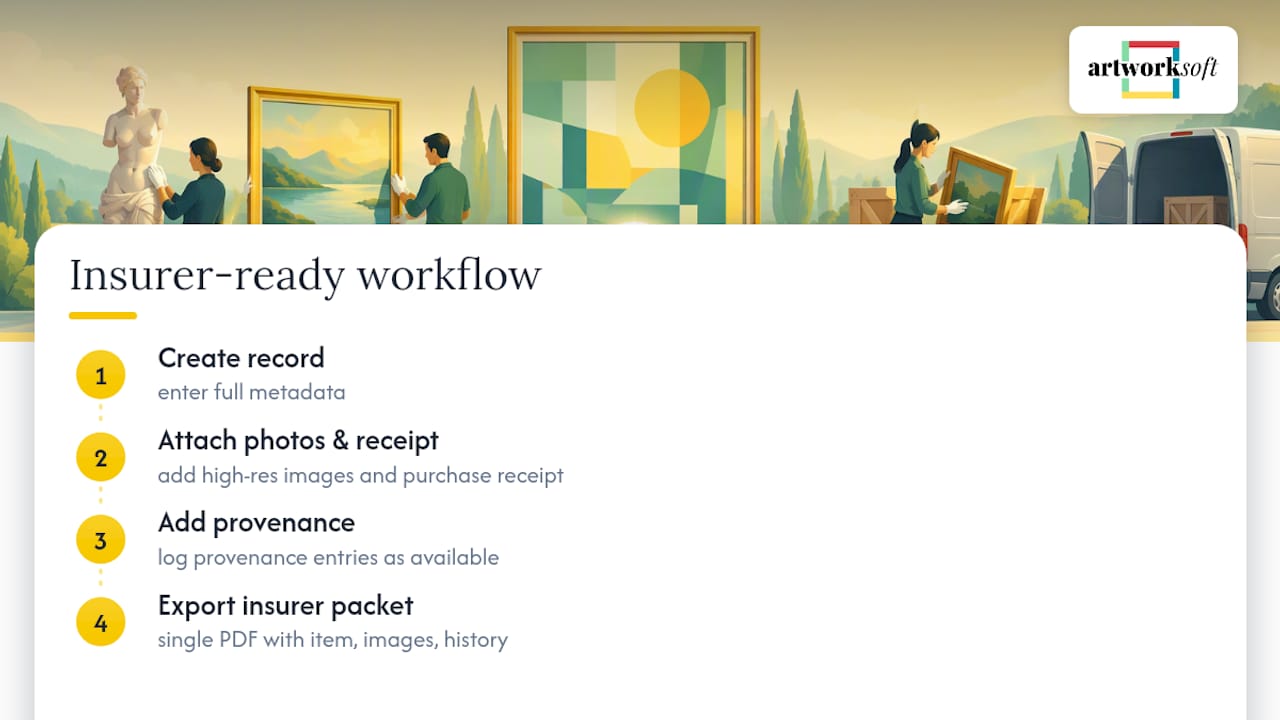
This structure supports an art management system that connects artwork records, locations, and transactions in one system, uses a structured valuation formula to remove guesswork from pricing, and generates professional documentation including certificates of authenticity. This allows collectors and galleries to track artwork movement and keep documentation attached to each piece rather than scattered across folders.
Before relying on any exported packet for a real claim, confirm the file formats with your insurer. Requirements differ, and a quick check avoids a scramble during an active claim.
Updating documentation after restoration or condition changes
Restoration changes a work’s condition record, and the documentation needs to change with it. Once conservation work is complete, add a new condition report describing what was repaired, the materials or techniques used, and the conservator’s assessment of the current state, ideally with a signed statement from the conservator.
Photograph the piece again after treatment, using the same shot list as the original inventory photos: full frontal, detail shots, and any areas that were treated. Keep the pre-restoration and post-restoration records side by side rather than replacing one with the other, since insurers and future appraisers benefit from seeing the full history.
Restoration can also affect value, upward if it stabilizes a deteriorating piece, or downward if the market discounts restored works in that artist’s category. Flag the item for reappraisal rather than assuming the prior valuation still holds. The same logic applies to any physical change: reframing, remounting, or structural repairs to a sculpture all belong in the updated record, dated and attached to the object’s file.
Legal considerations and compliance for art documentation
Ownership documentation does more than support an insurance claim. It establishes legal title, which matters for resale, inheritance, and disputes over authenticity or provenance. Keep every transfer document, whether a bill of sale, gift letter, or estate distribution record, in a form that would hold up if ownership were ever formally challenged.
Cross-border shipments and international loans can introduce additional requirements, including customs documentation and, for certain materials or origins, cultural property or export considerations. These rules vary by jurisdiction and by the specific material involved, so a work with uncertain export history or materials like ivory or protected woods warrants a conversation with a specialist before it travels.
Insurance policies themselves are legal contracts, and the declared value you provide becomes part of that contract. Misrepresenting value, condition, or ownership history, even unintentionally, can complicate or void a claim. When documentation is incomplete or an item’s legal status is unclear, a sworn statement or a specialist’s written opinion is a reasonable interim step, but it does not substitute for resolving the underlying gap where possible.
Documenting artwork on exhibition or loan to a gallery or museum
Loans introduce a period where the artwork leaves your direct control, and documentation needs to account for that gap. Before a piece leaves, complete a full condition report and photograph set, since this becomes the baseline for comparison when the work returns.
A loan agreement should specify who insures the work during transit and while on display, since institutions typically carry their own coverage but the terms vary. Confirm this in writing rather than assuming, and keep a copy of the borrowing institution’s certificate of insurance with the item’s record.
Chain-of-custody documentation matters here as much as it does for shipping. Log the date the piece left your possession, who received it, the transport method, and the condition at handoff. When the work returns, complete a new condition report and compare it directly against the pre-loan version. Any discrepancy should be raised immediately, while the loan details are still fresh and the borrowing institution’s records are still accessible.
Documenting multi-artist collections and series
Collections spanning multiple artists, or single series with multiple related works, need documentation that keeps each piece distinct while preserving the relationships between them. A shared series title or exhibition history should not blur into a single combined record.
A workable checklist for this scenario:
- Give each work its own object ID, even when several pieces share a title or series name.
- Record the series name and sequence number as a field on each individual entry, not as a separate combined record.
- Attach artist-specific provenance and certificates to each piece, since authentication standards and market comparables differ by artist even within the same collection.
- Note any shared acquisition details (a single bulk purchase, for example) on each affected item’s record, so the transaction history stays traceable to every piece it covers.
This structure keeps a claim involving one piece from becoming entangled with the rest of the series, and it keeps valuation accurate when different artists in the same collection have different market trajectories.
Making documentation an easy habit
The collectors who avoid claim disputes are rarely the ones with the most expensive collections. They are the ones who treat documentation as a habit, not a project. Inventory a new acquisition within seven days of purchase, while receipts and gallery paperwork are still easy to find.
Three habits prevent most problems: a monthly review of photo records for new damage, an annual date marked for appraisal review, and a standing reminder to confirm the off-site backup is current. None of these takes long, and each one closes a gap that tends to surface only after a loss has already happened.
— Nealda
How Artworksoft supports your documentation checklist
Building the documentation set described above by hand, spreadsheets, scanned receipts, folders of photos, is workable for a handful of pieces and unmanageable past that. Artworksoft was built to hold this checklist in one connected system rather than several disconnected ones.

The platform’s structure maps directly onto insurer needs:
- Item records that hold metadata, images, and transaction history in one place.
- PDF export for certificates of authenticity and other documentation, generated directly from the record.
- Movement and location tracking, which doubles as a chain-of-custody log for loans and shipments.
- A structured valuation formula, giving collectors and galleries a consistent basis for declared value instead of ad hoc estimates.
A practical starting task: import your ten highest-value pieces, attach photos and receipts to each, and export a sample packet to see how the documentation holds together. The Free Plan is a reasonable place to begin that test, and the Provenance Plan, from $5 per month, adds capacity for larger collections. Galleries and collectors who want help setting the system up can use the Onboarding & Collection Management Service rather than building the structure alone.
Whichever system you use, confirm the exported document formats with your insurer before treating them as claim-ready.
Where to check insurer-specific rules and photo specs
- IRS Publication 5497: photographic specifications for appraisal review.
- Chubb fine art insurance: coverage thresholds and appraisal guidance.
- Union Fine Art Services: declared-value documentation requirements.
- Hanover Insurance Group: fine art coverage basics and claim packet guidance.
Sources
- Photographic Requirements for Art, Antiques, Decorative Arts & Other Cultural Properties Reviewed by Art Appraisal Services and The Commissioner’s Art Advisory Panel
- Documentation For Declared-Value Art Insurance Policies – UNION
- How do I insure fine art? | The Hanover Insurance Group
- 19.1.4 Fine Arts Insurance | Accounting and Financial Management (AFM), UT Austin
FAQ
What is an example of art documentation?
A complete example includes a dated full-frontal photograph, a signed condition report, the original purchase receipt or gallery invoice, and a certificate of authenticity, all attached to a single inventory record with a unique object ID. Together these establish what the piece is, what it cost, and what condition it was in.
Can you provide some examples of insurance documents?
Common insurance documents for art include the policy schedule listing insured items and values, a formal appraisal report, condition reports, and, for shipped works, bills of lading and certificates of insurance covering transit. Declared-value policies typically require several of these together to substantiate the insured amount, according to Union Fine Art Services.
What documents are required for insurance?
At minimum, insurers expect proof of ownership, dated photographs, a condition report, and a purchase receipt or invoice for each piece. A formal appraisal becomes necessary above certain value thresholds or when a policy specifically requires one for high-value items.
What is the 70/30 rule in art?
There is no universally recognized rule by that name in art insurance or valuation documentation. If you encountered this term in a specific context, it likely refers to a niche or informal guideline rather than a standard insurer or appraisal practice, and it is worth confirming the source directly.











