Number a limited-edition artwork as n/N, for example 24/100: the first figure identifies the specific impression, the second states the total authorized edition. Artist’s proofs and other proof types are recorded separately and do not count toward that total. Every fraction, proof count, and provenance detail should be logged at the time of creation, since that record becomes the foundation for later authentication and valuation.
TL;DR:
- Limited editions are numbered with a fraction indicating their position in the run and the total, but the number itself does not impact value significantly.
- Artist’s proofs are typically limited to about 10% of the edition size and recorded separately from the numbered run.
- Edition size, condition, provenance, and artist demand are the main factors influencing long-term value, not the specific placement within the edition.
- Proper inscription placement and detailed recordkeeping of proofs, signatures, and provenance are essential to maintain authenticity and prevent future disputes.
- Posthumous editions require clear notation and documentation of authorization by the artist’s estate to verify legitimacy and market value.
Table of Contents
- How edition fractions and format variants work
- Proof types and reasonable limits
- Where and how to inscribe numbers and signatures
- Building a documentation and provenance checklist
- What actually drives value: edition size versus edition number
- Common mistakes that damage provenance
- How Artworksoft supports edition-based recordkeeping
- Legal standards that protect against edition fraud
- Numbering posthumous and estate-authorized editions
- Numbering variations within the same edition
- Numbering sculptural editions and other non-flat works
- A practical note on adopting the discipline
- Getting started with consistent edition tracking
- Sources
- FAQ
How edition fractions and format variants work
An edition fraction follows a fixed order: the numerator marks where a given piece falls in the production sequence, and the denominator states the total number of authorized examples. In an edition of 100, the twenty-fourth impression produced is marked 24/100. The number does not necessarily reflect the order in which pieces were printed or cast, since many editions are numbered after the full run is complete.
Some works carry no fraction at all. A unique piece is marked 1/1, signaling that only one example exists and no further copies are authorized. Open editions, by contrast, carry no number because the publisher has not capped the total, which is why unnumbered prints are generally valued differently from limited runs.
What limits an edition varies by medium:
- Prints are often limited by the artist’s decision or the physical wear of a plate, stone, or screen.
- Photographs are limited by publisher or artist choice, since digital and most photographic processes impose no natural cap.
- Sculptures and cast multiples are limited contractually, with the mold or master retained or destroyed once the run closes.
- Mixed-media or hybrid works follow whichever component medium sets the practical constraint.
Because the reasoning behind a cap differs by medium, the edition record should note not just the fraction but why that particular total was set.
Proof types and reasonable limits
Proofs sit outside the numbered edition but still need clear labels and defined limits so they do not distort how large the run actually looks to a buyer.
- Artist’s proof (AP): retained by or for the artist, separate from the numbered run and typically limited to around 10% of the total edition size.
- Printer’s proof (PP): set aside for the printer as compensation or reference, kept to a small, fixed count.
- Bon à tirer (BAT): the single proof approved by the artist as the standard the edition must match, with only one BAT typically produced and retained by the printer as a control copy.
- Trial proof (TP): produced during testing, before the image or process is finalized.
- State proof (SP): documents a distinct stage of the image’s development, often labeled with a state number alongside its own small edition, such as State I 1/10.
- Edition variation (EV): a piece that differs from the standard run in a defined way, such as color or substrate, while remaining part of the same overall project.
Pro Tip: Record every proof type on its own inventory line, never folded into the edition count, so a buyer or appraiser can see the true total availability at a glance.
Where and how to inscribe numbers and signatures
Placement and material matter because an inscription has to survive handling, framing, and decades of storage without smudging or damaging the work.
For works on paper, the edition number and signature typically go in pencil in the lower margin, with the number on the left, the title centered, and the signature on the right. Pencil is preferred over ink because it does not bleed, fade unevenly, or react with the paper over time. Marking directly on the image area should be avoided, since it interferes with the printed surface and reduces the piece’s presentation value.
For photographs, numbering often appears on the verso in pencil or archival ink, sometimes paired with a printed label carrying the publisher’s information. For sculpture and cast multiples, the number is usually stamped, engraved, or cast into the base rather than written, since the work has no margin and needs a mark durable enough to survive outdoor display or repeated moves.
A few conventions keep multipart works consistent:
- Multi-sheet or triptych editions should carry the same edition fraction on every panel, with a suffix noting the sheet’s position when needed.
- Sculptural editions typically include a foundry mark alongside the number to confirm where the cast originated.
- Any deviation from the standard inscription location for a given medium should be noted in the object’s record, since it can otherwise look like an inconsistency during resale.
Building a documentation and provenance checklist
A number inscribed on the work only carries weight when it is backed by a matching record. Galleries and artists should treat the following as the minimum fields to capture for every editioned piece:
- Edition fraction and total edition size (N)
- Proof notation and count, recorded separately from the edition fraction
- Artist signature, title, and date of creation
- Dimensions and materials
- Printer or publisher information
- Certificate of authenticity details, including issue date and issuer
- Provenance entries documenting each change of ownership
- A stable object ID that ties the physical piece to its digital record
Turning that list into a workflow means scanning the certificate of authenticity, photographing the inscribed margin or verso label, and assigning an object ID that ties the physical piece to its digital record that never changes even if the piece moves between owners. Guidance on numbering formats and ID structure can help standardize this across a growing collection, and a provenance research process helps verify ownership history before it is entered into the record.
Retention matters as much as capture. A PDF certificate of authenticity, an exportable inventory report, and a physical label copy kept with the object all reduce the risk of a mismatch surfacing years later during a sale or loan. Consistent photographing of inscriptions at the time of acquisition makes that later verification far faster.
What actually drives value: edition size versus edition number
Edition size sets the ceiling on scarcity, and a smaller total generally draws more collector interest than a larger one. An edition of 25 is inherently less common than an edition of 500, and that gap in total supply is what most affects long-term demand.
A widely repeated myth doesn’t hold up: auction market guidance states that a piece’s position within the run, such as 5/100 versus 95/100, does not by itself command a higher price. Value tends to follow edition size, condition, provenance, and demand for the artist, not the specific number printed on the sheet.
Proofs follow the same logic. An artist’s proof is not automatically worth more than a numbered impression; its appeal depends on documented rarity and provenance, not on the AP designation alone.
Common mistakes that damage provenance
Small recording errors are hard to undo once a piece has changed hands, so it pays to get the basics right the first time.
- Do not combine the edition total and proof count on the same inscription line: keep them as separate, clearly labeled entries.
- Avoid non-archival pens, adhesives, or labels on works intended to last, since these materials can degrade or bleed through paper and canvas.
- Never let a certificate of authenticity exist without a matching internal inventory record linked to the physical inscription.
- Do not renumber or alter an inscription after the fact; if an error occurred, document the correction rather than erasing the original mark.
Pro Tip: Cross-check the inscribed number against the inventory record every time a piece is photographed, packed, or transferred, since that is when transcription errors are most likely to appear.
How Artworksoft supports edition-based recordkeeping
Artworksoft centralizes the fields this checklist requires: edition fraction, proof notation, publisher or printer details, and provenance history all live against a single object record rather than scattered spreadsheets. Its valuation formula factors edition size and condition into a consistent starting point for reserve or list prices, reducing the guesswork galleries face when pricing multiple pieces from the same run. Certificates of authenticity generate directly from the recorded data, and for galleries managing larger edition projects, onboarding and ongoing collection management services help standardize inscription and recordkeeping practices from the outset.
Legal standards that protect against edition fraud
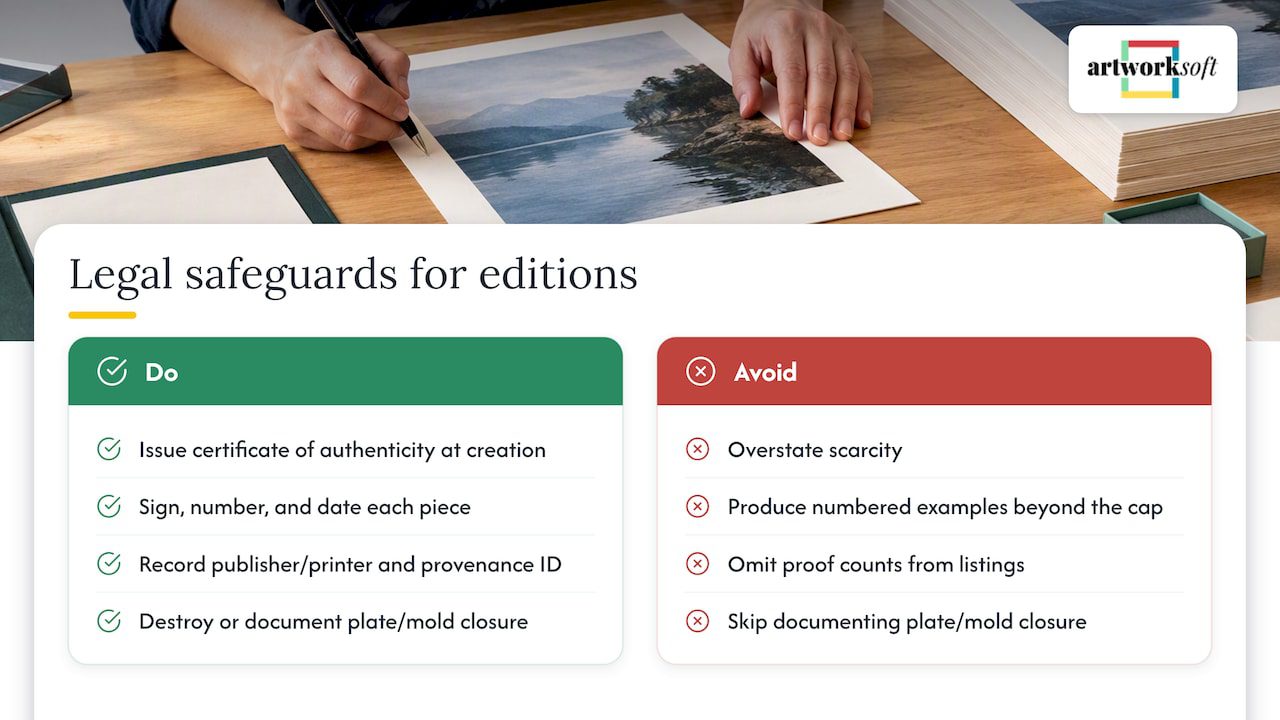
Edition numbering carries legal weight because a false or inflated edition size can constitute misrepresentation to a buyer. Standard practice in printmaking and sculpture treats the declared edition size as a binding limit: once a publisher states an edition is capped at 100, producing additional numbered examples beyond that figure undermines the authenticity of every piece already sold.
The safeguards that protect buyers and sellers rest on the same trust signals collectors already expect: a certificate of authenticity issued at the time of creation, a clear artist signature and inscription, documented publisher or printer information, and a provenance record tied to a stable object identifier. Editioned prints are usually signed, numbered, and often dated by the artist, and that combination of signature, number, and date is what distinguishes an authorized edition from an unauthorized reproduction.
Destroying the printing plate, stone, screen, or sculptural mold once an edition closes is a further safeguard, since it makes it physically impossible to produce additional unauthorized examples later. When that step is skipped or undocumented, buyers have no way to confirm the edition was actually closed at the stated number.
For sellers, the practical takeaway is to treat the edition declaration as a representation of fact, not a marketing figure. Overstating scarcity, whether by underreporting the true edition size or omitting proof counts from a listing, exposes a gallery or artist to disputes that a clear, consistent inscription and record would have prevented.
Numbering posthumous and estate-authorized editions
Editions produced or authorized after an artist’s death require a distinct notation so collectors are never left assuming a piece was numbered or signed during the artist’s lifetime. The standard approach is to mark posthumous editions clearly as such, often with a stamped signature or estate seal in place of a handwritten one, alongside a separate edition fraction that does not overlap with any edition produced while the artist was alive.
Documentation carries more weight here, not less. The record should specify who authorized the posthumous run, typically an estate, foundation, or rights holder, and cite the agreement or authority under which the edition was produced. A certificate of authenticity for a posthumous piece should state plainly that the work was produced after the artist’s death and name the authorizing party, since that distinction affects both authenticity and market value.
Where an artist left instructions for future editions, such as approved plates or molds intended for posthumous casting, the edition record should reference that authorization directly rather than assuming it. Buyers and appraisers rely on this paper trail to distinguish a legitimately authorized posthumous edition from an unauthorized reproduction made from surviving materials.
Numbering variations within the same edition
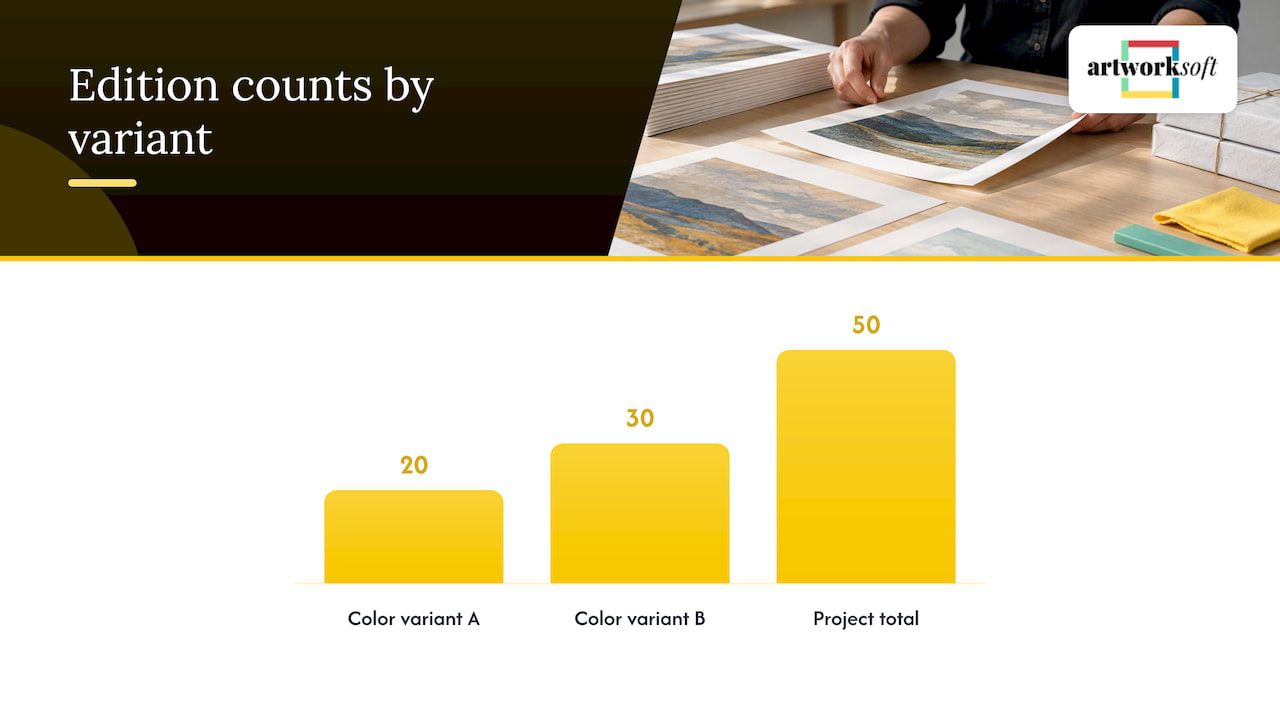
Some editions include planned variations, such as different colorways, papers, or formats, while still belonging to a single overall project. The clearest approach numbers each variation within its own sub-sequence rather than folding every variant into one undifferentiated count, since a buyer needs to know how many examples exist of the specific variation they own, not just the project as a whole.
A common convention labels the variation directly in the inscription, for example noting a color designation alongside the fraction, so the edition variation is identifiable without cross-referencing external paperwork. When variations are numbered independently, each variant’s total should be documented separately, and the sum of all variants should be recorded alongside the project’s overall total so the full scope of the edition is transparent.
Consistency across variants matters as much as the numbering itself. If one color variation is limited to 20 and another to 30 within the same project, both totals need to appear in the object record and any accompanying certificate, since a collector comparing two pieces from the same series has no way to judge relative scarcity without that information.
Numbering sculptural editions and other non-flat works
Sculptural multiples follow the same n/N logic as prints, but the physical format changes where and how that information appears. Because there is no margin to inscribe, the number is typically stamped, engraved, or cast directly into the base, often alongside a foundry mark identifying where the piece was cast. Modern editions in this category are usually signed, numbered, and often dated, following the same underlying convention used for works on paper.
For cast multiples, the mold or master remains a central provenance question: whether it was destroyed after the edition closed, and if not, who retains control of it and under what agreement. That detail belongs in the object record alongside the edition fraction, since an intact mold raises the possibility of future authorized casts that would affect existing owners’ understanding of scarcity.
Multi-part sculptural works, such as an installation produced in multiple identical units, should carry the same fraction on every component, with each unit clearly linked to the others in the inventory record. Where a sculptural edition includes variations, such as different patinas or finishes, those differences should be documented the same way variations are handled in print editions: numbered and recorded separately rather than folded into one combined total.
A practical note on adopting the discipline
Consistent numbering and complete records rarely feel urgent until a sale, loan, or appraisal stalls over a missing detail, and by then the fix costs far more time than the original inscription would have. Treating a checklist and a digital certificate of authenticity workflow as standard practice from the first piece onward is the difference between a smooth transaction and a delayed one.
— Nealda
Getting started with consistent edition tracking
Artworksoft’s Free Plan gives artists and collectors a starting point for logging edition fractions, proof counts, and provenance fields in one place rather than across scattered spreadsheets and paper files. Other plans may extend these features with fuller documentation and valuation tools for growing collections.

Galleries managing larger or ongoing edition projects can turn to Artworksoft’s onboarding and collection management services to standardize inscription practices and recordkeeping across an entire inventory. Start with the Free Plan to see how edition data, certificates, and provenance fit together in one record.
Sources
- Printmaking terms — Graphicstudio
- Curating prints — academic notes (UMBC)
- How to read an art edition — Sotheby’s
- Edition (art term) — Tate
FAQ
What does the fraction on a limited edition print mean?
The fraction shows an impression’s place in a numbered sequence over the total authorized edition size, such as 24/100. It does not necessarily reflect the order pieces were printed, since many runs are numbered after production is complete.
Does a lower edition number make an artwork worth more?
No. Market guidance from auction specialists states that position within the run, such as 5/100 versus 95/100, is generally not a primary driver of value. Edition size, condition, and provenance matter far more than which number appears on a specific piece.
How many artist’s proofs should an edition include?
Common practice limits artist’s proofs to around 10% of the total edition size. They are recorded separately from the numbered edition and should never be added into the main edition total.
How should a posthumous edition be numbered differently?
A posthumous edition should carry its own separate fraction, clearly marked as authorized after the artist’s death, often with a stamped signature rather than a handwritten one. The certificate of authenticity should name the estate or authorizing party responsible for the release.
What records should accompany a numbered edition for resale?
At minimum, keep the edition fraction, proof counts, signature, publisher or printer details, a certificate of authenticity, and a provenance history tied to a stable object ID. Platforms like Artworksoft can centralize these fields alongside COA generation for easier verification during a sale.