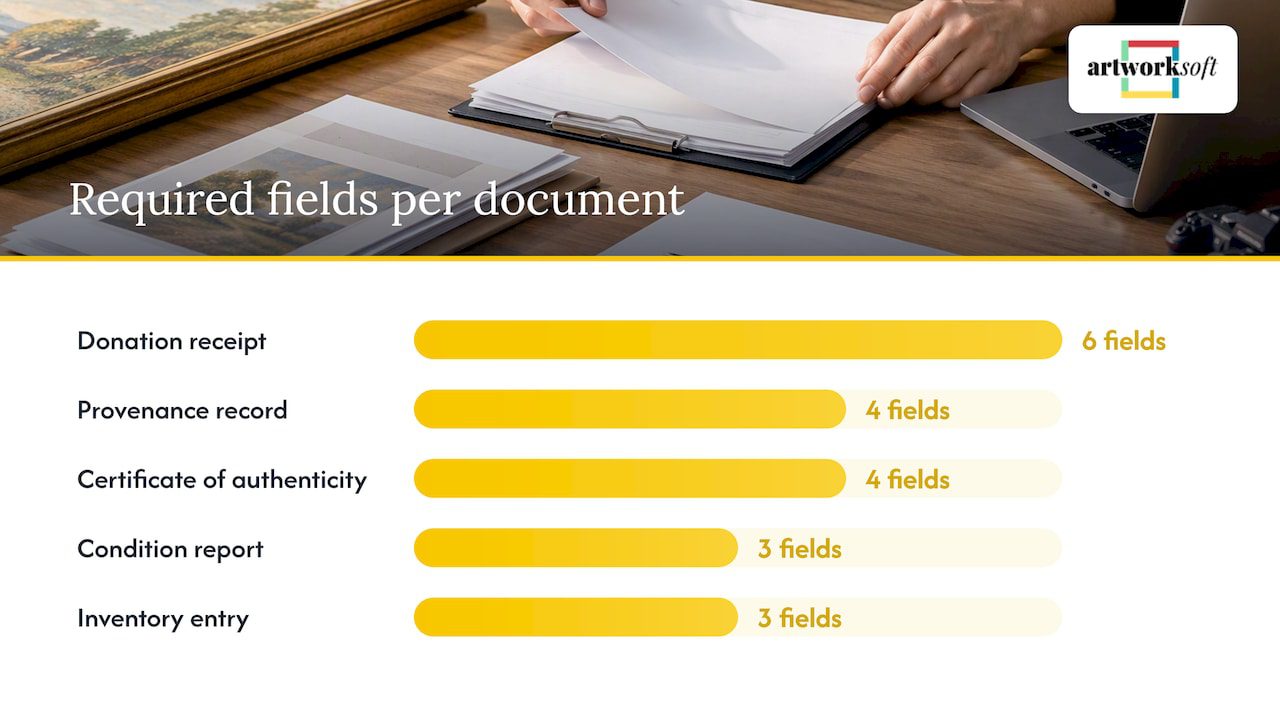
Every artwork transfer or donation needs five linked documents: a donation receipt, a provenance record, a certificate of authenticity, a condition report, and an inventory entry with a current image. We recommend storing all five together in a collection management system so they stay connected to the object record. When research is incomplete, a short limitations statement belongs in the file alongside them.
TL;DR:
- Accurate documentation must include all five key documents: donation receipt, provenance record, certificate of authenticity, condition report, and inventory entry with images.
- Provenance records should be clear, citing sources for each transfer, and include a narrative and Authority/Citation section aligned with industry standards.
- Condition reports must be thorough, linked to the object ID, and documented with photographs, inspector details, and inspection date to support future authenticity reviews.
- Certificates of authenticity need to specify the basis of opinion, include full identification details, and be signed and dated, with copies stored in the object’s file.
- Proper record retention involves indefinite storage of provenance and condition documentation as part of the object’s permanent history, separate from tax-specific appraisals.
Table of Contents
- 1. Core documents checklist for every transfer
- 2. How to structure provenance so it’s readable and defensible
- 3. Condition reporting that supports the chain of custody
- 4. Certificates and receipts built to withstand future scrutiny
- 5. Step-by-step Artworksoft workflow for building a donation dossier
- 6. Deliverable checklist and file-export template for dossiers
- 7. IRS requirements for appraisal documentation and qualified appraisers
- 8. Form 8283 completion guidelines for art donations
- 9. IRS valuation standards and acceptable evidence for art donations
- 10. Record retention timelines and audit preparation tips
- 11. Impact of art donation documentation on tax deductions and limitations
- 12. Documentation as stewardship and market confidence
- Build your donation dossier in Artworksoft
- FAQ
- Sources
1. Core documents checklist for every transfer
Each document in the set carries its own required fields. Skipping one weakens the whole dossier, because a receiving institution or future researcher cannot verify the object’s history without all five pieces working together.
- Donation receipt: donor name, recipient name, object ID, description, date of transfer, and a reference to the linked image file.
- Provenance record: chronological owner list, dates or date ranges, method of transfer, and footnoted citations for each entry.
- Certificate of authenticity: full identifying data, a high-resolution image, basis of the authenticity opinion, and a signed, dated line from the author or an authorized representative.
- Condition report: inspection date, inspector name and role, and a description of condition at the time of transfer.
- Inventory entry: a unique object ID, current location, and movement history tied to that ID.
The Responsible Art Market guidelines specify that professional transfer documentation should include artist, title, year, medium, dimensions, edition number where applicable, a high-resolution image, and a dated signature from the author or an authorized representative. Every document should reference the same object ID so a reviewer can cross-check the full file in minutes rather than hours.
Pro Tip: Assign the object ID before drafting any paperwork, then reference it in the file name of every document you generate for that piece.
2. How to structure provenance so it’s readable and defensible
A provenance record works best in two parts: a narrative paragraph that reads naturally, followed by an Authorities and Citations section that documents sources. The CMOA/Art Tracks provenance standard built this format specifically to make provenance both human-readable and machine-interoperable, since the structured citations can link to external authority files for people, places, and events.
Each ownership entry should record the owner’s name, life dates when known, the location of ownership, the method of transfer (sale, gift, bequest, inheritance), and a date or date range. Footnotes should cite the source for every transfer, even an oral history, with a date attached to that citation.
- Mark uncertain entries with qualifiers such as “probably” or “by descent (unconfirmed)” rather than stating them as fact.
- Cite the source for every transfer event, including informal sources like family correspondence or auction catalogs.
- Keep an Authorities and Citations block separate from the narrative so future researchers can trace each claim independently.
Aligning the format with AAM collections stewardship standards keeps the record consistent with how receiving museums and institutions expect provenance to be organized, which matters if the donated work eventually enters a public collection.
3. Condition reporting that supports the chain of custody
A condition report done at the time of transfer becomes part of the object’s permanent record. It should be thorough enough that a conservator reviewing the file years later can understand exactly what the piece looked like on the transfer date.
- Photograph the front, verso, edges, stretcher or frame, and any labels or inscriptions, then note any repairs or restoration visible on inspection.
- Record the inspector’s name and role, whether the inspection was conducted in person or from photographs, and the exact date of examination.
- Link the condition report to the donation receipt and provenance record using the shared object ID so the three documents read as a continuous history.
- File conservation invoices and treatment records in the same object folder, since they support both condition claims and future authenticity review.
The Responsible Art Market guidelines note that back-of-object details, including labels, inscriptions, and stretcher marks, are often decisive provenance clues and should be photographed and transcribed verbatim rather than summarized.
4. Certificates and receipts built to withstand future scrutiny
A certificate of authenticity should contain the same identifying fields as the rest of the dossier: artist, title, medium, dimensions, and a high-resolution image, plus a clear statement of what the opinion is based on. For contemporary work, the Artquest guidance on authenticity certificates describes a signed document from the artist as a durable proof-of-authorship that should travel with the piece whenever possible.
- State plainly whether the opinion is based on direct examination of the object or on photographs alone.
- Add a limitations statement when any part of the provenance or attribution research remains incomplete.
- Retain copies of all supporting research, correspondence, and prior certificates in the object file, not just the final signed version.
- Date and sign the certificate, and keep an internal copy linked to the inventory record before the original travels with the work.
The College Art Association’s authentication guidelines describe a “consensus of evidence” standard, combining provenance, connoisseurship, and technical analysis, rather than relying on any single document to establish authenticity.
Pro Tip: Never issue a certificate from memory of a prior examination. Note the date of the most recent direct inspection, even if it differs from the certificate’s issue date.
5. Step-by-step Artworksoft workflow for building a donation dossier
We designed our system so galleries, collectors, and artists can assemble this entire document set inside one artwork profile rather than across scattered files.
- Create the artwork profile and upload a high-resolution image, then fill in object ID, artist, title, medium, dimensions, and signature or date details.
- Add provenance entries in chronological order, including owner, date range, transfer method, and a footnote citation for each entry.
- Attach the condition report and certificate of authenticity as linked PDF files tied to the same object profile.
- Use movement history and version control to log each transfer event, so the record shows who held the work and when.
- Export the full dossier as a single package for the donor, the recipient institution, or your own archive.
Mapping fields this way keeps every required identifying detail (object ID, artist, title, medium, dimensions, signer, date, and provenance citations) attached to one record instead of duplicated across separate word-processing files. Our structured valuation formula and saved templates speed up repeat dossier creation for galleries handling multiple transfers in the same year.
Pro Tip: Build a template dossier once for your most common transfer type (gift, loan, or sale) and duplicate it for new objects rather than starting from a blank profile each time.
6. Deliverable checklist and file-export template for dossiers
A finished dossier should separate what travels with the object from what stays in your own records.
- Travels with the object: signed donation receipt, certificate of authenticity, provenance summary with citations, and condition report.
- Stays in institutional records: high-resolution master images, full inventory entry, and any correspondence or release forms tied to the transfer.
- File formats: PDF for all narrative documents, TIFF for master images, JPEG for derivative images used in day-to-day reference.
- Naming convention: a consistent pattern such as object ID, artist, year, document type, and date keeps paperwork matched to the physical object even years later.
- Metadata to include in every export: object ID, export date, document version, and the name of the person who prepared the file.
7. IRS requirements for appraisal documentation and qualified appraisers
Separate from the professional paperwork described above, taxpayers claiming a deduction for donated artwork face specific appraisal rules under federal tax law. A qualified appraisal generally must come from an appraiser who holds recognized credentials, has verifiable experience valuing the type of property donated, and has no disqualifying relationship to the donor or the receiving organization.
The appraisal itself needs to describe the donated work in enough detail to identify it, state the appraiser’s qualifications, note the valuation method used, and specify the effective date of the appraisal, which should be close to the donation date. Because this falls under federal tax compliance rather than collection documentation, we recommend reviewing the requirements directly with a tax professional or the appropriate guidance before filing. Our guide to art donation appraisal rules walks through this process in more detail for readers who need the tax-filing side covered separately from the paperwork workflow described in this article.
8. Form 8283 completion guidelines for art donations
Donors claiming a deduction above certain thresholds for donated property, including artwork, typically need to file a specific IRS form alongside their tax return. That form asks for a description of the donated item, the date of the contribution, the appraised value, and the appraiser’s signature and information.
Because the form requires details that overlap with the professional documentation described in this article, such as a clear object description and date of transfer, keeping your donation receipt and inventory entry organized ahead of tax season makes the filing process considerably faster. We recommend consulting a tax professional for the exact thresholds and signature requirements that apply to your specific donation, since these rules depend on the claimed value and the type of property involved.
9. IRS valuation standards and acceptable evidence for art donations
Valuation for tax purposes generally relies on fair market value, supported by evidence such as a qualified appraisal, recent comparable sales, or auction records for similar works by the same artist. The standard of evidence expected for a donated artwork tends to scale with the claimed value: higher-value donations generally require more rigorous appraisal documentation than modest ones.
A gallery or collector preparing to donate should treat valuation as a separate step from the professional documentation covered earlier in this article. A certificate of authenticity and condition report support an appraiser’s work but do not substitute for a qualified appraisal when a deduction is being claimed. We recommend working with a qualified appraiser and a tax professional to confirm the acceptable forms of valuation evidence for your specific situation, since the rules vary by claimed value and donation type.
10. Record retention timelines and audit preparation tips
Tax records related to a charitable donation, including appraisal summaries and correspondence with the receiving organization, are generally worth retaining for several years beyond the filing date in case of an audit inquiry. Beyond the tax-specific records, the professional documentation described throughout this article, including provenance, condition reports, and certificates of authenticity, should be retained indefinitely as part of the object’s permanent history, regardless of any tax filing deadline.
Organizing both sets of records together, with consistent object IDs and file naming, means that if a donation is ever questioned, you can produce a complete picture quickly rather than searching through disconnected folders. A collection management system that links the donation receipt to the inventory entry and provenance record makes this retrieval far simpler than relying on separate paper files or disconnected spreadsheets.
11. Impact of art donation documentation on tax deductions and limitations
The strength of a donation’s documentation can directly affect whether a claimed deduction withstands scrutiny. A donation lacking a qualified appraisal, a clear chain of ownership, or a dated condition report leaves more room for a reviewer to question the claimed value or even the authenticity of the work itself.
Well-organized professional paperwork does not replace the specific tax forms and appraisal requirements discussed above, but it does support them. A provenance record with clear citations, a certificate of authenticity with a stated basis of opinion, and a condition report dated near the time of transfer all give an appraiser stronger material to work from, which in turn supports a more defensible valuation. Donors should still confirm the applicable deduction limits and substantiation rules with a tax professional, since these depend on the claimed value and the donor’s individual tax situation.
12. Documentation as stewardship and market confidence
Rigorous paperwork reduces future disputes and gives attribution researchers something solid to build on. Provenance combined with condition documentation also supports long-term collection value and public trust, since a well-documented object is easier to study, insure, and exhibit. We encourage routine updates to provenance records and clear limitations statements whenever research remains incomplete.
— Nealda
Build your donation dossier in Artworksoft
We built Artworksoft to produce the exact document set described in this article from a single artwork profile, so a gallery or collector does not need to assemble receipts, provenance notes, certificates, and condition reports across separate files.

Our Provenance Plan, starting from $5 per month, includes the structured provenance fields, document attachments, and export tools covered in the workflow section above. Galleries that want hands-on help setting up their first dossier can also start with our onboarding and collection management service. Start a free account at Artworksoft and build your first donation dossier today.
FAQ
What documents count as professional art donation documentation?
Professional documentation includes a donation receipt, a provenance record with citations, a certificate of authenticity, a condition report, and an inventory entry with a current image. These are distinct from the appraisal and tax forms required for a charitable deduction.
Do I need a qualified appraiser for every donated artwork?
Appraisal requirements depend on the claimed deduction value and are governed by federal tax rules rather than collection documentation standards. A tax professional can confirm whether your specific donation requires a qualified appraisal.
How should provenance uncertainty be noted in the record?
Use qualifiers such as “probably” or “by descent (unconfirmed)” rather than stating an uncertain transfer as fact, and footnote the source for every entry. The CMOA/Art Tracks standard recommends keeping these citations in a separate Authorities section so the uncertainty is visible to future researchers.
Can Artworksoft generate the certificate of authenticity and donation receipt together?
Yes, the platform links the artwork profile to provenance entries, condition reports, and certificate templates so all documents reference the same object ID and can be exported as a single dossier.
How long should condition reports and provenance records be kept?
Provenance and condition records should be retained indefinitely as part of the object’s permanent history, separate from any tax-specific retention period. Keeping them linked to the inventory entry makes them easier to produce if the object’s history is ever questioned.
Sources
- Guidelines – Responsible Art Market
- Collections stewardship | American Alliance of Museums (AAM)
- CMOA provenance standard (Art Tracks)
- CAA Guidelines on Authentications
- Authenticity certificates | Artquest