


An art inventory audit is defined as a systematic review and verification process that confirms every artwork in a collection is accurately documented, correctly valued, and physically accounted for. This process is the foundation of sound art inventory management, covering documentation types such as provenance records, condition reports, purchase receipts, and formal appraisals. Tools like Artwork Archive and NetSuite’s Gallery ERP software are widely used by galleries and collectors to support this process. Without a structured audit routine, collections accumulate errors that compound over time, creating serious risks for insurance claims, sales, and asset protection.
What does an art inventory audit involve?
An art inventory audit is a multi-step verification process, not a single administrative task. The industry term for this practice is a collection audit or collection inventory review, and it applies equally to solo artists managing their own catalogs, private collectors, and commercial galleries. The process requires gathering physical evidence, cross-referencing records, and updating every data point that has changed since the last review.

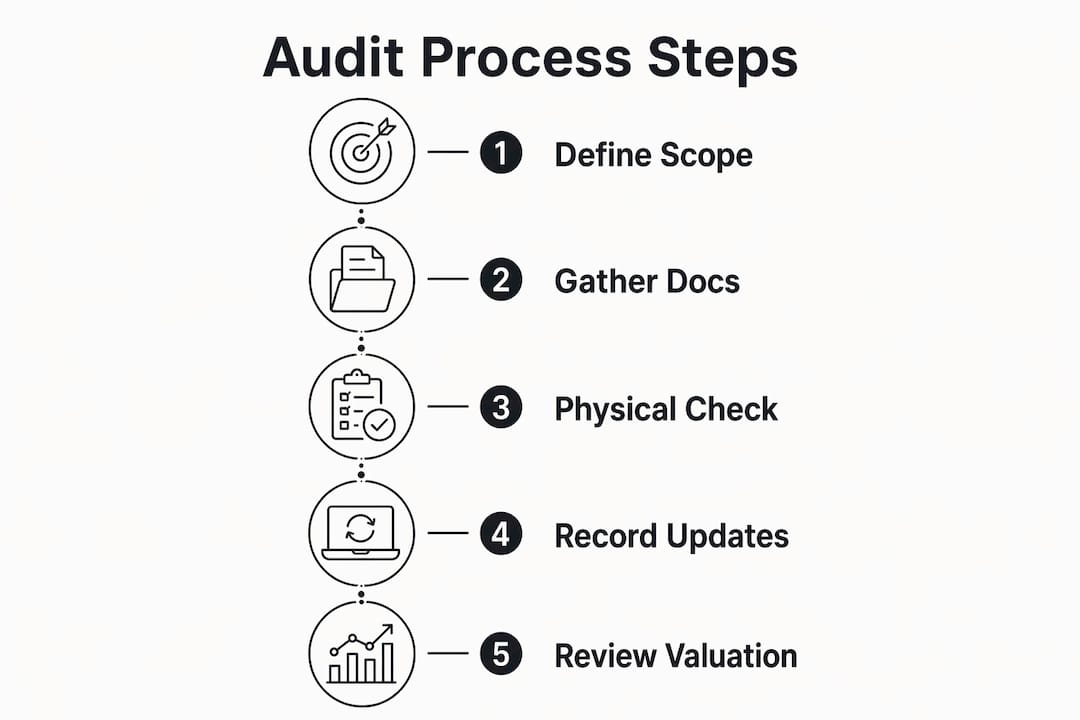
Audit preparation begins with collecting all relevant documentation, including purchase receipts, provenance records, previous appraisals, and condition reports. This step establishes the baseline against which physical reality is measured.
Follow these steps to conduct a thorough audit:
- Compile all documentation. Pull every record associated with each artwork: receipts, provenance files, prior appraisals, exhibition history, and condition reports.
- Physically verify each artwork. Confirm the piece is present at its recorded location. Note any visible condition changes, damage, or restoration work not previously documented.
- Cross-reference records against physical findings. Flag any discrepancy between what the record states and what the physical inspection reveals.
- Update location and status data. Record current storage location, display status, and any recent movements. Catalogs must be updated immediately after acquisitions, sales, restorations, and location changes to prevent data from drifting away from physical reality.
- Revise valuations. Confirm that current market conditions and any condition changes are reflected in the recorded valuation. Use formal appraisals where significant value shifts are suspected.
- Digitally record all findings. Enter updated data into a dedicated art management system or structured spreadsheet. Assign or confirm a unique identifier for each work to support tracking across future moves.
- Schedule the next review. Quarterly reviews are the standard for active collections. Trigger an unscheduled audit after any major event: a new acquisition, a sale, a move, or a reported loss.
Pro Tip: Treat your audit as a living maintenance routine, not a one-time project. The most reliable collections are those where records are updated within 24 hours of any physical change, not during an annual review.
Who benefits from art inventory audits?
Every stakeholder in the art market gains measurable value from a disciplined audit process. The benefits differ by role, but the underlying need is the same: accurate, verifiable records that hold up under scrutiny.
- Artists: A current inventory supports pricing decisions, grant applications, and exhibition submissions. It also establishes a professional record of the artist’s output and its condition over time.
- Private collectors: Detailed records support insurance claims, prove ownership in disputes, and preserve the collection’s history for future generations or estate planning.
- Galleries and dealers: Verified inventory prevents double sales, supports accurate consignment tracking, and provides the documentation buyers and auction houses require before a transaction closes.
- Insurers and appraisers: A well-maintained audit trail reduces the time and cost of assessments. It also strengthens claims by providing photographic evidence and a documented chain of custody.
- Estate administrators: Accurate records simplify valuation for tax purposes and reduce legal exposure when collections transfer between owners.
Regular audits help identify missing items, track condition changes, and preserve collection value over time. That last point is significant: a collection with clean, current records consistently achieves better outcomes at auction and in private sales than one with fragmented documentation.
What are the common challenges in art inventory audits?
The most persistent challenge in any audit is the static catalog. Records that are not updated in real time become unreliable within weeks of a major collection event. Outdated records, dispersed documentation, and inventory uncertainty without integrated systems are the three most common failure points galleries report.
| Challenge | Manual process | Software-supported process |
|---|---|---|
| Record currency | Updated manually, prone to delays | Triggered automatically by transactions |
| Location tracking | Relies on staff memory or paper logs | Real-time location fields with change history |
| Condition documentation | Inconsistent, often undated | Timestamped entries with photo attachments |
| Double-sale risk | High without centralized tracking | Eliminated by live inventory status flags |
| Provenance integrity | Fragmented across files and emails | Centralized, searchable, and exportable |
| Audit trail | Difficult to reconstruct after the fact | Automatically generated by system activity |
Detecting condition changes is a second major challenge. Artworks deteriorate gradually, and without photographic documentation taken at each audit interval, it becomes difficult to pinpoint when damage occurred. This matters for insurance claims and for assigning responsibility after a loan or transport.
Managing records across multiple locations adds further complexity. A gallery with works in storage, on loan, and on the primary exhibition floor must reconcile three separate physical environments against a single master record. Without a centralized system, this process is error-prone and time-consuming.
Pro Tip: Assign a unique accession number to every artwork at the point of acquisition. This identifier should follow the work through every record, every location change, and every transaction. It is the single most effective way to maintain a reliable chain of custody across years of collection activity.
What tools and technologies support art inventory audits?
Digital tools have replaced paper-based systems as the standard for professional collection management. The shift is not just about convenience. Dedicated apps and inventory management systems offer tracking accuracy and data integration that spreadsheets and paper ledgers cannot match.
The core technology stack for a modern audit includes:
- Art management software: Platforms like Artwork Archive provide structured fields for provenance, condition, location, valuation, and exhibition history. Artworksoft offers a comparable system with built-in art valuation tools and Certificate of Authenticity generation, designed specifically for artists, collectors, and galleries.
- Gallery ERP systems: NetSuite’s Gallery ERP triggers inventory updates automatically when a transaction occurs, providing live inventory visibility and an auditable chain of custody. This eliminates the manual update step that creates most data drift.
- Barcode and mobile scanning: Physical labels with barcodes or QR codes allow staff to scan and confirm a work’s location during a walkthrough, updating the digital record in real time without manual data entry.
- Photographic documentation: High-quality photos from multiple angles taken at each audit interval create a visual record that supports condition verification, insurance claims, and provenance documentation. Front, back, detail, and signature shots are the standard set.
- Cloud-based storage: Storing documentation in the cloud ensures that provenance files, appraisals, and condition reports are accessible from any location and protected against physical loss.
The advantage of specialized art management software over generic tools like Microsoft Excel is not just feature depth. It is the structured data model. A spreadsheet has no built-in concept of provenance or chain of custody. A purpose-built system enforces those fields, making gaps in the record visible before they become problems. Artworksoft’s artwork profile management tools reflect this approach, connecting each work’s documentation, location history, and transaction record in a single profile.
Key takeaways
A reliable art inventory audit requires consistent documentation, immediate record updates after every collection event, and purpose-built tools that enforce data integrity across the full lifecycle of each artwork.
| Point | Details |
|---|---|
| Define the audit scope first | Collect all documentation before physically verifying any artwork to establish a reliable baseline. |
| Update records immediately | Condition and location data must be updated within 24 hours of any physical change to prevent data drift. |
| Use unique identifiers | Assign an accession number to every work at acquisition and carry it through every record and transaction. |
| Leverage purpose-built software | Specialized art management systems enforce structured data fields that spreadsheets cannot replicate. |
| Schedule audits by trigger, not just calendar | Conduct reviews after acquisitions, sales, moves, and loans, not only on an annual cycle. |
Why I stopped treating audits as annual events
The conventional approach to collection audits treats them as a scheduled obligation, something to complete once a year and file away. In practice, that model produces records that are accurate for roughly two weeks after the audit closes and increasingly unreliable for the remaining fifty weeks.
The collections I have seen managed most effectively share one habit: they treat every physical change to the collection as an audit event. A work moves to a different storage rack, and the location record is updated that day. A conservator completes a cleaning, and the condition report is amended before the invoice is paid. This is not bureaucratic discipline for its own sake. It is the only way to maintain a record that is actually useful when a buyer, an insurer, or an estate attorney asks a question.
The other pattern worth noting is the communication gap between artists, galleries, and collectors. A gallery may move a consigned work three times in a year without notifying the artist. The artist’s own inventory then reflects a location that has not been accurate for months. Closing that gap requires agreed-upon protocols, not just better software. The software matters, but the protocol comes first.
My recommendation is to build a short audit checklist that travels with every artwork movement, every sale, and every loan agreement. The checklist does not need to be long. It needs to be completed every time, by everyone involved. That consistency is what separates a collection with reliable records from one that requires a full reconstruction every time something significant happens.
— Nealda
How Artworksoft supports your audit process
Artworksoft is built for the exact workflows an art inventory audit requires. The platform connects artwork records, location history, valuation data, and transaction documentation in a single system, so every audit starts from a complete and current baseline.

Artworksoft’s art documentation tools support provenance recording, condition tracking, and Certificate of Authenticity generation without requiring separate software or manual file management. The sales and transactions module updates inventory status automatically when a work is sold or transferred, eliminating the manual update step that creates most audit discrepancies. Artists, collectors, and galleries can access the platform at no cost to get started. Visit Artworksoft to set up your art inventory system today.
FAQ
What is an art inventory audit?
An art inventory audit is a systematic review that verifies every artwork in a collection is physically present, accurately documented, and correctly valued. It covers provenance records, condition reports, location data, and appraisals.
How often should an art collection audit be conducted?
Quarterly reviews are the standard for active collections, with additional unscheduled audits triggered by acquisitions, sales, loans, or reported losses.
What documents are needed for an art inventory audit?
A complete audit requires purchase receipts, provenance records, prior appraisals, condition reports, and photographic documentation for each artwork in the collection.
Why is art collection valuation part of the audit process?
Valuation must be reviewed during each audit because market conditions and physical condition both affect an artwork’s current worth. Outdated valuations create risk for insurance coverage and sales negotiations.
Can spreadsheets replace dedicated art inventory software?
Spreadsheets lack the structured data fields, chain-of-custody tracking, and automated update triggers that purpose-built art management systems provide. For collections of any significant size or activity level, dedicated software produces more reliable audit outcomes.











