
Pick one formula, apply it with honest inputs, and stay consistent across your entire body of work. For most emerging painters, that means starting with (H+W)×index, square-inch×rate, or hourly-plus-materials, then adjusting for career stage and sales channel. No formula is perfect on its own, but a documented, repeatable method beats guessing every time a collector asks “how much?” The rest of this guide breaks down each formula, shows you how to set the numbers, and walks through real math on three sizes of work.
TL;DR:
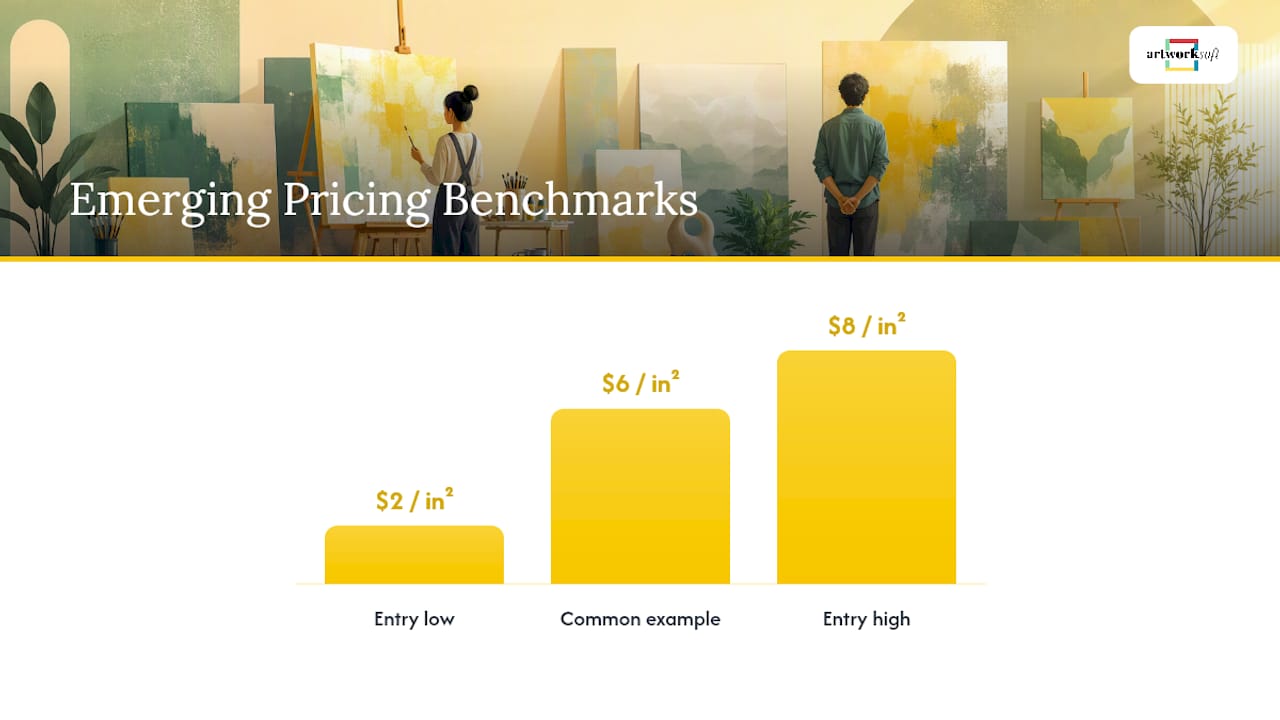
- Using a square-inch rate of $2 to $8 per square inch is common for emerging painters, but it risks overpricing very large works and underpricing small ones.
- Setting linear-inch or index-based prices requires careful comparison with similar artists, adjusting for career milestones, and honest tracking of studio hours.
- Gallery sales often demand retail prices twice the net amount needed after commission, while direct sales and online channels should include costs like shipping, framing, and overhead.
- Documenting all inputs and maintaining a pricing log increases transparency and helps justify pricing adjustments over time.
- Consistency in pricing across channels and clear communication about increases help preserve trust and demonstrate professionalism to collectors.
Table of Contents
- Art Pricing Formula Basics: Which Calculation Method Fits Your Work
- How to Choose Your Per-Inch Rate, Index, and Hourly Wage
- Adjusting for Commission, Channel, and Overhead
- Three Worked Examples: Small, Medium, and Large
- Staying Consistent (and Raising Prices Without Losing Trust)
- Why Recordkeeping Makes Your Pricing Formula Defensible
- Why the Formula Matters More Than the Number
- Put Your Pricing Formula on Autopilot
- Sources
Art Pricing Formula Basics: Which Calculation Method Fits Your Work
There is no single, official art pricing formula that works for every artist or every medium. What exists instead is a small set of proven starting formulas that professionals adjust based on career stage, medium, and on where the work sells, according to ArtConnect’s pricing guide. Treat each one as a calculator, not a rulebook, and expect to recalibrate as you gather sales data.
Square-inch pricing is the most common entry point for painters. Multiply height by width to get total square inches, then multiply that number by a dollar rate tied to your reputation and market. A 16×20 canvas comes to 320 square inches; at $6 per square inch, that’s $1,920 before framing or materials get added, a calculation detailed in the Artists Network pricing formula. The appeal is speed. The drawback is that it scales harshly at the extremes: a tiny painting can price itself out of an impulse buy, and a mural-sized canvas can balloon past what your market will bear.
That’s where the linear-inch method, often written as (H+W)×index, earns its place. Instead of multiplying dimensions together, you add height and width, then multiply the sum by an index number. A 16×20 painting becomes 36 inches; at an index of 25, that’s $900. Because addition grows more slowly than multiplication, this formula moderates the size-driven spikes that square-inch pricing produces, which is why the Contemporary Art Issue pricing guide recommends it for painters transitioning between career stages. Index numbers should shift as your résumé grows. Many emerging painters start somewhere between 8 and 15 and increase the number after documented sales momentum, not on a whim.
Time plus materials works differently, and it fits commissions, sculpture, and mixed-media pieces where size alone doesn’t capture the labor involved. The math is straightforward:
- Hourly rate × hours worked = labor cost
- Add material costs (canvas, paint, framing, hardware)
- Add a markup, typically 10% to 30%, to cover overhead and profit
- Total = your base price before channel adjustments
This method rewards precision. If you’re not logging your actual studio hours, you’re guessing at your own labor cost, which defeats the purpose of using a formula at all.
Prints and editions need their own math because you’re pricing a multiple, not a one-of-a-kind object. Limited editions of 25 or fewer typically hold value better than open editions, since scarcity itself becomes part of the price.
For starter ranges, most emerging painters land between $2 and $8 per square inch, or an index of 8 to 20 for linear-inch pricing, before adjusting for medium and market feedback. Test your number against real interest, not assumptions. If three consecutive pieces sell within days at your current rate, you likely have room to raise it. If nothing moves after months on display, the number needs to come down before your reputation does.
How to Choose Your Per-Inch Rate, Index, and Hourly Wage
The formula is only half the equation. The number you multiply by is where most emerging painters guess, and where a little research pays off disproportionately.
- Pull 3 to 5 comparables. Look at painters at a similar career stage, working in a similar medium, selling through a similar channel (gallery, online, art fair). Note their asking price and the dimensions, then back-calculate their implied price per square inch or their linear-inch index. Recent sales matter more than list prices, since a stale asking price that never sold tells you nothing about actual market appetite, a point the sales comparison approach to art valuation makes clear.
- Map your career stage to a multiplier. A painter with no exhibition history typically sits at the low end of any index range. Gallery representation, juried show acceptances, and a consistent sales record justify moving up. Base the increase on documented achievements, not a gut sense of “getting better,” since objective criteria like exhibitions and sales history hold up better with buyers and appraisers alike.
- Time yourself honestly. Track actual hours on your next three paintings, including sketching, mixing, and correction time. Most painters underestimate this by 30% or more until they log it.
- Adjust for medium and material quality. Oil on linen with museum-grade framing costs more to produce than acrylic on canvas board, and your formula’s material line should reflect that gap directly rather than getting absorbed into a vague markup.
Pro Tip: Keep a simple spreadsheet with columns for comparable artist, dimensions, asking price, and implied price per square inch. After five entries, you’ll see your own market range emerge instead of relying on one lucky data point.
Reputation multipliers deserve extra care because they’re the easiest input to inflate. A structured approach to how artist reputation impacts valuation ties your index bump to specific, checkable facts: gallery representation, museum acquisition, press coverage, sales volume. Self-rating your own talent is not a pricing input. Documented career milestones are.
Adjusting for Commission, Channel, and Overhead
Your base price and your retail price are rarely the same number, and confusing the two is one of the fastest ways to underprice your own work.
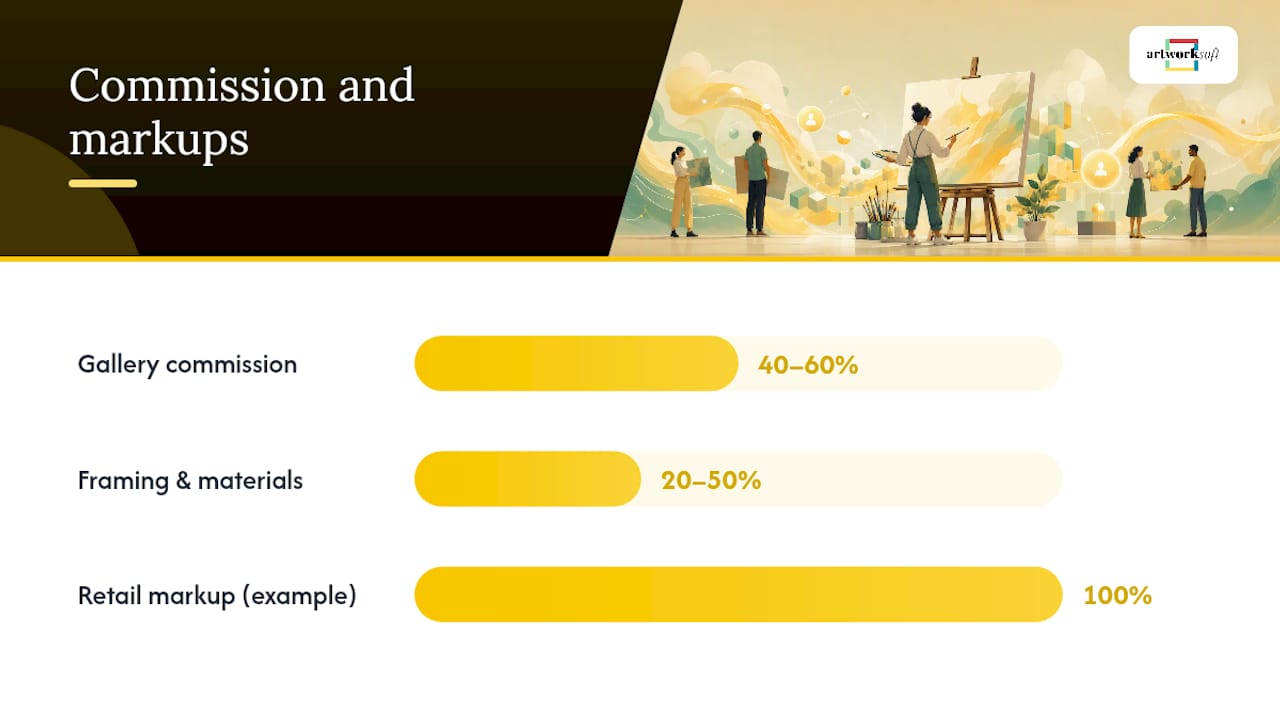
If you sell through a gallery, work backward from the amount you actually need to keep. Galleries commonly take 40% to 60% commission, so if you want a $1,000 net on a painting and your gallery takes 50%, the retail price needs to be $2,000, not $1,500, according to the Artists Network commission guidance. Selling direct, through your own site or a platform like Payhip, removes that split but shifts shipping, payment processing, and marketing costs onto you instead.
A few line items get missed constantly when artists build their retail number:
- Framing and materials, which can add 20% to 50% to your base cost depending on complexity.
- Shipping and insurance, especially for larger canvases that need custom crating.
- Sales tax obligations, which vary by state and by whether you’re selling in person or online.
- Business overhead, including studio rent, website fees, and marketing spend, spread across your annual output.
On pricing psychology: round numbers ($2,000) signal confidence and suit established galleries, while charm pricing ($1,995) can nudge online impulse buyers but tends to undercut perceived value at higher price points. For original paintings above a few hundred dollars, round numbers generally serve emerging artists better.
Three Worked Examples: Small, Medium, and Large
Numbers make the formulas real. Here’s how each one plays out on an actual canvas.
- Small painting, 8×10 inches, direct sale. Using (H+W)×index at an index of 12: (8+10)×12 = $216 base. Add $40 for framing and materials, bringing the subtotal to $256. Selling direct online with no commission, round to a retail price of $260, which is also your artist net after materials.
- Medium canvas, 18×24 inches, gallery sale. Using square-inch×rate at $5 per square inch: 18×24 = 432 square inches × $5 = $2,160 base. Materials for a canvas this size often run higher, so double a typical small-format material estimate to around $150. Base plus materials equals $2,310. At a 50% gallery commission, retail price needs to be $4,620 to net $2,310, so you’d likely round the gallery retail listing to $4,600 and accept a net closer to $2,300 after the split.
- Large commission, 40×60 inches, hourly plus materials. At 60 hours of labor and a $35 hourly rate, that’s $2,100 in labor. Materials for a canvas this size, including stretcher bars and heavy-body paint, might run $300. Adding a 20% markup for overhead and risk: ($2,100 + $300) × 1.20 = $2,880. Sold direct to the client with no gallery split, your retail price and your artist net are the same $2,880, though you’d still want to check that figure against a linear-inch estimate (40+60=100 × an index around 25 = $2,500) to see whether the two methods land in a similar range before finalizing.
Notice that the small piece carries a higher effective rate per square inch than the large one. That’s normal. Small works demand nearly the same setup time and material handling as medium ones, so many painters intentionally price them at a premium per inch rather than let the math punish smaller formats.
Staying Consistent (and Raising Prices Without Losing Trust)
Three rules keep your pricing credible over time. First, charge the same base price everywhere your work appears, adjusting only for documented channel costs like gallery commission, not for who’s asking. Second, keep a price-change log noting the date, the piece or series, the old and new price, and why it changed. Third, when you do raise prices, tell your gallery contacts and repeat collectors directly rather than letting them discover it cold; a heads-up preserves the relationship even when the number goes up.
Before listing any new piece, run through a quick checklist:
- Materials cost logged and current, not estimated from memory
- Actual studio hours recorded, not guessed
- Channel markup applied correctly (gallery split, shipping, tax)
- Framing and delivery costs included in the final number
Discounts and limited early-bird pricing can work for a specific launch, but treat them as an exception you announce clearly, not a permanent floor collectors come to expect. Practitioners who’ve watched pricing mistakes play out over full careers tend to agree on one thing: raise prices incrementally after a run of strong sales, and avoid the kind of abrupt jump that leaves past buyers wondering why they paid more for less, a pattern the Mastrius pricing guide for artists calls out directly.
Pro Tip: Review your sale-to-asking ratio every quarter. If more than half your recent pieces sold at full asking price with no negotiation, that’s a strong signal you’re underpriced for your current demand.
Why Recordkeeping Makes Your Pricing Formula Defensible
A formula only works if you can prove the inputs behind it. Comparables go stale, materials costs shift, and your own memory of “what I charged last year” is rarely as accurate as you think. Fresh, well-documented comparables produce more reliable pricing than guesswork pulled from an old invoice, which is exactly why sales comparison valuation depends on current, verifiable data rather than assumptions.
A basic spreadsheet can hold formula inputs and outcomes for a while. It gets unwieldy fast once you’re tracking dozens of pieces across multiple sales channels, each with different commission structures and material costs. A structured art inventory system keeps every input, dimension, materials cost, hours logged, sale price, and channel, tied to each specific piece, so your next pricing decision draws on real history instead of memory.
- Store every formula input (dimensions, hours, materials, index used) alongside each artwork’s record.
- Generate professional documentation, including Certificates of Authenticity, the moment a piece sells.
- Review your full pricing log quarterly to catch drift between similar pieces.
Set up a pricing log this month, even a simple one, and revisit it every three months. That habit alone puts you ahead of most emerging painters still pricing from instinct.
Why the Formula Matters More Than the Number
Most advice to new painters focuses on finding the “right” price, as though one perfect number exists waiting to be discovered. It doesn’t. What separates artists who price with confidence from those who second-guess every sale isn’t a magic index or a secret rate. It’s whether they can explain, in one sentence, how they arrived at a number.
That explanation is what collectors actually respond to, more than the number itself. A buyer who hears “this is priced using the same per-inch rate I apply across my whole current series, adjusted for this gallery’s commission” trusts the transaction in a way that “it felt right” never earns. Consistency reads as professionalism even to buyers who couldn’t tell you what a linear-inch index is.
The mistake I see most often isn’t underpricing or overpricing. It’s inconsistency, the same painter charging noticeably different rates for comparably sized work with no documented reason. That erodes trust faster than a high price ever will, because it signals the pricing was never really systematic to begin with.
— Nealda
Put Your Pricing Formula on Autopilot
Running these formulas by hand works for your first few sales, but the math gets harder to trust once you’re tracking dozens of paintings, multiple galleries, and a growing index history. Artworksoft replaces the spreadsheet with a structured art valuation workflow built specifically around the kind of formulas covered here, so every price you set is backed by stored inputs instead of memory.

Inside the platform, you can log dimensions, hours, and materials against each piece, apply your chosen index or rate consistently across your portfolio, and generate professional Certificates of Authenticity the moment a sale closes. Sales and transaction records stay tied to the artwork permanently, giving you the comparables history this guide recommends building for yourself. If you want to see how the formula-first approach translates into an actual working tool, start free with Artworksoft and set up your first artwork profile today.
Sources
- Pricing Your Art: A Comprehensive Guide for Artists 2026
- A simple formula for pricing artwork (Artists Network)
- How To Price Your Art: The Ultimate Guide (+Calculator)
- Art valuation — Wikipedia