


Art sales reporting for galleries is the systematic process of recording every transaction, tracking inventory movement, and reconciling artist payouts to maintain accurate financial and operational records. Galleries that treat this process as an afterthought face inflated revenue figures, missed tax obligations, and strained artist relationships. The industry context makes rigorous reporting more urgent than ever: global dealer sales reached an estimated $34.8 billion in 2025, yet 38% of dealers reported lower profitability due to rising operating costs. That gap between top-line sales and actual margin is exactly what structured gallery financial reporting is designed to close.
What is art sales reporting for galleries?
Art sales reporting for galleries is the formal practice of documenting each sale from buyer invoice through consignor payout, creating a traceable record that supports accounting, tax compliance, and artist relations. The industry term most commonly used in bookkeeping contexts is consignment sales reporting, because the majority of gallery transactions involve artwork held on consignment rather than owned outright. Both terms describe the same document flow, and understanding that distinction matters for how you classify revenue.
The core purpose is accuracy at every stage. A gallery that records the full selling price as revenue is misrepresenting its financials. Only the gallery’s commission is recognized as revenue; the artist’s share is a payable liability until the payout clears. This single principle separates galleries with clean books from those that face reconciliation problems at year-end.
Accurate reporting also supports inventory valuation. When a work sells, its status must update immediately across your records. Stale inventory data leads to double-selling attempts, incorrect insurance valuations, and inaccurate consignor statements.

What documents and data fields does gallery reporting require?
Audit-ready sales reports require a repeatable document flow built on three core records: the buyer sale invoice, the consignor statement, and the payout record. Each document serves a distinct purpose and feeds the next step in the process.
The buyer sale invoice confirms the transaction between the gallery and the collector. It captures the gross selling price, applicable taxes, any discounts applied, and payment terms. This document is the starting point for every downstream calculation.
The consignor statement translates the sale into artist-facing terms. It shows the gross price, the gallery’s commission percentage, any deductions, and the net amount owed to the artist. Galleries should issue these statements on a defined schedule, typically monthly or per sale.
The payout record documents when and how the artist was paid. It closes the liability loop opened when the work sold.
Every sale record should contain these fields at minimum:
- Artist name and artwork ID
- Gross selling price and any discounts applied
- Commission rate and commission amount
- Tax collected and tax jurisdiction
- Net amount payable to the artist
- Payment status and payment date
- Buyer reference (for private transaction logs)
Pro Tip: Keep sensitive transaction details, such as buyer discounts and special payment terms, in a private internal log separate from the consignor statement. Confidentiality in high-value sales is a professional standard, and mixing these details into artist-facing documents creates unnecessary exposure.
A common pitfall is conflating gross sales with gallery revenue. If a work sells for $10,000 and your commission is 50%, your revenue is $5,000. The remaining $5,000 sits as a liability on your books until you pay the artist. Treating the full $10,000 as income overstates revenue and distorts every profitability metric you track.
Which kpis should galleries track in sales analysis?
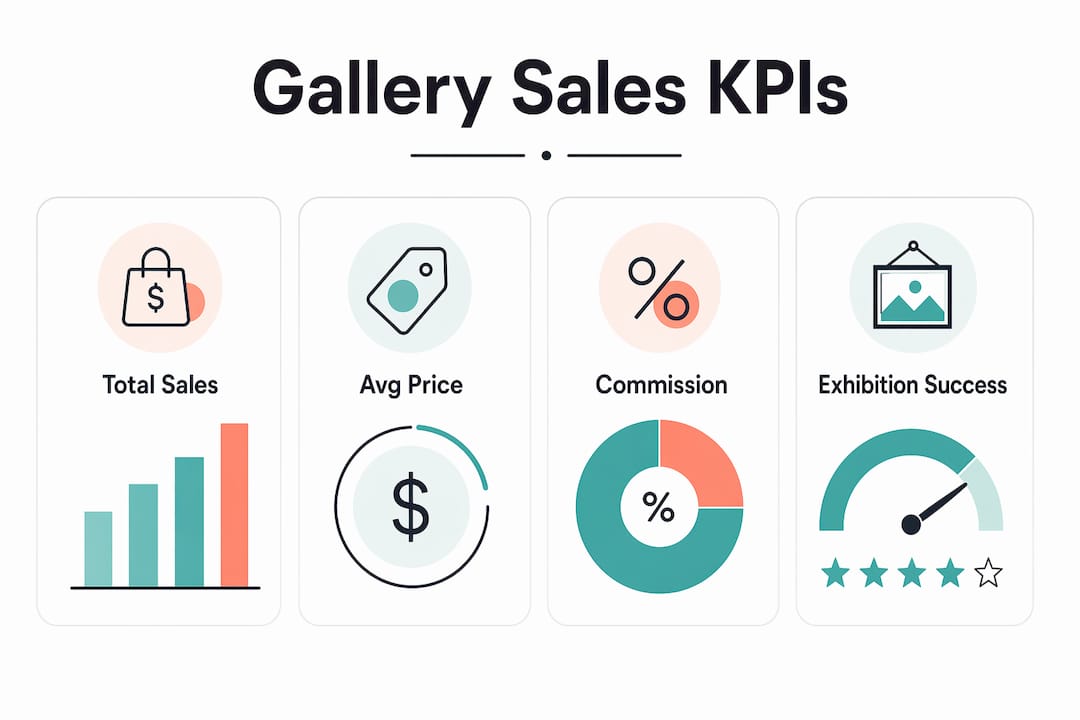
Effective sales reporting tracks total sales, average selling price, profit per category, and exhibition performance to identify the most profitable artists and venues. These metrics move gallery decision-making from intuition to evidence.
The table below summarizes the key performance indicators galleries should monitor and the business decisions each one informs.
| KPI | Definition | Business Impact |
|---|---|---|
| Total sales (gross) | Sum of all buyer invoices in a period | Measures market activity and sets revenue baseline |
| Commission earned | Gallery’s share of total sales | Actual revenue figure for P&L reporting |
| Average selling price | Total sales divided by number of works sold | Tracks collector price sensitivity and market positioning |
| Exhibition performance | Sales and commission per show | Identifies which exhibitions justify their costs |
| Artist sales contribution | Revenue attributed per artist | Guides roster decisions and consignment renewals |
| Monthly sales trend | Period-over-period sales movement | Reveals seasonality and informs cash flow planning |
| High-value sale frequency | Number of sales above a defined threshold | Signals collector base depth and pricing ceiling |
Commission earned and exhibition performance are the two most decision-relevant metrics for mid-market galleries. Mid-market galleries face margin pressures that make this level of reporting necessary for identifying which shows generate returns and which consume resources without payoff.
Pro Tip: Set a monthly KPI review cadence rather than waiting for year-end. Catching a declining average selling price in month three gives you time to adjust pricing or exhibition strategy before the full year is lost.
Art fairs accounted for 35% of galleries’ turnover in 2025. That concentration means fair-specific performance tracking is not optional. A gallery that cannot isolate fair revenue from gallery revenue cannot accurately assess whether fair participation is profitable.
What are common art sales reporting formats?
Galleries use several distinct reporting formats, and each serves a different audience and purpose. Understanding the differences helps you choose the right format for each use case rather than producing one generic report that serves none of them well.
The table below compares the most common formats galleries implement:
| Format | Primary Audience | Frequency | Key Contents |
|---|---|---|---|
| Consignor statement | Artist / consignor | Per sale or monthly | Gross price, commission, net payout, payment date |
| Sales ledger | Internal accounting | Monthly | All transactions, gross and net, payment status |
| Exhibition sales report | Management | Per exhibition | Sales by show, commission earned, unsold inventory |
| Annual payout summary | Artist / tax purposes | Annually | Total payouts by artist, payment dates, amounts |
| Inventory movement report | Internal operations | Monthly | Works sold, works returned, works on hold |
Reporting formats differ in detail level, intended audience, and frequency. Some integrate payout tracking and commissions, while others focus on sales analytics per category or artist. The right mix for your gallery depends on the size of your roster, the volume of transactions, and your accounting requirements.
Digital inventory and sales management tools like Artworksoft connect these formats within a single system. Rather than maintaining separate spreadsheets for consignor statements and sales ledgers, a connected platform generates each document from the same underlying transaction data. That eliminates transcription errors and ensures every format reflects the same figures.
Year-end tax reporting becomes straightforward when your formats are consistent throughout the year. Maintaining artist-level payout histories by amount, date, and payment method enables verification at tax time rather than reconstruction from incomplete records.
How do galleries apply sales reporting to inventory and transactions?
Sales reporting and inventory management are inseparable in a functioning gallery. Every sale triggers an inventory update, a commission calculation, and a payout obligation. Treating these as separate processes creates the gaps that lead to reconciliation problems.
Here is the process flow galleries should follow for each transaction:
- Record the sale. Enter the buyer invoice immediately upon sale confirmation. Capture all required fields: artwork ID, gross price, discount, tax, and payment terms.
- Update inventory status. Mark the work as sold in your inventory system. This prevents the work from appearing in active consignment lists or being offered to another buyer.
- Generate the consignor statement. Calculate the artist’s net payout based on the agreed commission rate. Issue the statement to the artist within your defined timeline.
- Record the payout liability. Log the amount owed to the artist as a payable in your accounts. Do not close this entry until payment is confirmed.
- Execute and document the payout. Pay the artist and record the payment method, date, and amount. This closes the liability and completes the transaction cycle.
- Reconcile monthly. At month-end, compare your sales ledger against your payout records and inventory status. Any discrepancy signals a missing step in the process.
Year-end reporting is built throughout the year when galleries capture and document payouts by artist, amount, date, and payment method. Galleries that follow this process monthly arrive at year-end with records that require verification, not reconstruction.
Galleries leveraging detailed sales reporting can deepen collector and artist relationships through data rather than relying on memory or informal records. An artist who receives accurate, timely consignor statements is an artist who renews their consignment agreement. A collector whose purchase history is tracked accurately is a collector who receives relevant acquisition recommendations.
The best practice for audit readiness is to treat every transaction as if it will be reviewed externally. That standard produces records that are clean for tax purposes, defensible in disputes, and useful for internal analysis.
Key takeaways
Accurate art sales reporting requires consistent document flow, correct revenue recognition, and KPI tracking to protect gallery margins and artist relationships.
| Point | Details |
|---|---|
| Revenue recognition accuracy | Record only the gallery commission as revenue; the artist’s share is a liability until paid. |
| Three-document flow | Every sale requires a buyer invoice, consignor statement, and payout record to close the cycle. |
| KPI tracking by exhibition | Track commission earned and exhibition performance separately to identify profitable shows. |
| Format selection by audience | Use consignor statements for artists, sales ledgers for accounting, and payout summaries for tax reporting. |
| Monthly reconciliation | Compare sales ledger, payout records, and inventory status each month to catch discrepancies early. |
Why galleries can no longer afford informal reporting
I have reviewed financial records from galleries of every size, and the pattern is consistent: the galleries with the most serious cash flow problems are almost always the ones that never formalized their reporting process. They know their gross sales number. They have no reliable figure for commission earned, outstanding artist payables, or exhibition-level profitability.
The revenue recognition error is the most damaging and the most common. A gallery recording $500,000 in annual gross sales when its actual commission revenue is $225,000 is not just keeping bad books. It is making staffing, exhibition, and acquisition decisions based on a number that is more than double the real figure. I have seen this mistake persist for years before a tax audit or a partnership dispute forced a correction.
The shift toward data-driven collector relationships makes this more consequential, not less. Small dealers increased their local private collector sales share to 71% in 2025. That concentration in private sales means your reporting needs to track individual collector purchase histories, not just aggregate transaction totals. A gallery that cannot answer “what has this collector bought, at what price, and when?” is leaving relationship capital on the table.
My practical advice: start with the three-document flow described in this article. Buyer invoice, consignor statement, payout record. Get those three documents right for every transaction before you build out KPI dashboards or exhibition analytics. The foundation has to be solid before the analysis is meaningful.
— Nealda
Start tracking sales the right way with Artworksoft
Implementing a clean sales reporting process is straightforward when your tools are built for it.

Artworksoft connects artwork records, sale invoices, consignor statements, and payout tracking within a single platform. When a sale is recorded, inventory status updates automatically, commission calculations generate without manual entry, and consignor statements are ready to issue. The system supports the full document flow described in this article, from buyer invoice to artist payout, and produces the records galleries need for year-end tax reporting and audit support. Gallery owners can start the free system and begin building audit-ready sales records from their first transaction. No complex setup, no guesswork in pricing, and no detail left untracked.
FAQ
What is art sales reporting for galleries?
Art sales reporting is the systematic process of recording buyer invoices, generating consignor statements, and documenting artist payouts for every gallery transaction. It supports accurate inventory management, financial reporting, and tax compliance.
How should a gallery record revenue from consignment sales?
Only the gallery’s commission is recorded as revenue. The artist’s share of the gross selling price is a payable liability until the payout is made, not income for the gallery.
What are the most important kpis for gallery sales analysis?
Commission earned, average selling price, and exhibition performance are the three most critical KPIs. They directly inform profitability analysis and exhibition planning decisions.
How often should galleries reconcile their sales records?
Monthly reconciliation is the standard best practice. Comparing the sales ledger, payout records, and inventory status each month prevents discrepancies from compounding into year-end problems.
What reporting formats do galleries typically use?
The most common formats are consignor statements for artists, sales ledgers for internal accounting, and annual payout summaries for tax reporting. Each format serves a distinct audience and should be generated from the same underlying transaction data.











