An art business online presence is defined as the combination of an owned website, search engine visibility, social media engagement, and direct collector relationships that together make your work discoverable and your business sustainable. Artists who rely on a single platform or marketplace expose themselves to algorithm changes, commission hikes, and sudden policy shifts that can erase years of audience building overnight. The most resilient approach integrates all four channels into a system you control. Organic search drives 53% of all website traffic, which means SEO is not optional for artists who want consistent discovery. Email marketing outperforms every social channel for conversion, and a professionally managed catalog strengthens every transaction you make.
How to build art business online presence with a professional website
Your website is the only digital asset you fully own. Social platforms can suspend accounts, change their algorithms, or shut down entirely. Artists relying solely on third-party marketplaces risk losing visibility the moment commissions or ranking rules change. A self-hosted website removes that dependency and gives you a permanent, searchable home for your work.
What your artist website must include
A professional artist website needs four core sections to function as a business hub.
- Artist bio and statement: Write a clear, specific bio that names your medium, style, and location. Collectors search for “abstract oil painter in Chicago” more often than they search for your name.
- Gallery pages organized by series or medium: Group work logically so collectors can browse by what interests them. Each piece should have its own page with title, dimensions, medium, year, and price.
- Contact and inquiry form: Make it easy for collectors, galleries, and press to reach you. A missing or buried contact page costs sales.
- Certificate of Authenticity documentation: Professional documentation signals that you operate a serious business. Artworksoft generates Certificates of Authenticity directly from your catalog, which you can link or attach to any listing.
Technical basics that affect search rank and visitor retention
Page speed and mobile formatting directly affect how long visitors stay and where Google ranks your pages. Compress images to under 200KB without sacrificing quality, use descriptive file names like “blue-abstract-oil-painting-2024.jpg,” and write alt text for every image. Add a meta title and meta description to every page, and use your primary keywords naturally in headings and body text. Internal linking between your gallery pages and blog posts helps search engines index your full site.
Pro Tip: Use Google Search Console (free) to monitor which search queries bring visitors to your site. Artists consistently find that medium-specific and location-specific terms drive more qualified traffic than their own name.

| Website element | SEO and business impact |
|---|---|
| Descriptive image alt text | Helps Google index artwork and appear in image search |
| Mobile-responsive design | Reduces bounce rate and improves search ranking |
| Individual artwork pages | Creates multiple indexed URLs and long-tail keyword opportunities |
| Artist bio with location and medium | Captures local and niche collector searches |
| Internal links between pages | Improves crawlability and distributes page authority |
Which social media platforms should artists focus on in 2026?
Platform selection is the decision most artists get wrong. Spreading effort across Instagram, TikTok, Facebook, Pinterest, LinkedIn, and YouTube simultaneously produces weak results on all of them. Focusing deeply on two platforms and maintaining a light presence on one more outperforms scattered effort by preventing brand dilution and creator burnout.
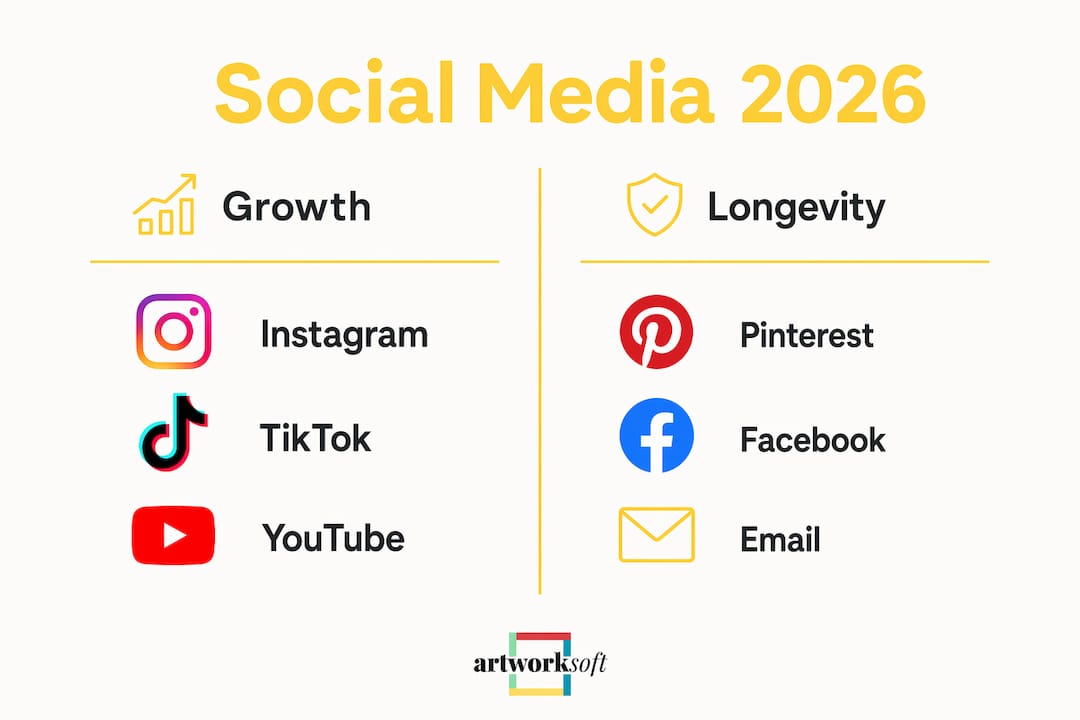
The two platforms that deliver the strongest results for visual artists right now are Instagram and TikTok for audience growth, with Pinterest serving as the long-term traffic engine. Pinterest content has a 90-day lifespan compared to Instagram’s two-hour lifespan. That difference means a well-optimized Pinterest board continues driving collector traffic for months after you post it.
A content strategy that works with current algorithms
- Post process reveal videos as your primary content format. Social media algorithms in 2026 prioritize video-first content, and process videos outperform static images in reach and saves. Film your work in progress, narrate your decisions, and show the finished piece at the end.
- Publish at least three times per week. Consistency signals to algorithms that your account is active. Three posts per week is the minimum threshold for maintaining engagement momentum.
- Use keyword-rich board titles and descriptions on Pinterest. Treat Pinterest like a search engine, not a mood board. Titles like “Large Abstract Oil Paintings for Living Rooms” outperform “My Art” by a wide margin.
- Respond to every comment within 24 hours. Engagement rate directly affects how widely platforms distribute your content. Artists who treat social media as relationship infrastructure rather than a broadcast channel build faster and more loyal audiences.
- Use your bio link to direct followers to your website, not a marketplace. Every click you send to your own site builds your SEO authority and keeps the collector relationship in your control.
Pro Tip: Batch-create content one day per week. Filming three to five process videos in a single session and scheduling them throughout the week reduces the mental load of daily posting without sacrificing consistency.
What SEO strategies work best for artists?
Search engine optimization for artists means mapping keywords to how collectors actually search, not how artists describe their own work. Collectors search by style, medium, size, color palette, and intended room. They rarely search by technique name or art movement. Targeted SEO strategies for artists can increase organic visitors by 45% to 111%, which represents a significant and compounding traffic advantage over time.
Building keyword maps for your art niche
Start with four keyword categories:
- Name-based: Your full name, studio name, and any public aliases you use professionally.
- Style and medium: “Watercolor botanical prints,” “large-scale abstract acrylic,” “figurative oil portraits.”
- Buyer intent: “Buy original oil painting,” “commission a portrait artist,” “affordable abstract art for home.”
- Location: “Contemporary artist in Austin,” “New York abstract painter,” “Los Angeles portrait commission.”
Publish one piece of targeted content per week addressing one of these keyword clusters. A blog post titled “How I Price Large Abstract Oil Paintings” serves both SEO and collector education simultaneously.
The long-term nature of organic search growth
SEO is not a short-term tactic. Growing to 20,000 monthly organic visits took 16 months of consistent content creation and technical optimization for one art gallery that documented the process. That timeline is typical. The payoff is that organic traffic compounds. A page that ranks well in month 16 continues delivering visitors in month 36 without additional cost. Social media posts do not work that way. Owning your website and email list protects your career from platform algorithm changes that can eliminate social reach overnight. You can learn more about professional online showcasing to complement your SEO work with strong visual presentation.
Why your email list is your most valuable business asset
Email is the only collector relationship you fully own. A social platform can ban your account or collapse entirely. Your email list stays with you regardless of what any platform does. Email marketing outperforms social media for conversion, and artists who build and segment their lists consistently report stronger sales than those who rely on social alone.
How to build and use your collector email list
- Offer a clear reason to subscribe. A free downloadable print, a behind-the-scenes studio video, or early access to new work all convert better than a generic “join my newsletter” prompt.
- Segment buyers from general subscribers immediately. Separating buyers from general subscribers and giving them first access to new work improves conversion by approximately 300% compared to sending the same message to everyone.
- Send newsletters monthly at minimum. Include one personal story, one featured work with full details and price, and one exclusive offer or preview. Keep the format consistent so subscribers know what to expect.
- Write subject lines that reference specific works. “New 36×48 abstract available this Friday” outperforms “Monthly newsletter” every time.
Pro Tip: Add a simple email capture form to every page of your website, not just the homepage. Collectors who land on a specific artwork page are already interested. Capture them there with an offer tied to that work’s style or series.
Building collector relationships through email requires consistency over time, but the return on that investment exceeds any paid advertising channel available to independent artists.
How do subscription and co-creation models strengthen your art business?
Single-piece sales create unpredictable income. Subscription, micro-license, and co-creation models increase lifetime customer value, stabilize income, and keep collectors engaged between major purchases. These models are gaining traction among independent artists who want to reduce dependence on sporadic gallery sales or marketplace traffic.
Practical models worth considering:
- Monthly print subscription: Subscribers receive one limited-edition print per month. This creates recurring revenue and gives collectors a reason to stay connected to your work year-round.
- Micro-licensing for digital use: License your artwork for commercial use in defined contexts, such as book covers, product packaging, or editorial illustration. Pricing by use case rather than by piece opens a new revenue stream without requiring additional studio time.
- Co-creation voting: Share two or three works in progress with your email list or social audience and let them vote on which one you complete next. This tactic increases perceived ownership and emotional investment in the final piece, which directly raises the likelihood of purchase.
- Tiered membership access: Offer a paid tier that includes studio visit videos, early access to new work, and discounted commissions. Platforms that support membership tiers make this straightforward to set up and manage.
These models work best when your art business profile is already established and your audience trusts your work. They are not a substitute for building an audience. They are a way to deepen the relationship with an audience you already have.
Key Takeaways
Building a sustainable art business online presence requires owning your website and email list, applying consistent SEO, and selecting social platforms with discipline rather than spreading effort thin.
| Point | Details |
|---|---|
| Own your digital hub | Your website and email list are the only assets immune to platform algorithm changes. |
| SEO compounds over time | Consistent targeted content can grow organic traffic by 45%–111% and takes up to 16 months to mature. |
| Platform focus beats volume | Deep investment in two social platforms outperforms scattered presence across many. |
| Email segmentation drives sales | Separating buyers from general subscribers improves conversion by approximately 300%. |
| Subscription models stabilize income | Micro-licenses, print subscriptions, and co-creation models extend collector engagement beyond single sales. |
What I have learned about building a resilient art business online
The most common mistake I see artists make is treating social media as a megaphone. They post finished work, wait for sales, and feel frustrated when nothing happens. Social platforms reward conversation, process, and personality. The artists who grow fastest are the ones who show how they think, not just what they make.
The second mistake is platform overextension. I have watched talented artists burn out trying to maintain a presence on six platforms simultaneously. The work suffers, the posting becomes mechanical, and the audience senses it. Picking two platforms and committing to them fully is not a compromise. It is the correct strategy.
The insight that changed how I think about this entire topic is the distinction between rented and owned audiences. Every follower you have on Instagram is technically Instagram’s follower. Every subscriber on your email list is yours. Artists who understand that distinction build differently. They use social media to grow their list, not as the destination itself. They treat their website as the center of gravity, not an afterthought. That shift in thinking is what separates artists who build durable businesses from those who stay dependent on platforms they do not control.
— Nealda
Artworksoft supports your art business management and online growth
Managing a professional art business online requires more than a good website and active social accounts. It requires accurate records, professional documentation, and a clear picture of your inventory and sales at any given moment.
Artworksoft provides an art inventory system that connects your artwork catalog, location tracking, and sales records in one place. Artists use it to generate Certificates of Authenticity, track artwork movements, and apply a structured valuation formula that removes uncertainty from pricing. A well-documented catalog strengthens every online listing and every collector conversation. You can start free at Artworksoft and explore how organized inventory management supports a more credible and professional online presence.
FAQ
What does “art business online presence” mean?
An art business online presence is the combination of your website, search engine visibility, social media activity, and direct collector relationships that make your work discoverable and your business credible to buyers.
How long does SEO take to work for artists?
SEO for artists is a long-term process. One documented case shows that growing to 20,000 monthly organic visits took 16 months of consistent content creation and technical optimization.
Which social media platform is best for selling art?
Instagram and TikTok drive the strongest audience growth for visual artists, while Pinterest delivers longer-term collector traffic with a 90-day content lifespan compared to Instagram’s two-hour lifespan.
Why is email marketing more effective than social media for artists?
Email marketing outperforms social media for conversion because you own the list and control delivery. Segmenting buyers from general subscribers improves conversion by approximately 300% compared to sending undifferentiated messages.
How can artists stabilize income beyond single-piece sales?
Subscription models, micro-licensing, and co-creation engagement increase lifetime customer value and create recurring revenue streams that reduce dependence on sporadic individual sales.