


Yes, a certificate of authenticity can be faked, and buyers, sellers, and collectors should treat every unverified COA as unproven until checked. The first move is not admiring the signature or the seal. It’s finding the verification method the issuer actually provides and using it before any money changes hands.
If the certificate has a QR code or a printed verification URL, scan it or type it in immediately. No QR code or URL? Look for a serial or registration number and search the issuer’s own database for a matching record. For anything with real financial weight, a painting, a signed jersey, a limited-edition print, pause the transaction until you’ve done one of the following:
- Confirmed the item photo and serial number in the issuer’s online record match what’s in front of you
- Contacted the issuing organization directly through a phone number or email you found independently, not one printed on the certificate itself
- Requested provenance documents (prior sale records, gallery invoices, exhibition history) if the piece is high-value or the issuer can’t be reached
Key Takeaways
Certificates of authenticity are only as trustworthy as the verification method behind them, and a serial number or QR code that resolves to a real, item-matched record is what separates a genuine COA from a forged one.
| Point | Details |
|---|---|
| Verify before you buy | Scan the QR code, enter the verification URL, or look up the serial number in the issuer’s registry before paying. |
| Know the forgery playbook | Template copying, remanufactured holograms, and reused serial numbers are the most common forgery methods. |
| Inspect the physical document | Check for issuer contact details, a matching serial, embossed seals, watermarks, and consistent fonts. |
| Escalate for high-value items | Professional authenticators typically charge $50 to $200 or more per item depending on category. |
| Build verifiable records | Artworksoft generates COAs with item photos, serial numbers, and exportable provenance records for buyers and authenticators. |
Table of Contents
- How Certificates of Authenticity Get Faked
- What to Check on the Physical Document
- Using Digital Verification to Confirm a Certificate
- When to Bring in a Professional Authenticator
- What to Do Right Now If You Suspect a Fake
- Why Verifiable Documentation Protects Everyone in the Market
- Give Buyers a Certificate They Can Actually Verify
- Frequently Asked Questions
- Sources
How Certificates of Authenticity Get Faked
Forgers rarely invent a new scheme. They copy an old one and swap the details.
- Template copying. Scanned or photographed COAs from legitimate issuers get reused as templates, with new names, dates, and item descriptions dropped in. The layout looks right because it was lifted from a real one.
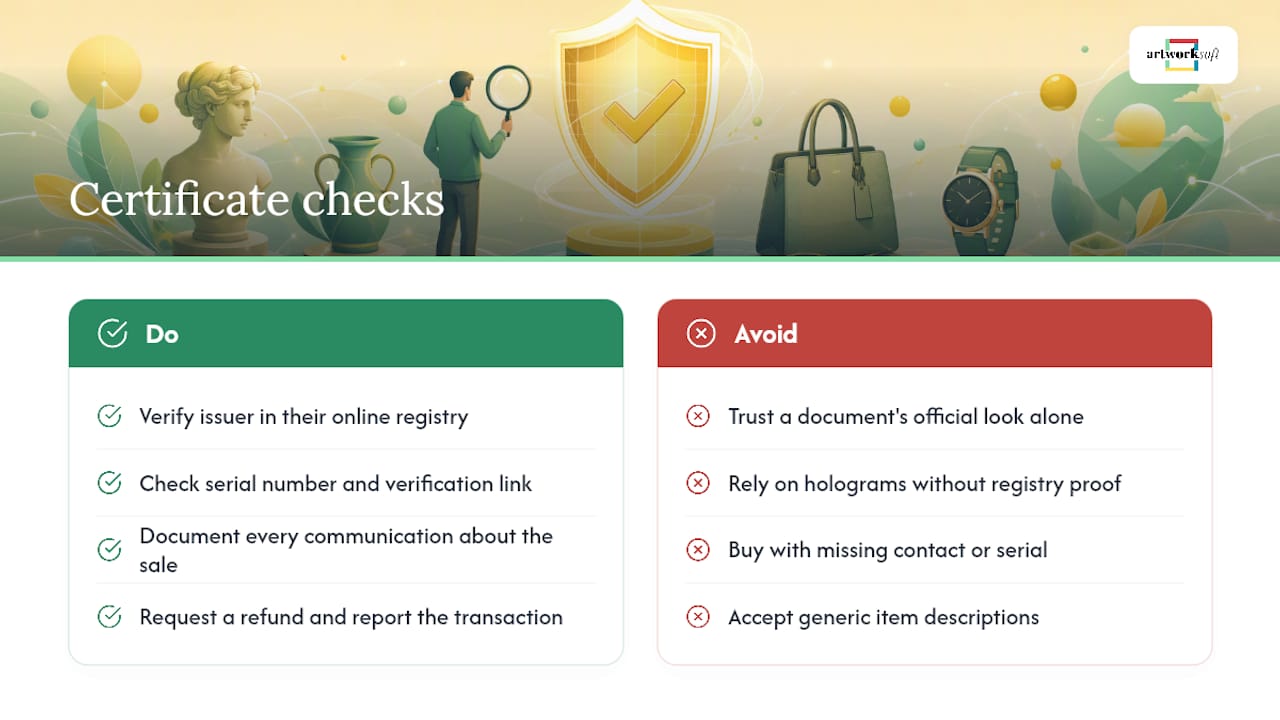
- Counterfeit holograms and security stickers. Holograms feel like proof, but they can be remanufactured cheaply, and guides for collectors note that holograms alone mean little unless tied to an issuer-managed registry. A shiny sticker is not a verification system.
- Reused or invented serial numbers. Some forged COAs print a serial that links nowhere, or one already assigned to a different item entirely. Others use a working-looking format with no registry behind it at all.
- Issuer impersonation. Fraudsters invent authentication companies with official-sounding names, sometimes with a working but empty website, to lend false legitimacy to a fake COA.
- Item-swapping fraud. A COA is real, but it’s been separated from its original item and paired with a fake or a different piece entirely, a risk that item-level photo pairing is specifically designed to prevent.
The scale of this problem isn’t theoretical. Sports Illustrated documented a long-running counterfeit operation that used forged certificates of authenticity to move fake autographed memorabilia through the market for years, generating what investigators described as a billion-dollar counterfeit trade before it unraveled. That’s not a niche problem limited to flea markets. It touched auction houses, dealers, and buyers who assumed a certificate meant something on its own.
What to Check on the Physical Document
A legitimate certificate carries specific information, and its absence is itself a warning sign. Before you evaluate materials or printing quality, confirm the basics are actually present.
- Issuer’s name and verifiable contact information, not just a logo
- A serial or registration number tied to a record you can look up independently
- A detailed, specific description of the item, not generic boilerplate
- A photograph of the actual piece or signature, not a stock image
Collector guidance consistently flags a missing serial number, absent issuer contact details, or a generic item description as red flags, regardless of how polished the document looks otherwise.
Once the content checks out, look at the materials. Legitimate issuers increasingly build in physical security that’s expensive and difficult to replicate. Premium paper stock combined with watermarks, fluorescent security fibers, and serialized holograms makes duplication far harder than a home printer or a basic laminator can manage. Check the paper under a light for a watermark. Look for raised or embossed seals rather than flat ink stamps. Run your finger over any hologram, genuine security holograms are usually embedded in the paper stock, not applied as a peel-off sticker.
Design details matter too. Compare the logo against the issuer’s official website pixel by pixel if you have to. Fonts should be consistent throughout the document, not mixed weights or slightly different typefaces in different sections, a common tell when a forger has edited a scanned template. Blurry or pixelated images on an otherwise clean document usually mean the certificate was copied and reprinted rather than issued fresh.
Finally, confirm that any serial or hologram code printed on the certificate also appears on the item itself, engraved, embossed, or on an attached tag, as recommended by examples like IPalpiti Artists International. A COA whose codes exist only on paper, with nothing matching on the physical piece, is far easier to detach and reattach to something else entirely.
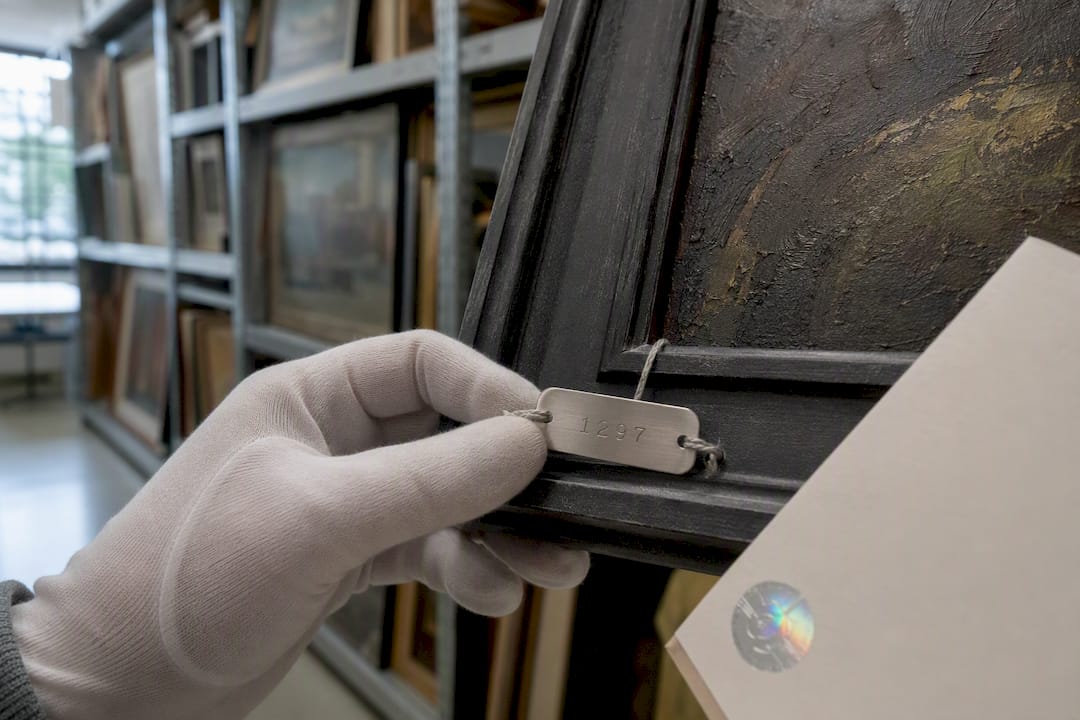
Pro Tip: Photograph the certificate and the item together, showing both serial numbers in the same frame, before you finalize any purchase. That single image becomes your own record if a dispute comes up later.
Using Digital Verification to Confirm a Certificate
Physical inspection catches sloppy forgeries. Digital verification catches the sophisticated ones, because it checks the certificate against a record the forger doesn’t control.
- Scan the printed QR code with your phone’s camera
- If there’s no QR code, type the verification URL directly into your browser rather than clicking a link embedded in the document
- No URL either? Search the serial number directly on the issuer’s official website
Verification providers describe these three methods, QR scan, URL entry, and serial lookup, as the fastest ways to confirm a certificate, and a genuine result should return specific information: the recipient’s or owner’s name, the item description, the issuing organization, and the date of issue. A record that only says “verified” with no supporting detail is not much of a verification at all.
It’s worth understanding what you’re actually looking at. Simple online registries are just databases the issuer maintains and updates manually, which works fine as long as the issuer is reputable and the database is current. Blockchain-backed verification takes a different approach, recording the certificate on a distributed ledger that can’t be edited retroactively, which adds a layer of tamper resistance that a standard database doesn’t have. Neither approach guarantees the underlying item is authentic. Both only confirm the certificate itself is genuine.
Watch for these digital red flags: a verification link that returns a 404 error or a generic “page not found,” a record that shows no item photo or a photo that doesn’t match your piece, or a database entry with placeholder text where real details should be. Any of these should stop a transaction cold until the issuer clarifies.
When to Bring in a Professional Authenticator
Some situations call for more than a checklist. High-value items, contested provenance, or a certificate you simply can’t verify through normal channels are all good reasons to hire an independent authenticator rather than guess.
- Expect fees that vary by category and service level, with providers commonly charging in the range of $50 to $200 or more per item, and categories like fine watches, jewelry, and designer handbags often sitting toward the higher end
- Authenticators examine far more than the paper certificate: materials, construction, signature characteristics, and how the item’s history lines up with known provenance
- A professional authentication report becomes its own standalone record, one that can outlast a disputed or lost original COA and strengthen the documented history behind an artwork’s price
- Replacement certificates for lost or damaged originals often carry an additional fee separate from the initial authentication charge
For collectors and sellers managing multiple pieces, Artworksoft’s art documentation tools support this process by keeping provenance records, prior valuations, and item photos organized and ready to hand to an authenticator when the question comes up.
What to Do Right Now If You Suspect a Fake
If something about a certificate feels off, work through this order rather than reacting to any single red flag in isolation.
- Stop the payment. Don’t send funds, release an item, or finalize a sale until verification is complete. A legitimate seller or issuer won’t rush you past this step.
- Request official verification directly. Contact the issuer through their published website or listed phone number, never through contact information printed only on the certificate itself.
- Run the digital check. Scan the QR code or enter the verification URL, then compare the serial number, item photo, and description against your piece.
- Document everything. Save screenshots of any verification attempt, save your messages with the seller, and note dates and times. This record matters if you need a refund or have to file a dispute.
- Request a refund if verification fails. A failed or missing verification record is grounds to walk away from the deal, and most reputable marketplaces or payment processors will back a documented refund request.
- Escalate for high-value or unresolved cases. If the item is expensive or the issuer is unresponsive, submit it to a recognized third-party authenticator and report the seller to the marketplace or platform where the transaction took place.
Pro Tip: Keep a simple folder, physical or digital, for every certificate, photo, and message tied to a purchase. If a dispute happens six months or six years later, that folder is what gets your money back.
Sellers face the mirror image of this problem, and buyer skepticism is often justified. If your own documentation doesn’t hold up to this same scrutiny, that’s worth fixing before a buyer flags it first. Reviewing your art identification and traceability practices is a reasonable place to start.
Why Verifiable Documentation Protects Everyone in the Market
Collectors who insist on verifiable COAs aren’t being difficult. They’re protecting resale value that a vague or unverifiable certificate quietly erodes. A buyer three transactions down the line has no way to trust a paper document alone, but a serial number tied to a live, item-specific record still checks out years later.
Digital, item-level records shrink the fraud window because they remove the anonymity forgers depend on. A certificate copied from a template falls apart the moment someone tries to match it against an issuer’s database and finds nothing, or finds someone else’s item. Sellers who adopt this standard, generating documentation through a platform like Artworksoft, rather than a generic template, build a track record that holds up under scrutiny instead of collapsing under it.
Give Buyers a Certificate They Can Actually Verify
Handwritten certificates and generic templates leave buyers guessing, and guessing is exactly what forgers count on. Artworksoft generates certificates of authenticity that pair each document with the item’s own photo, a unique serial number, and a verification-ready PDF a buyer or authenticator can check against your records directly.

The platform keeps provenance, movement history, and prior valuations centralized in one place, so when a buyer, an insurer, or an authenticator asks for backup, you’re exporting a complete record instead of reconstructing one from memory. That kind of documentation is what turns a certificate from a piece of paper into evidence a market participant can trust. Start with the free plan and generate your first verification-ready certificate for an existing piece in your collection today.
Frequently Asked Questions
Can a certificate of authenticity really be faked?
Yes. Certificates of authenticity are copied, reprinted, and issued by fake companies regularly, which is why verification through the issuer’s own registry matters more than how official the document looks.
How much does a legitimate certificate of authenticity cost to obtain?
Certificate of authenticity cost varies widely by issuer and item type, but professional authentication services commonly charge in the $50 to $200-plus range per item, with higher-value categories often at the top of that range.
What are the most obvious signs of a forged certificate of authenticity?
Missing issuer contact information, no serial number, a dead or nonexistent verification link, and generic item descriptions are the clearest warning signs of fake memorabilia certification or a counterfeit authenticity certificate.
Do holograms on a certificate guarantee it’s real?
No. Holograms and security stickers can be remanufactured, so they only mean something when tied to a serial number you can verify in an issuer’s online registry.
What should I do if I already paid for an item with a fake certificate?
Document every communication, request a refund citing the failed verification, and report the transaction to the marketplace or payment platform where the sale occurred.
Sources
For deeper background on forgery cases and verification standards, see Sports Illustrated’s reporting on memorabilia fraud and Artworksoft’s digital documentation guide.
- Sports Illustrated — Billion-dollar counterfeit scheme rocks autographed sports memorabilia market
- Hahnemühle — My Art Registry / Holographic security
- SWAU — How to check a certificate of authenticity











