


A reserve price is the confidential minimum a seller will accept for artwork at auction. Understanding how artwork reserve pricing works separates informed sellers and collectors from those who leave money on the table or watch lots go unsold. This guide covers the mechanics of reserve prices, the formulas that support defensible valuations, and the negotiation dynamics between auction houses and consignors. Artists, gallery owners, and collectors will find practical frameworks here for setting reserves that protect value while keeping bidding competitive.
How does reserve price function in an artwork auction?
A reserve price is set privately during the consignment process, before the auction begins. It is the floor below which the seller refuses to sell, and it remains hidden from bidders throughout the event. This confidentiality is deliberate. Disclosing the reserve would remove the competitive tension that drives prices upward.
The reserve price differs from two other figures buyers often confuse it with: the starting bid and the public estimate. The starting bid is the opening number the auctioneer calls out to ignite competition. It is public and typically set well below the reserve. The public estimate, published in catalogs by houses like Christie’s and Sotheby’s, reflects the auction house’s expectation of where bidding will land. The reserve typically aligns with or sits slightly below the published low estimate.
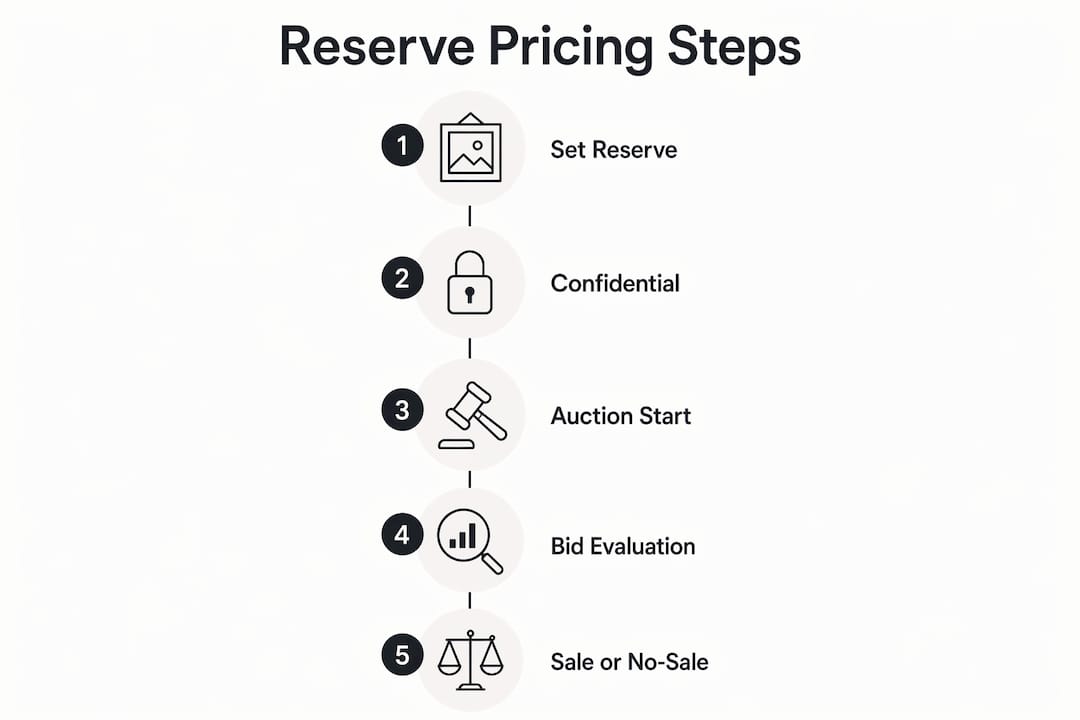
Here is how the sequence plays out during a live auction:
- The auctioneer opens bidding at the starting bid, which may be 30%–50% below the reserve.
- Bids rise incrementally. The auctioneer tracks progress against the undisclosed reserve.
- Once bidding crosses the reserve threshold, the lot is “on the market” and will sell to the highest bidder.
- If bidding stalls below the reserve, the auctioneer may signal the seller in real time to lower it.
- If no agreement is reached, the hammer falls and the lot is passed, meaning it goes unsold.
An unsold lot carries real consequences. It creates a public record of failure that can suppress future valuations and bidder confidence. Post-auction negotiations are possible. A buyer who bid close to the reserve may approach the auction house within 24–48 hours to negotiate a private sale, but the seller is under no obligation to accept.
Pro Tip: Setting your reserve below the low public estimate, rather than at or above it, builds bidding momentum and reduces the risk of a passed lot. Auctioneers at major houses consistently recommend this approach.
What pricing formulas inform a strong reserve?
Defensible reserve prices start with a defensible base price. Artists who price artwork using structured formulas produce numbers they can explain and defend in any negotiation. Two formulas dominate professional practice.

The Time and Materials Formula calculates base price as: (Hourly Wage × Hours Worked) + Cost of Materials. This method grounds the price in real production cost. A painter who spends 40 hours on a canvas and pays herself $30 per hour, with $200 in materials, arrives at a base price of $1,400. That figure becomes the floor for any reserve conversation.
The Square Inch Formula scales price by physical size and career stage. Emerging artists typically command $1–$3 per square inch. Established artists with gallery representation and auction history can command $10 or more per square inch. A 16×20 inch canvas at $3 per square inch prices at $960. At $10 per square inch, the same canvas reaches $3,200. Career stage multipliers adjust the formula upward as an artist’s market presence grows.
Key factors that modify either formula include:
- Gallery commission adjustment: Gallery commissions can exceed 50%, so the retail price must be calculated as: Base Price divided by (1 minus Commission Rate). A $1,000 base price with a 50% commission requires a $2,000 retail price to preserve the artist’s income.
- Success modifier: Consistent sell-through rates, exhibition history, and press coverage justify upward adjustments.
- Market comparables: Recent auction results for similar works by artists at the same career stage anchor the price to real market data.
| Pricing Method | Best For | Reserve Setting Implication |
|---|---|---|
| Time and Materials | Emerging artists, commissions | Sets a hard cost floor for the reserve |
| Square Inch Formula | Painters, printmakers, photographers | Scales reserve with career stage |
| Market Comparables | Established artists with auction records | Anchors reserve to verifiable sales data |
Pro Tip: Consistent pricing across all sales channels, galleries, studios, and auctions, builds collector trust. Arbitrary price swings signal instability and suppress reserve credibility.
Biannual price reviews are the professional standard. Raise prices only when consistent sales, increasing demand, and improved market presence support the change. Arbitrary increases undermine the defensibility of any reserve you set.
How do auction houses and sellers negotiate reserve prices?
Auction houses occupy an unusual position in reserve negotiations. They act as dual agents representing both the buyer and the seller simultaneously. This creates a structural conflict of interest that every consignor should understand before signing a consignment agreement.
The auction house earns its commission from the buyer’s premium and, in some arrangements, a seller’s commission as well. A sale at any price generates revenue. A passed lot generates nothing. This incentive structure can push auction house specialists to recommend lower reserves than the seller’s interests warrant.
“Transparent discussion between auction houses and sellers on reserve pricing mitigates conflicts of interest and helps align expectations and commissions.” This principle, drawn from analysis of auction house practices, is the single most protective step a consignor can take before any auction.
Sellers who understand this dynamic negotiate more effectively. The following practices protect consignor interests:
- Request a written explanation of how the specialist arrived at the recommended reserve.
- Compare the recommended reserve against recent comparable auction results from public databases.
- Ask explicitly whether the auction house receives any financial benefit from a lower reserve.
- Retain the right to withdraw the lot if the reserve is lowered without consent.
Savvy gallery owners treat the reserve negotiation as seriously as the consignment fee negotiation. Both directly affect the net proceeds from a sale.
Reserve auctions vs. absolute auctions: what are the trade-offs?
An absolute auction carries no reserve. The highest bid wins regardless of price. This structure increases bidder confidence because every participant knows the lot will sell. Competitive bidding tends to be more aggressive as a result.
The trade-off is real risk of undervaluation. A work that might command $15,000 under normal conditions could sell for $4,000 if the room is thin on a given day. For artists and estates, that outcome creates a damaging public price record.
Reserve auctions protect against that outcome. The seller retains control over the minimum acceptable outcome. The cost of that protection is the possibility of a passed lot and the reputational signal it sends.
| Factor | Reserve Auction | Absolute Auction |
|---|---|---|
| Seller price protection | Yes, via confidential minimum | None |
| Bidder confidence | Moderate | High |
| Risk of unsold lot | Present if reserve is too high | None |
| Best for | Established artists, high-value works | Estate clearances, time-sensitive sales |
| Post-auction negotiation | Possible | Not applicable |
Sellers should choose between these structures based on three factors:
- Urgency of sale: Estate liquidations and time-sensitive situations favor absolute auctions.
- Work value and uniqueness: Significant or irreplaceable works warrant reserve protection.
- Market conditions: Current modern art market trends affect buyer appetite and should inform whether a reserve or absolute structure is more likely to produce a strong result.
Auction estimates also play a role in this decision. Auction estimates signal market confidence and are derived from condition reports, provenance research, rarity assessments, and recent comparable sales. A strong estimate range supports a higher reserve. A narrow or uncertain estimate range suggests a more conservative reserve to avoid a passed lot.
Key takeaways
Reserve pricing is the most direct tool sellers have to protect artwork value at auction, and it works only when grounded in a defensible, formula-based valuation.
| Point | Details |
|---|---|
| Reserve price definition | A confidential minimum price set before auction; the lot goes unsold if bids fall short. |
| Formula-based valuation | Use Time and Materials or Square Inch formulas to establish a defensible price floor before setting any reserve. |
| Auction house conflict | Auction houses benefit from sales at any price; sellers must negotiate reserves independently and in writing. |
| Reserve vs. absolute | Reserve auctions protect value; absolute auctions drive bidder confidence but risk undervaluation. |
| Pricing discipline | Raise prices only when sales data supports the increase; biannual reviews maintain credibility. |
Setting reserves that actually hold up
I have worked with enough artists and gallery owners to know that the reserve conversation usually happens too late. By the time a consignor is sitting across from an auction house specialist, they often have no independent valuation to anchor the discussion. The specialist’s recommendation becomes the default, and that recommendation is shaped by the house’s commission interests, not the seller’s.
The fix is straightforward. Build your pricing structure before you ever approach an auction. Use the Time and Materials formula or the Square Inch method to establish a base price you can defend with documentation. Then treat the reserve as a percentage of that number, not as a figure the auction house hands you.
The artists I have seen achieve the strongest auction results are those who arrive with a pricing history: consistent gallery prices, documented sales, and a clear record of price progression tied to career milestones. That record gives them standing to push back when a specialist recommends a reserve that undervalues the work.
One more thing: do not confuse a passed lot with a failed career. A work that does not sell at auction because the reserve was not met is not a market rejection. It is a pricing signal. Review the comparable sales, adjust the reserve for the next opportunity, and relist. The artists who treat passed lots as data points rather than defeats are the ones who build durable market positions over time.
— Nealda
Manage your artwork pricing with Artworksoft
Pricing discipline requires organized records. Without a clear view of your inventory, sales history, and valuation data, setting a defensible reserve becomes guesswork.

Artworksoft is an art management system built for artists, collectors, and galleries who need to connect pricing, inventory, and transaction records in one place. The platform’s structured valuation tools help you apply consistent pricing formulas across your catalog, track artwork movements, and generate professional documentation like Certificates of Authenticity. When auction season arrives, your pricing history is already documented and ready to support any reserve negotiation. Start your free art inventory with Artworksoft and build the pricing foundation your work deserves.
FAQ
What is a reserve price in art auctions?
A reserve price is the confidential minimum a seller will accept for a work at auction. If bidding does not reach this threshold, the lot goes unsold and no sale occurs.
How is a reserve price different from a starting bid?
The starting bid is the public opening figure the auctioneer calls to begin competition. The reserve price is private and set higher, representing the actual floor below which the seller will not sell.
Where should i set my reserve relative to the estimate?
The reserve price typically aligns with or sits slightly below the published low estimate. Setting it below the low estimate builds bidding momentum and reduces the risk of a passed lot.
Can i negotiate after a lot goes unsold?
Yes. Post-auction private negotiations are possible, typically within 24–48 hours of the sale. The buyer who bid closest to the reserve may approach the auction house, but the seller retains full discretion to accept or decline.
How often should artists review their pricing?
Biannual price reviews are the professional standard. Price increases should be supported by consistent sales, growing demand, and documented career progression, not applied arbitrarily.











