

Use a defensible formula: calculate your base cost (materials, hourly floor, overhead), then apply a per-inch or index multiplier and adjust for channel. Calculate the base cost for one piece today, pull two or three comparables to check yourself, then repeat the process across your catalog. Three worked examples later in this guide show the math for a small piece, a mid-size framed work sold through a gallery, and a large studio piece priced with an index number.
Methodology:
- Use a documented cost-plus method to determine a solid base price that includes materials, labor, and overhead, and never sell below this number.
- Most artists should apply a consistent multiplier or index based on size, medium, and career stage, adjusting for sales venue and market expectations.
- Presenting artwork in tiered formats and rounding prices to clean figures can influence buyer perception and justify premium pricing with certificates of authenticity.
- Regularly record sales to inform gradual price increases of 10 to 20 percent per year, avoiding sudden jumps and protecting the perceived value of your work.
How Do You Calculate the Base Cost of a Painting?
Base cost is the floor beneath every price you set. It’s the sum of materials, labor, and overhead, and it’s the number you should never sell below regardless of how a buyer negotiates.
Start with materials. Track canvas or panel, paint and mediums, framing, varnish, and packaging or shipping supplies. These costs vary widely by medium, and a supply list you update per piece prevents the slow creep of underpricing that happens when artists round down from memory.
Labor is the piece most artists skip, and it’s the one that sinks their income. Set an hourly wage the way any skilled trade would: reference market wages for comparable creative labor, using Bureau of Labor Statistics data as one sanity check, then adjust up as your reputation and demand grow. A working studio artist should not price their hours below what a skilled contractor charges.
Overhead gets allocated per piece rather than ignored. That means:
- Studio rent or utilities, divided across your expected monthly output
- Software subscriptions, marketing costs, and website fees
- Shipping, framing labor, and insurance
- A portion of self-employment tax reserved before profit is calculated
Add these three categories together and you have a base price. Cost-plus pricing built this way. Everything from here is markup and positioning.
What Are the Main Art Pricing Formulas?
Once you have a base cost, you need a system to translate size and quality into a consistent price across your whole body of work. Five approaches dominate professional practice, and most working artists end up blending two of them.
- Square-inch formula. Multiply width by height to get square inches, then multiply by a dollar-per-square-inch rate (for example, a 16x20 canvas at $4 per square inch runs $1,280 before framing or markup). This scales cleanly but can undervalue detailed small works and overvalue simple large ones.
- Linear-inch formula. Add width plus height instead of multiplying them, then apply a rate per linear inch. It produces gentler price jumps between sizes, which suits artists who work across many dimensions.
- Hourly (cost-plus) method. Multiply your hourly wage by hours worked, add materials and overhead. This works best as a floor check against the other formulas rather than a standalone system, since two pieces of identical size rarely take identical time.
- Index or multiplier system. A single number, tied to career stage and medium, multiplied against size to generate a price across your entire portfolio. Index numbers are what most galleries expect to see, because they signal a repeatable logic rather than a guess.
- Hybrid approach. Calculate the square-inch or index price, then confirm it clears your hourly floor and covers materials. If it doesn’t, raise the multiplier rather than discounting the labor.
Pick one primary formula and use the hourly method only as your floor. Consistency, not the formula itself, is what convinces buyers your prices are real.
How Do You Find Comparable Art Prices?
Comparables tell you whether your formula lands in the range your market will actually pay. Pull data from artists at a similar career stage, working in the same medium, selling through similar venues, before you finalize any price.
Compare on four dimensions: size, medium, exhibition or sales venue, and career stage relative to yours. A price from a 30-year mid-career sculptor tells you little if you’re two years into painting.
Good sources include:
- Artist websites that list retail prices publicly
- Gallery price sheets from artists at a comparable level
- Marketplace listings (Saatchi Art, Artsy, and similar platforms) filtered by size and medium
- Exhibition catalogs and juried show records, which often list sold prices
Convert what you find into a per-inch or index rate, then check it against your hourly floor. If the market rate falls below what your labor and materials require, that’s a signal to reconsider your venue, not to underprice your time.
How Do Gallery Commissions Affect Your Prices?
Gallery commissions typically run between forty and fifty percent, and that split has to be built into your retail price before the work ever reaches the wall. If a gallery takes half, your retail price needs to be roughly double what you’d need to net directly, not a modest bump above your studio price.
The math: if your net target is $600, a 50% commission means the retail price is $1,200. Saatchi Art’s pricing guidance confirms this is standard practice, not an artist-unfriendly exception.
Wholesale or trade pricing, common with interior designers and hospitality buyers, typically runs 20% to 50% below retail. Reserve those discounts for genuine bulk or trade relationships, not for anyone who asks.
- Never let your gallery price undercut your direct-sale price
- Keep wholesale terms in writing and limited to qualifying buyers
- Treat your website price as the anchor every other channel prices against
Selling the same painting for different prices across channels is the fastest way to lose credibility with both collectors and dealers, since either group can find the discrepancy in minutes.
Does Presentation Change What Buyers Will Pay?
Presentation doesn’t change your formula, but it changes what buyers are willing to accept as fair. Tiered offerings (small studies, mid-size editions, signature large works) give buyers an entry point and an aspirational target in the same collection.
Charm pricing works differently in art than in retail. A price of $980 instead of $1,000 can look like an odd attempt to dodge a round number; many collectors respond better to clean figures that suggest confidence rather than negotiation room.
- Offer three tiers per collection: entry, mid, and signature
- Round to clean numbers ($800, not $795) once you’re past very small studies
- Use a certificate of authenticity, framing quality, and provenance notes to justify premium pricing without touching your core formula
Pro Tip: A well-presented certificate of authenticity often does more to justify your price than another round of negotiation. Buyers pay for confidence as much as for canvas.
How Often Should You Raise Your Art Prices?
Detailed sales records are your best evidence when a price increase needs defending, whether to a collector who bought last year or a gallery weighing your next show. Note the date, price, buyer type, and venue for every sale, and that history becomes the argument for your next number.
Pacing matters more than magnitude. Industry guidance recommends increases of roughly 10% to 20% per year, or increases tied to milestones like a museum acquisition, a press feature, or a sold-out series.
Modest, consistent increases beat sudden jumps. A 10% to 20% annual adjustment, or a raise tied to a genuine career milestone, keeps collectors from feeling blindsided and keeps your pricing history coherent.
Avoid raising prices out of frustration after a slow month, and avoid dropping them out of panic. Announce increases at natural points, a new series launch, a show opening, rather than mid-inventory on existing unsold work.
Three Worked Pricing Examples You Can Copy
Numbers make this concrete. Here’s how the formulas above play out for three different artist profiles.
Example 1: Small emerging work. An 8x10 acrylic painting (80 square inches) at $3 per square inch gives a base of $240. Materials run $25, and 6 hours of labor at $20 an hour adds $120. Total cost-plus floor: $145, comfortably under the $240 formula price, so $240 to $260 is defensible after overhead.
Example 2: Mid-career framed work with gallery placement. A 24x30 framed oil (720 square inches) at $5 per square inch gives $3,600 direct. The artist wants to net $1,800 through a gallery taking 50% commission, which sets the gallery retail price at $3,600, matching the direct formula and keeping channels consistent.
Example 3: Large studio piece with an index number. A 48x60 mixed-media piece uses an index number of 6 (tied to ten years of career history and gallery representation) multiplied by size in inches, generating a price around $17,280, then adjusted upward for a recent museum feature that justifies a perceived-value premium.
| Example | Size | Method | Base Price | Adjustment |
|---|---|---|---|---|
| 1. Emerging artist | 8x10 (80 sq in) | $/sq in + hourly floor | $240 | Confirmed above $145 cost floor |
| 2. Mid-career, gallery | 24x30 (720 sq in) | $/sq in with 50% commission math | $3,600 retail | Nets $1,800 after gallery split |
| 3. Established studio | 48x60 | Index number (6x) | $17,280 | Increased for milestone premium |
Run your own numbers through whichever method fits your medium, then cross-check against the hourly floor from your base cost calculation. If the formula price and the floor disagree by a wide margin, trust the floor first.
Why Index Numbers and Gradual Increases Work
Structured, transparent metrics give artists something a gut feeling never can: a number they can explain to a skeptical gallery director in one sentence. Comprehensive pricing guidance for artists treats square-inch formulas and index numbers as the backbone of scalable pricing, precisely because they remove the guesswork that makes buyers uneasy.
Index numbers are numeric multipliers tuned to medium and career stage. Applied consistently across a portfolio, they prevent emotional or inconsistent pricing and make future price increases predictable rather than arbitrary.
That single move is also the strongest card you hold when negotiating gallery representation, since a dealer can see exactly how your prices will evolve rather than wondering if you’re pricing by mood.
How Should Pricing Differ by Medium?
A painting, a sculpture, and a digital file carry different cost structures, and pricing them with one blanket formula misses real differences in materials and market expectations.
Paintings fit the square-inch or linear-inch model most naturally, since canvas size correlates directly with material and time investment. Framing adds a separate line item, not a buried cost, so buyers understand what they’re paying for.
Sculpture resists per-inch math because volume, not surface area, drives material and fabrication cost. Bronze casting, welding, or stone carving each carry different per-hour labor demands, so sculptors often price closer to a cost-plus model with a healthy multiplier for scarcity, since three-dimensional work is harder to reproduce and typically commands a premium over comparable-size paintings.
Digital art breaks the physical-materials assumption entirely. There’s no canvas or frame, so the formula shifts almost entirely to labor, software costs, and the value of exclusivity, whether through a numbered edition, a signed print, or a unique file transfer. Digital pieces sold as one-of-one originals should price closer to unique physical work; digital pieces sold as open editions need a print-run model instead, closer to the reproduction pricing discussed next.
Whatever medium you work in, keep the same underlying discipline: base cost first, then a multiplier suited to that medium’s market, never a price pulled from comparing yourself to an unrelated discipline.
How Do Limited Editions and Reproductions Affect Price?
An original one-of-a-kind piece and a print of that same image are not the same product, and pricing them identically undersells the original while overpricing the print.
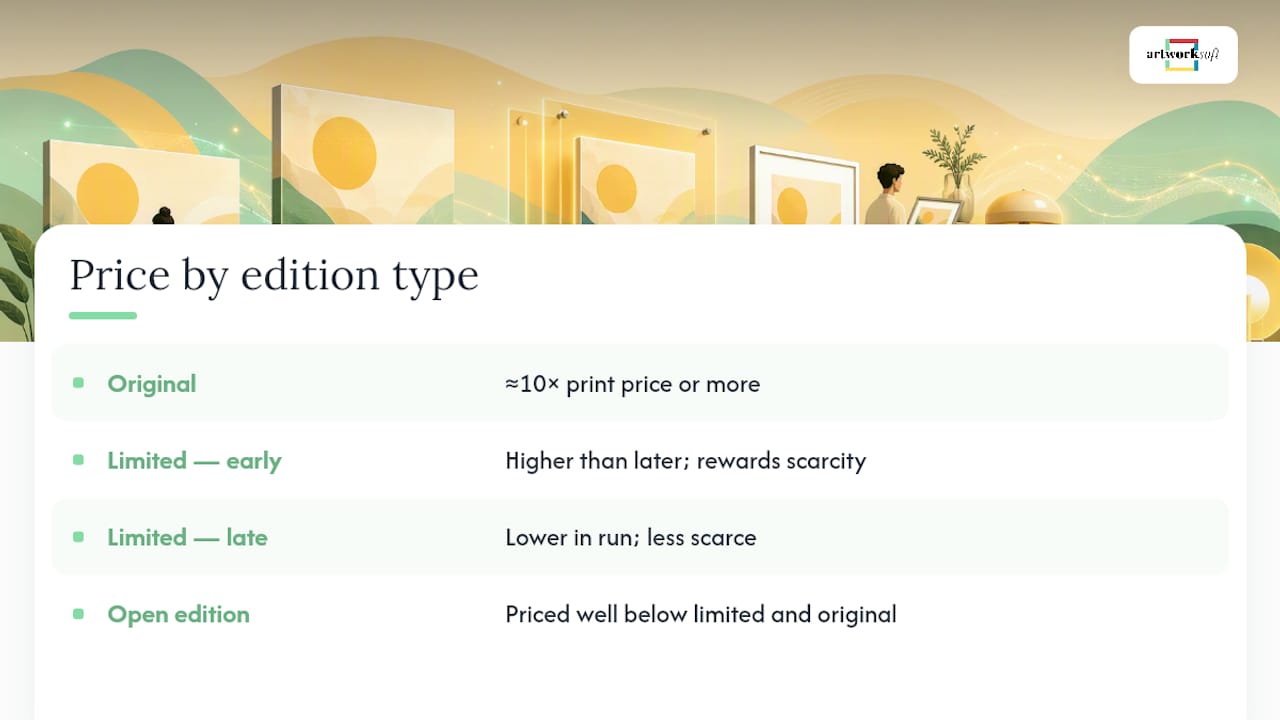
Limited editions should price on a sliding scale tied to edition size and position within the run. A print numbered 2 of 25 can reasonably cost more than number 20 of 25, since scarcity increases as the edition closes. A common structure: set a base print price, then increase it by a fixed percentage every few numbers sold, so early buyers are rewarded and your total edition revenue climbs as availability shrinks.
Open editions and reproductions, prints with no cap on quantity, should price well below both the original and any limited edition, since they carry none of the scarcity value collectors pay for. Treat these as accessible entry points into your work rather than investment pieces, and say so plainly in your listing.
The original itself should never be priced as if it competes with its own prints. If a giclée print of a painting sells for $150, the original oil should sit at a multiple reflecting the hours, materials, and uniqueness a reproduction can’t replicate, often ten times the print price or more depending on size and medium. Keeping that gap wide and consistent protects the value of both the original and the smaller print business built around it.
Should Commissions Be Priced Differently Than Ready-Made Work?
Commissioned pieces carry a different risk profile than ready-made inventory, and the pricing needs to reflect that rather than mirror your existing price list.
A ready-made piece already exists; a buyer either purchases it or moves on, and the artist’s time is already spent. A commission requires the artist to commit hours before knowing whether the buyer will be satisfied, plus the added labor of revisions, communication, and custom sizing.
This protects you if a client backs out mid-project and signals to the buyer that custom work carries real cost from the first sketch.
Be explicit about what’s included. Revisions beyond an agreed number, rush timelines, or significant scope changes (a size increase mid-project, an added figure in a portrait) should carry a stated additional charge, agreed to before work begins rather than negotiated after the piece is finished. A written agreement outlining size, medium, deposit, timeline, and revision limits prevents the scope creep that quietly erodes the hourly rate you calculated at the start.
Can You Discount Art Without Hurting Its Value?
Discounting is where careful pricing work gets undone fastest, and the mistake is almost always doing it publicly and repeatedly on the same pieces.
Never discount the marked retail price visible to the public. Instead, offer value-adds at the same price: free shipping, a bonus small print, or expedited framing. The number on the tag stays intact.
Structured collector incentives work better than public discounts. A repeat-buyer program, a bundle price for purchasing two works together, or an early-access preview for past collectors rewards loyalty without touching the public price point.
If inventory genuinely needs to move, retire the piece from public listing and offer it privately to your collector list at a reduced price, framed as an unlisted or archive sale rather than a markdown. That keeps your active catalog’s pricing integrity intact while still clearing older work.
Sales tied to occasions, an anniversary show, a studio milestone, a charity partnership, read as intentional and time-bound rather than a signal that your prices are soft. The distinction that matters is whether a discount looks like a strategic event or a permanent retreat from your stated value.
What Should You Do Right Now?
Calculate the base cost for three of your current works using the materials, labor, and overhead method above. Collect three genuine comparables in your medium and career stage, then decide on one primary rate or index multiplier and apply it across your entire catalog rather than pricing piece by piece from memory.
Consistency beats perfection here. A defensible, repeatable system you can explain in one sentence will outperform a technically “correct” price you can’t justify to a buyer who asks how you got there.
— Nealda
A Practical Way to Automate Your Pricing Records
Artworksoft gives you a structured place to run the exact formulas covered above without rebuilding a spreadsheet every time you price a new piece. Its valuation tools apply consistent formulas across your catalog, so an index number or per-inch rate stays uniform whether you’re pricing your fifth painting or your five-hundredth.

The platform tracks inventory, generates Certificates of Authenticity and other professional documentation, and logs sales history so every price increase has a paper trail you can show a gallery or collector without digging through old invoices. It’s particularly useful once you’re managing gallery relationships, running limited editions, or scaling past the point where memory and spreadsheets can keep your channel pricing consistent.
If you’re ready to stop rebuilding pricing logic from scratch for every new piece, you can start a free plan at Artworksoft and set up your first valuation formula today.
Sources
- Art Business — Price changes guidance
- Professional Art Pricing Guide: Index Numbers by Medium, Career Stage, and Market Context
- How to Price Your Artwork – Help Center (Saatchi Art)
- How to Price Your Artwork: A Beginner’s Guide - The Art League