

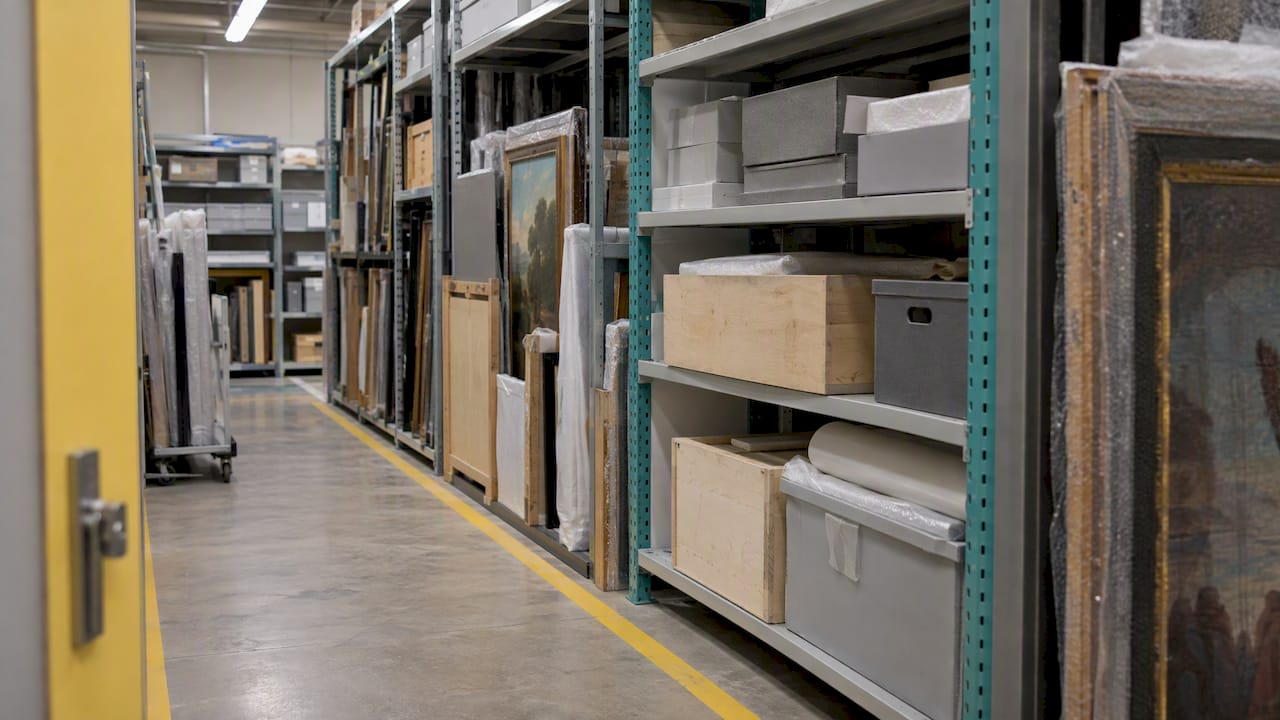
Use a building to floor to room or area to zone or rack to shelf or bin hierarchy, and give every fixed space a unique, immutable code recorded in a collections management system (CMS). Moveable furniture, such as rolling racks or map cases, gets linked to that fixed location as a container rather than treated as the primary code. We built Artworksoft to record these hierarchies and movement logs directly, so collection managers can enforce the structure instead of just documenting it on paper.
TL;DR:
- Multi site institutions should include building and floor levels, while galleries with multiple rack rows or flat files need row or drawer coordinates.
- For every move, record the mover, approver, departure and arrival condition checks, and start and end times; add transport details for fragile works.
- Give each object exactly one current location, preserve prior locations rather than overwriting them, and assign distinct codes to staging, quarantine, conservation, exhibit, and loan.
- Log every move on the day it happens, spot check locations monthly, complete a full inventory annually, and escalate mismatches to the responsible location owner.
- Restrict exact room and shelf details to authorized staff, remove precise coordinates from exports unless recipients need them, and log who views or exports records.
Table of Contents
- What a location hierarchy is and why fixed spaces come first
- Designing immutable, human- and machine-friendly location codes
- Creating sub and tertiary locations without breaking the hierarchy
- Transit locations and movement control that prevent lost items
- How to implement the hierarchy in a collections management system
- Maintain and audit location data on a routine schedule
- Practical templates: sample codes and a movement log entry
- Privacy and security considerations for location data
- Training staff on location hierarchy protocols
- Automating alerts for location changes and movement
- Trade-offs and quick wins for busy collection managers
- Artworksoft: a practical option to record location hierarchies and movement
- FAQ
- Sources
What a location hierarchy is and why fixed spaces come first
A location hierarchy breaks a storage facility into nested levels, each one narrower than the last. A typical structure runs: building, floor, room or area, zone or row or rack, then shelf or bin or container. A gallery might code its print storage as Building A, Floor 2, Room 204, Rack 3, Shelf B. A museum with multiple annexes needs the building level from the start; a single-room gallery can often skip straight to rack and shelf.
The practical risk collection managers run into is anchoring codes to furniture instead of architecture. If a code lives on a rolling rack and someone repositions that rack during a renovation, every artwork record tied to it becomes wrong. Architectural spaces do not move; furniture does. The ArchiveSpace location specification reflects this by requiring building, floor, and room as core fields, with up to three additional coordinate labels for finer detail.
Sub and tertiary levels earn their place in specific situations:
- Large repositories with multiple hanging-rack rows need a row identifier beneath the room level.
- Map cases and flat-file storage usually need drawer-level coordinates, since a single cabinet can hold dozens of works.
- Facilities expecting growth benefit from reserving unused codes in the sequence rather than renumbering later.
Designing immutable, human- and machine-friendly location codes
A good code schema holds up for decades, not just until the next inventory. Five principles keep it stable:
- Uniqueness: no two fixed spaces ever share a code, even across buildings.
- Immutability: once assigned to a fixed space, a code is never reused or reassigned, even if the space is emptied.
- Consistent ordering: every code follows the same building-floor-room-rack-shelf sequence so staff can read position at a glance.
- Machine readability: codes should work equally well typed into a database field or scanned from a label.
- Human clarity: a staff member unfamiliar with the collection should be able to locate a piece from the code alone, with minimal training.
Three common formats illustrate the trade-offs. A compact code like “A2-204-R3-SB” suits small collections with one building; it is short but assumes shared context. An extended code such as “BLDG-A.FLR-02.RM-204.RACK-03.SHELF-B” removes ambiguity for multi-site institutions at the cost of length. A barcode-backed scheme keeps a short human-readable code on the shelf label while the barcode itself links to the full location record in the CMS, which the Collections Trust procedure recommends pairing with a single authoritative location field per object.
Governance matters as much as the format. Decide early who can create or deprecate a code, and log every change with a timestamp and the staff member’s name.
Pro Tip: Reserve a block of unused codes at every level when you first build the hierarchy, so future expansion never forces a renumbering project.
Creating sub and tertiary locations without breaking the hierarchy
Each location record should model a parent-child relationship: a shelf belongs to a rack, which belongs to a room, which belongs to a floor. Tertiary levels, such as individual drawers in a flat-file cabinet or numbered slots in a hanging rack, follow the same logic one level deeper.
Assigning a single item to a location takes a handful of required fields: the location code, the date of the move, the staff member’s name, the reason for the move, and a brief condition note. Batch moves, such as relocating an entire rack during a renovation, need a pre-move validation step that confirms every item’s current code matches its physical position before the move starts, and a post-move verification pass that confirms the new codes before the old ones are retired.
Each location record itself should carry:
- A type designation (storage, display, transit, conservation).
- Capacity notes, including maximum items or weight.
- Environmental conditions, such as humidity control or light exposure.
- Access restrictions, including who is authorized to enter or retrieve items.
Transit locations and movement control that prevent lost items
Items in motion are where collections lose track of objects. A location hierarchy needs coded transit states: staging, quarantine, conservation, on exhibit, and on loan, each with its own code rather than a blank “in transit” note. The UNESCO handling of collections in storage guidance recommends treating these temporary locations with the same documentation rigor as permanent ones, since an undocumented transit state is how items fall into what practitioners call a system void.
Every movement record needs metadata beyond the destination code:
- Who moved the item and who approved the move.
- A condition check at both departure and arrival.
- The transport method, for high-value or fragile pieces.
- Start and end timestamps for the move itself.
SPECTRUM’s location and movement control standard requires an up-to-date current location alongside a full movement history for every object. One business rule keeps this enforceable: an object has exactly one current location at any moment, and the system preserves every prior location rather than overwriting it. High-value moves should route through an approval workflow before the code changes. Regular spot checks against this history catch missing items faster than waiting for a full inventory.
How to implement the hierarchy in a collections management system
Before touching software, gather floor plans for every storage space, assign an owner responsible for each room or zone, settle on a code format, and decide whether barcodes or QR codes will back up the human-readable codes.
- Create top-level location records for each building and floor first, so every lower-level record has a valid parent.
- Add rack, shelf, and bin records beneath each room, following the agreed code format without exception.
- Link each artwork record to its current location and link moveable containers, like rolling racks, as separate records tied to a fixed space.
- Set permissions so only authorized staff can create new codes, and require approval for high-value moves.
Done this way, retrieval time drops because staff search by code instead of memory, insurance readiness improves because every object has a documented chain of custody, and capacity planning becomes a query instead of a walkthrough. In Artworksoft, location and movement records link directly to each artwork’s profile, so a search for an object returns its current position and full movement history in one view. Readers evaluating a setup can review plan options or request onboarding support for the initial data migration.
Pro Tip: Build the full location hierarchy in the CMS before importing a single artwork record. Retrofitting codes onto thousands of existing entries takes far longer than starting clean.
Maintain and audit location data on a routine schedule
Location data decays without regular checking. A workable cadence logs every movement the day it happens, samples a subset of locations monthly for a physical spot check, and runs a full inventory annually.
Any mismatch gets flagged and escalated to the location owner before it becomes a conservation or insurance problem.
Four reports do most of the maintenance work:
- Occupied versus vacant locations, for capacity planning.
- The transit log, showing everything currently outside permanent storage.
- Recent movements, for a rolling audit trail.
- An exceptions list, flagging locations with mismatched or missing data.
ICCROM’s storage planning guidance notes that fixed storage typically occupies only 30% to 40% of available floor area, with the remainder reserved for access and workspace, a ratio worth checking against the occupancy report before adding new racking.
Practical templates: sample codes and a movement log entry
Three code formats cover most situations. A compact code, “A2-204-R3-SB,” fits a single-building gallery. An expanded code, “BLDG-A.FLR-02.RM-204.RACK-03.SHELF-B,” suits a multi-site institution where ambiguity is costly. A barcode-backed code keeps the shelf label short while the scan resolves to the full record.
A CSV-friendly location record template needs these columns: location code, type, parent location, capacity, environmental notes, access restriction, and date created. A movement log entry needs: object ID, origin code, destination code, mover name, approver name, condition note, and timestamp.
Worked example: a framed painting moves from storage shelf A2-204-R3-SB to the conservation bay, coded CONS-01, for cleaning, then returns. The movement log carries two entries, one for each leg, each with its own condition note and timestamp, so the full round trip stays visible in the object’s history rather than collapsing into a single unclear move.
| Field | Outbound entry | Return entry |
|---|---|---|
| Origin code | A2-204-R3-SB | CONS-01 |
| Destination code | CONS-01 | A2-204-R3-SB |
| Reason | Scheduled cleaning | Treatment complete |
| Condition note | Minor surface dust | Cleaned, no new damage |
Privacy and security considerations for location data
Location data is sensitive in ways that go beyond the artwork itself. A record showing exactly where a high-value piece sits, which door accesses it, and who is authorized to retrieve it is effectively a map for anyone with bad intent. Treat that data with the same access discipline applied to the objects it describes.
Role-based permissions matter more here than in most parts of a collection database. Staff who need to view an object’s general status do not necessarily need the exact shelf and room code; reserve that detail for people with a legitimate retrieval or audit task. An example of institutional practice comes from the National Galleries’ location and movement policy, which restricts updates to a central database to authorized staff only, with movement logs visible in near-real time to those who need them.
Export controls deserve particular attention. A full location export, whether for an insurance appraisal or a board report, should strip precise coordinates unless the recipient specifically needs them. Audit logs that record who viewed or exported location data, not just who edited it, close a gap many smaller institutions overlook. Cloud-based systems should carry standard safeguards: encrypted storage, regular backups, and a clear policy on who outside the organization, such as insurers or appraisers, ever receives raw location detail rather than a summarized status.

Training staff on location hierarchy protocols
A well-designed hierarchy fails the moment staff work around it instead of through it. Training needs to cover not just how to read a code, but why the immutability rule exists and what happens when someone skips the logging step to save time.
New staff benefit from a short, hands-on walkthrough: locate three objects using only their codes, then move one object and complete the full movement log entry before it is considered done. This catches the habits that cause misplacement faster than a slide deck ever will.
Refresher sessions matter after any change to the storage facility itself, a renovation, a new annex, or a reorganized room, since that is exactly when staff default to memory instead of the updated code. A short written reference, posted near each storage area, listing the active transit codes and who approves high-value moves, reduces the guesswork that leads to undocumented shifts.
The habit worth reinforcing above all others: no object moves without a corresponding log entry, even for a five-minute relocation. Institutions that treat this as a hard rule rather than a suggestion see far fewer unexplained gaps during annual inventory.
Automating alerts for location changes and movement
Manual spot checks catch problems after the fact. Automated alerts catch them as they happen. A CMS that supports rule-based notifications can flag a move the moment it falls outside normal parameters, rather than waiting for the next scheduled audit.
Useful triggers include a high-value object leaving its assigned zone without an approval record attached, an item remaining in a transit location, such as staging or conservation, past an expected return date, or a location nearing its stated capacity. Each of these conditions points to a real operational risk: an unapproved move, a forgotten return, or an overloaded rack.
Notifications work best when routed to the right person rather than broadcast to everyone. The location owner for a room, the registrar overseeing a loan, or the conservator handling a treatment should each get alerts relevant to their responsibility, not a flood of every system event. This keeps the alerts useful instead of becoming noise that staff learn to ignore.
Trade-offs and quick wins for busy collection managers
Strict immutability and full metadata on every move is the ideal, but a short-staffed gallery cannot always achieve it on day one. Be strict about the code format and the single-current-location rule from the start, since fixing those later means touching every record. Be pragmatic about how much environmental and capacity detail gets filled in immediately.
Three moves pay off fastest: a consistent code format applied from the first record, one authoritative current-location field that staff trust over memory or sticky notes, and a weekly habit of reviewing the movement log rather than letting it pile up. Retrieval-time savings and fewer insurance disputes justify the setup effort on their own.
— Nealda
Artworksoft: a practical option to record location hierarchies and movement
We built Artworksoft around the idea that a collection’s location data should be as reliable as its valuation data, not a side note kept in a spreadsheet. Artwork profiles link directly to current locations and carry full movement histories, so a search returns position and provenance together instead of requiring two separate lookups.
- The Free Plan lets a smaller collection set up its first location hierarchy and test the workflow before committing to anything.
- The Provenance Plan, from $5 per month, adds the capacity most galleries need for ongoing documentation alongside location tracking.
- Our Onboarding & Collection Management Service handles the initial data migration for institutions moving from paper logs or spreadsheets.
- Ongoing Collection Management support is available for collections that prefer a managed setup over handling it entirely in house.

Start with the free plan sign-up to build out a first set of location codes, or reach out through our onboarding page if a full migration makes more sense for your collection’s size.
FAQ
What is the hierarchy of art storage locations?
The standard hierarchy runs building, floor, room or area, zone or rack, then shelf or bin, with each level nested inside the one above it. Fixed architectural spaces anchor the top levels, while shelves and bins at the bottom can be adjusted as storage needs change.
Where is the best place to store artwork?
The best storage space maintains stable temperature and humidity, limits light exposure, and restricts access to authorized staff only. Beyond environmental control, the location needs a unique, documented code in the collection’s hierarchy so the piece can always be found and its movement history tracked.
What is the 2/3 rule for art?
This is not a recognized standard in collections management or museum storage guidance, and definitions vary depending on where the phrase is used. Readers encountering it in a different context, such as framing or composition, should treat it separately from location hierarchy and storage planning.
What is the 70/30 rule in art?
This phrase is not a standard term in museum storage or collections management guidance. It likely refers to a composition or design principle used elsewhere in the art world, unrelated to how storage locations are structured or coded.
How do I avoid losing track of artwork during a move?
Code every transit state, such as staging or conservation, the same way permanent storage locations are coded, and require a movement log entry with mover, approver, and timestamp for every move. Spot-checking a sample of locations monthly catches gaps before a full inventory would.
Sources
- SPECTRUM location and movement control
- Handling of collections in storage (UNESCO cultural heritage guidance)
- Specification for Locations (ArchiveSpace)
- ICCROM storage planning resources
- Location and movement control – suggested procedure (Collections Trust)