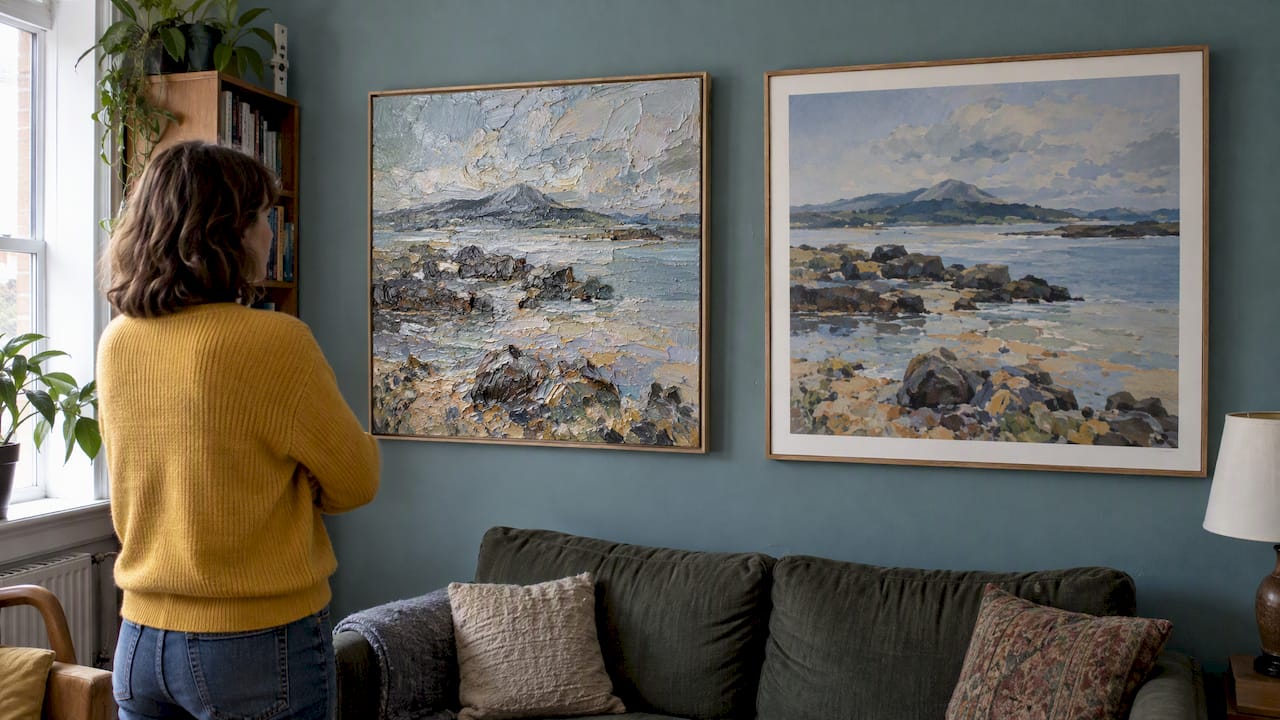
Prints usually sell for a fraction of the corresponding original, typically within a range influenced by edition size and finish quality. Photograph editions tend to be priced at a moderate fraction of a comparable unique work, while prints, silkscreens, and etchings sell for a somewhat lower fraction, according to market analysis of edition pricing. Edition size and finish quality are the two biggest variables behind that gap, and the sections below walk through the math and the steps artists and buyers can use to apply it.
TL;DR:
- Photograph editions commonly sell for 5% to 15% of a comparable original, while etchings and silkscreens usually fall between 3% and 10%.
- A $3,000 original might support a $450 print in an edition of 25, but an edition of 100 may bring the price near $150.
- Artists using cost plus pricing should add a 30% to 50% margin after counting printing, materials, packaging, and shipping costs.
- Artists should state and honor the edition size, sign and number each print, and provide a Certificate of Authenticity to help protect resale value.
- A print purchase typically transfers no copyright, and selling a photomechanical copy as an original print can expose the seller to legal risk.
Table of Contents
- How much cheaper are prints? Rule-of-thumb percentages and concrete examples
- Primary factors that determine the price gap
- Concrete pricing approaches artists use
- Do prints affect the value of originals?
- Practical pricing checklist for artists setting print prices
- Legal and copyright considerations affecting pricing of prints versus originals
- Examples of successful pricing strategies from established artists or galleries
- A practical take on releasing a small edition
- How Artworksoft supports pricing, documentation, and tracking
- FAQ
- Sources
How much cheaper are prints? Rule-of-thumb percentages and concrete examples
Dealers and galleries rely on fairly consistent benchmarks when pricing editions against a unique work. Photograph editions commonly sell for 5% to 15% of the price of a comparable original, while prints made through processes like silkscreen or etching tend to sell for 3% to 10%, with smaller edition sizes pushing that fraction higher, according to the edition pricing data. Cast sculpture and other multiples follow a different logic entirely, since each cast carries its own material and labor cost rather than a flat reproduction cost.
Prints commonly sell for 3% to 15% of a comparable original’s price, with the exact figure shaped by edition size, medium, and finish, based on market practice for artist editions.
A few quick scenarios show how this plays out:
- An emerging painter with a $3,000 original might price a print from an edition of 25 near $450 (15%), but drop closer to $150 (5%) in an edition of 100.
- A photographer with a $10,000 unique print might price an edition of 12 around $1,000 to $1,500, reflecting the tighter end of the photography range.
- A printmaker working in etching might set a $2,500 painting’s edition prints between $75 and $250, depending on paper quality and hand-finishing.
Many galleries also use stepped pricing, raising the price of each print as the edition sells through. The first few buyers pay the lowest price, later buyers pay more, and the mechanic rewards early collectors while signaling that the edition is moving, a practice described in the edition pricing research.
Primary factors that determine the price gap
The percentage a print commands against its original is not fixed. It shifts based on a handful of concrete variables that artists control and buyers should check before comparing prices across sellers.
- Edition size: smaller runs command a higher fraction of the original’s price because scarcity is built into the math.
- Materials and process: archival pigment prints on cotton rag paper price higher than standard giclée output, and lithographs or etchings carry their own cost structures tied to plates and press runs.
- Hand-finishing: prints with artist touch-ups, varnish, or mixed-media elements sit closer in value to originals than flat reproductions, a distinction Jackson’s Art Blog highlights in its advice on pricing artwork.
- Signature, numbering, and documentation: a signed and numbered print backed by a Certificate of Authenticity reads as more legitimate and typically supports a higher price than an unsigned reproduction.
- Artist demand and distribution: an artist with gallery representation or a publisher relationship often sees prints priced higher because of established collector demand and the margin built into the distribution chain.
Pro Tip: Before setting a print price, decide whether the edition will be hand-finished or purely mechanical reproduction, since that single choice shifts where the print sits between “reproduction” and “original print” in buyers’ minds.
Concrete pricing approaches artists use
Artists typically choose one of a few pricing methods, and each one answers a slightly different question.
- Per-square-inch formula: calculate a rate per square inch based on comparable originals, then apply it to the print’s dimensions. A painter charging $4 per square inch on a 16×20 inch original ($1,280) might set a print rate at $0.40 to $0.60 per square inch, landing a print around $128 to $192.
- Cost-plus pricing: total the production costs (printing, paper or canvas, packaging, shipping) and add a margin on top, often 30% to 50%, to arrive at a sale price that protects profitability regardless of the original’s price.
- Percentage-of-original: apply the 5% to 20% guideline directly to the original’s price, adjusting toward the higher end for smaller editions and toward the lower end for larger runs.
- Stepped pricing and numbering: set a base price for the first portion of the edition, then raise it in increments as numbers sell, which rewards early buyers and lets later numbers fund any production cost increases.
Our formula-first guide to pricing art walks through how these methods interact when an artist is setting prices across a full body of work, and the square-inch pricing breakdown goes deeper into that specific method for emerging painters.
Do prints affect the value of originals?
Prints do not automatically devalue originals. What matters is quality control and how deliberately the artist positions the edition relative to the unique work.
Artists protect original values by limiting edition sizes, signing and numbering every print, issuing Certificates of Authenticity, and reserving the first and best impressions for their highest-value sales. Galleries frequently use edition programs as a strategic tool to build a collector base rather than as a substitute for unique sales, since a $200 print can introduce a new collector who later buys a $5,000 original, a pattern described in the market research on edition strategy.
- Keep editions small enough that scarcity remains credible.
- Sign and number every piece, and document it with a Certificate of Authenticity.
- Treat distribution channels (direct sale, gallery, publisher) as a deliberate choice, not an afterthought.
Practical pricing checklist for artists setting print prices
Setting a print price works best as a sequence rather than a single decision.
- Calculate the full production cost per print, including materials, printing, packaging, and shipping.
- Set a cost floor, then apply a margin target, often 30% to 50% above that floor depending on market positioning.
- Decide the edition size and whether to use stepped pricing, then project per-unit revenue at a realistic sell-through rate.
- Add value signals, hand-finishing, a signature, numbering, a Certificate of Authenticity, and price those additions as small, clear increments over the base print price.
- Track actual sales and sell-through, then use that data to adjust future edition sizes and pricing.
Pro Tip: Treat the first edition of a new body of work as a pricing test: a smaller run gives faster feedback on demand before committing to a larger, harder-to-sell edition size.
Legal and copyright considerations affecting pricing of prints versus originals
Copyright in a work of art belongs to the artist unless it has been explicitly transferred, which means an artist can authorize unlimited reproductions even after selling the original unless a contract states otherwise. That distinction matters for pricing because a buyer purchasing an original is typically not purchasing reproduction rights, and a buyer purchasing a print is typically not purchasing any ownership stake in the underlying copyright.
Accurate labeling also carries legal weight. The IFPDA glossary of terms and techniques draws a clear line between an original print, created through a hand-pulled process like etching or lithography, and a photomechanical reproduction of an existing image. Selling a reproduction while implying it is an original print creates legal exposure and undermines buyer trust, which in turn affects what the market will pay for an artist’s work going forward.
Edition declarations carry similar weight. Stating an accurate edition size and sticking to it protects both the artist’s legal position and the print’s resale value, since a collector who discovers an edition was quietly expanded has grounds for a legitimate complaint. Artists working with publishers or galleries should also confirm who holds reproduction rights before signing a consignment agreement, since unclear terms can lead to disputes over future print runs of the same image.

Examples of successful pricing strategies from established artists or galleries
Established pricing strategies tend to share a few common threads rather than relying on one formula. Photography galleries frequently use tight edition sizes, often 5 to 15 prints, paired with stepped pricing that increases the price with each sale, which lets early collectors feel rewarded while later buyers pay a premium that reflects shrinking availability.
Printmaking studios working in etching or lithography commonly price based on the labor-intensive nature of the process itself rather than purely as a fraction of a painted original, since a hand-pulled print from a plate the artist worked for days carries production costs closer to a small original than to a digital reproduction. Jackson’s Art Blog notes that hand-finishing and artist involvement, even in small touches, let a print sit meaningfully closer to original value than a flat, mechanically produced copy, a point made in its guidance on digital print production.
Open edition strategies, by contrast, lean entirely on volume rather than scarcity. A landscape photographer offering open edition prints alongside limited editions, as outlined in this collector’s guide to print-on-demand versus limited editions, typically prices the open edition well below the limited run precisely because no cap on quantity exists to support a premium. The strategic lesson across these models is consistent: price reflects scarcity and labor, not just the image itself.

A practical take on releasing a small edition
Releasing a small, limited print edition alongside an original often does more than generate a secondary income stream. A tightly numbered run, priced honestly against production cost and signed individually, tends to attract collectors who were not ready to buy the original but return later for larger purchases once they trust the work. The edition becomes a relationship-building tool rather than a discount version of the real thing, and that distinction shapes how the next body of work gets priced and received.
— Nealda
How Artworksoft supports pricing, documentation, and tracking
Pricing prints and originals consistently requires more than a formula. It requires a system that tracks what was sold, at what price, in what edition number, and with what documentation attached. We built our platform around that structured approach, using a valuation formula that removes guesswork from pricing decisions across both unique works and editions.

The platform also generates professional documentation, tracks edition numbers and movement across each print in a run, and reports on sales so artists can see sell-through patterns before setting the next edition’s price. For a closer look at how structured valuation works, visit our art valuation product page, or explore the Free Plan and Provenance Plan to see which fits a growing print and original inventory.
FAQ
What is the 70/30 rule in art?
A business arrangement differs from a pricing formula for prints versus originals.
How much should I charge for my art prints?
A common starting point is 5% to 20% of the comparable original’s price, adjusted for edition size, with smaller editions supporting the higher end, based on edition pricing benchmarks.
What is the 80/20 rule in painting?
Definitions vary, but one common version applies the Pareto principle to studio practice, suggesting that a small portion of an artist’s output, often the originals, drives most of the revenue while prints and smaller works fill out the remainder. It is not a formal pricing rule, more a way of thinking about where value concentrates in a body of work.
What is the average price for art prints?
Prices vary widely by artist reputation, edition size, and medium, so there is no single average that applies across the market.
Are art prints worth it for buyers?
Prints offer a legitimate way to own work from an artist whose originals may be out of reach, provided the print is signed, numbered, and backed by clear documentation. Checking edition size, finish quality, and whether a Certificate of Authenticity accompanies the piece helps confirm the price reflects genuine value rather than an unverified reproduction.