
Scarcity is defined as the condition in which limited supply drives up demand and price, and nowhere does this principle operate more visibly than in the art market. The role of scarcity in artwork pricing is foundational: a work that exists in few copies, or as a single original, commands a premium that identical artistic quality alone cannot justify. Sotheby’s, Printed Editions, and Chris Wilson Studio each document how supply limits, provenance, and institutional backing combine to set prices that far exceed production cost. For artists setting prices and collectors making acquisition decisions, understanding how scarcity functions is not optional. It is the core of sound market strategy.
How does scarcity affect the demand and pricing of artwork?
Scarcity raises prices by restricting the number of buyers who can own a specific work. When supply is fixed and demand grows, collectors compete, and that competition pushes prices upward. The economic logic is straightforward, but the art market adds a psychological layer: ownership of a rare work carries social weight that ownership of a common object does not.

Smaller edition sizes significantly increase long-term collector competition and price premiums compared to larger editions. An edition of 10 commands far higher value than an edition of 500, because fewer buyers can ever own the work. As pieces enter private collections, market availability shrinks further, compounding the scarcity premium over time.
Artists and galleries use several mechanisms to create and sustain this effect:
- Edition limits: Capping print runs or sculpture casts at low numbers signals rarity from the point of sale.
- Selective exhibitions: Showing work in limited venues controls public exposure and maintains mystique.
- Withdrawal from market: Temporarily removing works from sale creates urgency when they reappear.
- Provenance documentation: Recording ownership history adds institutional weight that reinforces value.
Pro Tip: When setting an edition size, consider that smaller numbers create stronger long-term collector competition. An edition of 15 will almost always outperform an edition of 150 at resale, all else being equal.
The psychological desire for exclusivity is as powerful as the economic mechanism. Collectors do not just want art. They want art that others cannot have.
What types of scarcity exist in art and how do they influence pricing?
Scarcity in the art market is not a single condition. Three distinct types operate simultaneously, and each shapes collector perception and price stability in different ways.
Scarcity is a social and institutional construct, shaped by provenance, museum presence, and historical record more than by physical copy count alone. This means an artist with strong institutional backing can command higher prices than a technically superior artist without it.
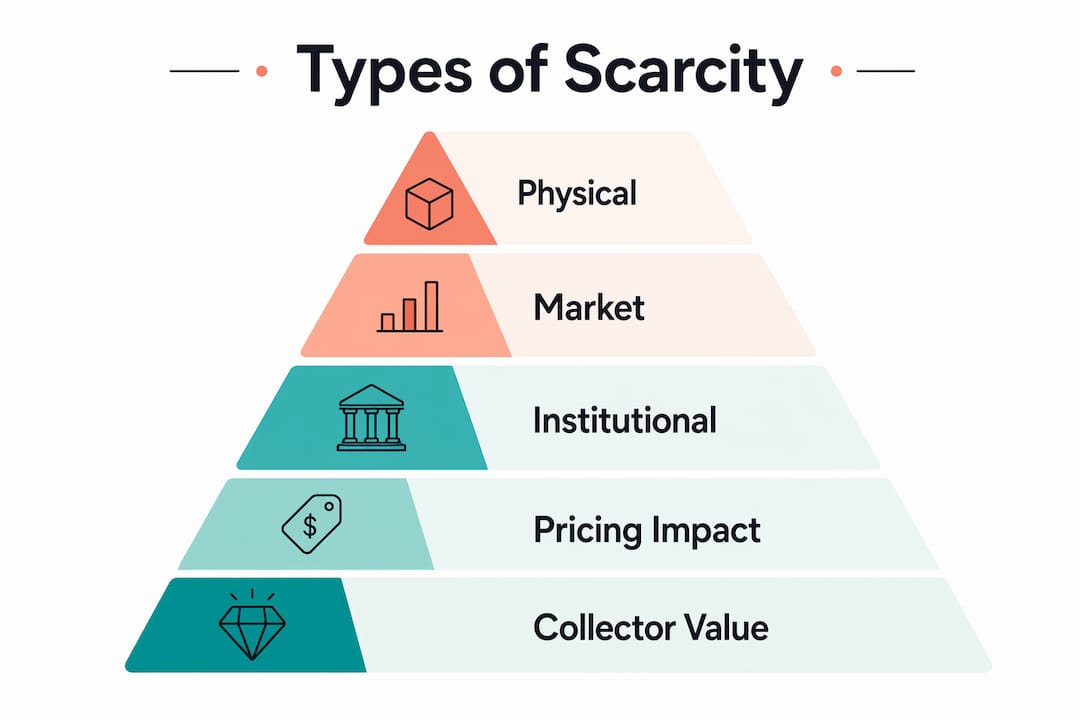
| Type of scarcity | Definition | Pricing impact |
|---|---|---|
| Physical scarcity | Limited edition size or single original | Direct premium; fewer works means higher per-unit price |
| Market scarcity | Works held in private collections, not available for sale | Drives auction competition when pieces resurface |
| Institutional scarcity | Museum holdings, major provenance, historical significance | Establishes long-term value floor; stabilizes prices across market cycles |
Physical scarcity is the most visible type. A painting that exists once is physically scarce by definition. A print edition of 5 is nearly as scarce. Both command premiums because supply is objectively finite.
Market scarcity is subtler. A work may exist in 200 copies, but if 195 are held in permanent private or museum collections, only 5 circulate. That circulation limit creates real competition at auction or in galleries, regardless of the original edition size.
Institutional scarcity is the most durable. When the Museum of Modern Art, the Tate, or the Guggenheim holds a work, the artist’s remaining output is elevated by association. Institutions backing a work create a form of scarcity that strongly influences collectors’ valuation, because institutional endorsement is itself a limited resource.
Understanding which type of scarcity applies to a specific work helps collectors assess true value and helps artists position their output strategically.
How do artists and galleries use scarcity as a pricing and marketing strategy?
Scarcity is both an aesthetic decision and a commercial tool. Intentional scarcity functions as an aesthetic practice, creating desire and urgency by limiting artwork availability. Artists who limit editions are not just managing supply. They are making a statement about the work’s worth and their relationship with the audience.
Practical scarcity strategy follows a clear sequence:
- Set edition limits before release. Announcing a cap of 20 prints before the first sale establishes scarcity as a founding condition, not an afterthought.
- Use tiered pricing to segment collectors. Tiered pricing models preserve perceived scarcity by differentiating products for various collector segments. Entry-level works carry lower prices; signature or unique pieces are reserved for high-tier collectors at a significant premium.
- Time market appearances carefully. Releasing work at strategic intervals, rather than flooding galleries continuously, maintains the perception that access is earned.
- Curate exhibition placement. Showing work in fewer, higher-profile venues concentrates attention and reinforces the sense that the work is not easily obtained.
- Document and communicate scarcity. Certificates of Authenticity, numbered editions, and provenance records make scarcity legible to buyers and verifiable at resale.
The risk in this strategy is overexposure. Overexposure can transform rare artworks from coveted to ubiquitous, diminishing perceived value. Managing visibility is the central discipline of scarcity strategy. An artist who licenses their image to mass-market products while maintaining a limited print edition creates a contradiction that erodes the premium on both.
Pro Tip: Track every public appearance of your work, including digital reproductions, press features, and social media shares. Overexposure often begins online before it registers in gallery sales data.
How to factor scarcity into pricing original art
The standard art pricing formula starts with time and materials, then applies a multiplier that reflects market position, exhibition history, and scarcity. Pricing should cover time and materials at minimum; scarcity and demand add a multiplier to reflect artistic and market value. Underpricing often stems from fear, but it harms brand development and limits future pricing growth.
For artists applying this in practice, the key variables are:
- Edition size: Smaller editions justify higher multipliers. A unique work carries the maximum scarcity premium.
- Medium and materials: Rare or labor-intensive materials reinforce scarcity by making replication difficult or impossible.
- Exhibition history: Works shown at recognized institutions carry institutional scarcity that supports higher pricing.
- Provenance: A documented ownership chain adds credibility and market confidence.
- Market demand signals: Waitlists, repeat collector inquiries, and auction results for comparable works all indicate where the multiplier should sit.
Square-inch pricing helps early-career artists price consistently, with the scarcity multiplier adjusting upward as market position develops. This approach prevents the common mistake of pricing emotionally rather than structurally.
| Pricing factor | Low scarcity scenario | High scarcity scenario |
|---|---|---|
| Edition size | 500 prints | 10 prints |
| Base multiplier | 1.0x | 3.0x or higher |
| Exhibition history | Local shows only | Major institutional exhibitions |
| Provenance | First sale | Multiple documented owners |
| Expected price premium | Minimal | Significant |
The most common pitfall is ignoring market demand when setting prices. An artist who prices a unique work the same as an edition of 100 is leaving the scarcity premium unclaimed. Conversely, pricing far above comparable works without the provenance or exhibition record to justify it creates market resistance.
How scarcity and exclusivity shape collector buying decisions
Collectors show a consistent bias toward unique works, driven by status and ownership impulses rather than strictly by artistic merit. One-offs are perceived as trophies conferring exclusivity, inflating their price over multiples even when the multiple is artistically equivalent. This is the scarcity illusion: the tendency to overvalue uniqueness as a social signal.
The practical consequence is that collectors will often pay a substantial premium for a single original over a print edition of the same image, even when the print quality is indistinguishable to the untrained eye. The value is not in the object alone. It is in the knowledge that no one else can own the same thing.
“Intentional scarcity acts as a dialogue between artist and audience about worth and exclusivity. Artists imposing limits trigger emotional urgency and exclusivity feelings that elevate perceived value and buyer commitment.” — Diverse Daily
Scarcity also creates competitive urgency at auction. When bidders know a work will not reappear on the market, the fear of permanent loss accelerates bidding. This dynamic is why limited edition prints attract serious collector competition even at price points well above comparable open editions.
The caution for collectors is equally important. Scarcity without artistic or cultural significance is a marketing condition, not a value guarantee. Successful limited editions combine scarcity with provenance and production quality. A work that is rare but culturally insignificant will not hold its value across market cycles.
Key takeaways
Scarcity drives artwork pricing by restricting supply, triggering collector competition, and creating exclusivity premiums that artistic quality alone cannot produce.
| Point | Details |
|---|---|
| Edition size determines premium | Smaller editions command significantly higher prices; an edition of 10 outperforms an edition of 500 at resale. |
| Three scarcity types operate together | Physical, market, and institutional scarcity each shape collector perception and price stability differently. |
| Overexposure destroys scarcity value | Unmanaged visibility erodes the exclusivity premium; artists must curate public appearances carefully. |
| Pricing formulas must include a scarcity multiplier | Time and materials set the floor; scarcity, provenance, and exhibition history set the ceiling. |
| Scarcity alone does not guarantee value | Rare works must combine limited availability with artistic merit and provenance to sustain long-term market interest. |
Scarcity is more than a supply count
I have spent years watching artists underprice their work because they focused entirely on materials and time, treating scarcity as an abstract concept rather than a concrete pricing variable. The artists who build lasting market value do something different. They treat scarcity as a decision they make before the first sale, not a condition they discover afterward.
The most durable mistake I see is conflating physical scarcity with market value. An edition of 5 means nothing if the artist has no exhibition record, no provenance documentation, and no collector community. Institutional scarcity, the kind that comes from museum holdings and serious critical attention, is what separates a work that holds value across decades from one that peaks at the first sale and declines.
My observation in 2026 is that the art market is becoming more sophisticated about this distinction. Collectors are asking harder questions about provenance and institutional backing. Artists who have built their scarcity strategy on edition limits alone are finding that those limits are necessary but not sufficient. The artists gaining ground are those who combine controlled availability with genuine cultural significance and meticulous documentation.
The practical advice is direct: decide your edition size before you go to market, document every ownership transfer, and resist the temptation to license your image widely while claiming your prints are rare. Scarcity is a commitment, not a label.
— Nealda
Manage your artwork’s scarcity and pricing with Artworksoft
Understanding scarcity is only half the work. Tracking it across an active collection or studio practice requires a system that connects edition records, provenance documentation, and pricing data in one place.

Artworksoft is a free art inventory system built for artists and collectors who need to manage limited editions, pricing tiers, and ownership history without the complexity of enterprise software. The platform generates Certificates of Authenticity, tracks artwork movements, and applies a structured valuation formula that accounts for scarcity multipliers directly. For artists building a pricing strategy around limited availability, and for collectors verifying the provenance of scarce acquisitions, start your free inventory with Artworksoft and bring the same discipline to your records that you apply to your market strategy.
FAQ
What is the role of scarcity in artwork pricing?
Scarcity limits the supply of available works, which increases collector competition and drives prices upward. Limited edition sizes, private collection holdings, and institutional backing each contribute to a work’s scarcity premium.
How does edition size affect the value of limited edition art?
Smaller edition sizes command significantly higher prices because fewer collectors can ever own the work. An edition of 10 generates far more long-term competition and price appreciation than an edition of 500.
What is the scarcity illusion in art collecting?
The scarcity illusion is the tendency for collectors to overvalue unique works based on social status rather than objective artistic merit. One-offs are perceived as exclusive trophies, which inflates their price relative to multiples of equivalent quality.
Can overexposure reduce an artwork’s scarcity value?
Overexposure can transform a rare work from coveted to ubiquitous, directly eroding its scarcity premium. Artists must manage visibility carefully, because uncontrolled digital and commercial exposure undermines the exclusivity that supports higher pricing.
How should artists include scarcity in their pricing formula?
The standard formula covers time and materials as a baseline, then applies a multiplier adjusted for edition size, exhibition history, and provenance. Scarcity raises the multiplier; underpricing ignores it and limits long-term pricing growth.