
Why searchable portfolios are critical for art businesses
A searchable portfolio is a digital art collection organized as a dynamic, queryable database rather than a static gallery, as explained in the Cross Stitch Pattern Bundle Benefits for Every Crafter overview. Art businesses that treat their portfolios this way gain a measurable advantage: Google data shows users are twice as likely to click through to a Preferred Source than to a generic link page, and portfolios structured as primary sources qualify for that designation.
The core benefits are direct:
- Increased discoverability: Each artwork becomes individually indexed, surfacing in buyer-intent searches like “original oil painting under $500” rather than disappearing inside a slideshow.
- Higher client engagement: Collectors and galleries can filter by medium, style, year, or availability instead of scrolling through unrelated work.
- More qualified inquiries: Buyers who find a specific piece through search arrive with intent, not curiosity.
- AI search eligibility: Portfolios with structured metadata and original content qualify as Google Preferred Sources, earning direct citations in AI Overviews.
Static, scrolling galleries force the viewer to adapt to the layout. A searchable portfolio adapts to the viewer’s query, delivering immediate clarity without scanning or guessing. For art businesses competing in a crowded digital market, that difference in user experience translates directly into sales opportunities.
What makes a professional art portfolio effective?
A professional art portfolio is a curated, documented collection that communicates an artist’s or gallery’s expertise, range, and commercial availability to collectors, curators, and institutional buyers. It is not a link page, a social media feed, or a generic image gallery. The distinction matters because search engines and AI platforms treat these formats very differently.
Effective professional portfolios share several defining characteristics:
- Individual artwork records: Each piece has its own page with title, medium, dimensions, year, provenance, and availability status.
- Rich metadata: Descriptive alt text, structured tags, and VisualArtwork schema markup make individual works discoverable through both image and text search.
- Original written content: Descriptions, artist statements, and process notes give search engines substantive text to index and give buyers the context they need to commit.
- Documentation quality: Certificates of Authenticity, condition reports, and provenance records signal professionalism and build buyer confidence.
- Accessibility and navigation: Clean URLs, logical category structures, and filtering options allow collectors to find relevant work without friction.
A portfolio built on these principles functions as a searchable art database rather than a presentation deck. That structural difference is what separates portfolios that generate inquiries from those that simply exist online.
Key features that give searchable portfolios a business advantage
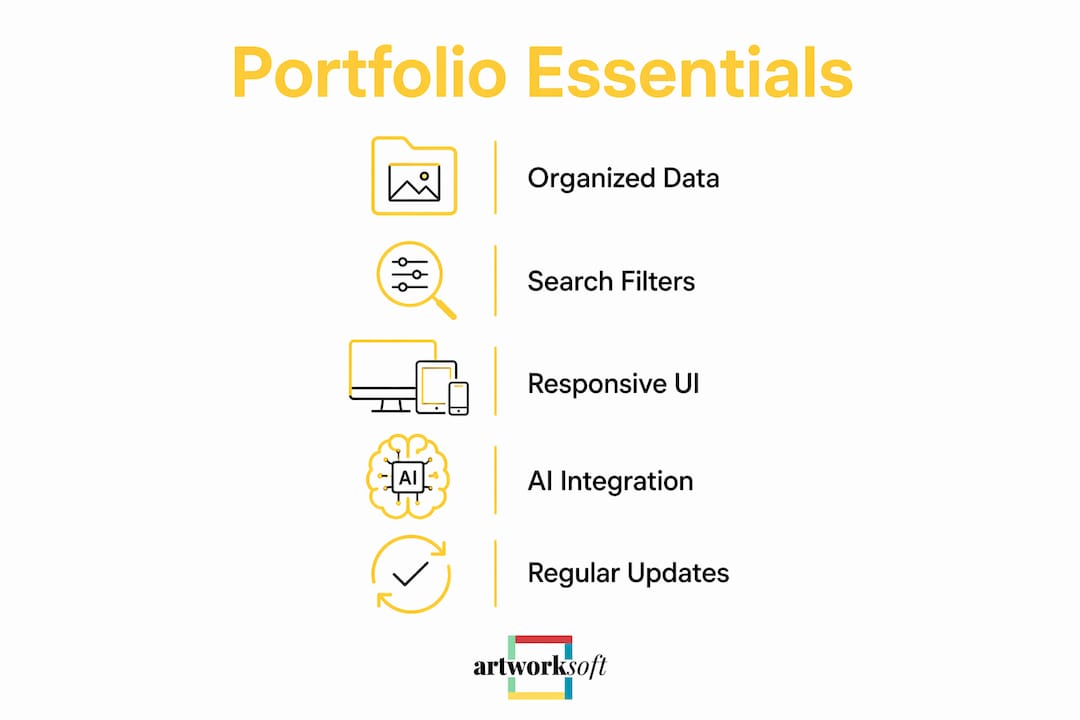
The specific technical and organizational features of a searchable portfolio determine how much commercial value it generates. Generic galleries with thumbnail slideshows are effectively invisible to search engines because artworks are hidden behind JavaScript that crawlers cannot index.
A portfolio built for discovery operates differently:
- Granular tagging: Filtering by medium, client, year, price range, and availability lets buyers self-qualify before making contact.
- Structured metadata and schema: VisualArtwork JSON-LD blocks allow AI search engines to walk from a medium query directly to a specific painting, making that page the citation card.
- Search-first presentation: Rather than requiring users to scroll a fixed narrative, a queryable portfolio retrieves only the content relevant to the user’s question.
- Long-tail keyword coverage: Individual artwork pages expand a site’s topical depth, enabling ranking for specific buyer-intent queries like “contemporary watercolor landscape Pacific Northwest.”
- Dynamic content updates: Fresh content signals active expertise to AI search systems, which favor portfolios updated within the last 90 days.
- Portfolio analytics: Tracking which works attract the most views and inquiries informs both collection strategy and pricing decisions.
These features collectively shift a portfolio from a passive display to an active sales and marketing asset. Art businesses that implement them consistently see more qualified traffic and higher conversion rates from organic search.
How to create and maintain an effective searchable art portfolio
Building a portfolio that performs in search requires deliberate decisions at every stage, from platform selection to ongoing content management.
-
Choose a platform that supports structured data. Select a content management system or SaaS tool that allows custom URLs, metadata fields, and schema markup per artwork. Platforms that lock artworks inside slideshows or restrict URL structures will limit indexability regardless of content quality.
-
Catalog each artwork individually. Every piece deserves its own record: title, medium, dimensions, year created, current location, availability, and price or inquiry path. This is the foundation of a queryable collection.
-
Write substantive descriptions for each work. A 300-word description covering materials, technique, the story behind the piece, and its physical context gives both buyers and search engines the information they need. Include buyer-language signals like room placement, scale references, and framing options.
-
Apply VisualArtwork schema markup. Structured data with artist, medium, dimensions, and an offer block if the work is for sale allows AI engines to reason across the portfolio in a single step. This is the technical requirement for AI citation eligibility.
-
Optimize image files. Use descriptive filenames (not IMG_0042.jpg), write alt text that combines medium, style, subject, and size, and compress images to under 200KB in WebP format to avoid load-time penalties.
-
Add original written content beyond artwork descriptions. Case studies, exhibition records, process articles, and commission guides qualify a portfolio as a Google Preferred Source. A portfolio updated with original writing within the last 90 days signals active expertise to AI search systems.
-
Integrate with marketing channels. Link social media profiles to specific artwork pages, not the homepage. A commission-inquiry page with clear pricing guidance and timeline expectations captures buyers who arrive through AI search before they reach any platform.
-
Audit and refresh content regularly. Update availability status, add new works promptly, and revise descriptions when pieces sell or move. Stale portfolios lose search relevance over time.
Pro Tip: Treat the portfolio as a living database, not a finished document. Art businesses that schedule monthly content reviews, adding new works and updating availability, maintain the freshness signals that AI search systems reward.
Common pitfalls that undermine portfolio visibility and sales
Most portfolio failures are structural, not aesthetic. The mistakes below are the ones that most consistently reduce discoverability and buyer engagement.
- Single-page gallery design: Housing an entire collection on one or two pages with thumbnail images gives search engines almost nothing to index. Each artwork needs its own URL with substantial content.
- Missing or generic alt text: Leaving alt text empty or filling it with only the artwork title wastes the primary signal for image search. The correct formula combines medium, style, subject, and size.
- No structured metadata: Portfolios without schema markup are invisible to AI search engines that require structured data to treat a page as a citation-worthy source.
- Ignoring long-tail buyer queries: Targeting broad terms like “abstract painting” is unwinnable for most art businesses. Specific queries like “small original oil painting under $500” attract buyers with clear intent and are genuinely rankable.
- Relying entirely on social media: Instagram and similar platforms limit organic reach algorithmically and do not drive compounding SEO value. An owned portfolio is the only channel an art business fully controls.
- Slow page loads and poor crawlability: Common technical issues like uncompressed images, JavaScript-only galleries, and slow load times reduce both search rankings and buyer engagement.
- Infrequent updates: A portfolio last updated more than six months ago signals dormancy to AI search systems and loses the freshness ranking advantage.
A portfolio that looks professional to a human visitor but lacks individual artwork pages, structured metadata, and original written content is functionally invisible to the search engines and AI platforms that now drive collector discovery. The presentation layer and the technical layer must both be built correctly.
How Artworksoft supports professional, searchable portfolio management
Artworksoft is built specifically for the operational and commercial needs of art businesses: galleries, collectors, consultants, and emerging artists who need their collections to function as professionally managed assets, not just image archives.
The platform addresses the full workflow of searchable portfolio management:
- Structured artwork records: Each piece is cataloged with medium, dimensions, provenance, location, valuation, and availability, creating the individual records that power both internal management and external discoverability.
- Automated documentation: Artworksoft generates Certificates of Authenticity and condition reports directly from artwork records, providing the documentation quality that builds buyer confidence and supports art documentation standards.
- Valuation support: A structured valuation formula removes guesswork from pricing, giving art businesses defensible figures for sales, insurance, and collection strategy.
- Sales and transaction tracking: The platform connects artwork records to sales history, supporting the provenance documentation that collectors and institutions require.
- Community and visibility features: Artworksoft includes tools that increase an artist’s professional presence online, supporting the discovery and engagement objectives that a searchable portfolio serves.
- Scalable collection management: Whether managing 50 works or 5,000, the system maintains the organizational integrity that makes a portfolio queryable rather than just browsable.
For art businesses building toward AI search eligibility, Artworksoft provides the structured data foundation that platforms without dedicated art management features cannot replicate. The artwork profile management tools ensure that every record contains the metadata depth required for both SEO performance and professional presentation.

Examples of art businesses using searchable portfolios effectively
The shift toward queryable, database-driven portfolios is visible across different segments of the art market, each applying the same core principles to different commercial contexts.
Working fine artists who structure their sites with individual VisualArtwork-marked pages for each painting report meaningful growth in direct collector inquiries, particularly for commission work. A collector searching for “commission a watercolor portrait” through an AI search engine lands on a commission-inquiry page with pricing guidance and portfolio examples, bypassing platform fees entirely. Over time, this owned channel typically accounts for a growing share of inquiries for mid-career artists, with no recurring platform commission attached.
Independent galleries use searchable portfolio systems to manage rotating inventory across multiple locations. When a collector asks for available works by a specific artist in a given medium, gallery staff can retrieve accurate availability and pricing in real time rather than relying on spreadsheets or memory. That operational efficiency directly supports the sales conversation.
Art consultants managing collections for corporate or private clients rely on queryable databases to filter by acquisition year, medium, location, and valuation status. The ability to generate filtered reports for insurance, estate planning, or collection review is only possible when the underlying portfolio is structured as a database. Platforms like Artworksoft are designed for exactly this use case, connecting art inventory management with professional reporting.
Emerging artists building their first professional presence benefit from the discoverability advantages of searchable portfolios before they have gallery representation. A well-structured portfolio with individual artwork pages, descriptive metadata, and original written content can rank for specific buyer-intent queries and attract collectors who would otherwise never encounter the work. Digital presence has a direct impact on branding and networking for artists at every career stage, and the portfolio is the owned asset that anchors all other channels.
The pattern across all these examples is consistent: art businesses that treat their portfolios as structured, queryable databases generate more qualified traffic, more professional credibility, and more direct sales opportunities than those relying on static galleries or third-party platforms alone.
Key Takeaways
Searchable portfolios give art businesses a direct advantage in AI-driven search by functioning as structured, queryable databases rather than static galleries, which is the foundation for both discoverability and professional credibility.
| Point | Details |
|---|---|
| AI search eligibility | Portfolios with structured metadata and original content qualify as Google Preferred Sources, earning direct AI citations. |
| Individual artwork pages | Each work needs its own URL, description, and schema markup to rank for buyer-intent queries. |
| Freshness signals matter | AI search systems favor portfolios updated within the last 90 days; regular content reviews maintain this advantage. |
| Owned channel advantage | An owned, searchable portfolio compounds SEO value over time; social media and marketplace platforms do not. |
| Documentation drives trust | Structured records with provenance, valuation, and Certificates of Authenticity build buyer confidence and support sales. |