


Fair market value in art is defined as the price a willing buyer and willing seller would agree upon in an open market, with neither party under compulsion and both fully informed of relevant facts. This definition, codified in Treasury Regulation §1.170A-1©(2), governs how the IRS evaluates charitable donations, estate transfers, and tax deductions involving artwork. Understanding what does fair market value mean in art separates collectors who protect their assets from those who face costly disputes. FMV is not the price a gallery asks, the amount an insurer pays, or what an artist hopes to receive. It is the price the market actually confirms.
How does fair market value differ from retail replacement value?
FMV and retail replacement value measure two entirely different things. Retail Replacement Value is often 1.5x to 2.5x higher than FMV, reflecting the economic gap between what a buyer pays at retail and what a seller receives at auction. That gap exists because retail prices include dealer markups, framing costs, shipping, warranties, and scarcity premiums. None of those costs appear in a realized auction price.
Insurance appraisals use replacement value because their purpose is to make you whole after a loss. FMV appraisals answer a different question: what would a real buyer actually pay in the open market today? Using the wrong appraisal type causes either insurance undercoverage or tax compliance problems. A collector who submits a retail appraisal to the IRS as FMV evidence is presenting a number that can be 40–60% higher than what the market supports.

The IRS specifically looks for realized auction prices over retail asking prices during audits. Auction results reflect actual transactions between informed, willing parties. Retail gallery prices reflect asking prices that include dealer margins and are often never tested by a real sale.
Pro Tip: Always confirm the purpose of an appraisal before commissioning it. An insurance appraisal and a tax appraisal for the same painting will produce different numbers, and submitting the wrong one to the IRS creates audit exposure.
| Appraisal type | Primary purpose | Typical value level | Accepted by IRS for tax? |
|---|---|---|---|
| Fair Market Value | Tax, estate, donation | Lower, auction-based | Yes |
| Retail Replacement Value | Insurance coverage | Higher, retail-based | No |
| Liquidation value | Forced or distressed sale | Lowest | No |
What factors influence fair market value in art?
Multiple attributes shape an artwork’s FMV, and no single factor controls the outcome. Appraisers weigh them together to arrive at a defensible number.
- Provenance and exhibition history. A documented ownership chain and exhibition record increase buyer confidence. Provenance and authentication directly support higher FMV because they reduce the risk of forgery or disputed title.
- Condition. Physical condition is one of the most direct value drivers. A painting with restored areas, fading, or structural damage trades at a measurable discount. The impact of condition on valuation follows consistent patterns across auction records.
- Scarcity. Limited supply relative to collector demand raises FMV. Scarcity’s role in pricing is especially pronounced for deceased artists whose output is fixed.
- Market demand and trends. Collector interest shifts with museum exhibitions, critical attention, and cultural moments. Experienced appraisers incorporate qualitative demand signals such as recent retrospectives or scholarly publications into their analysis.
- Geographic market. The International Society of Appraisers (ISA) specifies that market location matters for FMV. A work that sells well in New York may command a different price in a regional market, and forced sale prices from any location are not valid FMV evidence.
- Medium and size. Oil paintings by a given artist typically outperform works on paper. Monumental sculptures face a smaller buyer pool than portable works, which affects FMV directly.
Pro Tip: Request auction records for the specific artist, medium, and size range before accepting any FMV figure. Comparable sales within the same category are far more reliable than general artist reputation alone.
What challenges exist in determining fair market value for artworks?
The art market lacks the transparency of commodity markets. Stock prices are public and updated in real time. Art sales, especially private transactions, are often confidential. That opacity makes FMV determination genuinely difficult, not just technically complex.
- Limited comparable sales. Many artists have thin auction histories. When fewer than five comparable works have sold publicly in the past five years, appraisers must rely on private sale databases and expert judgment rather than clean data sets.
- Attribution and documentation gaps. A signed work is not automatically a secure asset. Poor documentation increases tax audit risk because the IRS requires clear evidence of authenticity and market comparables, not just a signature.
- Private versus public sale data. Auction records are accessible through databases. Private gallery sales are not. Appraisers who rely only on public data may miss significant transactions that would shift their FMV estimate.
- IRS scrutiny on inflated values. The IRS audits charitable donation deductions for art above $5,000 and requires a qualified appraisal. Appraisals that cite retail prices instead of auction results are the most common trigger for disputes.
- Market timing. FMV is tied to a specific effective date. A work appraised in a strong market year may carry a significantly different FMV than the same work appraised two years later after collector demand shifts.
The combination of these challenges explains why rigorous market research and a qualified appraiser are not optional. They are the minimum standard for a defensible valuation.
How do professional appraisers determine fair market value for art?
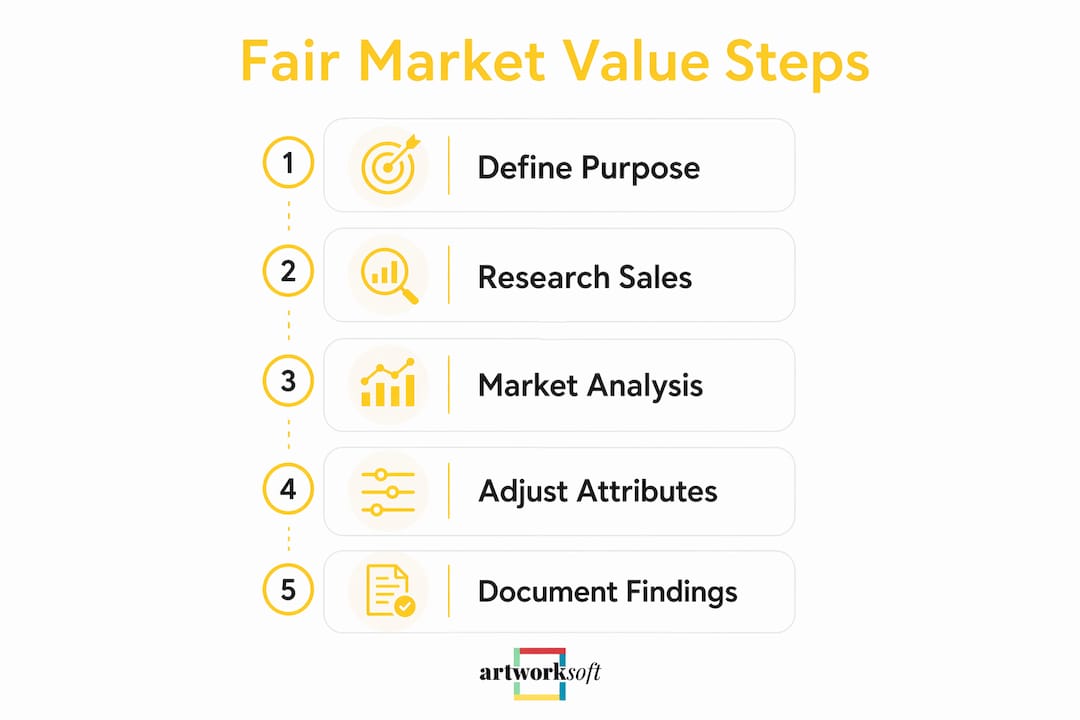
The art appraisal process follows a structured sequence. Each step builds toward a documented, defensible conclusion.
Setting purpose and effective date
Appraisers must define the intended use of the valuation before any research begins. An appraisal for estate planning, equitable distribution, and charitable donation all require FMV, but the context shapes which comparables are most relevant. The effective date fixes the valuation in time and must be documented in writing.
Researching comparable sales
Professional appraisers use both public auction databases and specialized private sales databases to build a comparable sales set. For artists with limited auction history, specialized databases are not a supplement. They are the primary source. Appraisers filter comparables by medium, size, date of creation, and condition to ensure relevance.
Qualitative market analysis
Raw sales data does not tell the full story. Appraisers assess collector demand by reviewing recent museum exhibitions, catalog publications, gallery representation, and critical coverage. A mid-career artist who received a major retrospective in the past 18 months will show different demand signals than an artist of equal technical skill who has not exhibited recently.
Adjusting for specific attributes
After identifying comparables, appraisers adjust for differences between the subject work and the comparables. A comparable that sold in better condition, larger format, or in a stronger market year requires a downward adjustment to the subject’s FMV. These adjustments must be explicit and documented.
Documenting findings with regulatory citations
Professional valuation reports must cite the full Treasury Regulation definition of FMV for the appraisal to be accepted in tax and estate matters. The report must also identify the appraiser’s qualifications, the methodology used, and the sources consulted. A report that omits any of these elements risks rejection by the IRS or a probate court.
| Appraisal step | Key action | Output |
|---|---|---|
| Define purpose and date | Confirm intended use and effective date in writing | Scope of work document |
| Comparable sales research | Search auction and private sale databases | Comparable sales set |
| Qualitative analysis | Review exhibitions, publications, and market signals | Demand assessment |
| Attribute adjustments | Adjust for condition, size, and medium differences | Adjusted value range |
| Final report | Document methodology, sources, and regulatory definitions | Qualified appraisal report |
Key Takeaways
Fair market value in art is the auction-confirmed price between informed, willing parties, and it is consistently lower than retail or insurance replacement values.
| Point | Details |
|---|---|
| FMV definition | FMV is the price an informed buyer and seller agree upon without compulsion, per Treasury Regulation §1.170A-1©(2). |
| FMV vs. replacement value | Retail Replacement Value runs 1.5x to 2.5x higher than FMV and is not valid for IRS tax reporting. |
| Key value factors | Provenance, condition, scarcity, market demand, and geographic market all shape an artwork’s FMV. |
| Appraisal purpose matters | The intended use of an appraisal must be defined before research begins to avoid legal and tax disputes. |
| Documentation is non-negotiable | Poor provenance records and missing comparable sales increase audit risk and weaken any FMV claim. |
Why I think most collectors misunderstand FMV until it costs them
Most collectors I have encountered treat fair market value as a single number that lives somewhere between what they paid and what they hope to sell for. That mental model causes real financial damage. FMV is not a midpoint. It is a specific, evidence-based conclusion tied to a date, a market, and a purpose.
The most common mistake I see is using an insurance appraisal for a tax deduction. The numbers look authoritative. They come from a credentialed appraiser. But insurance appraisals are built to replace, not to reflect what a buyer would pay. Submitting one to the IRS is not just an error in judgment. It is the kind of error that triggers audits and penalties.
Provenance documentation is the second area where collectors consistently underinvest. A work with a clean ownership history and exhibition record commands buyer confidence that translates directly into FMV. A work with gaps in its history, even a technically excellent one, trades at a discount because buyers price in the uncertainty. Maintaining well-documented collection records is not administrative overhead. It is value preservation.
My practical advice: before any significant transaction, donation, or estate transfer, commission a purpose-specific appraisal from a qualified appraiser who cites auction comparables and the Treasury Regulation definition. That document is your defense in any dispute.
— Nealda
How Artworksoft supports accurate art valuation and documentation
Accurate FMV appraisals depend on complete, organized records. Artworksoft gives artists, collectors, and galleries the infrastructure to maintain exactly that.

Artworksoft’s art inventory system centralizes provenance records, condition notes, exhibition history, and transaction data in one place. That documentation directly supports the comparable sales research and qualitative analysis that qualified appraisers rely on. The platform’s structured valuation tools help collectors track how an artwork’s value changes over time, creating a clear audit trail for tax, estate, and insurance purposes. Artworksoft also generates professional documentation, including Certificates of Authenticity, that strengthens every appraisal report. Start your free inventory and build the documentation foundation your collection requires.
FAQ
What does fair market value mean in art?
Fair market value in art is the price a willing buyer and willing seller would agree upon in an open market, with neither party under compulsion and both fully informed. This definition comes directly from Treasury Regulation §1.170A-1©(2) and governs IRS-accepted art valuations.
How is FMV different from insurance value?
FMV reflects what a buyer would actually pay at auction, while insurance value reflects the retail cost to replace the work. Retail Replacement Value is typically 1.5x to 2.5x higher than FMV and is not accepted by the IRS for tax deduction purposes.
What factors affect an artwork’s fair market value?
Provenance, condition, scarcity, artist reputation, market demand, and geographic market location all influence FMV. Appraisers weigh these factors together using comparable auction sales and qualitative market signals.
Does a signed artwork automatically have a higher FMV?
A signature alone does not guarantee a higher FMV or a secure asset. Poor provenance documentation and limited comparable sales can undermine the value of a signed work and increase the risk of IRS scrutiny.
How often should art be reappraised for FMV?
FMV is tied to a specific effective date, so appraisals become outdated as market conditions change. Collectors should commission a new FMV appraisal every three to five years, or before any significant transaction, donation, or estate transfer.











