

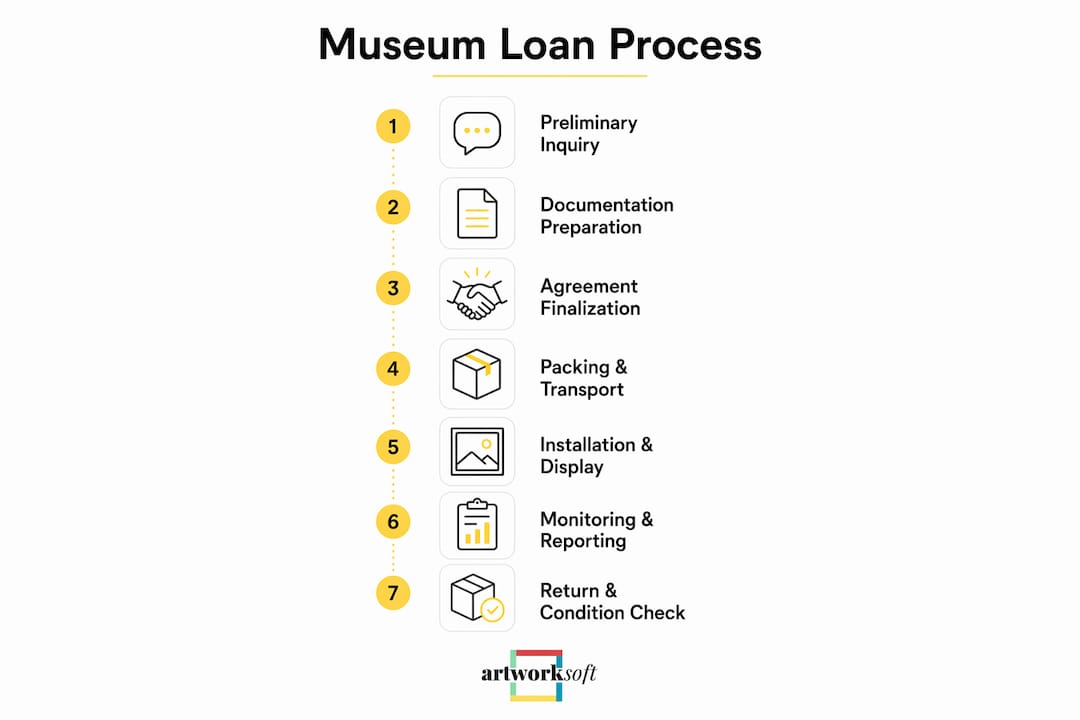
Managing art museum loans efficiently requires a defined pre-loan checklist, a signed loan agreement, professional condition reports, a valid insurance certificate, and a documented movement log. These five elements are the minimum standard recognized by U.S. institutions including the Smithsonian National Museum of American History (NMAH) and the National Park Service (NPS). The American Alliance of Museums (AAM) facility-report template is the industry benchmark for venue assessment. Before submitting any formal loan request, prepare a completed facilities report and a draft loan agreement. Artworksoft supports each of these steps through its loan record module, PDF document generation, and movement tracking features.
Quick pre-loan checklist:
- Preliminary inquiry confirming object availability
- Completed AAM-standard facilities report
- Draft loan agreement with cost allocation table
- Initial condition photographs with accession numbers
- Insurance plan identifying coverage dates and values
- Signed conservator clearance where required
Table of Contents
- Who is involved in a museum loan and what does it cover?
- Managing art museum loans: the pre-loan checklist and timeline
- What belongs in a loan agreement and supporting documentation?
- How should you handle packing, transport, and installation?
- Condition reports, photography, and chain-of-custody tracking
- Insurance and risk allocation for U.S. museum loans
- Why loan requests get declined and how to avoid it
- Sample timeline and typical cost categories
- How collection-management software supports every loan step
- How Artworksoft supports the full loan workflow
- Key Takeaways
- A registrar’s priorities in practice
- Artworksoft reduces paperwork and speeds loan approvals
- Authoritative sources and further reading
Who is involved in a museum loan and what does it cover?
A museum loan involves at least four parties: the lender’s registrar or curator, the borrower’s exhibition manager or registrar, a fine art courier, and an insurer. Conservators join the process when treatment or condition assessment is required before dispatch. Each party owns specific tasks, and gaps in responsibility are a common source of delays.
The loan itself covers exhibition dates, approved display and storage conditions, packing and transport specifications, insurance terms, and reproduction or credit-line rights. Federal institutions such as the Smithsonian and NPS set detailed expectations for documentation and environmental monitoring throughout the loan period. Understanding who owns each task before the formal application is submitted prevents the most avoidable failures.
Managing art museum loans: the pre-loan checklist and timeline
Insufficient notice is the single largest cause of declined loan requests, according to registrars at NMAH and similar institutions. NMAH requires a minimum lead time of eight months for outgoing loans, with a complete application package before review. Te Papa recommends a minimum six-month lead time for domestic loans. For international moves, plan for an extended lead time of twelve months or more, especially for complex loans.
Pro Tip: Submit your preliminary inquiry before investing time in a full application package. Registrars can confirm availability and flag conservation concerns informally, saving weeks of preparation on an object that is already committed elsewhere.
What belongs in a loan agreement and supporting documentation?
A complete loan agreement protects both parties and prevents disputes over cost, condition, and recall rights. NMAH and NPS both require signed agreements with explicit recall and renewal clauses; lenders reserve the right to withdraw objects for good cause at any time.
Core sections every loan agreement should include:
- Parties and contacts: Full legal names, institutional roles, and emergency contacts on both sides.
- Object list: Accession numbers, Certificates of Authenticity (COAs), dimensions, and current valuations.
- Loan period and venues: Confirmed exhibition dates and approved display locations.
- Display and storage conditions: Temperature, relative humidity, light levels, and security specifications.
- Packing and transport: Who packs, who ships, approved carriers, and courier escort requirements.
- Insurance and indemnity: Policy type, coverage dates, declared values, and lender named as additional insured or loss payee.
- Cost allocation: Clear table assigning responsibility for conservation, crating, courier fees, photography, and customs.
- Reproduction and credit-line terms: Approved image use, required credit wording, and embargo periods.
- Recall and dispute clauses: Conditions under which the lender may recall the object and the resolution process.
Support documents to attach: facilities report (AAM template), outgoing and incoming condition reports, provenance documentation, insurance certificate, and export or customs permits for international loans.
How should you handle packing, transport, and installation?
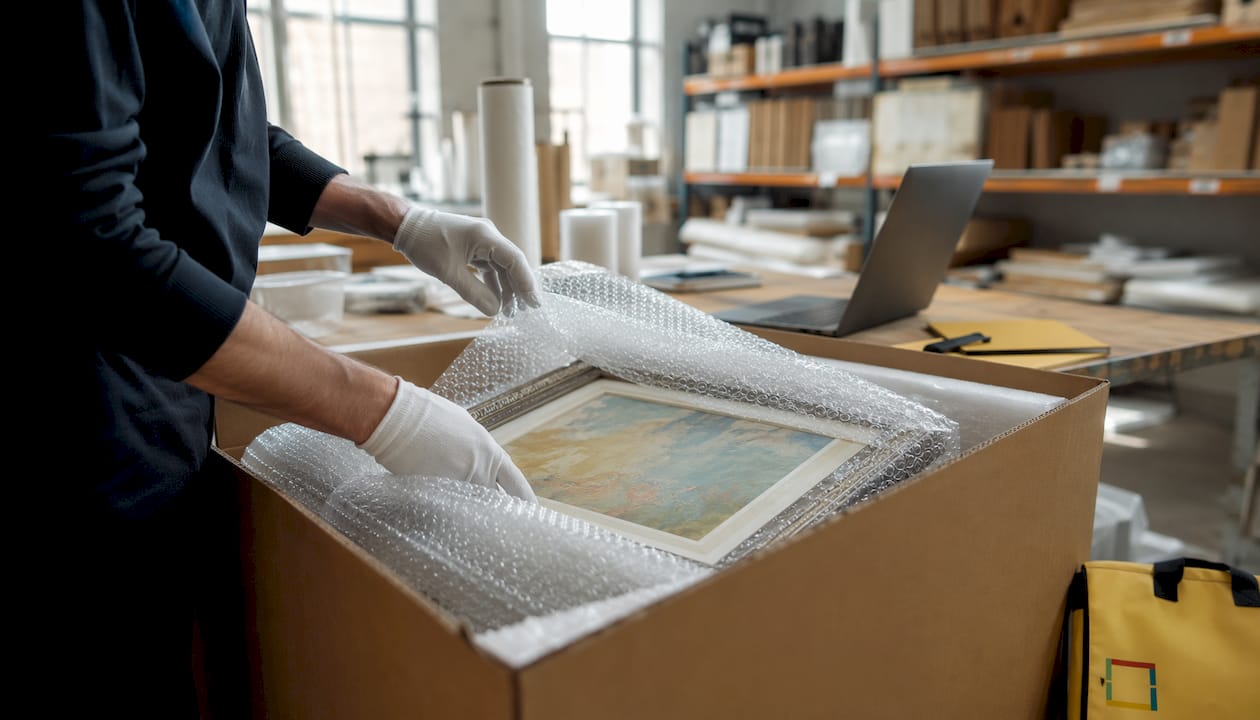
Packing standards vary by object type. Two-dimensional works typically travel in padded, climate-controlled crates with shock and tilt indicators; three-dimensional objects require custom-fitted foam cradles. The lender specifies packing materials and crate construction; the borrower pays unless the agreement states otherwise.
- Appoint a fine art courier with documented experience handling comparable objects.
- Require transit insurance covering the full declared value from point of departure to return.
- For international shipments, engage a licensed customs broker and confirm export permits before dispatch.
- On arrival, keep objects packed overnight to allow acclimatization before unpacking.
- Verify condition against the outgoing report before the courier departs the venue.
V&A and NMAH both require experienced fine art agents and may specify approved vendors for courier and installation work. Lenders often insist on courier presence during unpacking and installation; confirm this requirement in the agreement before booking.
Pro Tip: Agree on hanging mechanisms, display cases, and mounting hardware in writing before the object leaves the lender. Discovering incompatible fixtures on installation day causes delays and risks damage.
Condition reports, photography, and chain-of-custody tracking
A defensible condition record documents measurements, materials, current condition language, and annotated photographs of all surfaces including edges and verso. Pre-packing condition reports should be completed by the lender and provided to the borrower before dispatch; the borrower completes a return condition report at the end of the loan.
Photography standards that hold up under scrutiny:
- Minimum resolution sufficient for print reproduction (typically 300 dpi at full size).
- Color reference card included in frame; scale bar visible in at least one image per object.
- File names keyed to accession numbers for unambiguous matching.
- All images archived in a single loan folder alongside the condition report PDF.
Movement tracking creates an auditable chain of custody. Log every location change: departure from lender, arrival at courier facility, transit, arrival at venue, gallery position, de-installation, and return. Digital loan modules that centralize status history, condition reports, and automated reminders reduce human error during handoffs and improve auditability. Artworksoft’s movement and location tracking feature supports this log directly within the artwork’s record.
Insurance and risk allocation for U.S. museum loans
NMAH specifies two acceptable insurance models: the borrower arranges a fine arts “all risk” policy naming the lender as additional insured, or the Smithsonian arranges coverage and invoices the borrower. Both require a certificate of insurance before shipment.
Key insurance documentation lenders require:
- Certificate of insurance stating policy exclusions, deductibles, and coverage dates aligned with the full loan period.
- Declared value for each object, matching the loan agreement.
- “Nail to nail” coverage from point of packing through return.
- Terrorism coverage where the lender’s policy requires it.
Cost allocation for risk-related expenses should be explicit in the agreement: conservation treatment, packing, customs duties, and courier fees typically fall to the borrower. Add clauses covering early return, recall, and damage remediation so neither party faces ambiguity if something goes wrong.
Pro Tip: Require proof of insurance before dispatch, not on arrival. A certificate received after the object has left the lender’s facility creates a coverage gap that most institutional policies do not tolerate.
Why loan requests get declined and how to avoid it
Most declines trace back to four preventable problems. Insufficient lead time tops the list; submitting a formal application without a prior preliminary inquiry compounds the issue. Incomplete documentation, specifically a missing facilities report, absent condition photographs, or no insurance certificate, is the second most common cause. Inadequate environmental or security provisions at the borrowing venue eliminate requests that might otherwise succeed. Finally, unclear cost responsibilities or requests that contradict lender policy, such as asking for third-party sub-loans without prior written permission, result in immediate refusal.
Addressing all four before submission is the most reliable way to reach approval.
Sample timeline and typical cost categories
| Institution | Minimum notice | Loan type |
|---|---|---|
| NMAH (Smithsonian) | 8 months | Domestic outgoing |
| Te Papa | 6 months | Domestic/standard |
| V&A | 12 months (up to 18 for complex loans) | International |
A domestic loan from preliminary inquiry to return typically spans 8 months for Smithsonian affiliate loans or 6 months for standard Te Papa loans. Common cost categories and who usually pays:
- Conservation and treatment: Borrower pays; lender’s conservator determines scope.
- Packing and crating: Borrower pays; lender specifies standards.
- Transport and courier fees: Borrower pays; lender may require approved vendors.
- Insurance premium: Borrower pays or reimburses lender-arranged coverage.
- Photography: Borrower pays for any new photography required for the exhibition.
- Customs and clearance: Borrower pays for international shipments.
How collection-management software supports every loan step
Software maps directly to the loan lifecycle. The workflow below reflects how a well-configured system handles each stage:
Create a loan record and attach all object profiles with provenance fields, accession numbers, and current valuations. Attach condition report templates and assign conservator review tasks. Generate the loan agreement PDF from a pre-built template, then upload the signed copy and insurance certificate to the loan folder. Schedule courier booking and log transit milestones. On arrival, record the incoming condition check and update the object’s location. Set automated reminders for return dates, insurance renewal, and annual condition monitoring.
Dashboards should surface active loans, overdue returns, total insured value across all active loans, and partner activity summaries. This gives registrars and gallery managers a single source of truth without manual spreadsheet reconciliation.
How Artworksoft supports the full loan workflow
Artworksoft implements the steps above through purpose-built features. Artwork profiles include provenance fields, accession numbers, COA generation, and document attachments, covering the object-level data every loan agreement requires. The loan record module tracks status history from inquiry through return, with fields for insurance values, courier assignments, and venue details. Artwork profile management in Artworksoft structures records so condition reports and provenance documents attach directly to the relevant object, not to a separate folder that can become disconnected.
PDF generation produces loan agreements, condition reports, and Certificates of Authenticity in a consistent, professional format. Movement and location logs create the auditable chain of custody that lenders and insurers require. Automated reminders flag return dates and insurance renewal deadlines before they become problems. For galleries and collectors managing multiple concurrent loans, Artworksoft’s art documentation tools replace manual filing with a centralized, searchable record.
Key Takeaways
Efficient art loan management depends on lead time, complete documentation, and a centralized digital record that covers every stage from inquiry to return.
| Point | Details |
|---|---|
| Lead time is non-negotiable | Lead time requirements vary by institution, generally ranging from several months to a year or more for international loans. |
| Documentation drives approvals | A completed AAM facilities report and photo-backed condition report directly answer lender concerns about venue suitability. |
| Insurance before dispatch | Require a certificate of insurance naming the lender as additional insured before any object leaves the facility. |
| Chain-of-custody logging | Log every location change from packing through return to create an auditable movement record. |
| Artworksoft centralizes the process | Artworksoft’s loan record module, PDF generation, and movement tracking replace manual filing with a single source of truth. |
A registrar’s priorities in practice
The most preventable loan failures share a common root: someone assumed a step would be handled rather than confirming it in writing. Lead time, documentation completeness, and clear cost allocation are not administrative formalities. They are the criteria lenders use to assess whether a borrower can be trusted with an irreplaceable object. A facilities report and a certificate of insurance before dispatch are the two documents that answer the lender’s core question. Treating every loan transfer as a high-value movement with a required log, a named contact on both sides, and a signed agreement before anything moves is the standard that separates professional loan management from ad hoc arrangements that generate disputes.
Artworksoft reduces paperwork and speeds loan approvals
Galleries, collectors, and artists managing loan workflows manually spend significant time reconciling condition reports, chasing insurance certificates, and tracking return dates across email threads and spreadsheets. Artworksoft replaces that process with a single platform: loan agreement templates, condition report attachments, movement logs, and automated return-date reminders all live in one place, tied directly to the artwork record.

The practical starting point is a free Artworksoft plan, which lets you create a sample loan record, upload your first condition report, and generate a professional loan agreement PDF before committing to a paid tier. For galleries managing multiple active loans, the platform’s dashboard surfaces overdue returns and total insured values at a glance. Start your free art inventory today and build your first loan record in under 30 minutes.
Authoritative sources and further reading
The following primary sources underpin the guidance in this article and are recommended for deeper study:
- NMAH Loans Policy — U.S. federal-institution lead-time requirements, insurance options, and application documentation standards. The definitive reference for borrowers approaching Smithsonian affiliates.
- NPS Museum Handbook, Part 2, Chapter 5 — NPS outgoing loan rules, inventory procedures, and repository loan duration limits. Required reading for loans involving NPS collections.
- Te Papa Managing Loans Resource Guide — Practical guidance on facilities reports, condition reporting, and lead-time expectations. Widely used by registrars as a procedural template.
- V&A Loans Policy and Conditions — International lead-time benchmarks (12–18 months) and courier/vendor requirements; useful for planning cross-border loans.
- AHG Loan Module User Guide — Documents the features a loan-management software module should cover: status history, condition reports, facility assessments, transport actions, and dashboard reporting.











