

Blue chip art refers to works by artists with a long, verified auction record, sustained museum and institutional backing, and price performance that holds across market cycles. As an investment class, it functions best as a long-term portfolio diversifier rather than a vehicle for rapid capital growth. The Art Basel & UBS Global Art Market Report 2026 confirms the market returned to growth in 2025, with global sales rising 4% to an estimated $59.6 billion, and high-end lots leading the recovery.
Canonical names the market consistently treats as blue chip include:
- Pablo Picasso — museum holdings on every continent, decades of eight-figure auction results
- Claude Monet — Impressionist benchmark with consistent institutional demand
- Vincent van Gogh — historical record prices and permanent collection status worldwide
- Andy Warhol — the most traded postwar artist by auction volume
- Jean-Michel Basquiat — record-setting sales and growing retrospective history
- Jeff Koons — major contemporary with sustained gallery and museum presence
- Yayoi Kusama — one of the most exhibited living artists globally
- Damien Hirst — prominent secondary market presence across major auction houses
- Keith Haring — strong posthumous institutional support and catalog raisonné
- Banksy — a contested case addressed in detail below
Key Takeaways
Blue chip art is a long-term portfolio diversifier, not a short-term growth vehicle, and its value depends as much on rigorous documentation and provenance management as on the artist’s market reputation.
| Point | Details |
|---|---|
| Definition and criteria | Blue chip art requires a sustained auction record, museum holdings, top-tier gallery representation, and a catalog raisonné, not a single high sale. |
| 2025–26 market context | Global art market sales reached $59.6 billion in 2025 (+4%), with auction sales up 9%; high-end and Impressionist/Modern categories led the recovery. |
| Investment verdict | Blue chip works function as long-term diversifiers with a 10+ year horizon; transaction costs (buyer’s premium, tax, storage) create a high hurdle rate for short-term gains. |
| Due diligence priority | Verify provenance chain, catalog raisonné entry, and condition report before any purchase above six figures; check the Art Loss Register and FBI National Stolen Art File. |
| Artworksoft | Artworksoft provides Certificates of Authenticity, condition reports, movement logs, and valuation records to protect and present blue chip works professionally. |
What does “blue chip art” actually mean?
The phrase migrated directly from finance, where “blue chip” describes stocks of large, well-established companies with a long record of stable earnings. In equity markets, the term traces to poker, where blue chips historically held the highest value. Art dealers and market analysts adopted the label in the late twentieth century to describe artists whose work had achieved comparable stability: predictable demand, institutional validation, and prices that did not collapse in downturns.
The market-facing definition rests on a stack of signals, not a single price threshold. Masterworks defines blue-chip art by a long, proven auction record, museum and gallery backing, and consistent price performance across cycles. Invaluable describes these works as typically carrying six- to eight-figure price tags and offering more price resilience than speculative art. Neither source treats a single high sale as sufficient.
The concrete criteria the market uses to assign the label:
- Sustained auction history across multiple decades and multiple auction houses
- Museum and institutional holdings in major permanent collections (MoMA, the Tate, the Louvre, the Met)
- Gallery representation at the top tier (Gagosian, Hauser & Wirth, Pace, David Zwirner)
- Catalog raisonné or equivalent scholarly documentation of the artist’s output
- Repeated high-value sales across different market conditions, not a single outlier
- Critical and curatorial consensus evidenced by retrospectives, biennials, and art-historical literature
The label emerges over decades. An artist who sold a single work for $10 million at a peak market moment does not qualify. The distinction matters because it determines liquidity, insurance valuation, and the confidence of institutional buyers when a work comes to market.
How do you identify a blue chip work?
Identifying a blue chip work requires checking several independent evidence streams, not relying on a dealer’s representation or a single auction result.
- Search the auction record. Pull the artist’s full lot history on Sotheby’s and Christie’s, and cross-reference with Artprice and Artnet data. Look for consistent sale prices across at least two market cycles, not a single peak.
- Verify museum holdings. Check the permanent collection databases of MoMA, the Metropolitan Museum of Art, the Art Institute of Chicago, and comparable international institutions. Multiple holdings across different institutions carry more weight than one.
- Confirm gallery representation. Top-tier primary market galleries (Gagosian, Hauser & Wirth, Pace) maintain waiting lists and control supply. Representation at this level is a strong institutional signal.
- Locate the catalog raisonné. A published, scholarly catalog of the artist’s complete output is the gold standard for authentication and provenance. Its absence is a yellow flag for works priced above six figures.
- Review price band history. Map the artist’s price range across the last 10–20 years. Blue chip works show a floor that holds or rises; speculative works show dramatic peaks followed by steep corrections.
- Check exhibition history. Major retrospectives at institutions like the Guggenheim, the Whitney, or the Centre Pompidou confirm sustained curatorial interest.
Artprice publishes indices and artist-tracking tools that collectors and analysts use to benchmark performance at auction. Artnet Intelligence provides comparable data with editorial context. Both are useful, but neither replaces direct verification of individual lot records.
Pro Tip: A single outlier sale, such as a record-breaking result driven by a high-profile estate or a bidding war between two motivated collectors, can inflate an artist’s apparent market position. Always compare the outlier against the median of the last 20 sales, not the peak. The median tells you what a buyer can realistically expect to pay or receive.
Which artists are recognized as blue chip?
The roster below is illustrative, not exhaustive. Many blue chip names are historical or late-career, and the list shifts slowly as the market and institutions reassess reputations over time.
Pablo Picasso holds the most extensive institutional footprint of any twentieth-century artist, with works in virtually every major museum globally and a catalog raisonné that spans tens of thousands of works. His auction record at Christie’s and Sotheby’s spans decades of consistent eight-figure results.
Claude Monet is the Impressionist benchmark. Monet’s series paintings, particularly the Water Lilies, appear in permanent collections from the MoMA to the Musée de l’Orangerie and command prices that have held through multiple recessions.
Vincent van Gogh commands record prices and permanent collection status at the Van Gogh Museum in Amsterdam, the Art Institute of Chicago, and the Metropolitan Museum of Art. His market is driven by institutional demand and scarcity.
Andy Warhol is the most traded postwar artist by auction volume. His works appear regularly at Christie’s, Sotheby’s, and Phillips, with a price range that spans from affordable prints to nine-figure paintings. The Andy Warhol Foundation and its catalog raisonné provide strong authentication infrastructure.
Jean-Michel Basquiat has seen his market accelerate sharply over the past decade, with multiple works crossing the $100 million threshold. His retrospective history at the Barbican, the Brooklyn Museum, and the Fondation Louis Vuitton confirms institutional standing.
Jeff Koons occupies a unique position: his Balloon Dog (Orange) sold for $58.4 million at Christie’s in 2013, setting a then-record for a living artist. His work is held by the Whitney, the Guggenheim, and the Broad.
Yayoi Kusama is among the most exhibited living artists globally. Her Infinity Mirror Rooms have drawn record museum attendance, and her secondary market is thought to have strengthened considerably since her retrospective at the Whitney in 2012.
Damien Hirst has a prominent secondary market presence across all three major auction houses, though his market has shown more volatility than some peers. His institutional record includes the Tate Modern and the Palazzo Grassi.
Keith Haring benefits from a strong posthumous institutional program managed by the Keith Haring Foundation, which maintains a catalog raisonné and actively supports museum exhibitions. His works appear regularly at Phillips and Sotheby’s.
Is Banksy a blue chip artist? The answer is contested. Banksy’s auction prices have reached seven figures, and his works appear at major auction houses. However, the absence of a catalog raisonné, unresolved authentication challenges, and the deliberate anonymity of the artist create institutional risks that most blue chip names do not carry. Many market analysts treat Banksy as a high-profile mid-market or emerging-tier name rather than a fully established blue chip. The Artworksoft guide to famous artists covers evaluation signals collectors can apply to names like Banksy when the standard criteria are ambiguous.
How does blue chip compare to red chip and other tiers?
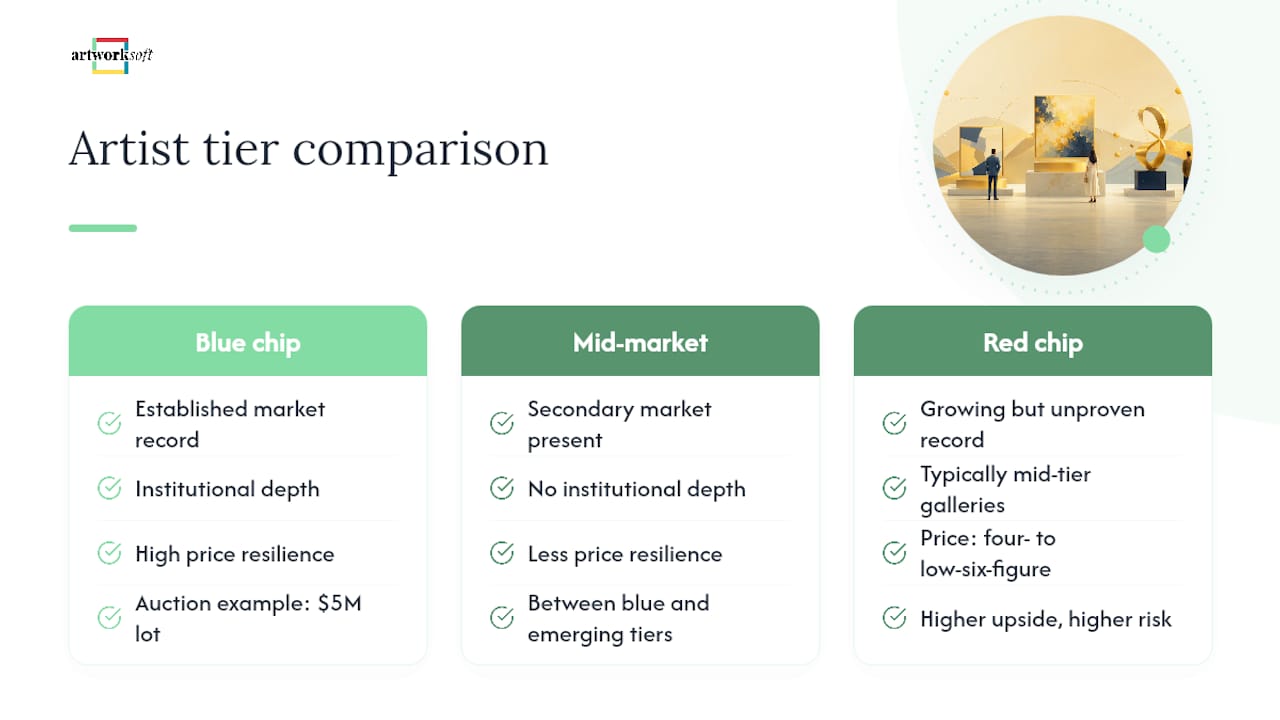
Red chip (or emerging) artists are those with a growing but unproven market record, typically represented by mid-tier galleries and selling in the four- to low-six-figure range. Their upside potential is higher, but so is the risk of a market correction or a career that plateaus. Mid-market artists occupy the space between: established enough to have a secondary market, but without the institutional depth or price resilience of the blue chip tier.
An artist can move through tiers, but it is rare and slow. Jean-Michel Basquiat was considered an emerging artist in the early 1980s, before posthumous retrospectives and record auction results elevated him to blue chip status over three decades. That trajectory is the exception, not the rule.
The fee structure deserves attention. A buyer’s premium of 25% on a $5 million lot adds $1.25 million to the acquisition cost before insurance, transport, or storage. That cost base means a blue chip work must appreciate meaningfully before a resale generates a net gain.
What are the pros and cons of investing in blue chip art?
The case for blue chip works
- Low correlation to equities. Art markets do not move in lockstep with stock markets, which gives blue chip works a genuine diversification role in a multi-asset portfolio.
- Price resilience at the top end. The Art Basel & UBS Global Art Market Report 2026 shows public auction sales rose 9% in 2025, with high-end lots driving the recovery. The top tier held value when mid-market segments softened.
- Institutional demand. Museums, foundations, and family offices compete for the same works, providing a structural demand floor that speculative art lacks.
- Tangible asset. Unlike financial instruments, a blue chip work can be displayed, loaned to institutions, and enjoyed while it appreciates.
Market signal: Artnet Intelligence reported that buyer demand concentrated into time-tested blue chip names in 2025, particularly in Impressionist and Modern categories, while the ultra-contemporary segment declined. That flight to quality is a recurring pattern in uncertain markets.
The risks and costs
- Illiquidity. A blue chip work cannot be sold in a day. Consigning to a major auction house typically requires a 6–12 month lead time, and private sales can take longer.
- High transaction costs. Buyer’s premiums at Christie’s, Sotheby’s, and Phillips typically range from 13% to 25% of the hammer price, and sellers pay a commission on top.
- Storage and insurance. Climate-controlled storage for a single large canvas can cost thousands of dollars annually. Fine art insurance for a $5 million work adds further carrying costs.
- Valuation opacity. Unlike publicly traded securities, art has no continuous price feed. Valuations between sales rely on comparable auction results and appraiser judgment.
- Survivorship bias in indices. Art market indices track artists who remained prominent. Artists who fell out of favor are underrepresented, which makes historical returns look stronger than they were for the average collector.
Fractional platforms such as Masterworks allow investors to buy shares in individual blue chip works, lowering the entry threshold from seven figures to a few hundred dollars. The tradeoff is reduced control, platform-specific liquidity constraints, and fees layered on top of the underlying art market costs. For collectors who want direct ownership, fractional platforms are an entry point, not a substitute.
How do you buy and sell blue chip art in the U.S.?
Where to source blue chip works
Major auction houses are the most transparent channel. Christie’s, Sotheby’s, and Phillips all hold regular sales in New York, publish pre-sale estimates and condition reports, and maintain searchable lot archives. Auction is the most liquid exit for a seller and the most price-transparent entry for a buyer.
Top-tier dealers and galleries offer access to works that never reach public auction, often at prices negotiated privately. Relationships matter here. Galleries like Gagosian and Hauser & Wirth maintain waiting lists for works by living blue chip artists and prioritize clients with institutional or collection credentials.
Art fairs such as Art Basel Miami Beach and Frieze New York concentrate gallery inventory in one place and allow direct comparison across dealers, though prices are rarely disclosed publicly.
Fractional platforms (Masterworks being the most prominent U.S. example) provide regulated, SEC-qualified access to individual works. They suit investors who want art market exposure without the logistics of physical ownership.
Step-by-step buying checklist
- Research the artist and work. Pull auction records from Christie’s, Sotheby’s, and Artnet. Confirm museum holdings and gallery representation.
- Obtain a pre-purchase valuation. Commission an independent appraisal from an ASA- or AAA-certified appraiser, not the seller’s own estimate.
- Request provenance documentation. Ask for the full ownership chain, bills of sale, exhibition records, and any catalog raisonné entry.
- Commission an authentication review. For works above six figures, engage a subject-matter expert or the relevant artist foundation.
- Order a condition report. A conservator’s written assessment of the work’s physical state is standard practice and affects both value and insurability. The impact of condition on valuation is well documented.
- Negotiate and execute. At auction, set a maximum bid before the sale and account for the buyer’s premium. In private sales, use an escrow arrangement and engage legal counsel for contracts above six figures.
- Arrange insurance and transport. Fine art insurance should be in place before the work leaves the seller. Specialist art shippers handle customs documentation for international works.
Fees and U.S. tax considerations
Buyer’s premiums at the major houses typically run 25% on the first $400,000 of the hammer price, stepping down to 20% and then 13% on higher amounts (exact tiers vary by house and sale). Sales tax applies in New York and most other states unless the buyer qualifies for an exemption. On resale, gains on collectibles held more than one year are taxed at a federal rate of up to 28% under current U.S. tax law, higher than the long-term capital gains rate on equities. State taxes apply on top. Consult a tax advisor before structuring a significant acquisition or sale.
How do you verify provenance, authenticity, and condition?
Provenance and authentication are where blue chip transactions most often go wrong. A work with a gap in its ownership history, a disputed attribution, or undisclosed restoration can lose a significant portion of its value and become unsaleable at major auction houses.
Due diligence checklist
- Full provenance chain. Every owner from the artist’s studio to the present seller, supported by bills of sale, estate records, or dealer invoices.
- Exhibition history. Catalog entries from museum or gallery shows confirm the work was publicly known and accepted by institutions.
- Catalog raisonné entry. Inclusion in the artist’s authoritative scholarly catalog is the strongest single authentication signal.
- Museum loan records. Works loaned to major institutions carry implicit institutional endorsement.
- Certificate of Authenticity. Issued by the artist, the artist’s estate, or a recognized foundation. For works by deceased artists, the foundation’s authentication committee is the relevant authority.
- Conservation and condition report. A written assessment by a conservator documenting the work’s physical state, any prior restorations, and current stability.
Pro Tip: Before purchasing any work above $100,000, it is advisable to check public databases such as the Art Loss Register, the FBI’s National Stolen Art File, and the INTERPOL Works of Art database to reduce the risk of acquiring a work with a disputed or stolen title.
Red flags
- Gaps of more than a few years in the ownership chain, particularly during periods of wartime displacement or estate settlement
- Conflicting documentation (two different bills of sale for the same work)
- Unverifiable or undisclosed restorations that affect the work’s original surface
- Prices dramatically below market value with no clear explanation
- Seller resistance to independent authentication or condition review
Authentication directly affects artwork price and insurability. Engaging an independent conservator, a provenance researcher, and legal counsel before a significant purchase is standard practice, not excessive caution.
What do the 2025–26 market data tell buyers?
The headline numbers from the Art Basel & UBS Global Art Market Report 2026 confirm a market in cautious recovery. Global art market sales reached an estimated $59.6 billion in 2025, up 4% year-on-year. Public auction sales rose 9% to $20.7 billion, with high-end lots leading the rebound. The United States remained the largest single market.
Statistic: Global art market sales reached an estimated $59.6 billion in 2025, up 4% year-on-year, with public auction sales rising 9% to $20.7 billion. High-end lots drove the recovery. Source: Art Basel & UBS Global Art Market Report 2026.
Artnet Intelligence’s Year Ahead 2026 report identified a clear flight to quality: buyer demand concentrated in Impressionist and Modern categories, while ultra-contemporary segments declined. UBS’s art market research echoes that finding, noting the continued importance of provenance and professional collection management as offline sales recovered.
| Metric | 2025 Figure | Implication for buyers |
|---|---|---|
| Global market sales | $59.6 billion (+4% YoY) | Market is recovering; entry timing is more favorable than recent peaks |
| Public auction sales | $20.7 billion (+9% YoY) | Auction liquidity improving; competitive bidding returning at the top end |
| Strongest segment | Impressionist and Modern | Established blue chip categories outperforming; flight to quality confirmed |
| U.S. market position | Largest single market | New York auction houses remain the primary liquidity venue |
For a collector holding blue chip works, the 2025–26 data suggest improving exit conditions at the top end, but not a broad market recovery. Mid-market and ultra-contemporary works face more selective demand. For a buyer, the recovery in high-end auction results means competition for the best lots is increasing, and pre-sale estimates at Christie’s and Sotheby’s are likely to reflect that.
Collecting versus investing: a perspective worth considering
The most persistent misunderstanding in the blue chip art market is treating collecting and investing as the same activity. They are not.
Investors optimize for return on capital, which means they need liquidity, transparent pricing, and a defined exit horizon. Blue chip art fails on all three counts relative to financial instruments. The transaction costs alone, buyer’s premiums, seller’s commissions, insurance, storage, and tax on gains, create a hurdle rate that most works do not clear over a 5–7 year hold. The collectors who have done well financially from blue chip art are, almost without exception, people who bought what they loved, held it for 20 or 30 years, and benefited from the compounding of cultural and institutional consensus around an artist.
That is not an argument against buying blue chip works. It is an argument for clarity about motivation. A collector who buys a Basquiat or a Kusama for the right reasons, cultural significance, aesthetic engagement, legacy, and who manages the asset professionally, documents provenance rigorously, insures it correctly, and tracks its condition over time, is in a fundamentally stronger position than one who buys speculatively and neglects the administrative work. The collection strategy framework that serious collectors use reflects this: the financial outcome is a byproduct of disciplined stewardship, not the primary driver.
Professional documentation is not optional at this level. A work without a complete provenance record, a current condition report, and a Certificate of Authenticity is harder to sell, harder to insure, and harder to loan to institutions. Those gaps cost money.
Artworksoft helps you protect and present blue chip works
Owning a blue chip work without professional documentation is a liability, not just an oversight. Provenance gaps, missing condition records, and absent Certificates of Authenticity directly reduce a work’s insurability and resale value. Artworksoft addresses that gap with purpose-built tools for collectors, galleries, and art businesses that need institutional-grade documentation without institutional overhead.

With Artworksoft, you can generate Certificates of Authenticity, maintain a full movement log, produce condition reports, and build a provenance record that satisfies the due diligence requirements of major auction houses and institutional buyers. Key features relevant to blue chip owners:
- Certificate of Authenticity templates with professional PDF output
- Movement and location tracking for works on loan or in transit
- Condition report documentation linked to individual artwork profiles
- Valuation records and AI-assisted valuation tools
- Export-ready asset reports for insurance, estate planning, and sale preparation
Turn your collection into a well-documented asset with Artworksoft’s free plan, or explore the full feature set at Artworksoft.
Sources
The Art Basel & UBS Global Art Market Report 2026 is the most comprehensive annual overview of global market size, regional shares, and segment performance. Artnet Intelligence reports provide editorial analysis of buyer behavior and category trends, including the 2025 flight-to-quality signal. Artprice’s Contemporary Art Market Report publishes artist-level indices useful for benchmarking performance over time. For individual lot research, the searchable archives at Christie’s and Sotheby’s remain the primary provenance and pricing references. UBS art market research offers a concise summary of key findings for collectors who want the headline data without the full report. For practical buying guidance, Masterworks Academy and Invaluable both publish accessible primers on blue chip identification and investment considerations.
- Introducing the Intelligence Report: The Year Ahead 2026
- Art market research — UBS
- What Blue-Chip Art Actually Means, and Why It Matters | Masterworks Academy
- What is Blue-Chip Art and How to Start Investing in it - Invaluable
- THE CONTEMPORARY ART MARKET REPORT 2023 — Artprice
- Sotheby’s
- Christie’s











