

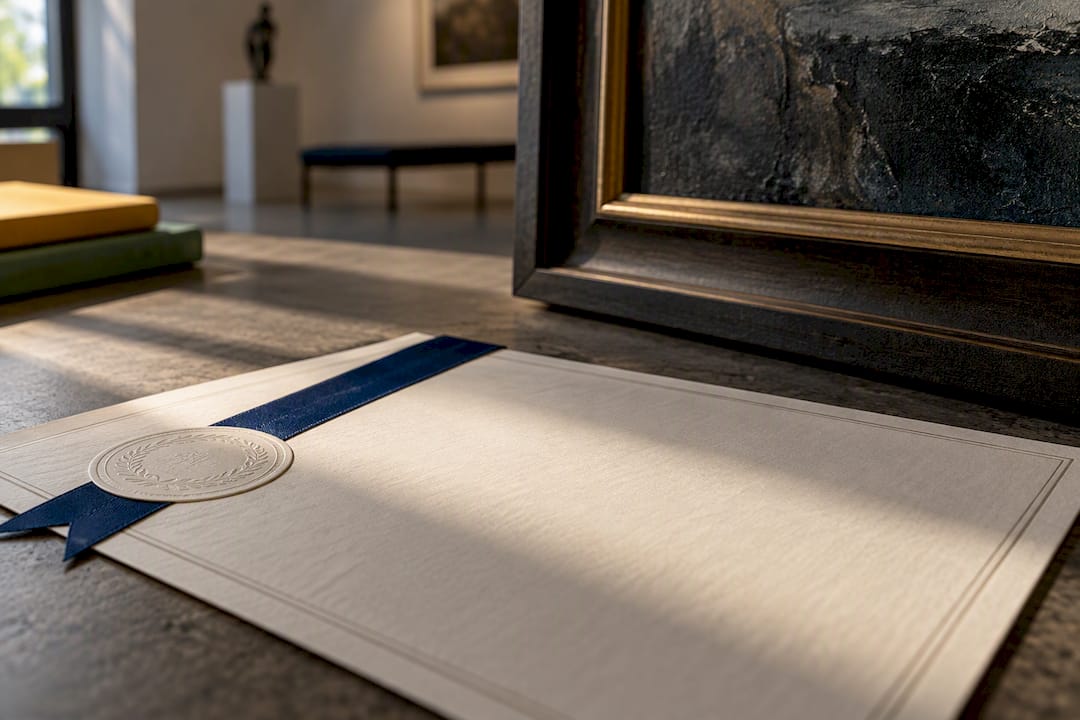
A branded certificate of authenticity is a signed, uniquely identified document that verifies a specific artwork or product and carries the issuer’s consistent visual identity. The single most important practice is pairing that certificate with a persistent, checkable verification record, whether a hosted webpage or a maintained registry, tied to a unique serial number. A certificate without traceability is just a piece of paper: inaccurate claims on it can also create legal warranty exposure for the issuer.
TL;DR:
- A certificate of authenticity must be paired with a traceable verification record, such as a hosted webpage or registry, to verify its legitimacy and avoid legal exposure.
- Including specific details like a unique serial number, issuer contact, high-quality images, and signatures is essential for creating a defensible and trustworthy COA.
- Physical features like tamper-proof finishes or digital QR codes enhance anti-forgery measures and facilitate quick online verification.
- Issuers risk legal liability if factual statements on a COA are inaccurate or if they issue certificates without proper traceability and recordkeeping.
- Using an integrated platform like Artworksoft helps maintain a consistent, branded, and verifiable COA process across multiple sales and ownership changes.
Table of Contents
- What Is a Certificate of Authenticity, and How Does It Differ From Provenance?
- Why Do Branded COAs Matter for Trust and Resale?
- What Fields Should Every Branded COA Include?
- How Should You Choose Paper, Finishes, and Premium Formats?
- How Do You Verify a Certificate of Authenticity Is Legitimate?
- What Legal Risks Come With Issuing a COA?
- How Do You Actually Produce a Branded COA?
- How Should You Maintain COA Records Over Time?
- What Are Some COA Templates You Can Adapt?
- How Does Artworksoft Support Branded COA Workflows?
- What Actually Goes Wrong When Sellers Issue COAs
- Start Issuing Branded, Verifiable COAs With Artworksoft
- Where to Learn More About COAs and Verification
- Sources
- FAQ
What Is a Certificate of Authenticity, and How Does It Differ From Provenance?
A certificate of authenticity is a document created at the point of sale or transfer that states specific facts about a single work: who made it, what it is, and who is vouching for those facts. Provenance, by contrast, is the ownership history of the piece, built up over years through invoices, exhibition records, prior sales, and correspondence. A COA is a snapshot; provenance is the whole timeline.
The distinction matters legally, not just semantically. Under commercial law, factual statements on a COA can function as an express warranty, meaning a buyer can hold the issuer to what the certificate claims. That is one reason a certificate of authenticity works best as a trust instrument backed by a reputable, traceable issuer, not as a standalone legal shield.
A COA should never be confused with an appraisal. Appraisals establish monetary value using recognized methodology, while a COA confirms identity and origin. For donations or insurance claims above certain thresholds, a qualified appraisal is required regardless of how detailed the certificate is.
Where COAs genuinely earn their keep:
- Confirming the specific artist, edition, or maker attribution at the point of sale
- Supporting insurance underwriting alongside a formal appraisal
- Anchoring a provenance research file for future resale
- Giving buyers a documented reference if authenticity is ever questioned
Treat the COA as the first entry in a growing provenance record, not the final word on a piece’s history or worth.
Why Do Branded COAs Matter for Trust and Resale?
Collectors buy confidence as much as they buy objects, and a professionally branded COA signals that confidence upfront. A certificate designed with consistent typography, a clear issuer statement, and your gallery or studio identity tells a buyer this transaction is being handled by someone who takes the work seriously.
The trust benefits show up at multiple points in an artwork’s life:
- At sale: buyers feel more comfortable paying full price when the paperwork looks deliberate rather than improvised.
- At insurance: underwriters and appraisers look for consistent documentation when valuing a claim.
- At resale: a future seller with a clean, branded certificate has an easier time commanding a strong price, since authentication history directly affects resale value.
- At dispute: a well-documented issuer is far easier to trace back to than an anonymous online seller.
A COA is fundamentally a trust instrument whose value rides on the reputation and traceability of whoever issued it. That is exactly why fraudulent certificates from anonymous marketplace sellers are worth nothing: there is no one standing behind the claim, and no way to check it. A sloppy or generic-looking COA does more than fail to help; it can actively raise suspicion, especially with collectors who have been burned before by inconsistent paperwork or vague attribution language.
What Fields Should Every Branded COA Include?
Every branded COA needs a baseline of fields that satisfy both legal clarity and provenance usefulness. Skipping any of these creates a gap that a future buyer, insurer, or appraiser will eventually notice.
- Artist or maker name, spelled and formatted exactly as used elsewhere in your records.
- Issuer name and contact information, so the certificate can be traced back to a real, reachable party.
- Title of the work, matching your inventory and any exhibition history.
- Year created, distinct from the year the COA itself was issued.
- Medium and materials, described precisely rather than generically.
- Exact dimensions, since vague measurements weaken the certificate’s specificity.
- Edition information, including edition number and total edition size for prints or multiples.
- A reference image of the actual piece, not a stock or representative photo.
- A short authenticity statement, plainly worded and free of unverifiable claims.
- Date of issuance, separate from the creation date.
- A signature, hand-signed or a verified digital signature tied to the issuer.
- Issuer contact details, repeated near the signature block for easy reference.
Beyond the baseline, several extras separate an adequate COA from a genuinely defensible one: a unique serial number, a matching label ID physically affixed to the artwork, references to any known provenance documents, basic care instructions, and clear limitation language for prints (edition size, whether the artist personally signed it, and whether plates were destroyed after the run). Practitioners specifically recommend a COA specific to a single artwork, with exact medium, dimensions, and an image, since generic templates weaken trust with professional collectors and insurers.
Pro Tip: Assign the serial number before you print anything. Retrofitting a unique ID after certificates are already in circulation creates confusing gaps in your records that are hard to explain later.
How Should You Choose Paper, Finishes, and Premium Formats?
Material choices carry both a branding function and a durability function, and the two do not always pull in the same direction. Archival, acid-free paper printed with archival inks resists yellowing and fading over decades, which matters because a COA that degrades faster than the artwork it certifies undermines its own credibility.
Premium formats add polish but come with trade-offs worth weighing before you commit to a batch print run:
- Foil stamping adds a refined, gallery-grade look and works well for logos or borders, though it raises per-unit cost noticeably.
- Embossing creates a tactile seal impression that is hard to replicate casually, adding a mild anti-forgery benefit alongside the visual effect.
- Die-cut cards feel premium and distinctive but require more setup time with a printer, making small runs less cost-efficient.
- Metal cards signal permanence and high value, ideal for limited editions or flagship pieces, but they add shipping weight and cost that may not suit lower-priced work.
On the production side, always confirm that any physical label affixed to the artwork matches the serial number on the certificate exactly. If you are printing certificates in batches rather than one at a time, build in a quality-check step where a sample from each batch is compared against the master proof before the whole run ships. Working with an experienced printer who understands print artwork file preparation standards will save you from misaligned bleeds, color shifts, and QR codes that scan poorly once trimmed.
How Do You Verify a Certificate of Authenticity Is Legitimate?
Verification is where a good-looking certificate proves it is more than good-looking. Physical anti-forgery measures still matter: hand-signed signatures, embossed seals, holographic stickers, and matched labels on the artwork itself all raise the effort required to fake a document convincingly.
Digital measures now carry most of the real verification weight, though:
- A unique ID printed on the certificate should map directly to an internal record you control.
- A QR code linking to a hosted certificate page lets a buyer confirm details instantly, from anywhere.
- Live verification pages let you update status (sold, transferred, restored) without reprinting anything.
- Blockchain-backed records offer long-term immutability, though they trade some buyer convenience and add cost, so they suit high-value or historically significant pieces better than everyday sales.
Experts increasingly point to this shift: certificates carrying a URL or digital record that can be re-validated are replacing static paper-only documents as the stronger trust signal. Verification-as-a-service platforms have emerged specifically to fill this gap, issuing QR-backed, hosted certificates that let a buyer re-check authenticity months or years after purchase without contacting the original issuer directly.
The workflow that works: issue the certificate with a printed QR code, host the underlying record on a page you control, and retain your own internal copy with a timestamp. This applies as much to collectibles as fine art. Counterfeiting is a widespread problem in adjacent markets too. Guides on spotting faux Pokémon cards before purchase illustrate how buyers in any collectibles category increasingly expect some form of checkable proof, not just a seller’s word.
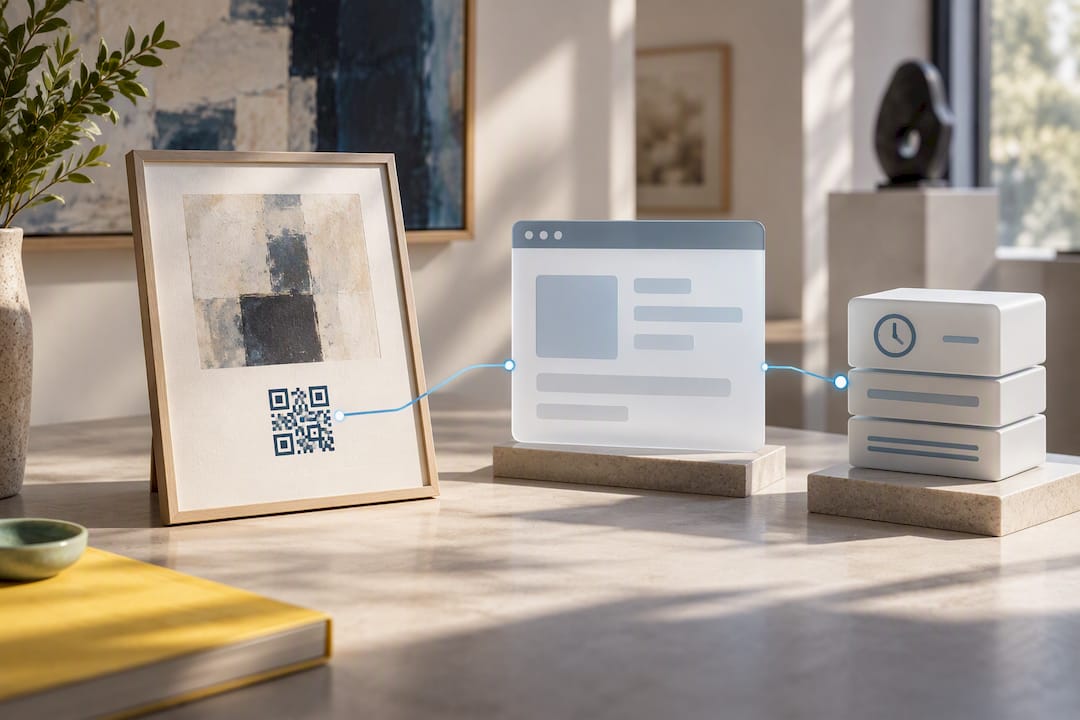
Pro Tip: If you sell through multiple channels (a gallery, your own site, and third-party marketplaces), use the same QR verification page across all of them. A buyer who sees inconsistent verification methods will assume something is being hidden.
What Legal Risks Come With Issuing a COA?
A certificate of authenticity is not a casual document, legally speaking. Wording on a COA can create express warranties under the Uniform Commercial Code, meaning inaccurate factual claims (wrong medium, incorrect edition size, an unverified attribution) can expose the issuer to civil liability if a buyer relies on those statements and they turn out false.
Several specific risk areas deserve attention before you finalize your certificate template:
- Several states require specific disclosures for prints and multiples, including edition number, total edition size, and whether the artist personally signed the work; missing these can create civil liability in multiple U.S. jurisdictions.
- Complying with these state disclosure statutes is an often underestimated operational risk for dealers who sell prints regularly, since a single inconsistent certificate can trigger a complaint.
- Knowingly issuing a false COA can expose the issuer to both criminal fraud charges and civil damages, well beyond a simple refund dispute.
- Notarization is commonly misunderstood as a shortcut to credibility. Real credibility comes from issuer reputation and traceable records, not a notary’s stamp, so rely on serial numbers and catalog raisonné references instead of assuming notarization solves anything.
If you discover an error on an already-issued COA, correct it promptly with a dated amendment referencing the original certificate’s serial number, and keep both versions on file. For high-value pieces, unusual attribution claims, or anything involving disputed authorship, get a qualified art attorney to review your certificate language before it goes out the door.
How Do You Actually Produce a Branded COA?
You have three realistic paths, and the right one depends on volume, value, and how much verification infrastructure you want to maintain.
- DIY template route: photograph the piece under consistent lighting, assign a unique serial ID, build a clean template in design software with your branding locked in, print on decent stock, sign by hand, and log the record in a spreadsheet or database immediately after issuance.
- Professional printing route: request archival paper stock, specify your chosen finish (foil, embossing, or a metal card), confirm exact QR code placement so it scans cleanly after trimming, and ask for a proof sample before committing to a full batch.
- Digital issuance provider route: these services generate a hosted certificate, assign a QR code automatically, and maintain a tamper-evident record on their end, which removes the burden of building your own verification page from scratch. When comparing providers, check whether the hosted record persists if you ever cancel the service, since pairing a digital COA with a traceable ID and consistent verification language only works if that record stays reachable long term.
The strongest end-to-end workflow combines all three impulses: a physically signed, well-printed certificate paired with a digital record you control, issued through a system that logs the serial number, image, and buyer transfer automatically rather than in a separate spreadsheet you might forget to update.
How Should You Maintain COA Records Over Time?
A certificate issued once and then forgotten loses most of its value within a few years. Maintaining a timestamped issuance log, tied to each unique serial ID, is what keeps a COA useful as the piece changes hands, gets loaned out, or undergoes restoration.
Practical recordkeeping habits that pay off later:
- Log every ownership transfer against the original serial number, not just at the point of first sale.
- Record loans, exhibition history, and condition reports as they happen, not months later from memory.
- Keep a hosted verification page live and current, since insurers and appraisers routinely check whether a certificate’s digital record still matches physical reality.
- Store internal copies separately from any third-party verification service, in case that service changes hands or shuts down.
Blockchain and other tamper-evident record formats offer strong long-term immutability, but they involve a real trade-off between permanence and buyer convenience worth weighing against your typical sale volume and average piece value before adopting them wholesale.
What Are Some COA Templates You Can Adapt?
Three patterns cover most real-world situations, and each calls for slightly different fields and emphasis.
- Artist-signed single-piece COA: built for one-of-a-kind works. Emphasize the hand signature, exact dimensions, medium, and a high-resolution image. Keep the authenticity statement short and specific to that single object.
- Gallery print COA with edition disclosures: designed for limited editions. Lead with edition number and total edition size, note whether the artist personally signed each print, and state clearly whether the plate or master was destroyed after the run.
- Premium metal card with hosted record: reserved for flagship or high-value pieces. Minimal printed text, a prominent QR code, and a serial number that links directly to a detailed hosted page carrying the full history.
Whichever template you start from, keep your logo placement, color palette, and typography consistent with your other client-facing materials, invoices, packaging, and your website alike. A certificate that looks disconnected from the rest of your brand undercuts the professionalism it is supposed to communicate.
How Does Artworksoft Support Branded COA Workflows?
The software builds branded certificates directly into its collection management workflow and can generate PDF certificates of authenticity tied to a unique artwork profile, keeping details such as serial ID, image, dimensions, and provenance references linked to one record.
Because Artworksoft also tracks artwork identification and traceability alongside movement history and transaction records, a certificate issued today stays connected to future sales, loans, or location changes. Users typically create the artwork profile once, generate the branded certificate from that profile, and allow the platform to maintain the traceable record as ownership or status changes.
What Actually Goes Wrong When Sellers Issue COAs
The biggest mistake I see is treating a COA as a formality rather than a claim with legal weight. Sellers write vague, generic authenticity statements because they seem safer, but vague language is exactly what invites confusion later. Specificity protects you more than caution does.
The second mistake is issuing a beautiful certificate with no traceable record behind it. A gorgeous metal card means nothing if there is no serial number anyone can look up. Traceability, not design polish, is what a serious buyer or insurer actually checks.
The third mistake is treating the certificate as a one-time document instead of a living record. Ownership changes, restorations happen, and provenance gets richer over time. A COA disconnected from that ongoing record goes stale fast.
If you take one thing from this: pair every signed certificate with a persistent verification path, and update that record every time something material changes.
— Nealda
Start Issuing Branded, Verifiable COAs With Artworksoft
Artworksoft is the practical alternative to juggling design templates, spreadsheets, and a separate verification tool for every artwork you sell. Rather than combining separate tools for PDF templates, serial numbers, and verification pages, the platform generates a branded certificate of authenticity directly from each artwork’s profile, keeping relevant details connected to one traceable record from issuance onward.

That connection matters most after the sale, when a buyer, insurer, or future owner needs to confirm the details still hold up. Artworksoft’s artwork profile management keeps that record current as pieces move, sell, or get restored, so your certificates never drift out of sync with reality.
Start with the Free Plan to generate your first branded certificates and see how the profile-to-document workflow fits your existing process. If you manage a larger collection or need hands-on setup, the Onboarding & Collection Management Service will build out your inventory and documentation structure with you directly.
Where to Learn More About COAs and Verification
A handful of sources go deeper into the mechanics covered above, useful if you are drafting your own template or reviewing legal language before printing.
- Certificates of Authenticity: A Complete How-To Guide, a practical overview of issuer trust, live verification trends, and blockchain trade-offs.
- Certificate of Authenticity Template: What to Include, a legal breakdown of UCC warranty exposure and state disclosure rules for prints.
- Certificate of Authenticity for Art: Digital COA Guide, on pairing digital certificates with traceable IDs at scale.
- Verifydoc, a look at how QR-backed hosted verification services operate.
This article is general information, not a substitute for advice from a qualified lawyer. Consult a qualified legal professional about your own circumstances before acting on anything here.
Sources
- Certificates of Authenticity: A Complete How-To Guide
- Certificate of Authenticity Template: What to Include – LegalClarity
- Verifydoc
FAQ
How do I know if a COA is real?
Check whether the certificate includes a unique serial number, an issuer name with reachable contact information, and ideally a QR code or URL linking to a hosted verification record. A legitimate certificate of authenticity traces back to a real, traceable issuer rather than existing as an isolated printed page.
How do I get a COA for my product or artwork?
You can build one yourself using a template with your branding, order one through a printer specifying archival materials and finish, or use a digital issuance provider that hosts the verification record for you. Artworksoft generates branded certificates directly from each artwork’s profile inside its platform, keeping the certificate linked to the underlying inventory record.
How can I tell if a certificate of authenticity is legit?
Look for specificity rather than generic language: exact medium, precise dimensions, a real image of the piece, and a signature tied to a named issuer. Certificates lacking a unique ID or any way to verify the claim independently are the ones most likely to be worthless or forged.
How do I get a COA for a signature?
For a signed piece, the certificate should describe the signature’s placement, confirm whether it was signed by the artist personally, and pair that claim with a unique serial number matched to a label on the artwork itself. This physical-to-digital pairing is considered more persuasive to insurers and registrars than notarization alone.
Does Artworksoft charge for generating certificates of authenticity?
Artworksoft offers a Free Plan that lets you start generating branded documentation, with the Provenance Plan available from $5 per month for expanded features. Current pricing details for both plans are listed on the Artworksoft pricing page.











