A provenance chain of custody is the documented, verifiable history of an artwork’s ownership, transfers, and location, and it is the foundation for proving authenticity and valid legal title. A well-maintained record makes a work ready for sale, loan, or insurance underwriting without delay. This guide covers what to record, how to verify it, and how to build a system that holds up under scrutiny.
TL;DR:
- Provenance records must include detailed custody event data, such as artwork identifiers, transfer types, parties involved, dates, locations, and condition notes.
- Verification relies on cross-referencing independent archives and documents, with a focus on primary evidence like dealer ledgers and estate records rather than secondhand descriptions.
- Consistent documentation with timestamps and confidence ratings facilitates transparent, durable records that simplify loan approvals and dispute resolutions.
- Red flags for provenance issues include inconsistent dates, reliance on defunct dealers, altered documents, missing primary evidence, and conflicting ownership claims.
- Digital record-keeping should adopt archival formats like PDF/A and CSV, with access controls and audit logs to ensure long-term reliability and trustworthiness.
Table of Contents
- What to record for each custody event
- How to verify provenance through archives and records
- Build a verifiable chain-of-custody record
- Common red flags and what to do when gaps appear
- Digital best practices for portable, searchable records
- Why consistent documentation changes outcomes for collectors
- Implementing the workflow with Artworksoft
- Sources
- FAQ
What to record for each custody event
Every transfer in an artwork’s history needs a consistent set of fields attached to it. Skipping any one of them creates a gap that a buyer, insurer, or lender will eventually ask about.
- Artwork identifiers: title, medium, dimensions, and a unique inventory number.
- Date and time of the transfer or custody change.
- Parties and roles: seller, buyer, consignor, agent, or estate representative.
- Transfer type: sale, gift, inheritance, loan, or consignment.
- Location: where the artwork was held before and after the event.
- Condition note: a brief description or reference to a condition report at the time of transfer.
- Signatures or witnesses, especially for high-value works.
Each entry should also carry the documents that support it: invoices, bills of sale, certificates of authenticity, loan agreements, shipping and customs paperwork, condition reports, and dated photographs, reflecting how we curate crystals and minerals to ensure provenance and quality. Not all evidence carries equal weight. A dealer’s original stock ledger entry is primary evidence; a secondhand description in an auction catalog is secondary and should be flagged as such. Rating each entry by confidence, rather than treating every document as equally reliable, keeps the record honest about what is proven and what is still assumed.
Pro Tip: Attach a one-line confidence rating (confirmed, probable, unverified) to every custody entry so gaps are visible at a glance rather than buried in a document folder.
How to verify provenance through archives and records
Verification means testing what a seller or prior owner claims against sources that exist independently of them. The Archives of American Art holds dealer ledgers, correspondence, and estate records that often reveal ownership chains not published anywhere else, and these archival materials count as primary evidence rather than secondary description.
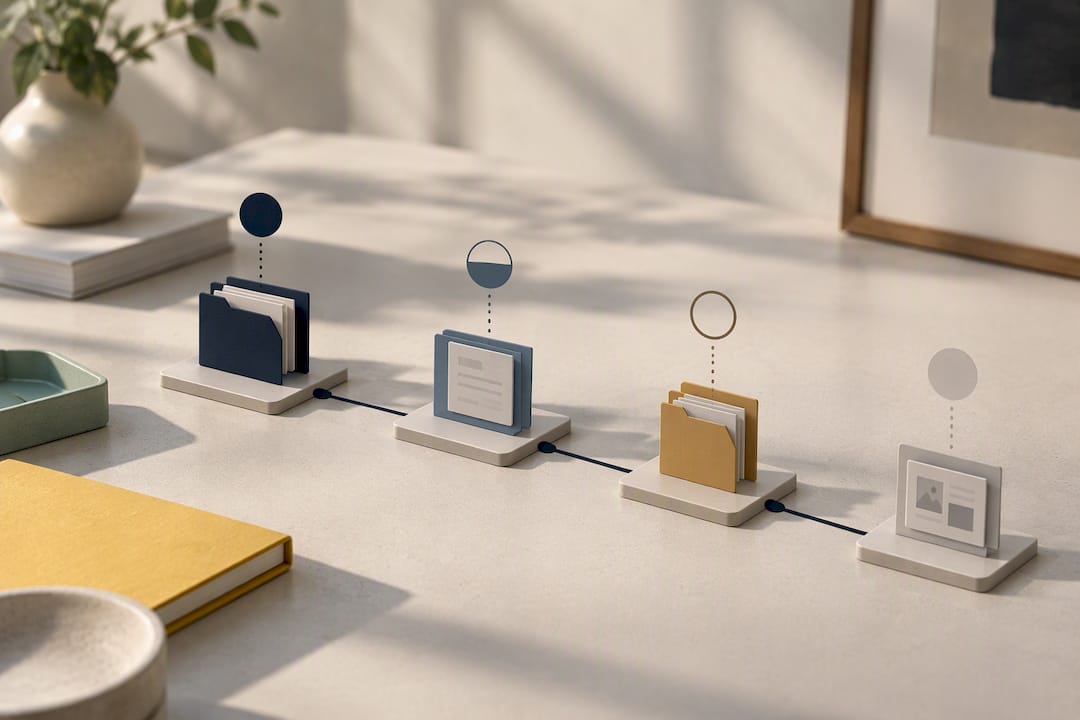
A practical verification routine follows four steps in order:
- Start with the paperwork in hand. Review every invoice, bill of sale, and certificate the current or prior owner can produce.
- Cross-check against independent archives. Search auction house records, dealer stock books, museum finding aids, and institutional archives for matching entries.
- Run a provenance gap analysis. Identify periods with no supporting record, and note whether the gap is a research limitation or a sign of something withheld.
- Document the findings formally. Record what was confirmed, what remains unverified, and which source resolved each question.
Customs records and legal filings can also confirm cross-border movement or settle ownership disputes, and it is worth checking whether a work has appeared in litigation. For high-value pieces or an unresolved gap, bringing in a provenance specialist or art counsel is a reasonable step rather than an overreaction. Our provenance research guide walks through this document-first approach in more detail.
Build a verifiable chain-of-custody record
Verification tells you what is true. A chain-of-custody record is where you make that truth durable and auditable.
- Create the artifact profile. Assign a unique ID, capture high-resolution photographs from multiple angles, and record a baseline condition assessment.
- Attach primary evidence to each transfer. Link the invoice, certificate of authenticity, or shipping manifest directly to the custody event it supports, not to the artwork file in general.
- Timestamp every entry and retain edit history. Note who added or changed a record and when, and consider a witness signature or notarization for high-value transactions.
- Schedule periodic provenance reviews. Set a recurring check, at least annually for significant works, to add new research or correct earlier entries.
A few habits make this workflow hold up over time:
- Never overwrite an old entry; append corrections with a date and reason instead.
- Keep a single master record per artwork rather than parallel files in different formats.
- Treat the record as unfinished: provenance is never fully closed, and new evidence can surface years later.
Pro Tip: Review provenance files on the same schedule as insurance renewals, since both depend on the same documentation being current.
Common red flags and what to do when gaps appear
Most provenance problems announce themselves early if you know what to look for.
- Inconsistent dates between a bill of sale and a stated transfer year.
- Reliance on defunct dealers or closed galleries whose records cannot be independently checked.
- Documents that look reproduced or altered, including certificates with mismatched fonts or signatures.
- Missing primary evidence for a decade or more of a work’s history.
- Multiple parties claiming ownership of the same piece at the same time.
Criminal cases prosecuted by the Department of Justice show how fabricated provenance and false ownership claims have supported large-scale art fraud, which is why cross-checking primary sources matters even when paperwork looks complete. If a red flag appears, pause the transaction, write down the specific concern, and preserve every document involved. Notify an insurer or underwriter if the work is already covered, and consult an archive or an authentication specialist before proceeding. When a gap cannot be closed, disclose it plainly to a buyer or borrowing institution rather than papering over it: transparency about what is unknown protects everyone in the transaction more than a confident but unsupported claim.
Digital best practices for portable, searchable records
A chain-of-custody record is only useful if it can be shared, searched, and trusted years later. File format matters more than most collectors assume.
- Save documents as PDF/A, a format built for long-term archival stability.
- Store images as high-resolution JPEG, PNG, or TIFF files, never compressed thumbnails.
- Export data as CSV or JSON so records can move between systems without reformatting.
At minimum, each record needs a unique ID, event date and time, the role of each party, location, linked proof document IDs, and a verifier name with a confidence rating. Immutable timestamping, including notarized records, adds a layer of trust, but it is worth being direct: blockchain entries alone do not replace documentary evidence if there is no underlying paperwork behind them. Finally, set access controls with distinct read and write roles, keep an audit log of every change, and redact sensitive ownership details before sharing a record externally.
Pro Tip: Export a CSV template with your standard fields once, then reuse it for every new acquisition instead of rebuilding the structure each time.
Why consistent documentation changes outcomes for collectors
Consistent chain-of-custody records shorten loan approvals, reduce friction with insurers, and give a gallery or collector a defensible position if ownership is ever challenged. The ICOM Code of Ethics asks institutions to apply due diligence beyond the legal minimum, and that standard is a reasonable one for private collectors and galleries to adopt voluntarily. The collectors who avoid disputes are rarely the ones with the most valuable pieces. They are the ones who treat documentation as a routine practice rather than a task reserved for the moment a sale falls through.
— Nealda
Implementing the workflow with Artworksoft
Building the workflow above by hand across spreadsheets and folders works for a small collection, but it gets harder to maintain as a collection grows. Artworksoft is built around the same structure this guide describes: artifact profiles, linked documents, and a permanent movement history for every piece.

- Create artifact profiles with unique IDs, high-resolution images, and baseline condition data.
- Attach invoices, certificates of authenticity, and loan agreements directly to each custody event.
- Generate professional Certificates of Authenticity and export provenance reports for buyers, lenders, or insurers.
- Maintain an audit trail showing who added or edited each record and when.
The Provenance Plan, priced from $5 per month, covers these features for galleries and collectors managing an active collection. For collectors who want hands-on help setting up their records, the Onboarding & Collection Management Service walks through the setup with a specialist. Start with the free plan to see how the structure fits your collection before upgrading.
Sources
- Provenance Research – Smithsonian’s National Museum of Asian Art
- A Guide to Provenance Research at the Archives of American Art | Smithsonian Institution
- ICOM Code of Ethics for Museums (2026)
- Two individuals plead guilty to prolific counterfeit art scheme | U.S. Department of Justice
FAQ
What documents count as proof of provenance?
Proof of provenance includes bills of sale, invoices, certificates of authenticity, loan agreements, shipping and customs records, and condition reports tied to a specific transfer. Primary sources like dealer ledgers or estate records carry more weight than secondhand descriptions in a catalog.
How far back should a provenance record go?
A provenance record should go back as far as documentation allows, ideally to the artist or the first documented sale. Gaps are common in older works, and provenance research is treated as an ongoing process rather than a one-time task, so a record can be updated as new evidence surfaces.
What should I do if I find a gap in an artwork’s history?
Pause any pending transaction, document exactly where the gap falls, and cross-check independent archives such as dealer stock books or museum finding aids before assuming the worst. If the gap cannot be closed, disclose it plainly to any buyer or lending institution rather than presenting an incomplete history as settled.
Can blockchain replace traditional provenance documentation?
Blockchain can add a timestamp layer for portability, but it does not replace the underlying documentary evidence a claim needs to be verified. A chain-of-custody record still depends on primary sources like invoices, certificates, and archival cross-checks.
Does Artworksoft help with provenance documentation?
Yes, the Provenance Plan lets galleries and collectors attach supporting documents, generate Certificates of Authenticity, and export audit-ready provenance reports for each artwork. Pricing starts from $5 per month, with an onboarding service available for collections that need setup support.