
Artwork movement tracking is the practice of recording every change in an artwork’s place and custody: what moved, who moved it, where it left and where it arrived. A complete record answers two questions at any moment: where a work is now, and where it has been. This guide sets out what to log, how to structure locations, which situations require an entry and what to expect from software built for the task.
TL;DR
- A movement record is an event, not a label. It captures the object, the actor, the origin and the destination, and the latest event defines the current location.
- Every storage location, from building to shelf, should carry a code that is entered in the catalogue and updated when the object moves.
- Display, exhibition, storage, conservation, loan and sale all call for an entry, particularly when custody changes hands.
- Software should connect artwork, location and transaction records, restrict who can change them and produce documents from the data.
- Artworksoft links artwork, locations and transactions in one cloud system, with a free plan and a Provenance Plan from $5 per month.
Table of Contents
- What artwork movement tracking records
- Inventory list versus movement history
- What to record when an artwork moves
- Structuring locations with codes
- Situations that require a movement entry
- Who may move the work
- Movement tracking by type of user
- What to look for in artwork location tracking software
- A worked example
- Our perspective on movement tracking
- Tracking artwork movements with Artworksoft
- Setting up a tracking routine
- FAQ
- Sources
What artwork movement tracking records
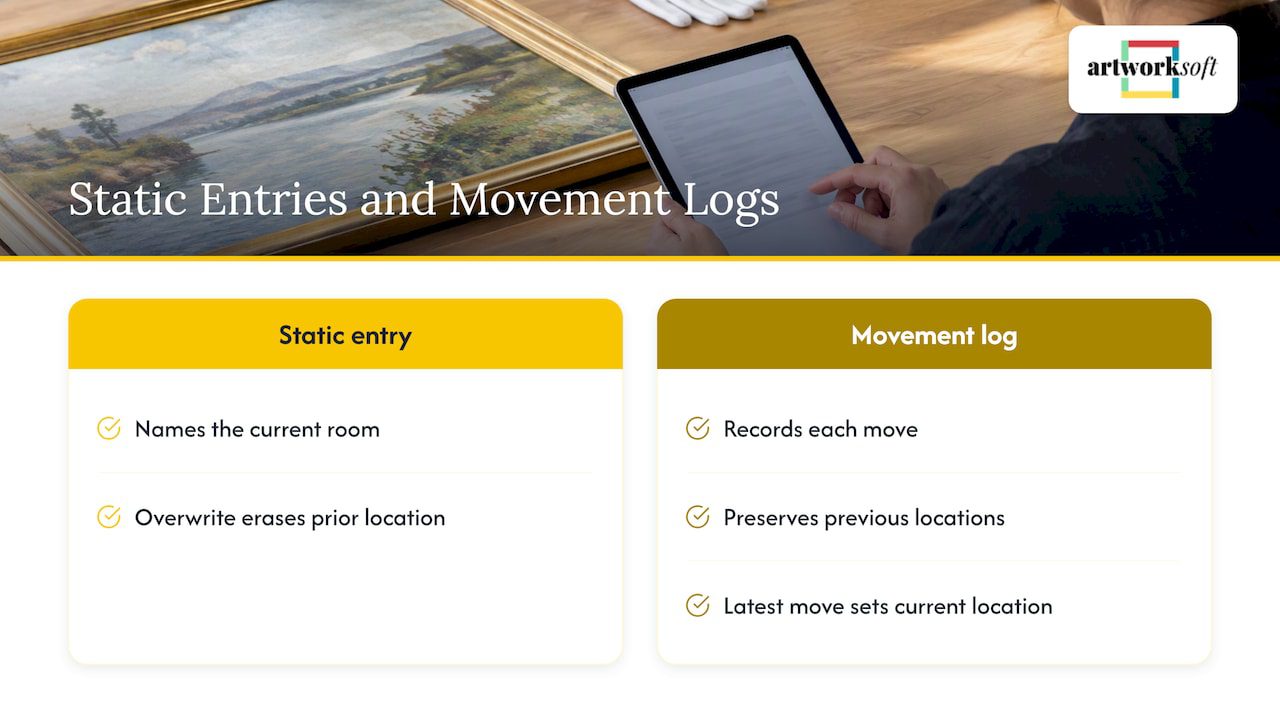
A static inventory states that a painting is in a given room. Movement tracking states how it came to be there. The Linked Art model for object location and movement describes a movement as an activity, carried out by an actor, that moves an object from one place to another. Under that model, the current location of an object is determined by its most recent movement.
This distinction has practical consequences. A list that is edited in place loses the past: once a cell is overwritten, the previous location is gone. A log of movements keeps each step, so the history can be audited, and the present location is simply the last line of that history.
The same logic applies whether the collection holds twenty works or twenty thousand. Only the volume of events changes.
Inventory list versus movement history
| Aspect | Static inventory list | Movement tracking |
|---|---|---|
| What it stores | The current location only | Every move, in order |
| How it changes | Cells are overwritten | New entries are added |
| Custody questions | Not answerable | Answerable from the log |
| Audit value | Low | High |
| Current location | Typed in by hand | Derived from the latest move |
A spreadsheet can imitate the right-hand column, but it depends on discipline. Each move requires a new row, a consistent location format and a person who remembers to enter it.
What to record when an artwork moves
The Linked Art model identifies the core elements: the moved object, the activity, the actor, and the source and destination locations. A practical record adds a date and a reason. A working checklist:
- Object: a unique identifier and title, so the entry cannot be confused with a similar work.
- Origin: the exact place the work left, recorded to the same level of detail as the destination.
- Destination: the exact place the work arrived.
- Actor: the person or organization that carried out or authorized the move.
- Date: the date the move took place, not the date it was entered.
- Reason: exhibition, storage, conservation, loan, sale, photography or another purpose.
- Custody: whether responsibility for the work changed, and to whom.
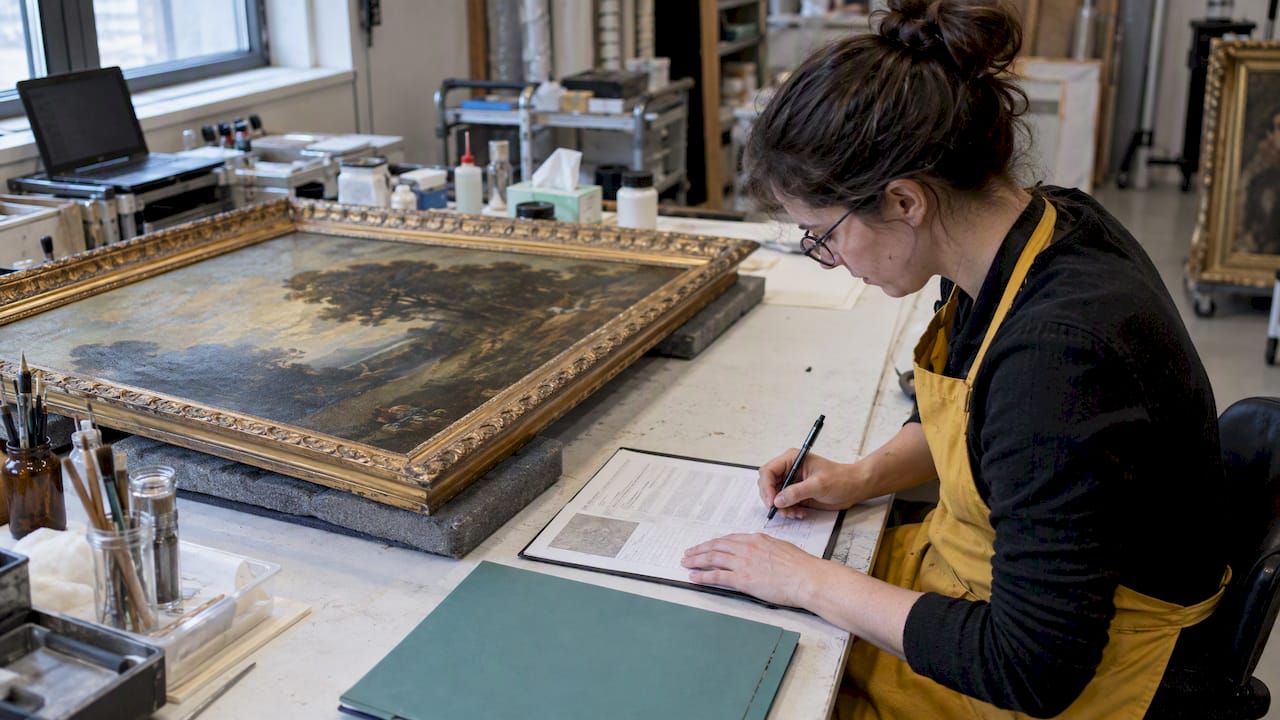
- Condition note: any change observed at departure or arrival.
The catalog standard of the U.S. Department of the Interior shows why the basics matter. Its museum property directive on collections documentation, effective September 21, 2012, requires catalog records to include a unique catalog number, current location, condition, date cataloged and cataloger. Few private collections are bound by that directive, but its list is a sound minimum for any collection.
Temporary and permanent moves
The registrar’s manual of the Wyoming State Museum separates the two cases. Temporary moves use check-out inventory sheets, and permanent moves are recorded on all copies of the inventory. The manual also expects the location to be detailed to the building, room or vault, case, row or cabinet, and shelf, drawer or wall.
The principle carries over to any collector or gallery. A work lent to a client for a week and a work moved to a new storage room are different events. The first should show an expected return, and the second should replace the previous home.
Structuring locations with codes
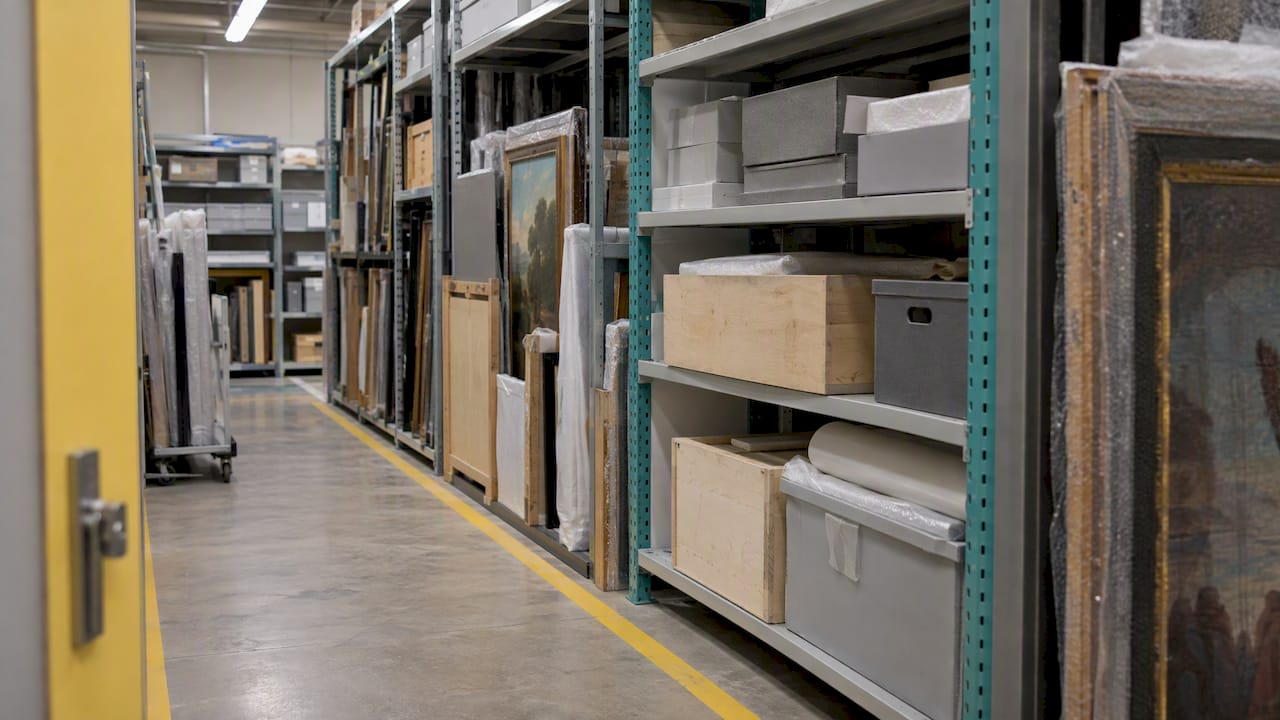
Free-text locations such as “back room” or “storage” cannot be searched reliably and do not survive staff changes. A UNESCO handbook on handling collections in storage, hosted by the Smithsonian’s Museum Conservation Institute, recommends giving every storage location a code, including a building, a room, a cabinet, a shelf or a box. The code is entered in the object catalogue, a new code is assigned when the object moves, and the codes are checked regularly.
A simple hierarchy works for most collections:
- Site (studio, gallery, residence, warehouse, hotel property)
- Room or area
- Fixture (rack, flat file, wall, crate)
- Position (shelf, drawer, slot)
A code such as GAL-R2-RK3-S4 is meaningful at a glance, unique within the collection and easy to verify against the physical position. Regular spot checks, comparing the record with what is on the shelf, catch errors before they accumulate.
Situations that require a movement entry
Linked Art names display, exhibition, storage, conservation and gallery changes as situations in which object movements are worth recording, including moves that also transfer custody between departments. In practice, the following events should each produce an entry:
- Installation and rotation: moving a work from storage to a wall, or between walls.
- Exhibition and art fairs: work leaving for a show and returning afterward.
- Conservation and framing: transfer to a restorer or framer, with the expected return.
- Loans: outgoing and incoming loans, each with its own terms and dates.
- Sales and consignment: a work leaving for a buyer or for another gallery.
- Storage changes: relocation between rooms, units or off-site facilities.
- Internal transfers: a work passing between departments, offices or properties.
Storage conditions matter during these changes. Collectors weighing an off-site option can review art storage climate control for collectors, and artists or small institutions comparing facilities can look at museum-grade art storage units. Whichever facility is chosen, its address and unit number belong in the location hierarchy so that the record stays accurate after the move.
Who may move the work
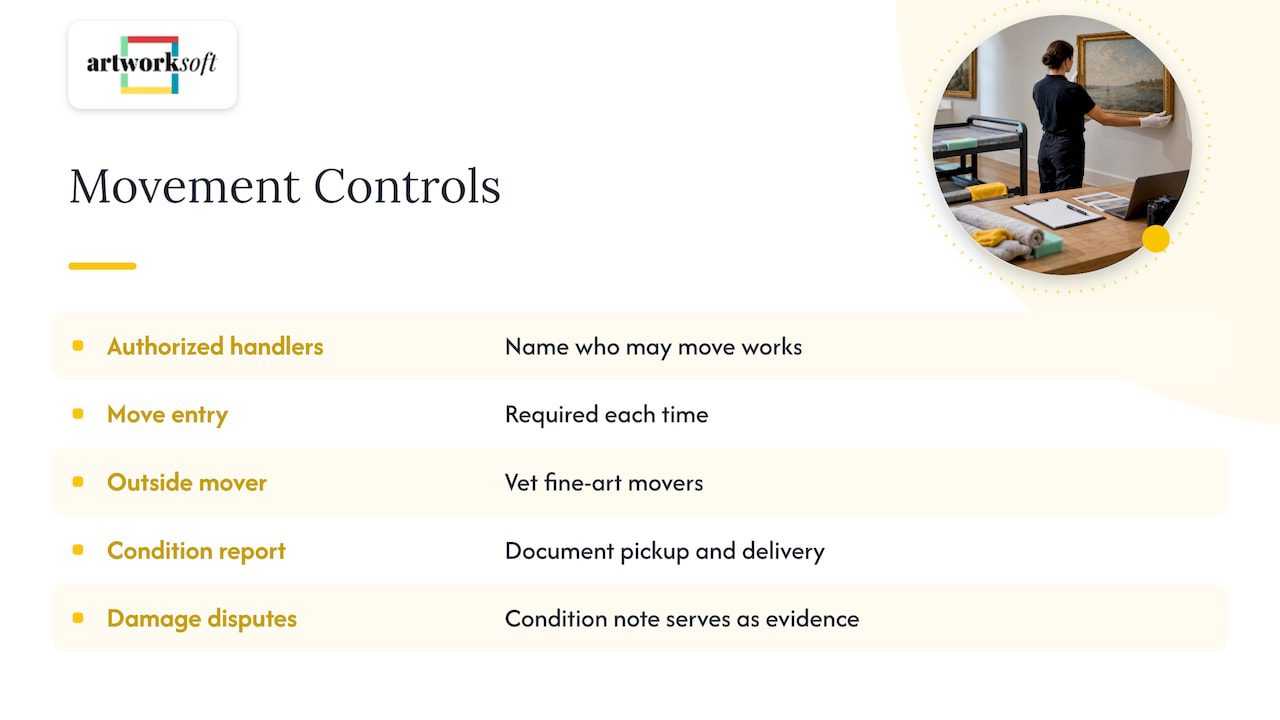
A movement log is only as reliable as the control over who moves the work. The Phillips Collection employee handbook states that only authorized preparators, conservators, registrars, museum supervisors and curators may touch or move artworks. Smaller organizations rarely have those roles, but the rule translates directly: name the people who may handle and relocate works, and require an entry each time they do.
For transport by outside parties, the same discipline applies. A mover handling fine art should be vetted and should document condition at pickup and delivery, a point covered in guidance on fine art moving and condition reports. The condition note on the movement record then becomes the evidence if damage is later disputed.
Movement tracking by type of user
Emerging artists
Artists move work between studio, exhibitions, galleries and buyers. Each location holds part of the sales story. A log shows which pieces are at which venue, which are available and which are on consignment, and it prevents offering a work that is already committed.
Collectors
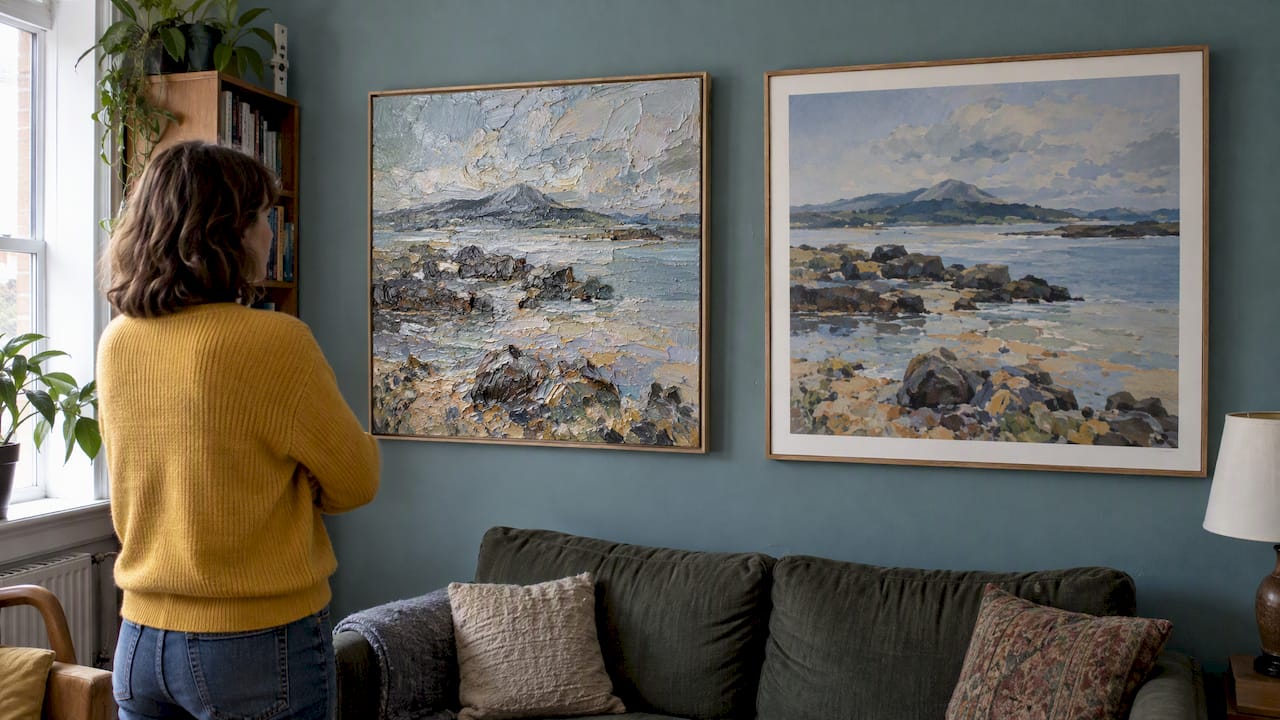
Collectors need to know where each piece hangs or is stored, and which works are on loan. A movement history also supports provenance, since it documents the period of ownership and each change of place.
Galleries
Galleries handle the highest volume of events: consignments in, works to fairs, works to clients on approval, and sales out. Linking each movement to a transaction avoids the common gap between the sales record and the physical record.
Insurers, hotels and law firms
Organizations that hold or oversee art without being art businesses need the same facts in a simpler form: which works are in which rooms, who is responsible for them and when that changed. A shared, structured record serves insurance schedules, property inventories and legal matters such as estates, where the location and custody of each work may need to be shown.
What to look for in artwork location tracking software
Software choices are best made against criteria that follow from the records described above.
| Criterion | What to check |
|---|---|
| Event-based history | Each move is stored as a new entry, and current location is derived from the latest one |
| Location structure | Hierarchical locations with unique codes |
| Link to transactions | Sales and loans connect to the physical movement |
| Access control | Control over who can add or change entries, and what clients can view |
| Documentation | Certificates of authenticity, invoices and reports generated from stored data |
| Required fields | Unique number, current location, condition, date and recorder, as in the DOI standard |
| Sharing | A way to give clients and partners read access without exporting files |
| Pricing | A plan that covers the full collection, with the price stated on the page |
Two cautions apply. A tool that only shows a map pin or a single location field is a list, not a movement record. And a tool that cannot produce documents from its own data forces retyping, which is where mismatches begin.
A worked example
The following illustration is hypothetical. A gallery sends an oil painting to a framer, then to an art fair, then to a buyer.
- Departure from the gallery. Origin: gallery storage, rack 3, shelf 4. Destination: framer. Actor: the registrar. Condition: no changes. Custody remains with the gallery.
- Return from the framer. Origin: framer. Destination: gallery storage. Condition note: new frame, glazing intact.
- Transfer to the fair. Origin: gallery storage. Destination: fair booth. Reason: exhibition, with an expected return.
- Sale. Origin: fair booth. Destination: buyer’s address. Custody transfers to the buyer, and the invoice is linked to the entry.
At any point, the last entry gives the current location, and the full list gives the history. If the buyer later asks where the work was in the year before purchase, the answer is a report, not a search through emails.
Our perspective on movement tracking
We treat artwork as an asset that carries a record. Location is one part of that record, alongside valuation, provenance and documentation, and these parts lose value when they are kept in separate files. A work whose location is known but whose sale terms are in another system still produces questions.
For that reason, Artworksoft connects artwork, locations and transactions in a single interface. A move, a loan and a sale are related events, and the system treats them that way. Artists, collectors, galleries and organizations such as hotels, insurers and law firms share a common need: a structured record that can be shown to a third party without reconstruction.
We also hold that the simplest dependable method is the best one. A consistent location code, a log entry at every move and a regular physical check will outperform an elaborate system that no one updates.
— Nealda
Tracking artwork movements with Artworksoft
Artworksoft is cloud-based art collection management software that organizes artwork, tracks movements and locations, manages sales and loan transactions, and generates documents such as Certificates of Authenticity, invoices and reports. The Free Plan and Provenance Plan are described on the pricing page, with the Provenance Plan listed from $5 per month. Collections that need help with setup can review the onboarding and collection management service. General information about the platform is available on the Artworksoft website.
Setting up a tracking routine
A routine is more important than a tool. A workable sequence:
- Assign a unique identifier to every work.
- Define the location hierarchy and code every site, room and fixture.
- Record the current location of every work as the starting entry.
- Decide who may move works and who may enter records.
- Log each move on the day it happens, with origin, destination, actor and reason.
- Note condition at departure and arrival.
- Compare records with physical positions at regular intervals and correct discrepancies as new entries.
Corrections should be added, not overwritten. A record that shows an error and its correction is more credible than one that appears to have been perfect.
FAQ
What is the difference between artwork location tracking and movement tracking?
Location tracking states where a work is now. Movement tracking keeps every change of place and custody, so the current location is the result of the latest entry. The second approach preserves history and supports provenance and audits.
What should be recorded each time an artwork moves?
At minimum, the object, the actor, the origin, the destination and the date. A reason, a condition note and any change of custody make the entry more useful. Temporary moves should also show an expected return.
How detailed should a location be?
Detailed enough to find the work without asking anyone. Museum guidance points to building, room, case or cabinet, and shelf or wall, and a UNESCO handbook recommends a code for each storage location. A code per level keeps entries consistent and searchable.
Does a small collection need software?
A spreadsheet can work for a few dozen pieces if every move is logged as a new row. Software becomes useful when moves, loans and sales multiply, or when documents and client sharing are needed. Artworksoft offers a free plan for collections starting out.
Sources
- Object Location and Movement, Linked Art
- DOI Museum Property Directives, required standards for collections documentation
- Registrar’s Manual, Wyoming State Museum
- Handling of collections in storage, UNESCO handbook hosted by the Smithsonian Museum Conservation Institute
- The Phillips Collection employee handbook
- Collectors: Stability First for Art Storage Climate Control
- Museum Grade Art Storage Units for Artists and Small Institutions
- Fine Art Moving: Verify USDOT, Condition Reports, Agreed Value