

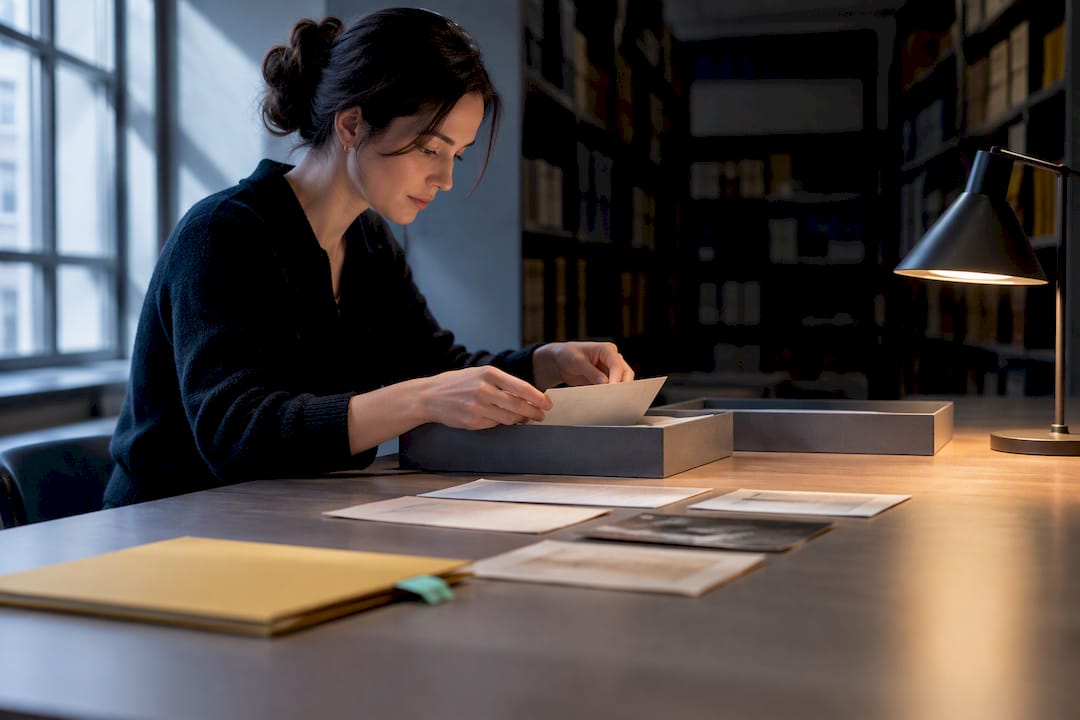
Art provenance documentation is the chronological record of an artwork’s ownership, transfers, and identifiers: the decisive file for authentication, lawful title, and ethical stewardship. It draws on bills of sale, exhibition catalogs, dealer stock books, and archival correspondence to establish who owned a work, when, and how it moved. This guide sets out the standard fields, a verification sequence, and a maintenance workflow collectors and curators can apply directly.
TL;DR:
- Gaps during the 1933 to 1945 period require especially thorough investigation due to increased restitution risks and stricter scrutiny for stolen or looted art.
- Supporting documentation, such as bills of sale and export records, must be prioritized and stored systematically to strengthen provenance claims.
- Digital provenance files should include physical identifiers, citations, and gap analysis, with regular updates and clear version control for ongoing research.
- Verify provenance by consulting the Getty Provenance Index, museum databases, auction archives, and cross-referencing exhibition histories with catalog evidence.
- Forged documents and inconsistent references are the primary threats to provenance integrity; physical document analysis helps detect fabrications or errors.
Table of Contents
- What museum-standard provenance entries look like
- Building a provenance packet: what to collect and how to store it
- Verifying provenance: where to search and in what order
- Red flags: ownership gaps, forged papers, and restitution risk
- A step-by-step workflow for assembling a provenance file
- Turning the workflow into software: features that support provenance records
- Provenance in ownership disputes and restitution claims
- Where provenance research goes wrong
- Provenance as a form of stewardship, not just paperwork
- Start documenting provenance with structured tools
- Sources
- FAQ
What museum-standard provenance entries look like
Reputable institutions record provenance as a chronological list of owners, not a narrative. Each entry states the owner’s name or “Private Collection” when identity is restricted, the date range of ownership, the method of transfer, and the location where the transaction occurred. The Yale University Art Gallery’s provenance guidance treats these entries as a public record that carries notes clarifying uncertainty rather than silence over gaps.
Every entry needs supporting citations: archive box numbers, catalog raisonné references, or auction lot numbers that let a third party verify the claim independently. Physical identifiers matter just as much as ownership history:
- Labels, stamps, or inventory numbers affixed to the back or frame of the work
- Maker’s marks, signatures, and inscriptions that tie the object to a specific hand or workshop
- Dimensions, medium, and condition notes recorded at each documented transfer
These identifiers, drawn from the Object ID standard, let researchers match an object to historical records even when ownership names are incomplete.
Building a provenance packet: what to collect and how to store it
A defensible provenance packet is assembled from documents ranked by evidentiary strength, not by convenience. Work through them in this order:
- Bills of sale and invoices, which name buyer, seller, price, and date and carry the strongest evidentiary weight for a specific transfer.
- Export, import, and customs records, which independently corroborate movement across borders and often carry official dates.
- Exhibition catalogs and loan agreements, which place the work at a named venue on a specific date under a specific owner.
- Correspondence between dealers, owners, or estates, which fills narrative gaps even when it lacks legal weight on its own.
- Certificates of authenticity and appraisal reports, useful as supporting context but never a substitute for chain-of-title documents.
When a transfer was informal, oral, or undocumented, label it explicitly as “unknown” or “reportedly” rather than guessing at a plausible date. The ICOM accessioning standards treat this kind of qualifier as standard archival practice, not an admission of failure.
Store digital copies with consistent file names (artwork ID, document type, date) in a shared folder structure so anyone reviewing the file, an insurer, a buyer, or a registrar, can find what they need without asking.
Pro Tip: Scan physical documents at 300 dpi minimum and keep a locked master copy separate from the working file you share with buyers or institutions.
Verifying provenance: where to search and in what order
Corroboration starts with the most comprehensive open-access source and moves toward specialized, harder-to-reach archives. The Getty Provenance Index holds millions of digitized records spanning dealer stock books, sales catalogs, and archival inventories from the 16th through 20th centuries, making it the logical first stop for historic ownership traces.
From there, work through:
- Major museum collection databases and published catalogs raisonné for the artist in question
- Auction house archives, which often retain lot-level records beyond what appears in public catalogs
- Dealer stock books held in institutional or private archives, frequently the only surviving record of an early sale
- Stolen-art and looted-art registries, checked as a matter of routine rather than only when suspicion arises
Use authority files such as the Getty’s Union List of Artist Names to resolve name variants, and cross-check exhibition histories against catalog entries to confirm a work’s documented path matches across sources. When gaps persist, particularly gaps that touch on Nazi-era transfers, or when the file’s stakes justify it, commission a professional provenance researcher or consult legal counsel before proceeding with a sale or acquisition.
Red flags: ownership gaps, forged papers, and restitution risk
Gaps overlapping 1933 to 1945 deserve heightened scrutiny regardless of how minor they appear. The Washington Principles and related best practices call for open archives and proactive research into works that may have passed through Europe during that period, and the HEAR Act extends the statute of limitations for restitution claims in the United States, beginning when a claimant has reason to know of a theft rather than when the theft occurred.
Watch for these warning signs:
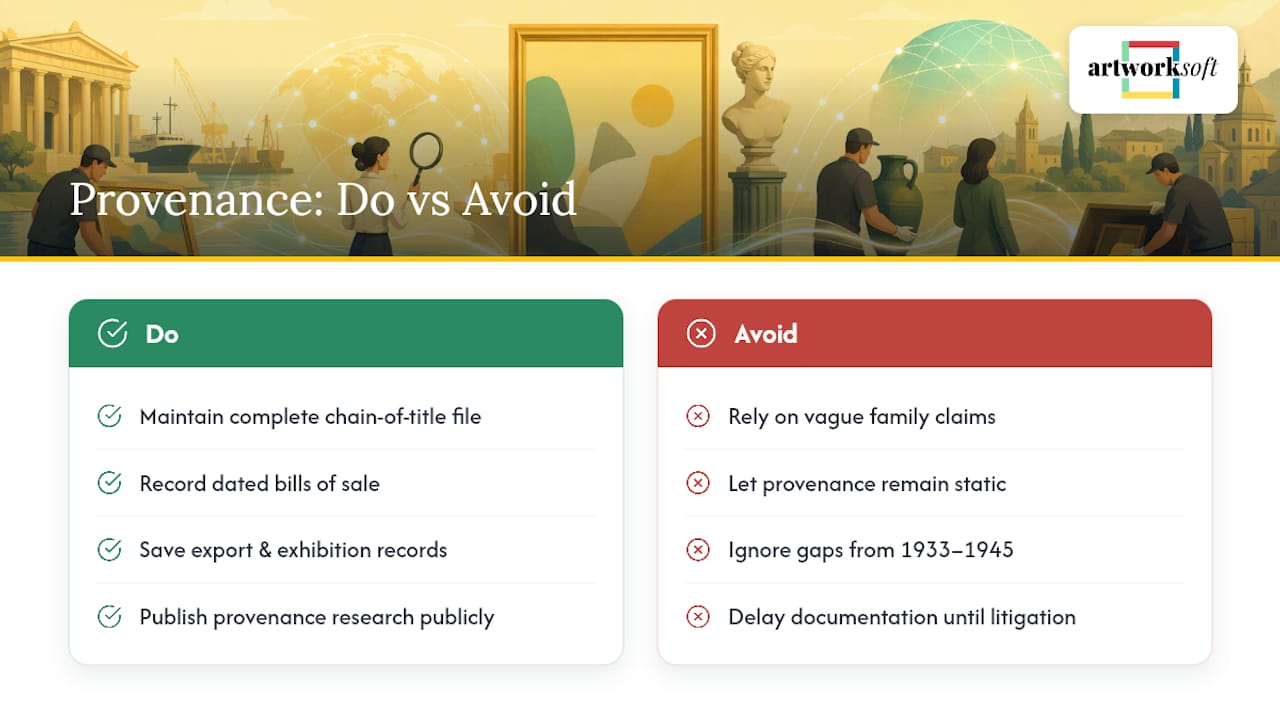
- An ownership gap with no explanation, especially one spanning the 1933 to 1945 window
- Paperwork that looks recently manufactured, inconsistently aged, or uses anachronistic language
- Catalog references that contradict each other on dates, dimensions, or prior owners
- A seller or intermediary who resists sharing full documentation on request
When any of these appear, pause the transaction, request the complete file rather than a summary, and check the work against stolen-art registries before moving forward with counsel involved.
A step-by-step workflow for assembling a provenance file
A provenance file is built once and maintained continuously. The following sequence produces a defensible packet:
- Intake: record the artwork’s basic identity, title, artist, medium, and dimensions, at the moment it enters the collection.
- Physical identification: photograph labels, stamps, signatures, and inscriptions per Object ID conventions.
- Document capture: gather bills of sale, invoices, and any existing certificates from the current owner or dealer.
- Archival search: work through the Getty Provenance Index, museum databases, and auction archives in priority order.
- Gap analysis: mark every unverified period, rate its risk (routine gap versus high-risk 1933 to 1945 window), and note what research would close it.
- Secure storage and versioning: keep a master file and a shareable copy, each dated and version-labeled.
- Sharing and transfer protocol: define who receives the file, buyer, insurer, or institution, and under what conditions.
A complete packet presented to a buyer or insurer should include the chronological ownership list, supporting citations, physical identification photos, and a plain statement of any remaining gaps. Log new findings as addenda rather than rewriting the original file, so the research history itself stays traceable.
Pro Tip: Treat the gap analysis as a living document. Revisit it whenever a new archive digitizes records or a related work’s provenance research surfaces new information.
Turning the workflow into software: features that support provenance records
Artworksoft structures the fields this workflow requires: chronological ownership entries, transfer method, physical identifiers, and supporting citations, inside a single artwork record rather than scattered folders. The platform generates professional Certificates of Authenticity and exportable documentation, tracks movement and location history across venues, and attaches valuation data drawn from the same structured record.
Collectors and registrars applying the archive-first method described above can follow Artworksoft’s provenance research guide for a detailed methodology, or review its identification and traceability tools for guidance on capturing physical identifiers consistently across a collection. These resources translate the checklist above into a repeatable system rather than a one-time exercise.
Provenance in ownership disputes and restitution claims
A well-documented provenance file is often the deciding factor when ownership is contested. Restitution claims, particularly those tied to Nazi-era transfers between 1933 and 1945, hinge on whichever party can produce the more complete and internally consistent chain of title. A gap in the record does not prove wrongdoing, but an unexplained gap during a high-risk period shifts the burden toward the current owner to demonstrate good-faith acquisition.
Museums and institutions increasingly publish their provenance research specifically to invite claimants to come forward before a dispute escalates into litigation. That transparency serves both parties: a claimant gains a documented path to pursue a claim, and an institution or collector holding a work in good faith builds a public record that supports its title if a claim is later contested. The 2026 update on collection ethics notes that the HEAR Act’s extended statute of limitations increases long-term liability for owners of poorly documented works, which makes early, thorough documentation a practical safeguard rather than a purely academic exercise.
When a dispute does arise, the strength of a claim or a defense rests on specifics: dated bills of sale, export records, exhibition catalog entries, and archival correspondence that corroborate each link in the chain. Vague assertions of long-term family ownership carry little weight against a claimant who has assembled documentary evidence. This is why registrars and collectors are advised to treat provenance not as paperwork completed once at acquisition, but as an ongoing file that strengthens a work’s legal and market position over time.
Where provenance research goes wrong
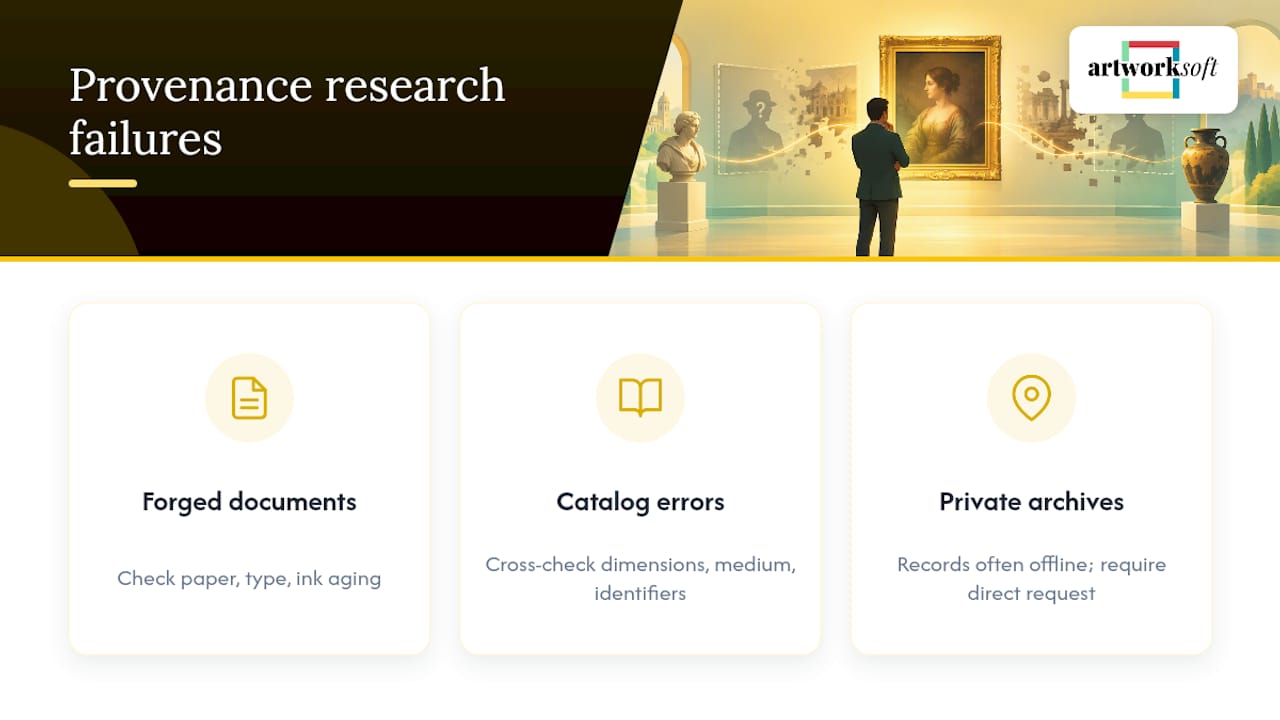
Forged or altered documents are the most direct threat to a provenance file. A certificate of authenticity can be fabricated to match a genuine work’s description, and bills of sale can be backdated or invented outright to paper over a gap. Reviewing the physical characteristics of a document, paper stock, typeface, ink aging, alongside its content is a necessary step, and Artworksoft’s guide on spotting a fake certificate of authenticity walks through the specific inconsistencies that give forged paperwork away.
Falsified or misattributed catalog references present a subtler problem. A work cited in a catalog raisonné under one title, then sold under a slightly different title with different dimensions, may be the same object recorded inconsistently, or two different objects conflated by an error that then gets repeated across subsequent sales. Cross-checking dimensions, medium, and physical identifiers against every citation, rather than trusting the title alone, catches most of these discrepancies.
Private archives present a structural challenge rather than a fraud risk: many dealer stock books and family records never make it into a public database. The Getty Provenance Index initiative is moving toward linked open data to improve discoverability, but a significant portion of the record still exists only in archives that require a direct request. Researchers who stop at digitized sources risk missing the document that would have closed a gap entirely.
Provenance as a form of stewardship, not just paperwork
Provenance documentation does more than protect a transaction. It creates accountability for how cultural objects move through history, and that record has value independent of what it does for market price. Collectors and institutions who share provenance files openly, including with potential claimants, are practicing stewardship rather than simply managing risk.
Treat a provenance file as something that grows rather than something completed once. Every new archival find, every closed gap, adds to an object’s documented history and to the broader record of how art moves through the world.
— Nealda
Start documenting provenance with structured tools
The workflow above, chronological ownership entries, physical identifiers, gap analysis, and secure sharing, maps directly onto what a collection management system should do. Artworksoft’s Provenance Plan, available starting at an affordable monthly fee of a few dollars, builds these fields into each artwork record and generates the Certificates of Authenticity and reports that a buyer, insurer, or institution expects to see.

Collectors who want a managed setup rather than a self-service start can use the onboarding and collection management services to have provenance records structured and migrated directly.
| Workflow step | Artworksoft feature |
|---|---|
| Chronological ownership entries | Structured artwork records |
| Physical identifiers and marks | Identification and traceability fields |
| Document generation for buyers and insurers | Certificate of Authenticity export |
| Movement and location history | Movement tracking |
Begin with the free plan to structure your first records, then upgrade as your provenance files grow.
Sources
- Provenance Index | Getty Tools & Databases
- Provenance Research | Yale University Art Gallery
- ICOM accessioning standards (Accessioning Standards_EN.pdf)
- 2026 HEAR Act update (collection ethics overview)
FAQ
What is the 70/30 rule in art?
The “70/30 rule” is not a recognized provenance or authentication standard; definitions circulating online vary and none trace to a museum, legal, or archival authority covered in this guide. Readers encountering the term should verify its source before relying on it.
What is an example of art documentation?
A typical provenance document is a chronological ownership list showing owner name or “Private Collection,” date range, transfer method, and location, supported by a bill of sale or exhibition catalog citation. The Yale University Art Gallery publishes examples of this citation format.
Can you provide an example of provenance information for artwork?
A sample entry might pair an owner or holder with a date and a stated method of transfer, following the format museums use in published catalogs, for example: “Private Collection, by descent; [Dealer name], purchased from the above; Private Collection, purchased from the above.” Each line states the owner’s name or “Private Collection” when identity is restricted, the date range of ownership, and the method of transfer.
How do museums verify provenance?
Museums cross-check ownership claims against archival sources such as the Getty Provenance Index, dealer stock books, and auction records, then record any unresolved period as an explicit gap rather than an assumption. This chronological, citation-backed approach, described in Yale’s provenance research guidance, is the standard practice institutions use before accessioning a work.











