

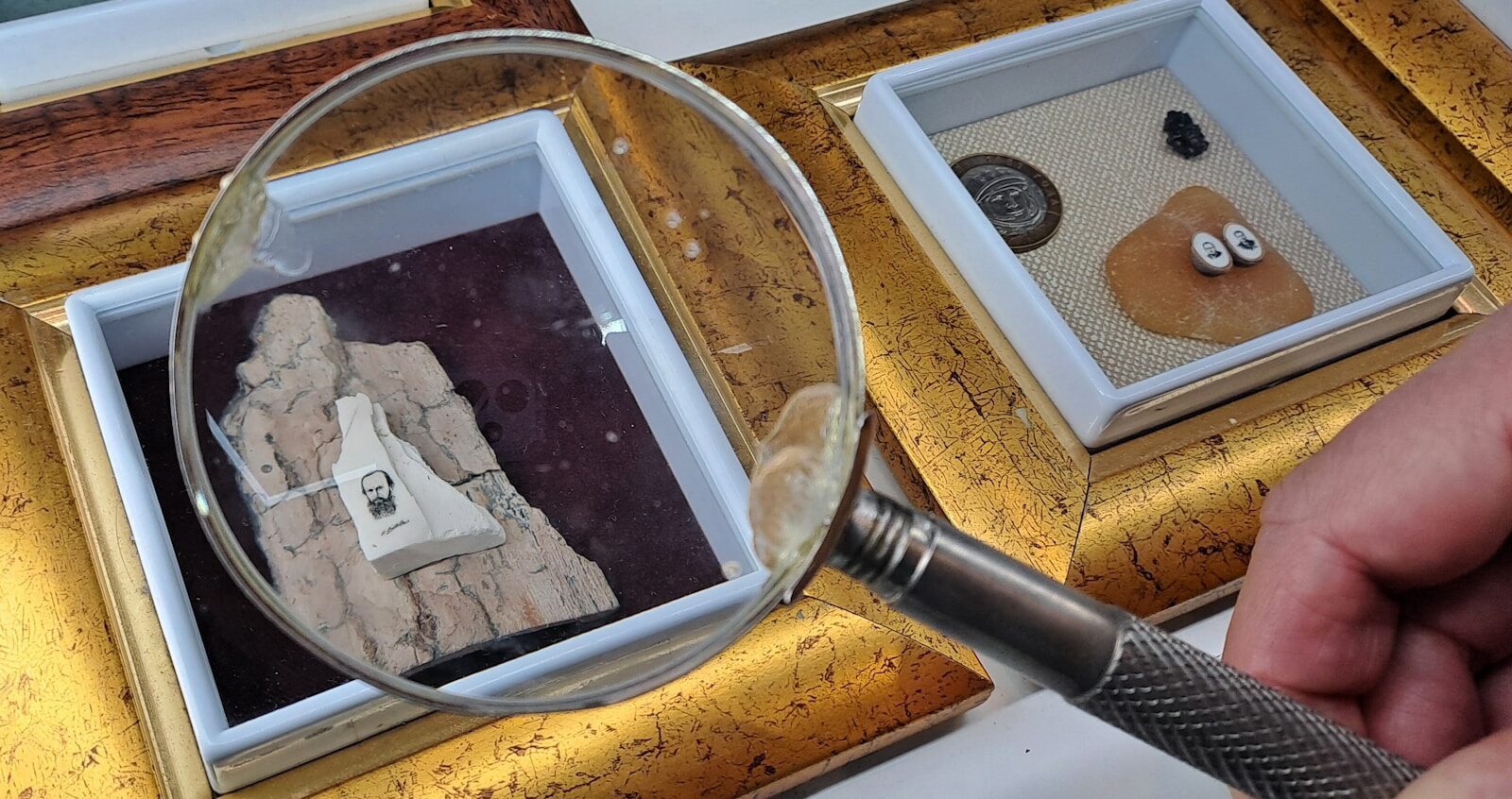
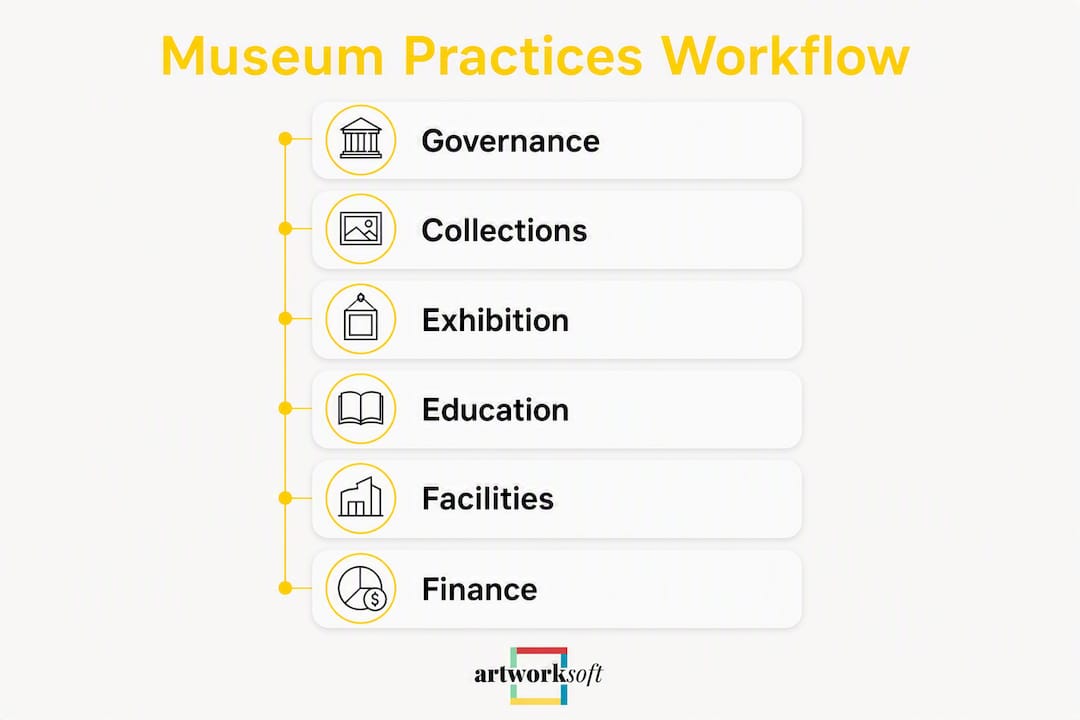
Museum practices are the standards, workflows, and ethical frameworks museums use to care for collections, serve audiences, and operate sustainably. The field draws on guidance from the American Alliance of Museums (AAM) and covers every operational domain from governance to gallery installation. Whether you are a registrar building a collections policy from scratch or a director aligning a strategic plan with community priorities, the same core domains apply.
Core domains every museum practitioner must master:
- Governance and public trust: board accountability, mission alignment, and conflict-of-interest policies
- Collections stewardship: accession, documentation, provenance, conservation, loans, and deaccession
- Education and interpretation: inclusive programming, co-curation, and audience evaluation
- Facilities and risk management: environmental controls, security, and disaster preparedness
- Financial stability: budgeting, revenue diversification, and reserve policies
- Exhibition development: multi-phase workflow from interpretive planning through production
- Skills and training: museum studies programs, professional competencies, and career pathways
- Diversity, equity, access, and inclusion (DEAI) and sustainability: anti-bias policies and climate-responsible operations
The single most useful next action: draft or review a prioritized policy checklist that maps each domain to a responsible staff member and a completion date.
How do governance and public trust anchor ethical museum management?
Sound governance is not a formality. It is the structural foundation that allows every other museum function to operate with credibility. The board of trustees holds legal and fiduciary responsibility for the institution’s mission, finances, and ethical conduct. Executive leadership translates board direction into operational plans. Stakeholder engagement, including community advisory groups and public reporting, keeps the institution accountable to the audiences it serves.
AAM’s Strategic Institutional Plan guidance specifies that a credible strategic plan must be multi-year, mission-aligned, and include measurable goals, prioritized action steps, assigned responsibilities, and implementation timelines. A plan that lists aspirations without owners and deadlines is a document, not a management tool.
Public trust depends on transparency. That means publishing annual reports, disclosing financial relationships, maintaining a written conflict-of-interest policy for board members, and reporting on collection-related decisions such as deaccessions. The Art Museum Directors Survey 2025 found that 87% of directors prioritize community-centered programming, which signals that accountability to community stakeholders has moved from a values statement to an operational priority.
Core policy documents every museum should maintain:
- Written mission statement, reviewed and ratified by the board on a defined cycle
- Collections management policy (covering accession, deaccession, loans, and care standards)
- Accession and deaccession policy with ethical disposal guidelines
- Disaster preparedness and emergency response plan
- Accessibility policy aligned with ADA requirements
- Conflict-of-interest policy for board and senior staff
Strategic planning elements that keep governance functional:
- Multi-year goals tied to the mission, with annual milestones
- Program-level budgets linked to strategic objectives
- Assigned staff or committee owners for each goal
- Quarterly review cycles to assess progress and adjust resources
- Community engagement mechanisms (surveys, advisory panels, public comment periods)
Pro Tip: Treat the strategic plan as a living document by scheduling a formal mid-year review where department heads report on milestone progress. Attach budget adjustments to that review cycle so resource decisions follow evidence, not inertia.
What does responsible collections stewardship require in practice?
Collections stewardship is the technical and ethical core of museum work. It encompasses every decision made about an object from the moment it enters the institution to the moment it leaves, whether through loan, transfer, or deaccession.
Core collection care activities
Accession records establish legal ownership and begin the documentation chain. Each new acquisition needs a unique identifier, a deed of gift or purchase agreement, a condition report at intake, and a location record. Cataloging follows, capturing minimum metadata: object name, maker, date, medium, dimensions, provenance history, and acquisition source. Photographic documentation should cover the object from multiple angles, including any existing damage, maker’s marks, and mounting hardware.
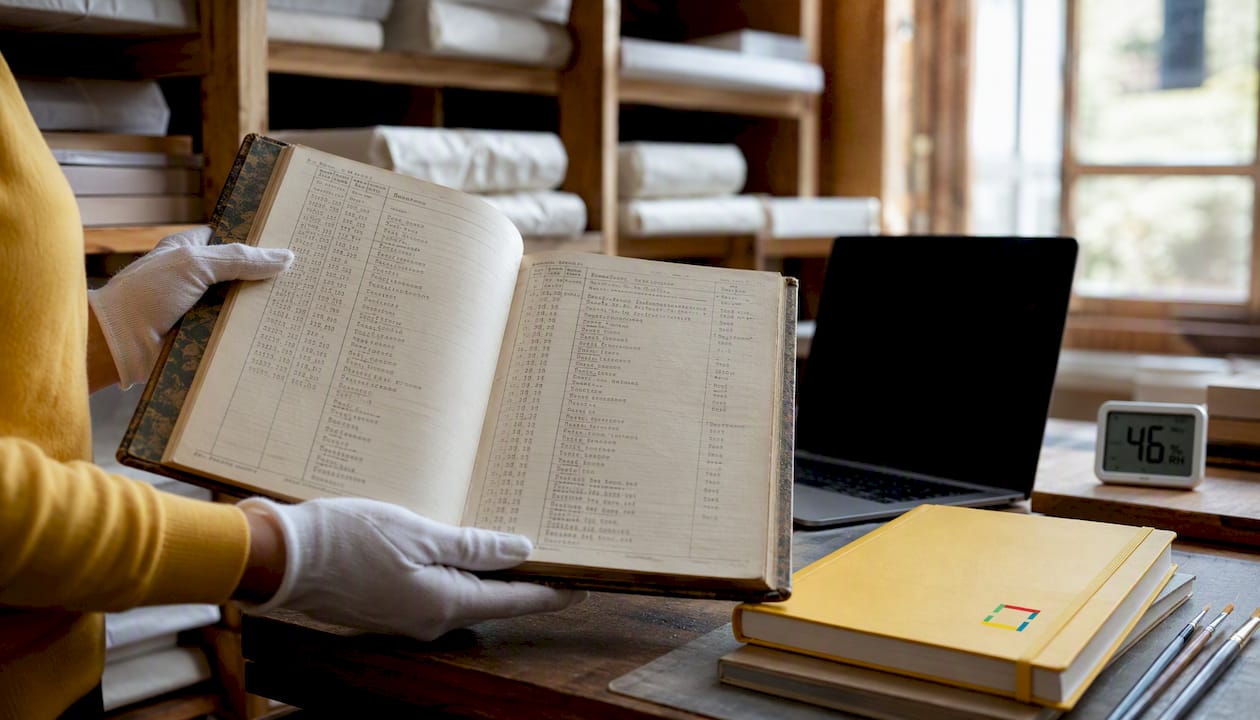
Preventive conservation is less expensive than treatment. Environmental monitoring, specifically maintaining stable temperature and relative humidity within ranges appropriate to collection type, reduces deterioration faster than any other single intervention. Artwork storage classifications vary by material sensitivity, and storage areas should be organized accordingly, with climate-sensitive works in controlled environments and robust objects in standard storage.
Loans and legal considerations
Outgoing and incoming loans require written agreements covering insurance values, transit conditions, credit lines, and condition-reporting protocols at each transfer point. The borrowing institution assumes responsibility for the object during the loan period, and that responsibility must be documented at packing, transit, and receipt. U.S. museums must also comply with the Native American Graves Protection and Repatriation Act (NAGPRA) for applicable collections, and with the 1970 UNESCO Convention standard for provenance due diligence on acquisitions.
Deaccession principles
Deaccession is one of the most ethically scrutinized decisions in the field. AAM standards require that proceeds from deaccessioned objects be used only for the direct care of collections, not for operating expenses. The process must be documented, reviewed by the collections committee and board, and, where appropriate, communicated publicly. Transparent decision-making protects institutional credibility.
Template outline for a collections management policy:
| Section | Required content |
|---|---|
| Scope and purpose | Objects covered, institutional authority, and policy review cycle |
| Acquisition criteria | Mission alignment, legal title, condition thresholds, and ethical sourcing standards |
| Accession procedures | Documentation steps, numbering system, and approval authority |
| Care and conservation | Environmental standards, treatment authorization, and conservation records |
| Loans (in and out) | Agreement requirements, insurance minimums, and condition-report protocol |
| Deaccession procedures | Ethical disposal hierarchy, proceeds policy, and board approval requirement |
| Access and use | Researcher access, reproduction rights, and digital access policy |
Pro Tip: Before any object goes on display, photograph its mount, plinth, or case hardware separately and log the mounting method in the object record. This single step cuts deinstallation time and reduces handling risk when the exhibition closes.
Maintaining a complete artwork movement history for every object, recording each location change with date, handler, and condition notes, is the documentation practice that most directly protects collections during transit and disaster recovery.
How do inclusive methodologies strengthen education and interpretation?
The shift from object-centered to people-centered practice, accelerated by the COVID-19 pandemic, has made audience engagement a strategic priority rather than a supplementary function. Scholarly and sector literature document how museums moved toward social education models and community-centered programming as digital access expanded and in-person attendance patterns changed.
Interpretation connects objects to meaning for specific audiences. Effective interpretation starts with a clear audience analysis: who visits, who does not, and what barriers prevent broader participation. From that analysis, educators and curators can design programs that address actual community needs rather than assumed ones.
Inclusive methodologies in practice:
- Co-curation: Invite community members to participate in selecting objects, writing labels, and shaping exhibition narratives. Shared authority produces more accurate and resonant interpretations.
- Community collecting: Acquire objects that reflect the histories of underrepresented groups, with input from those communities on what is significant and how it should be described.
- Oral history programs: Record and archive community voices as primary sources, integrating them into exhibitions and digital collections.
- Accessible design: Apply plain-language label writing, large-print alternatives, audio descriptions, tactile elements, and multilingual content as standard practice, not add-ons.
- Anti-bias review: Audit existing labels and interpretive text for language that centers dominant perspectives or uses outdated terminology.
Evaluation checklist for education programs:
- Defined learning outcomes tied to the mission and audience profile
- Attendance data disaggregated by demographic group where possible
- Qualitative feedback collected through exit surveys, focus groups, or community advisory input
- Iterative revision cycle: programs reviewed and updated based on evaluation findings
- Staff training in culturally responsive facilitation
Pro Tip: When co-creating a program with a community partner, document shared authority explicitly in a written agreement that specifies who controls the final content, how credit is attributed, and how the community retains access to materials produced.
Digital engagement and online access:
- Publish collection records with open-access licensing where rights permit
- Develop virtual tours and digital exhibitions for audiences who cannot visit in person
- Use social media and online platforms to extend programming reach and gather audience feedback
What facility and risk standards protect collections and visitors?
Facilities management is where policy meets physical reality. Environmental setpoints, security protocols, and emergency procedures must be written, tested, and updated regularly. A policy that exists only on paper provides no protection.
Environmental and storage standards:
- Temperature and relative humidity should be maintained within ranges appropriate to collection type; mixed collections typically require a stable environment rather than extreme precision, with gradual seasonal adjustments preferable to rapid fluctuations
- Storage areas should be organized by storage classification, with climate-sensitive materials in monitored, controlled spaces
- Display materials, including MDF used in case construction, should be sealed and off-gassed before contact with collection objects; Te Papa’s exhibition guidance recommends off-gassing MDF for three weeks and using Mylar barriers between wood surfaces and objects
- Visitor circulation pathways in galleries should maintain adequate clearance to support accessibility and reduce accidental contact with objects
Security and preventive measures:
- Access control systems limiting collection storage to authorized staff
- Object tracking logs updated at every location change
- Condition monitoring on a defined schedule, with records retained in the collections management system
- Integrated alarm systems with documented response protocols
Disaster preparedness checklist:
- Written emergency response plan with staff roles assigned by name and position
- Salvage priority list identifying which objects to recover first based on value, fragility, and irreplaceability
- Off-site backup for all digital collection records, updated on a regular schedule
- Contact list for conservators, insurers, and mutual-aid partners
- Annual tabletop exercise to test staff familiarity with the plan
| Risk category | Preventive measure | Documentation required |
|---|---|---|
| Fire and water damage | Sprinkler systems, drainage, and fire suppression | Salvage priority list, floor plan with object locations |
| Theft and vandalism | Access control, CCTV, and alarm systems | Incident log, object photographs, and insurance records |
| Environmental fluctuation | Continuous monitoring with alerts | Data logs, condition reports |
| Transit damage | Condition reports at packing and receipt | Loan agreements, packing specifications |
| Pest infestation | Integrated pest management program | Inspection logs, treatment records |
Pro Tip: Maintain a current light plot and mount diagram for every active exhibition. When a disaster or emergency deinstallation occurs, these documents allow staff to remove objects safely and in the correct order without relying on memory.
How do museums build and sustain financial stability?
Financial stability requires more than a balanced budget. It requires a diversified revenue base, a written reserve policy, and budget structures that connect spending to strategic priorities.
Budget fundamentals:
- Separate operating and capital budgets to avoid using long-term assets for short-term expenses
- Use program-based budgeting, allocating costs to specific programs and activities so leadership can evaluate the true cost of each function
- Link every major budget line to a strategic objective, making the connection between spending and mission explicit
Revenue diversification strategy:
- Earned revenue: admissions, retail, facility rentals, and fee-based programs. Reliable but sensitive to attendance fluctuations.
- Contributed income: individual donors, corporate sponsors, and foundation grants. Requires active cultivation and relationship management.
- Government funding: federal, state, and local grants and appropriations. Competitive and subject to policy changes.
- Endowment distributions: income from invested assets. Provides stability but requires a long-term investment policy and spending-rate discipline.
- Membership programs: recurring revenue with the added benefit of building a loyal audience base.
Single-source dependence is a structural risk. Museums that rely heavily on a single major grant or sponsor for operating budget face increased financial fragility. Diversification across at least three revenue categories is a standard risk-management practice.
Reserves and contingency planning:
A written reserve policy should define a target reserve size, typically expressed as a number of months of operating expenses, and specify the conditions under which reserves may be drawn. Many institutions target three to six months of operating expenses in liquid reserves. The policy should also define the process for replenishing reserves after a draw.
Sample budget outline for a small-to-mid-size museum:
- Personnel (salaries, benefits, and payroll taxes): typically the largest single cost category
- Conservation and collections care: condition treatments, supplies, and environmental monitoring equipment
- Exhibition production: design, fabrication, installation, and deinstallation costs
- Insurance: property, liability, fine arts, and directors-and-officers coverage
- Facilities: utilities, maintenance, and capital repairs
- Education and public programs: staff time, materials, and contractor fees
- Administrative and technology: software subscriptions, audit fees, and communications
What does the exhibition development workflow look like from start to finish?
Exhibition development follows a structured, multi-phase process. Each phase produces specific deliverables, and moving to the next phase without completing the prior one creates costly errors in fabrication and installation. The Smithsonian’s Guide to Exhibit Development maps this workflow clearly for practitioners at any scale.
| Stage | Key deliverables | Typical duration |
|---|---|---|
| Interpretive master plan | Audience analysis, thematic framework, content brief | 4 weeks |
| Concept design | Preliminary floor plans, mood boards, object list | 4 weeks |
| Schematic design | To-scale layouts, label drafts, AV/interactives outline | — |
| Design development | Detailed construction drawings, lighting plan, mount specifications | — |
| Final design and production | Production-ready files, fabrication, installation, and punch list | — |

Spatial planning at the schematic and design development stages relies on CAD-based tools. Vectorworks Spotlight supports floor plan drafting, lighting plots, rigging analysis through its Braceworks module, and VR previsualization for stakeholder review. These capabilities allow teams to resolve spatial conflicts, verify sight lines, and confirm object clearances before fabrication begins, which reduces costly changes during installation.
Exhibition design is inherently multidisciplinary. Effective exhibit projects draw on architecture, graphic design, interaction design, and lighting expertise, and require vendor lists, prototyping plans, and transport and assembly specifications. Managing those relationships and deliverables across disciplines is as much a project-management challenge as a creative one.
Technical tools and deliverables:
- To-scale floor plans showing object placement, case positions, and visitor circulation
- Light plots specifying fixture types, positions, and color temperatures
- Rigging analysis for suspended elements (Braceworks within Vectorworks)
- Object mounting documentation: drawings and photographs for each mount
- 3D models and VR walkthroughs for stakeholder and accessibility review
Pro Tip: Require object-level installation documentation, including a photograph of each mount in place and a diagram showing attachment points, before the exhibition opens. This record is the deinstallation guide and the insurance documentation in one.
Gallery layout best practices for visitor circulation and object placement complement the technical workflow, particularly at the schematic design stage when pathways and viewing distances are being set.
What skills and training pathways lead to museum careers?
Museum careers require a combination of disciplinary knowledge, technical skills, and documented practical experience. Career guides from leading institutions consistently identify research and analytical skills, pedagogical training, communication, and hands-on collections experience as foundational for curatorial and education roles.
Core competencies by role:
- Registrar: collections database management, loan administration, condition reporting, legal compliance (NAGPRA, copyright, import/export regulations)
- Curator: object research, exhibition concept development, provenance investigation, scholarly writing, and community engagement
- Educator: curriculum design, facilitation, audience evaluation, and inclusive program development
- Exhibitions technician: spatial planning, mount fabrication, lighting, AV installation, and condition handling
Recommended training pathways:
- Complete a museum studies program with hands-on practicum requirements. Programs such as the Museum Practice and Heritage Management program at UCCS and the Museum and Gallery Practices program at Alfred University combine theoretical grounding with applied fieldwork.
- Pursue targeted short courses in collections management software, condition reporting, or grant writing through AAM, regional museum associations, or ICOM’s online learning offerings.
- Complete internships or apprenticeships in at least two functional areas (collections and education, for example) to build cross-departmental fluency.
- Seek mentorship from a senior practitioner in your target specialization, with a defined learning plan and regular check-ins.
- Document every project workflow you manage, including timelines, deliverables, and outcomes, as portfolio evidence for job applications.
Action steps for career progression:
- Build a professional portfolio that includes policy documents, exhibition plans, or program evaluations you have contributed to
- Gain hands-on collections experience through volunteer or practicum placements, even if your primary role is in education or administration
- Join AAM and at least one discipline-specific professional association (American Association for State and Local History, Association of Registrars and Collections Specialists, or similar)
- Maintain an updated digital portfolio; practitioners working across institutions benefit from resources on building an online portfolio that remains accessible regardless of location
The COVID-era shift toward digital access has made digital collections management and online programming competencies increasingly expected across roles, not just in technology-focused positions.
A prioritized implementation checklist for the first year
Starting from a gap assessment is more efficient than starting from a blank policy template. Identify which core documents exist, which are outdated, and which are missing entirely. That audit drives the sequencing below.
Priority checklist:
- Confirm the mission statement is current and board-ratified
- Identify which core policies are missing or more than five years old
- Conduct a physical inventory of at least the highest-priority collection areas
- Assign staff owners to each policy and each collection area
- Schedule a staff training session on emergency response procedures
Recommended sequencing by milestone:
- Days 1–90: Draft or update the collections management policy and the emergency response plan. Run a condition survey on the highest-risk collection area. Establish or verify environmental monitoring in storage and gallery spaces.
- Days 91–180: Complete the accession/deaccession policy. Begin a systematic condition-reporting cycle for uncatalogued objects. Launch one community engagement initiative, even a small one, to establish the practice.
- Days 181–365: Develop or update the accessibility policy. Plan and execute one small pilot exhibition using the five-stage workflow. Conduct a financial review to assess revenue diversification and reserve levels.
Typical cost ranges for common activities:
| Activity | Typical cost range | Major cost drivers |
|---|---|---|
| Policy drafting (consultant-assisted) | — | Consultant rate, complexity, and review cycles |
| Condition survey (small collection) | — | Number of objects, travel, and report format |
| Small exhibition development | — | Fabrication, AV, design fees, and installation labor |
| Collections management software | — | Feature tier, number of users, and data migration |
| Staff training (one-day workshop) | — | Facilitator fees and materials |
Cost ranges above reflect general U.S. market conditions and vary significantly by institution size, geographic location, and scope. They are provided as planning benchmarks, not fixed estimates.
The Art Museum Directors Survey 2025 reports that 64% of directors have made environmental sustainability a priority, yet many institutions have not yet estimated the cost of climate-responsible operations. Adding a sustainability line to the first-year budget, even a modest one for energy audits or packaging changes, establishes the practice before costs escalate.
Short priority checklist for small institutions deciding what to fund first:
- Collections management policy (protects legal and ethical standing)
- Emergency response plan (protects objects and staff)
- Condition survey of highest-risk objects (identifies urgent conservation needs)
- One community program (demonstrates public value and builds audience)
- Environmental monitoring equipment (prevents ongoing deterioration)
Key Takeaways
Effective museum practice requires aligning governance, collections stewardship, education, facilities, finance, and exhibition workflows under a single mission-driven framework with assigned owners and measurable milestones.
| Point | Details |
|---|---|
| Governance anchors everything | A multi-year strategic plan with assigned responsibilities and measurable goals is the foundation for all other museum functions. |
| Documentation prevents loss | Object-level condition reports, mount diagrams, and movement histories protect collections during transit, installation, and disaster recovery. |
| Inclusive interpretation is operational | Co-curation, accessible design, and anti-bias label review are standard practice requirements, not optional enhancements. |
| Financial diversification reduces risk | Museums dependent on a single revenue source for more than 30% of operating income face structural financial fragility. |
| Artworksoft supports documentation workflows | Artworksoft’s cloud-based inventory system tracks movement histories, generates condition reports, and produces professional documentation to support collections stewardship. |
The gap between strategy and daily operations is where most museums lose ground
The sector’s most persistent problem is not a lack of good plans. It is the distance between a well-written strategic document and the day-to-day decisions staff actually make. A director can articulate a compelling vision for community engagement, and the front-line educator can still be running programs designed five years ago for a different audience, with no evaluation mechanism and no budget line for revision.
The fix is structural, not motivational. When a strategic plan assigns a goal to a named staff member, attaches a budget, and schedules a quarterly check-in, it becomes executable. When it does not, it becomes a document that gets reviewed at the next accreditation cycle and filed again.
The same logic applies to installation documentation. Institutions that photograph every mount, maintain a current movement history, and keep light plots updated are not doing extra work. They are doing the work once, correctly, so that deinstallation, insurance claims, and future reinstallation do not require reconstructing decisions from memory. The Art Museum Directors Survey 2025 finding that 66% of directors now treat staff wellbeing as a priority reflects a related insight: sustainable operations depend on staff who are not constantly recovering from poor planning.
For practitioners building or rebuilding these systems, tools that centralize documentation, track object movements, and generate professional reports reduce the administrative burden enough to make good practice the path of least resistance, not the heroic exception.
How Artworksoft supports museum documentation and collections management
Museums and galleries that need to move from paper-based or fragmented records to a structured, searchable system have a concrete option in Artworksoft. The platform centralizes artwork inventory and documentation in a cloud-based environment, allowing registrars and collection managers to log condition reports, track location changes, manage loan records, and generate professional PDFs, including Certificates of Authenticity and collection reports, without switching between systems.

Movement history tracking is built into the platform’s object records, which means every location change is logged with date and handler information. That record supports both day-to-day operations and disaster recovery. For institutions evaluating a collections management system, the key features to assess are data security, automated backup, and data-export capabilities. Artworksoft’s tiered subscription model includes a free plan for smaller collections, with paid tiers adding branded documentation, analytics dashboards, and client-sharing tools.
Paper systems and bespoke databases remain valid approaches for institutions with limited budgets or highly specialized needs. For most galleries, mid-size museums, and institutional collectors, a purpose-built platform reduces documentation errors and speeds reporting. Start with a free Artworksoft account to assess whether the platform fits your collections workflow before committing to a paid tier.
Useful sources for further reading
The sources below are authoritative starting points for practitioners drafting policies, designing exhibitions, or building professional development plans.
- Guide to Exhibit Development (Smithsonian): The definitive U.S. reference for the five-stage exhibition workflow, deliverables, and interdisciplinary team coordination. Use it as a template when scoping exhibition projects.
- Strategic Institutional Plan (American Alliance of Museums): AAM’s guidance on required elements for institutional planning and their relationship to core standards. The primary reference for governance and strategic planning sections of accreditation applications.
- Exhibition design beginners guide (Vectorworks): An introduction to using Vectorworks Spotlight for spatial planning, lighting plots, and rigging analysis in exhibition contexts.
- Art Museum Directors Survey 2025: Sector data on director priorities including community programming, staff wellbeing, and sustainability. Use it to benchmark institutional priorities against peer institutions.
- Museum Practice and Heritage Management, UCCS: A U.S. undergraduate program combining anthropology, heritage management, and applied museum practice. A reference point for curriculum design and competency frameworks.
- Museum and Gallery Practices, Alfred University: An applied program integrating studio, curatorial, and gallery management training. Useful for practitioners evaluating formal education options.
- A beginner’s guide to exhibit design (RGD): Covers the multidisciplinary nature of exhibition projects, including vendor coordination, prototyping, and transport planning.
These sources function as citation anchors when drafting institutional policies or exhibition workflows. Linking your internal documents to primary sources from AAM and the Smithsonian strengthens both the credibility and the defensibility of your procedures.











