


The fastest secure way to handle private art catalog sharing is a curated invite-only viewing room with per-recipient access controls and expiring links. Password protection or authenticated accounts should gate entry, and you need the ability to revoke access instantly. Some art management platforms build this workflow into standard collection management rather than treating it as an afterthought.
TL;DR:
- Private art sharing should use invite-only rooms, expiring links, or password protection, with instant access revocation for maximum security.
- Preparing high-quality, metadata-rich images and controlling sensitive details minimizes risk and supports informed decision-making.
- Access controls should be layered with roles like viewer, downloader, and collaborator to match the recipient’s actual needs and relationship.
- Ongoing collection updates and access reviews are essential to maintaining accurate, secure private shares over time.
- Using integrated platforms like Artworksoft streamlines secure sharing, access logging, and documentation, reducing manual effort and error.
Table of Contents
- Private Sharing Options: Which One Fits Your Situation?
- What to Prepare Before You Share a Single Image
- How Do You Keep Access Controls Tight?
- Who Should See What: Matching Access to the Relationship
- The Six-Step Workflow for Sending a Private Catalog Today
- Does Privacy Law Apply to How You Share Art Data?
- Connecting Private Sharing to Your Existing Collection Records
- How Do You Know Who’s Actually Viewing Your Catalog?
- Beyond On/Off: Setting Real Permission Levels
- Adding Works to a Catalog You’ve Already Shared
- A Practical Take on Where Sharing Tools Actually Help
- Try Artworksoft for Controlled, Trackable Art Sharing
- Sources
- FAQ
Private Sharing Options: Which One Fits Your Situation?
Not every recipient needs the same level of access, and matching the tool to the relationship is what separates a controlled disclosure from a leak. The right choice depends on how often you’re sharing, how sensitive the works are, and whether the relationship is one-time or ongoing.
- Invite-only private rooms work best for curated presentations and repeat collaborators. Advisors, gallery partners, and recurring buyers get a stable space you update over time instead of resending files.
- Password-protected or expiring links suit one-off viewings. A single collector considering a purchase doesn’t need a persistent account, just timed access.
- Secure, watermarked PDFs handle offline use, appraisal submissions, or shipping paperwork where a live link isn’t practical.
- Permissioned portals with client accounts fit long-term collaboration, especially when you need an audit trail of who saw what and when.
Embedding a gated gallery on your own site makes sense when you’re building a durable presence for repeat visitors. Sending a direct link is faster for a single transaction that won’t repeat. Kolibri Gallery’s private viewing model, scheduled by appointment with follow-up documentation on pricing and certificates, illustrates how structured the process gets once real money is on the table.
What to Prepare Before You Share a Single Image
Sloppy asset prep is the most common reason private sharing backfires, either through overexposure of sensitive details or through images too poor to support a decision. Get the files and metadata right before anyone outside your circle sees them.
Photograph each work with consistent lighting and color balance, and capture multiple angles for anything with texture, frame detail, or surface condition worth noting. A single flat shot rarely answers the questions an appraiser or serious buyer will ask.
For metadata, include details that can also be managed through controlled digital downloads to ensure proper handling of derivative files and access rights:
- Title, medium, dimensions, and year
- Provenance summary and ownership history
- Condition notes and any restoration history
- Certificate of Authenticity reference, when one exists
Redact exact storage locations and specific pricing history when the recipient doesn’t need them. A family member checking on an inherited piece doesn’t need your insurance valuation; an appraiser does. File naming should follow a consistent pattern, artist last name, title abbreviation, and year, so recipients can navigate a catalog of fifty works as easily as one of five.
Pro Tip: Keep a master version of every certificate, invoice, and condition report in one folder, then attach only the specific documents each recipient’s purpose requires. Sending your entire archive by default is how private details end up in the wrong hands.
How Do You Keep Access Controls Tight?
Security for a private art catalog isn’t one setting. It’s a stack of smaller decisions that together make unauthorized access difficult and any breach easy to trace.
- Default to authenticated accounts over public links whenever a work carries meaningful value. A public link, even a long unguessable one, can still be forwarded.
- Use passwords, one-time tokens, and expiration dates for intermediate cases where a full account feels like overkill.
- Apply watermarks or low-resolution previews for anyone who hasn’t been fully vetted, and reserve conditional, tracked downloads for verified recipients.
- Turn on logging and email notifications so every view triggers a record.
- Revoke access immediately once a viewing period ends or a deal falls through, and audit the log afterward.
- Confirm HTTPS is active and ask any platform you use whether data is encrypted in transit; for six figure or seven figure works, verify the recipient’s identity before sending anything.
Concierge services catering to high-net-worth collectors already treat this as routine. Firms like AC Private build confidentiality, provenance verification, and encrypted communication into every private transaction they arrange, which sets a reasonable baseline for anyone sharing valuable works digitally.
Who Should See What: Matching Access to the Relationship
Disclosure level should track the recipient’s actual need, not your default sharing settings. Appraisers and insurers need full provenance and condition detail, delivered through secure access rather than an email attachment. Galleries and prospective buyers respond best to curated rooms where pricing visibility can flex depending on negotiation stage.
- Advisors and family members generally need ownership context, not exact pricing.
- Conservators and shippers need technical specs and close-up condition photography, not sales history.
- Press or public audiences belong in a separate, intentionally public gallery, never the same space used for private negotiations.
Private museum tours follow a similar logic: access and pricing scale with exclusivity. The same tiered thinking applies to how you disclose catalog details.
The Six-Step Workflow for Sending a Private Catalog Today
- Curate the works. Pick pieces relevant to this specific audience and purpose, not your entire inventory.
- Capture images and attach metadata. Include provenance, condition, and dimensions for each piece before you build the share.
- Create the room or link and set access rules. Decide between an authenticated room, a password, or a time-limited link based on the relationship.
- Attach supporting documents and set download controls. Certificates and condition reports go in as controlled, tracked files, not open attachments.
- Send invites and confirm expirations. Verify the recipient’s email or account, then set a clear end date for access.
- Monitor activity and revoke access when the purpose is served. Check the log, and close the door once the viewing period ends.
This sequence takes under an hour for a modest catalog and scales cleanly as your collection grows.
Does Privacy Law Apply to How You Share Art Data?
It often does, and the trigger is usually personal data rather than the art itself. Provenance records, buyer names, shipping addresses, and payment details all count as personal information under frameworks like the EU’s General Data Protection Regulation and, for California residents, the California Consumer Privacy Act. If a recipient list includes people in those jurisdictions, you’re expected to handle their data with reasonable security and limit retention to what the transaction actually requires.
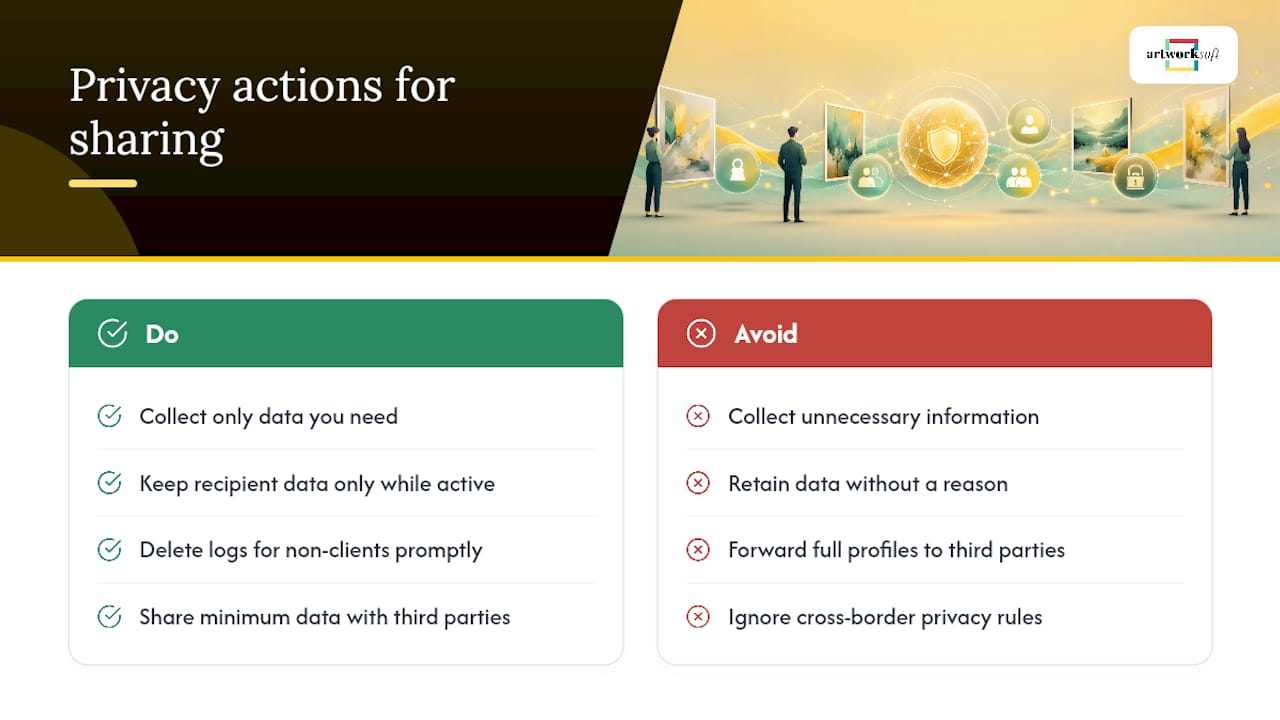
Practically, this means a few habits matter more than legal jargon. Don’t collect more information than you need to complete a viewing or sale. Store recipient data only as long as the relationship is active, and delete access logs for people who never became clients if you have no ongoing reason to keep them. When a third party, like a shipping company or appraiser, needs data you hold, share the minimum required rather than forwarding a full profile.
None of this requires a legal department for most individual collectors and small galleries. It requires the same discipline that already applies to access controls: know who has your data, know why, and be able to remove it on request. If your collection spans international buyers or institutional clients, a short conversation with a lawyer familiar with data privacy in your jurisdiction is worth the cost before you scale up your sharing practices.
Connecting Private Sharing to Your Existing Collection Records
Private sharing works best when it draws directly from records you already maintain, rather than requiring a duplicate export every time someone new asks to see your catalog. If your inventory, provenance notes, and valuation history already live in one system, building a private room becomes a matter of selecting works, not re-entering data.
This is where the gap shows up for collectors and galleries using spreadsheets or a patchwork of folders: every private share means manually pulling images, retyping metadata, and hoping nothing gets missed. A platform built around a searchable portfolio structure eliminates that duplication, because the same record that tracks an artwork’s location and ownership history also feeds the private view you send out.
Integration matters most at the update stage. When a work sells, changes condition, or gets reappraised, a connected system reflects that change everywhere it appears, instead of leaving an outdated PDF circulating with a buyer who saw it three months ago. For galleries running both public-facing and private sharing simultaneously, keeping one source of truth behind both is what prevents contradictory information from reaching different audiences.
How Do You Know Who’s Actually Viewing Your Catalog?
Knowing who opened a room and when turns a static share into a live signal. Basic tracking should tell you the recipient’s name, the timestamp of each visit, which specific works they lingered on, and whether they downloaded anything. That level of detail changes how you follow up: a buyer who returned to view one painting three times in a week is a different conversation than one who opened the link once and never came back.
Analytics also protect you operationally. If a certificate or high-resolution file leaks somewhere it shouldn’t, an access log narrows down who had it and when, which matters far more than it sounds until the day you actually need it. For appraisers and insurers, a timestamped view log doubles as informal documentation that due diligence happened on schedule.
The practical minimum: view counts per recipient, download logs, and expiration status visible in one place, not buried across email confirmations and link services you have to check individually.
Beyond On/Off: Setting Real Permission Levels
Simple access control, meaning someone can either see the catalog or they can’t, breaks down once you have more than a handful of recipients with different needs. A more useful structure assigns roles: viewer, downloader, and collaborator are the three that cover most situations.
A viewer role should let someone browse images and basic metadata without downloading anything, appropriate for an early-stage buyer or a family member checking on an inheritance. A downloader role adds the ability to pull high-resolution images or PDFs, reserved for appraisers, insurers, or a buyer in active negotiation. A collaborator role goes further, allowing someone like a co-owner or an advisor to suggest edits to metadata or flag condition changes, though final approval should stay with the collection owner.
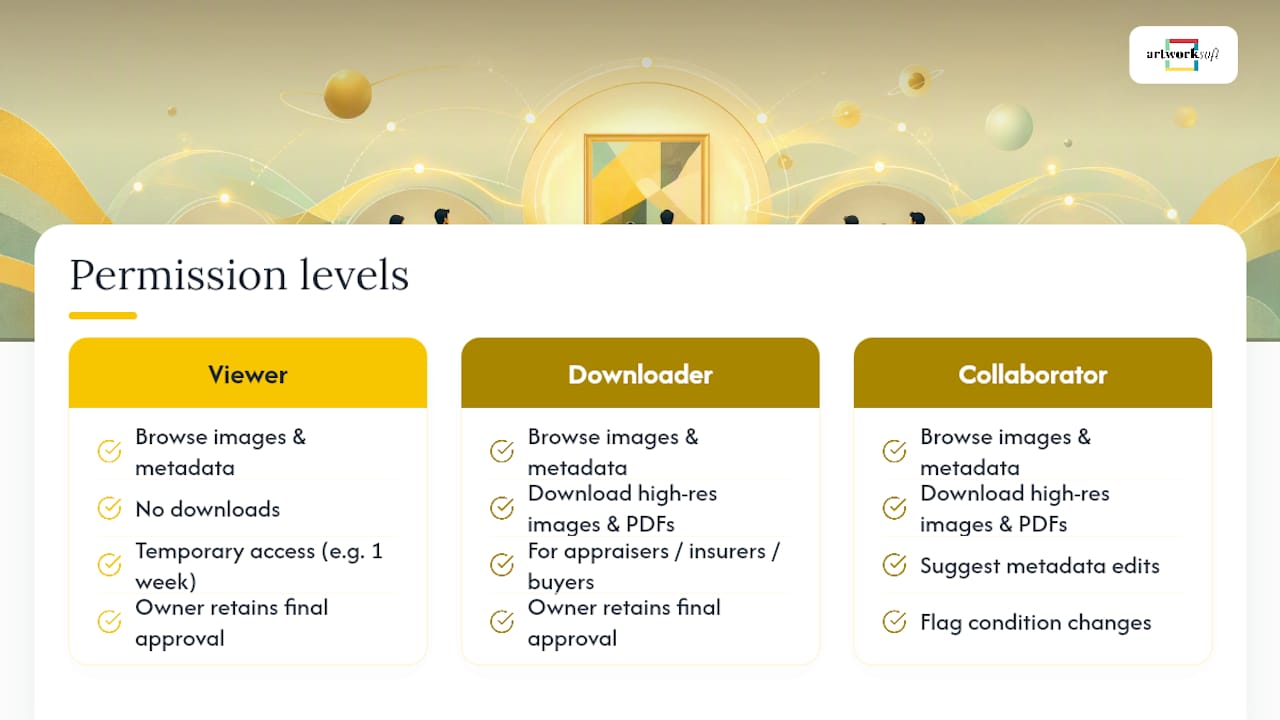
Layering roles this way means you’re not choosing between full access and no access for every single person. A gallery director can hold collaborator status permanently, while a one-time inquiry gets viewer access that expires in a week. Permissioned portals built for institutional relationships already work this way, and the same logic scales down to an individual collector managing a dozen ongoing contacts.
Adding Works to a Catalog You’ve Already Shared
A private room isn’t a one-time export. Collections grow, get reappraised, and occasionally need a piece removed from view, and the update process needs the same discipline as the initial share.
When adding a new work, apply the same metadata and image standards used originally rather than dropping in a rushed placeholder to fill the gap quickly. Notify existing recipients of the update rather than assuming they’ll notice, especially if the addition changes the overall value or theme of the collection they’re evaluating. If a piece needs to come down, whether it sold, was withdrawn, or the owner changed their mind, remove it and adjust any pricing or provenance context tied to related works still in the room.
Re-verify access permissions periodically rather than leaving a room open indefinitely. A viewing set up for a three-month negotiation shouldn’t still be live a year later with the same password. Treat every addition as a chance to also review who still needs access, not just what needs to be added.
A Practical Take on Where Sharing Tools Actually Help
Balancing privacy, provenance, and convenience is less about picking the strictest possible settings and more about matching effort to stakes. A collector sharing five paintings with a nephew doesn’t need the same infrastructure as a gallery running simultaneous private negotiations with three institutional buyers, and treating both cases identically wastes time on the small one and under-protects the large one.
Native platform features, private rooms, access logs, and automated document generation, remove the manual reassembly that makes ad-hoc sharing risky in the first place. Every time someone rebuilds a PDF by hand or forwards an old email thread instead of using a live system, the odds of an outdated price or an unredacted detail slipping through go up. A platform becomes clearly preferable once you’re managing more than a handful of active shares, need to prove who saw what, or want professional documentation, Certificates of Authenticity, condition reports, invoices, generated without starting from a blank template every time.
None of this replaces judgment about whom to trust with sensitive information. It just removes the friction that leads people to cut corners.
— Nealda
Try Artworksoft for Controlled, Trackable Art Sharing
Artworksoft functions as the practical alternative to piecing together sharing security from scratch with generic file tools. Instead of assembling PDFs, hoping a link doesn’t get forwarded, and manually tracking who saw what, Artworksoft builds private sharing, access logs, and document generation, including Certificates of Authenticity, into the same system where your inventory and provenance already live.

Collectors and artists managing a growing catalog can start with the Free Plan to test private rooms and access controls firsthand, then move to the Provenance Plan, priced from $5 per month, once they need expanded documentation and analytics. Galleries or collectors who want hands-on setup can request the Onboarding & Collection Management Service instead of building the structure alone. Whichever path fits, the next step is the same: create your first private room and see how access logging changes the way you share.
Sources
- An Insider’s Guide to Ultra-Exclusive Private Art Museum Tours | Observer
- Art & Jewellery Concierge for UHNWI | AC PRIVATE Luxury Concierge
- Private Viewings | Kolibri Gallery | Lisbon
FAQ
What Is the Best Platform for Sharing Art Privately?
The best choice depends on scale: a single sale might only need a password-protected link, while an ongoing collection benefits from a dedicated system with private rooms and access logs. Artworksoft covers both ends by combining private sharing with inventory and provenance tracking, so pricing scales from a free tier to paid plans as needs grow.
What Is the 70/30 Rule in Art?
There’s no single, universally recognized “70/30 rule” in the art world; the phrase gets used informally in different contexts, from composition guidelines to gallery commission splits. If you’ve encountered it in a specific context, it’s worth confirming the source’s exact definition rather than assuming a standard meaning.
What Is the 80/20 Rule for Artists?
This usually refers to the general Pareto principle applied loosely to art careers, the idea that a small portion of an artist’s output or client relationships tends to generate most of the income or recognition. It’s a business heuristic borrowed from other industries rather than a formal art-world standard, so treat it as a rough planning tool, not a fixed rule.
Is DeviantArt Still Active?
DeviantArt remains an active platform, but it’s built for public community sharing rather than confidential, permissioned access. For catalog work that requires password protection, expiring links, or audit logs, a dedicated private sharing tool serves the purpose better than a public art community.
How Do I Revoke Access to a Shared Art Catalog?
Revocation should be immediate and built into whatever platform hosts the share, ending the link, deauthorizing the account, or expiring the token on demand. Always check the access log afterward to confirm no further views occurred and to document that the revocation took effect.











