

Public art project management is the coordinated delivery of a commissioned artwork from concept approval through long-term stewardship, with a single accountable project manager (PM) holding responsibility for artist vision, municipal compliance, fabrication, installation, and ongoing maintenance. Start by confirming your scope and budget baseline, naming one PM, and registering core documents in a centralized system.
Three immediate steps to begin:
- Confirm scope and establish a budget baseline. Multi-stakeholder coordination across artists, municipal agencies, fabricators, and community partners is the defining operational challenge of any public art commission.
- Nominate a single PM. Project management fees typically run 8–10% of the total public art budget, a reliable planning benchmark.
- Register and track all core documents, including contracts, permits, and Certificates of Authenticity, in a dedicated system such as Artworksoft from day one.
Table of Contents
- What does public art project management actually require from each role?
- How long does a public art project take, and what does it cost?
- What permits and legal compliance does a U.S. public art project require?
- How do you center equity and community engagement in public art practice?
- What procurement and installation practices reduce fabrication risk?
- How should you document, value, and plan maintenance for a public artwork?
- What contracts and risk management practices protect a public art project?
- How do you vet and select a public art project manager?
- What deliverables should every professionally managed public art project produce?
- Key Takeaways
- The negotiation reality most public art guides skip
- Artworksoft centralizes the records your public art project depends on
- Useful sources for further reading
What does public art project management actually require from each role?
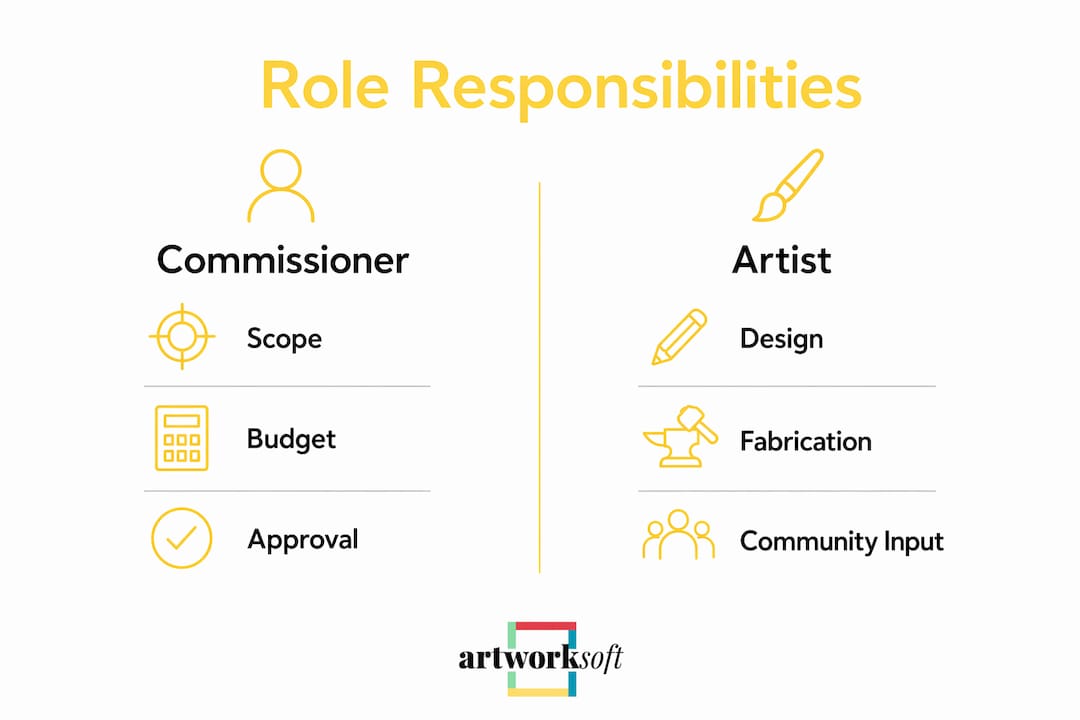
Clarity on who owns each decision is the single most reliable way to prevent rework. Role ambiguity is the most common execution pitfall in public art commissions, and a documented RACI resolves it before conflict starts.
Core roles and primary accountabilities:
- Commissioner/Funder: Approves scope, budget, and final design; holds ownership post-installation.
- Project Manager: Coordinates all parties from inception to handover; acts as advocate, broker, and negotiator between artist and commissioner.
- Lead Artist/Design Team: Delivers concept, design development, and fabrication specifications.
- Fabricator/Engineer: Executes structural engineering, shop drawings, and physical construction.
- Municipal Contacts: Manage permits, right-of-way, public works coordination, and ADA sign-off.
- Community Liaisons: Represent neighborhood and stakeholder interests throughout design development.
- Installers: Execute on-site placement, rigging, and snagging.
- Collection Manager: Maintains condition records, insurance certificates, and valuation history post-installation.
RACI matrix for key decisions:
| Decision | Commissioner | PM | Artist | Fabricator | Municipality | Community |
|---|---|---|---|---|---|---|
| Scope & brief | A | R | C | I | I | C |
| Budget approval | A | R | C | I | I | I |
| Technical approvals | I | R | C | A | A | I |
| Community consultation | C | R | C | I | I | A |
| Installation sign-off | A | R | I | C | A | I |
| Maintenance handover | A | R | C | I | I | I |
R = Responsible, A = Accountable, C = Consulted, I = Informed
Pro Tip: When the commission sits inside a larger construction project, split the PM role explicitly: one PM owns the art-specific scope and artist relationship; the construction PM owns site logistics. Without that split, the artist’s needs routinely get subordinated to the construction schedule.
How long does a public art project take, and what does it cost?
Stage timeline and key milestones:
| Stage | Typical Duration | Key Milestone |
|---|---|---|
| Concept & brief | 1–3 months | Approved project brief |
| RFQ/RFP & artist selection | 2–4 months | Shortlist and commission award |
| Design development | 2–6 months | Approved final design |
| Permits & approvals | 1–4 months | All permits issued |
| Fabrication | 3–12 months | QA sign-off at fabricator |
| Shipping & installation | 1–3 months | Installed and snagged |
| Launch & documentation | 1 month | Public launch, records filed |
| Maintenance onboarding | Ongoing | Maintenance schedule active |
Total project durations commonly range from 12 to 36 months for mid-to-large commissions.
Sample budget line items (use as a starting framework, not a fixed formula):
- Artist fee and design development
- Shortlisted artists’ fees (RFP stage)
- Structural and specialty engineering
- Fabrication and materials
- Site preparation and foundation work
- Permitting and planning fees
- Insurance (installation floater, general liability)
- Transportation and rigging
- Installation labor
- Documentation, photography, and launch
- Contingency: 10–20% of total project cost
- Long-term maintenance fund
Budget documents should be treated as active management tools, not fixed figures. Size contingency at 10% for straightforward commissions with well-defined sites, and up to 20% for complex multi-material works, seismic zones, or projects with significant community co-design components.
What permits and legal compliance does a U.S. public art project require?
Every U.S. public art project must resolve a core set of compliance items before fabrication begins. Skipping any one of them typically causes costly delays at installation.
Primary compliance checklist:
- Local building and encroachment permits
- Site easements and right-of-way agreements
- ADA access and clearance review (path of travel, reach ranges, protruding objects)
- Structural engineering sign-off and stamped drawings
- Utility clearances (underground and overhead)
- Environmental review where applicable
- Planning or design review board approval
Ownership must be documented in writing before installation. Whether the municipality takes title, the commissioning body retains custody under a loan agreement, or a public-private arrangement applies, the ownership structure determines who carries insurance, who authorizes conservation work, and who is liable if the work causes injury. Ambiguous ownership is one of the most common causes of deferred maintenance and uninsured loss in public collections.
Insurance minimums to require from artists and fabricators: general liability (minimum $1 million per occurrence is a common municipal threshold), installation floater, builder’s risk during construction, and pollution liability where materials or site conditions warrant it. Store all signed insurance certificates, engineering reports, and permits in a searchable system so they survive staff turnover.
How do you center equity and community engagement in public art practice?
Funders increasingly expect measurable engagement outcomes, not just delivery of a finished object. The distinction between token consultation and genuine co-creation is visible in the process record.
Engagement checklist:
- Convene a representative steering group before the RFP is issued, not after.
- Hold at least two public input sessions at accessible venues with interpretation services.
- Distribute bilingual or multilingual communications materials where the community warrants it.
- Document every input received and show explicitly how it informed design decisions.
- Track participation diversity: age, language, zip code, and organizational affiliation.
- Report attendance, survey results, and media coverage to funders in the final evaluation.
Practical impact metrics include post-installation attendance counts, pre/post community surveys, diversity of participants relative to neighborhood demographics, and earned media coverage. Portland’s public art program, which has added more than 1,700 works to its collection since the 1980s, explicitly prioritizes acquiring work from underrepresented artists and bringing art to historically underserved communities — a model worth studying for any equity-centered commission.
Pro Tip: Document community inputs in a dated log with the specific design responses they generated. This record protects the project against later challenges and satisfies the equity-centered practice requirements of most federal and state public art funders.

What procurement and installation practices reduce fabrication risk?
Three procurement models cover most U.S. public art commissions: an open call RFQ for broad community reach, an invited shortlist for projects requiring specific technical expertise, and a negotiated commission for established relationships or urgent timelines. The open call is the most defensible for publicly funded projects.
Procurement documents should specify: deliverables and technical requirements, insurance minimums, payment milestones with holdback clauses (typically 10% retained until final sign-off), maintenance expectations, and decommissioning responsibilities.
A PM who can translate artistic intent into technical drawings and realistic budgets materially reduces rework during fabrication and installation. Require shop drawings and a full-scale mockup for any structural or site-integrated element before approving the fabrication budget.
Fabrication and installation logistics checklist:
- Vet subcontractors with references from comparable public projects.
- Schedule QA checkpoints at 25%, 50%, and 90% of fabrication.
- Confirm packing, crating, and transport specifications in writing with the fabricator.
- Coordinate on-site storage and security before the work arrives.
- Schedule city crew or contractor access, traffic management, and any crane or rigging permits.
- Conduct a formal installation sign-off with the PM, artist, and municipal representative present.
Movement and logistics records for each piece, from fabricator to site, should be logged and retained as part of the permanent project file.
How should you document, value, and plan maintenance for a public artwork?
Post-installation stewardship is frequently under-resourced. Best practice is to create condition reports, maintenance protocols, and insurance records immediately upon installation, not months later.
Essential documentation deliverables:
- As-built drawings and material specifications
- Installation photographs (pre, during, and post)
- Signed Certificate of Authenticity (COA)
- Maintenance manual with scheduled inspection intervals
- Warranty documents from fabricators and subcontractors
- Insurance certificates
- Condition report template for annual inspections
Valuation approach for commissioned public artworks: start with the original commission cost, add documented provenance and exhibition history, then apply condition adjustments based on annual inspection reports. Record each valuation update with its date and methodology so insurers and funders have an auditable history. Artworksoft’s art valuation tools support exactly this workflow, storing valuation records alongside COAs and condition reports in a single searchable profile.
Long-term maintenance plans should specify inspection frequency, the conservation budget per cycle, and the named responsible party post-installation. Require the artist to supply a maintenance schedule at contract stage and confirm a maintenance fund or municipal commitment before handover.
What contracts and risk management practices protect a public art project?
Short risk register (cover these six categories at minimum):
- Scope risk: Design changes after approval. Mitigation: written change-order process with commissioner sign-off required.
- Schedule risk: Fabrication delays or permit holds. Mitigation: float built into timeline; milestone-based payment schedule.
- Technical risk: Structural or material failure. Mitigation: stamped engineering drawings; QA checkpoints; fabricator warranty.
- Community risk: Stakeholder opposition post-selection. Mitigation: documented engagement process; steering group sign-off on design.
- Health and safety risk: On-site incidents during installation. Mitigation: site-specific safety plan; contractor insurance certificates on file.
- Financial risk: Cost overruns beyond contingency. Mitigation: 10–20% contingency line; holdback clause in artist contract.
Essential contract clauses: payment schedule tied to milestones with a 10% holdback at final sign-off; IP and reproduction rights (specify who may photograph and publish the work); maintenance and decommissioning responsibilities; force majeure; and a dispute resolution clause naming mediation before litigation.
Require performance bonds for fabrication contracts above your organization’s risk threshold, and obtain additional contractor warranties for any structural element with a design life exceeding ten years.
How do you vet and select a public art project manager?
Strong PM candidates combine construction-environment experience with genuine community engagement skills. Neither alone is sufficient.
Vetting checklist:
- Documented experience managing public art or large-scale cultural commissions.
- At least two references from projects of comparable scale and complexity.
- Demonstrated familiarity with municipal permitting, ADA compliance, and structural engineering coordination.
- Evidence of community engagement practice, not just attendance at public meetings.
- Clear subcontracting arrangements with named partners or a transparent procurement process.
Interview questions to ask:
- Describe a project where the artist’s design required a technical compromise. How did you resolve it while preserving artistic intent?
- Walk through how you managed a permit delay that threatened the installation schedule.
- How do you document community inputs and demonstrate their influence on design decisions?
Red flags: no references for public-sector or construction-adjacent projects; unwillingness to commit maintenance and insurance requirements to writing; opaque subcontracting with no named partners; and a portfolio limited to gallery or studio work with no site-integrated commissions.
What deliverables should every professionally managed public art project produce?
A complete project file signals professional administration to funders, insurers, and future collection managers. CPAG and Public Art Fund role specifications both treat documentation and collection stewardship as core PM duties, not afterthoughts.
Deliverables checklist:
- RFQ/RFP and all artist submissions
- Signed artist contract with payment schedule and maintenance obligations
- Signed engineering approvals and stamped drawings
- As-built drawings and material specifications
- Installation photographs
- Maintenance manual
- Condition report template (for annual use)
- Certificate of Authenticity
- Insurance certificates (artist, fabricator, installer)
- Final evaluation report with community engagement metrics
Store all of these in a collection management system with search, audit trail, and export capabilities. Artworksoft’s artwork profile management allows teams to attach every document type above to a single artwork record, making funder reporting and insurance claims straightforward.
Version control and naming conventions: use a consistent file-naming format (ProjectName_DocumentType_YYYYMMDD) and maintain a master document register with version numbers. This prevents confusion during staff transitions and satisfies the audit requirements of most public funders.
Key Takeaways
Effective public art project management requires a named PM, a signed RACI, a contingency-inclusive budget, and centralized documentation from day one.
| Point | Details |
|---|---|
| Name one accountable PM | Assign a single PM before the RFP launches; PM fees typically run 8–10% of the public art budget. |
| Use a RACI from the start | Map every key decision to a responsible and accountable party to prevent role conflict and rework. |
| Build in 10–20% contingency | Size contingency by project complexity; 20% is appropriate for multi-material or community co-design projects. |
| Document equity-centered practice | Log all community inputs with dated records showing how each informed design decisions, as funders require this. |
| Centralize records in one system | Store COAs, condition reports, permits, and valuation history in a searchable platform to survive staff turnover. |
| Artworksoft for long-term stewardship | Artworksoft centralizes COAs, valuation records, condition reports, and movement logs in a single auditable system. |
The negotiation reality most public art guides skip
The operational literature on public art administration covers timelines, budgets, and permits with reasonable thoroughness. What it consistently underplays is the daily negotiation work that determines whether a project actually delivers on its artistic ambitions.
The most instructive situations are not the dramatic ones, where an artist walks off a project or a municipality rejects a design outright. They are the quieter moments: an engineer who flags a structural concern that, if accepted without pushback, would require removing a defining material element; a steering group that wants to relocate a work to a “safer” site that drains its meaning. In both cases, the PM’s job is not to advocate for the artist’s preferences as a matter of loyalty, but to make the case, with documented evidence, that the artistic decision serves the project’s stated public goals.
The practical discipline here is a decision log. Every concession, every compromise, every escalation should be recorded with the rationale. This is not bureaucratic caution. It is the only way to demonstrate to funders, community members, and future collection managers that the project’s outcomes were intentional, not accidental. A PM who cannot show that record has not managed the project. They have merely supervised it.
Artworksoft centralizes the records your public art project depends on
Public art projects generate more documentation than almost any other commission type: contracts, engineering approvals, COAs, condition reports, insurance certificates, maintenance schedules, and funder reports. Managing these across email threads and shared drives creates gaps that surface at the worst moments, during an insurance claim, a conservation decision, or a funder audit.

Artworksoft gives artists, galleries, and institutions a single platform to document and protect artworks from installation through long-term stewardship. Attach RFP documents, installation photographs, and as-built drawings to an artwork profile. Schedule maintenance checks and log condition reports. Export a valuation report for insurers with one click. Every record is searchable, auditable, and exportable, so nothing is lost when staff changes or a funder requests evidence of equity-centered practice.
Start with a free Artworksoft account and build your first public artwork profile today.
Useful sources for further reading
These resources are worth downloading and filing in your project record for compliance, procurement, and handover purposes.
- Americans for the Arts — Public Art Administrators resources: Workflow guidance and digital tool recommendations for multi-stakeholder public art administration.
- Public Art Online — Advice on Project Management: Sample timetables, fee guidance, and the PM person specification. Download and adapt the timetable for your project brief.
- Artists Handbook — Managing Public Art Projects: Negotiation frameworks, RACI principles, and budget-building guidance for artist-led commissions.
- Cultural Council of Greater Jacksonville — Public Art Project Manager job description: A model job description covering planning, community engagement, artist selection, and collection stewardship.
- Public Art Fund — Project Manager spec (2024): Detailed role requirements for complex installation coordination and contractor management.
- Chicago Public Art Group — Project Manager guidance: Post-installation stewardship, condition reporting, and conservation planning protocols.
- Portland.gov — Public Art Administrator posting: A real-world example of municipal public art administration scope, including Percent for Art program management and equity commitments.











