


A simple consignment agreement is a short, fill-in-the-blanks contract between a consignor (owner) and a consignee (seller) that keeps legal ownership with the consignor until an item sells; it sets commission, payment timing, and what happens to unsold goods. The Cornell Law School Legal Information Institute confirms retention of title as the core legal feature separating consignment from an outright sale.
This guide gives you a fillable template, a sample Exhibit A inventory schedule, and a pre-signing checklist. Before you fill it out, gather:
- Legal names and contact details for both parties
- A full inventory list (item descriptions, SKUs, condition, prices)
- Your preferred commission percentage and payment schedule
- Proof of insurance coverage, if goods will be stored off-site
Commission structures typically fall between 25% and 60% of the sale price, depending on the goods and retail setting. That range is your starting negotiation point, not a fixed rule.
Key Takeaways
A simple consignment agreement protects both parties only when it pairs clear clause language with a signed delivery receipt and detailed Exhibit A inventory schedule.
| Point | Details |
|---|---|
| Retention of title is core | Ownership stays with the consignor until an item sells to a third-party buyer. |
| Commission ranges vary | Typical splits run 25% to 60%, with payment due 15 to 30 days after each sale. |
| Exhibit A prevents disputes | Detailed descriptions, photos, and pricing per item beat vague inventory lists. |
| Sign before transfer | Execute the agreement and delivery receipt before goods change hands, not after. |
| Software can extend the template | Artworksoft complements the paper agreement with digital inventory tracking, photo records, and sales reporting for sellers managing multiple consignments. |
Simple Consignment Agreement Template With Exhibit A
A workable consignment contract does not need to run ten pages. It needs the right clauses, stated plainly. Here is fill-in-the-blanks language you can copy into a Word document or PDF and adapt to your situation.
Consignment Agreement
This agreement is entered into on ______ (date) between ______ (Consignor, legal name) and ______ (Consignee, legal name), collectively “the Parties.”
- Goods. Consignor delivers the items listed in Exhibit A (“Goods”) to Consignee for the purpose of sale.
- Retention of Title. Consignor retains full legal ownership of the Goods until sold to a third-party buyer. Consignee holds the Goods in trust and acquires no ownership interest.
- Commission. Consignee retains ______% of the gross sale price as commission; the remainder is remitted to Consignor.
- Payment and Reporting. Consignee shall pay Consignor within ______ days of each sale, accompanied by an itemized sales report.
- Consignment Period. This agreement covers a period of ______ days from the delivery date, after which unsold Goods are returned or the term is renewed by mutual written agreement.
- Risk of Loss and Insurance. Consignee assumes risk of loss or damage while Goods are in its possession and shall maintain insurance naming Consignor as additional insured or loss payee.
- Markdowns. Consignee may reduce prices up to ______% without prior written consent from Consignor.
- Return of Unsold Goods. Upon expiration or termination, Consignee shall return unsold Goods within ______ days in the condition received.
- Dispute Resolution. Disputes shall first be addressed through mediation before pursuing arbitration or litigation in ______ (state/county).
- Governing Law. This agreement is governed by the laws of the state of ______.
- Signatures. Both parties sign and date below to indicate acceptance.
Exhibit A: Inventory Schedule
| Item # | Description | SKU/Serial | Condition | Retail Price | Minimum Price | Qty |
|---|---|---|---|---|---|---|
| ___ | ___ | ___ | ___ | $___ | $___ | ___ |
Each line item should include enough detail (dimensions, materials, distinguishing marks) that nobody could mistake it for a different piece later. Template providers such as LegalTemplates build their downloadable Word and PDF packages around this same structure: fillable fields plus a separate inventory schedule attachment. Services like Contractbook and USLegal offer comparable formats if you want to compare layouts before settling on final wording.
Save the executed copy as a PDF with both signatures visible, and keep one copy with each party. A cloud folder shared between consignor and consignee prevents the “I never got that” problem months later.
How Do You Fill Out and Sign a Consignment Agreement?
Follow these steps in order, and don’t skip the documentation ones just because they feel tedious.
- Gather legal names and contact information for both parties, matching formation documents or government ID.
- Complete Exhibit A with full descriptions, condition notes, and pricing for every item.
- Negotiate commission and payment method, then write the agreed percentage directly into the contract.
- Set the consignment period and markdown authority so neither side is guessing later.
- Request proof of insurance before goods leave your possession.
- Sign the agreement before any goods change hands. Retroactive contracts create ambiguity that’s hard to unwind if something goes wrong early.
- Create a delivery receipt at handoff, referencing Exhibit A line by line.
- Keep copies of everything, including photos taken at drop-off.
Pro Tip: Require a signed delivery receipt that references Exhibit A, plus timestamped photos of each item at handoff. If a dispute over condition or loss comes up later, that paper trail matters more than the contract itself.
Standard remittance windows run 15 to 30 days after a sale, and consignment periods commonly span 30 to 120 days. Use those ranges as negotiation anchors, not hard rules.
What Do the Key Clauses in a Consignment Contract Mean?
Each clause in a consignment agreement does a specific job. Understanding what it protects helps you write it clearly instead of copying boilerplate you don’t fully understand.
Retention of title is the clause that makes a consignment a consignment rather than a wholesale sale. Word it directly: “Consignor retains full ownership of the Goods until sold to a third party.” Vague language here is the single easiest way to lose a legal argument later.
Description and inventory (Exhibit A) matters because a contract that says “assorted jewelry” protects nobody. Reference the schedule by name in the body of the agreement, and keep the schedule itself detailed, right down to serial numbers where they exist.
Commission and pricing clauses should state who sets the retail price (usually the consignor, sometimes negotiated jointly) and cap how far the consignee can mark items down without approval. Commission ranges of 25% to 60% are typical, with higher splits common in high-turnover retail and lower splits in fine art or high-value goods.
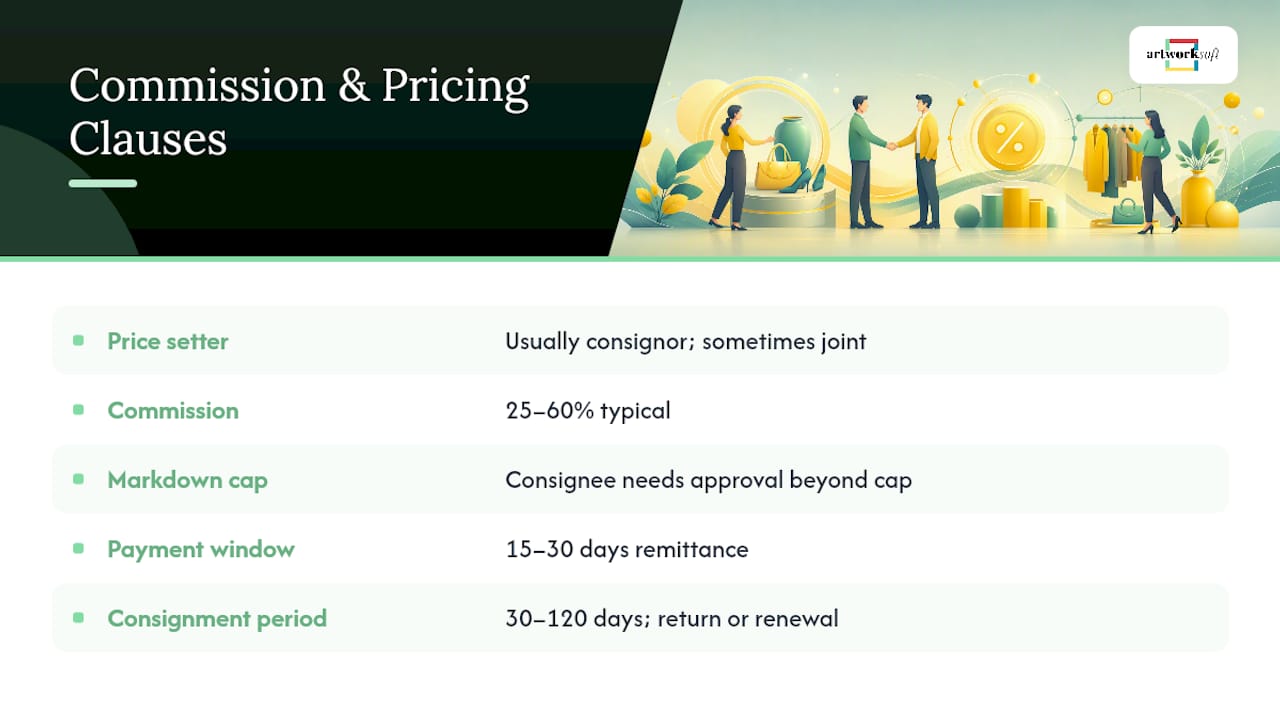
Payment timing and reporting should specify an exact remittance window, typically 15 to 30 days, along with a requirement for itemized sales reports. Without a report, you have no way to verify the commission math.
Risk of loss and insurance allocates responsibility while goods sit with the consignee. Sample agreement language commonly names the consignor as additional insured or loss payee on the consignee’s policy, which matters if a fire or theft occurs mid-consignment.
Consignment period and return of unsold goods should state a clear duration and what happens automatically at expiration, whether that’s return, renewal, or a markdown to clearance pricing.
Dispute resolution works best as mediation first, arbitration as fallback. A sample clause: “Any dispute shall first be submitted to mediation; unresolved matters proceed to binding arbitration under the laws of [state].”
Typical values at a glance: Commission 25–60% · Payment within 15–30 days · Consignment period 30–120 days
Common Pitfalls to Avoid in a Consignment Contract
Most consignment disputes trace back to the same handful of gaps. Ambiguity about who bears risk of loss tops the list, closely followed by these:
- Vague item descriptions instead of a detailed Exhibit A with photos and serial numbers.
- Using informal or incorrect legal names instead of names matching formation documents or ID.
- No signed delivery receipt or photo evidence at handoff, which weakens any later claim about condition.
- Unclear payment timing or no itemized sales reports required with each remittance.
- A consignee who refuses to provide an insurance certificate or resists a UCC-1 filing on high-value goods. Treat that resistance as a red flag worth pausing over.
A Filled-Out Consignment Agreement Example
Picture a ceramic artist consigning six framed prints to a local boutique.
Mini Exhibit A:
At delivery, both parties sign a receipt referencing this Exhibit A, noting condition for each print. Signatures for the main agreement appear on the final page, dated the same day the prints change hands.
Pre-Signing Checklist Before You Hand Over Goods
Run through this list before anything leaves your hands:
- Confirm legal names match ID or business formation documents.
- Complete Exhibit A in full, with photos attached to each line item.
- Confirm commission percentage and markdown authority in writing.
- Request an insurance certificate covering the consignment period.
- Schedule pickup, drop-off, or return logistics in advance.
- Sign a delivery receipt at the moment of transfer, not after.
Pro Tip: A good delivery receipt references Exhibit A by item number, records condition in a sentence or two, and carries a printed name, signature, and date from both sides. Keep one copy each. For logistics planning around larger handoffs, see this guide to art transportation.
Legal Considerations Before You Sign
Ownership retention is the legal backbone of a consignment relationship, and the Uniform Commercial Code provides the framework most states rely on. For higher-value goods, filing a UCC-1 financing statement can protect your ownership claim if the consignee runs into insolvency or unsecured creditors come looking for assets.
A contract alone may not shield your goods if the consignee’s business fails. Filing a UCC-1 financing statement records your ownership interest and gives you priority standing against the consignee’s creditors, which is why practitioners recommend it for consignments involving significant value.
Talk to an attorney when the consignment involves high-value pieces, cross-state or cross-border tax questions, or genuine disagreement about who bears risk of loss. For routine, lower-value arrangements between small businesses, a well-drafted template like the one above generally covers the ground you need.
Why Short Contracts Beat Long Ones
Clear, short contracts win because they get signed faster and leave less room for the kind of ambiguity that turns into a dispute six weeks in. The clauses that actually protect you (retention of title, payment timing, risk of loss) fit on a page and a half.
What tends to get skipped, and shouldn’t, is the paper trail around handoff. A signed delivery receipt and a handful of timestamped photos resolve more arguments than another paragraph of legal language ever will.
Let Software Handle the Paperwork Your Template Can’t
Your simple consignment agreement handles the legal terms. It doesn’t track condition photos, generate a professional delivery receipt, or reconcile sales reports across a dozen active consignments at once, and that’s where a lot of small sellers start losing time. Artworksoft replaces the manual Exhibit A spreadsheet with a structured inventory record, generates branded documentation, and logs movement of each piece from drop-off to sale.

The template alone works fine for a single consignment or two. Once you’re juggling multiple consignees, multiple items, and sales reports on different remittance schedules, a system built specifically for art inventory tracking saves you from reconstructing spreadsheets by hand. Start a free account and see whether it fits how you already work before you decide it’s worth paying for.
Where to Read More
- Cornell Law School: legal definitions and ownership rules.
- LegalTemplates: downloadable fillable templates.
- LegalClarity: drafting and signing walkthroughs.
Frequently Asked Questions
What makes a consignment agreement “simple”?
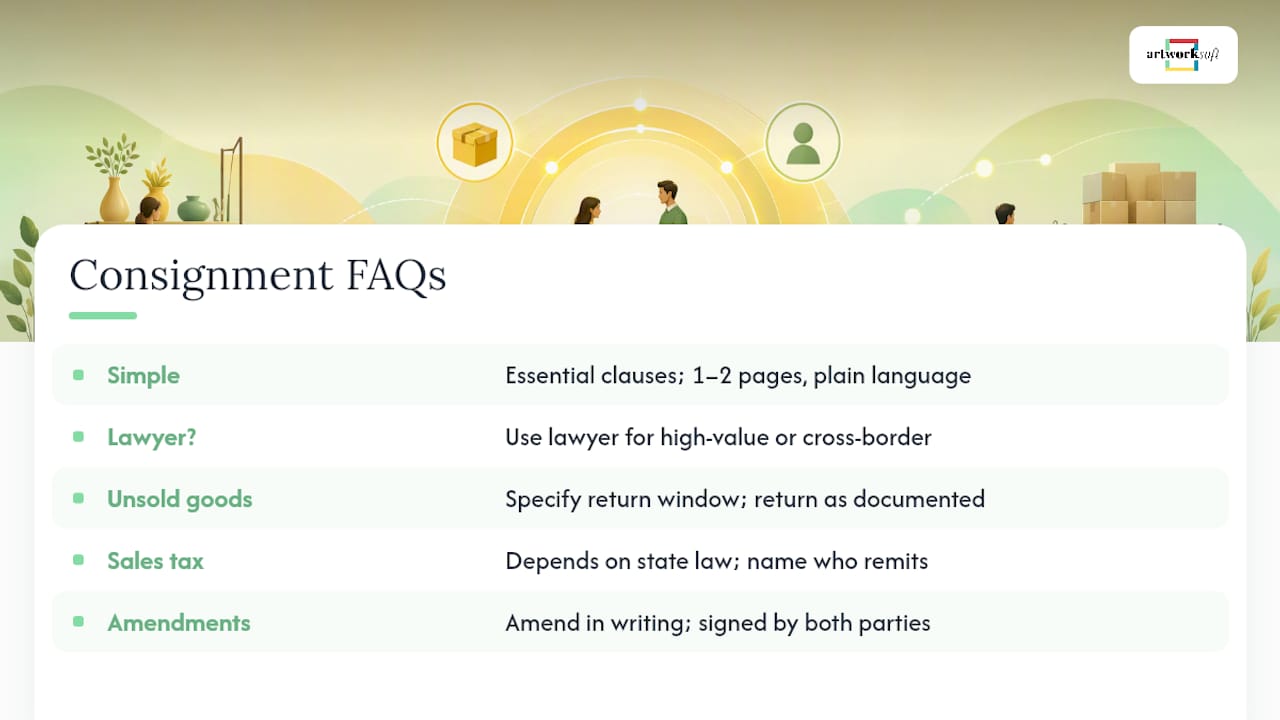
A simple consignment agreement covers the essential clauses (ownership, commission, payment, returns) in plain language on one or two pages, without the dense legal boilerplate longer contracts often carry.
Do I need a lawyer to use a consignment agreement template?
Not for routine, lower-value consignments between small businesses. Consult an attorney for high-value goods, cross-jurisdictional questions, or if the other party disputes risk allocation.
What happens to unsold goods at the end of the consignment period?
The agreement should specify a return window, typically within days of expiration, with goods returned in the condition documented at handoff unless both parties agree to a markdown or renewal.
Who pays sales tax on a consigned item?
That depends on state law and who holds the seller’s permit; many consignees collect and remit sales tax as the point-of-sale party, but the agreement should state this explicitly to avoid confusion.
Can I amend a consignment agreement after signing?
Yes. Add a written amendment signed by both parties referencing the original agreement date, rather than verbally changing terms, which is much harder to enforce later.
This article is general information, not a substitute for advice from a qualified lawyer. Consult a qualified legal professional about your own circumstances before acting on anything here.
Sources
- Consignment — Cornell Law School Legal Information Institute
- How to Fill Out a Consignment Agreement: Contract Terms and Signing — LegalClarity
- Free Consignment Agreement Template | PDF & Word — LegalTemplates
- Consignment Agreement & Guide — LegalZoom (PDF)











