


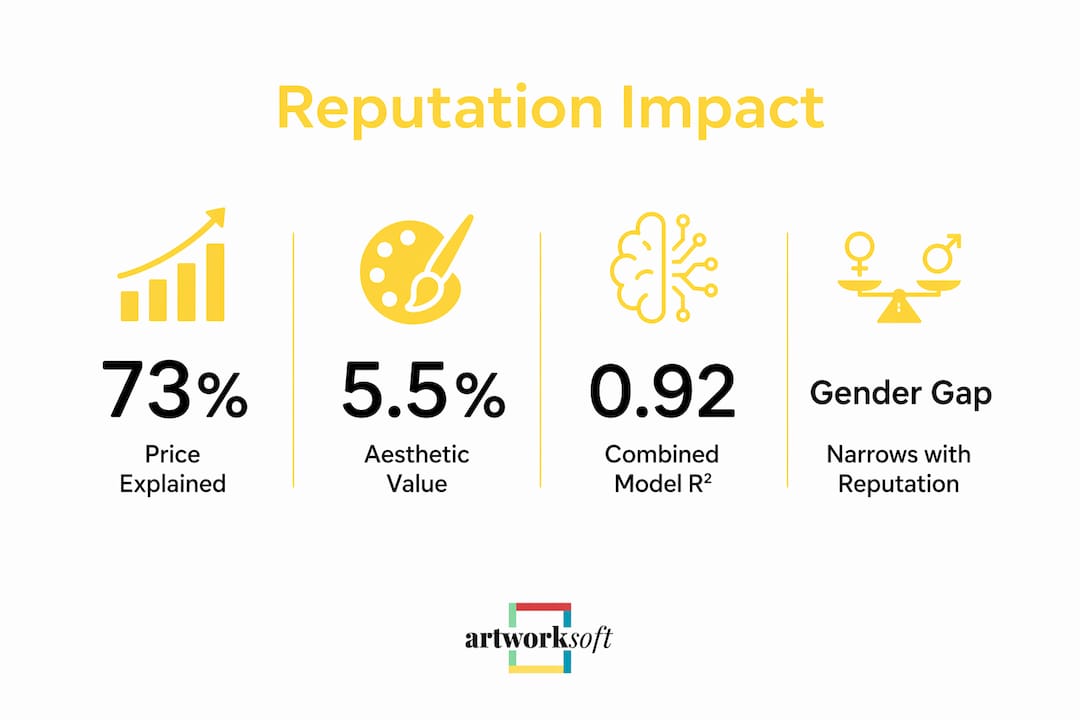
Artist reputation is the primary driver of artwork valuation, shaping market prices far more than aesthetic or material qualities. Understanding how artist reputation impacts valuation gives artists, collectors, and investors a measurable framework for pricing decisions. Algorithmic models using reputation metrics explain approximately 73% of auction price variance, a figure that rises to 92% when combined with pre-sale estimates. These numbers confirm that the art market prices reputation, not just the object on the wall. Exhibition history, institutional recognition, and auction records are the core variables that define an artist’s market standing.
What factors contribute to building an artist’s reputation?
Artist reputation is built through accumulated social and institutional capital, not through talent alone. The art market recognizes credibility through specific, verifiable signals that collectors and investors use to assess long-term value. Institutional recognition such as museum acquisitions, biennial inclusions, and sustained critical discourse forms the foundation that precedes and shapes price. Without these signals, even technically accomplished work struggles to command strong market prices.
The key reputation-building factors that directly affect art valuation factors include:
- Exhibition history: Solo shows at recognized institutions, participation in international biennials, and group exhibitions at reputable galleries all signal professional standing.
- Museum acquisitions: A work entering a public collection validates the artist’s place in art history and raises confidence in future price appreciation.
- Critical reception: Reviews in established publications, catalog essays by respected curators, and academic citations build the discourse that sustains long-term market interest.
- Auction records: A documented sales history at recognized auction houses provides price anchors that buyers and appraisers reference directly.
- Process transparency: Sharing the creative process publicly is an emerging credibility signal, particularly relevant as collectors increasingly value the human effort behind a work.
Price is a delayed effect of recognition. Artists who build institutional relationships consistently over years create a reputational foundation that the market converts into price premiums. Collectors prioritize editions and works connected to an artist’s core visual language and institutional visibility, reinforcing that sustained engagement with institutions drives sustained demand.
Demographic and symbolic factors also shape reputation growth. Gender, nationality, and gallery affiliation all influence how quickly an artist gains institutional traction. These factors do not determine ceiling value, but they do affect the pace and trajectory of reputation accumulation, particularly in early career stages.

Pro Tip: Document every exhibition, acquisition, and critical mention from the start of your career. Gaps in this record are difficult to reconstruct later and directly affect how appraisers assess your market standing.
How does artist reputation statistically impact artwork prices?
Empirical research quantifies reputation’s effect on price with precision that surprises most collectors. Algorithmic valuation models built on social reputation features, including exhibition history, institutional presence, and auction records, explain 73% of price variance in auction results. That is a strong predictive result for any single category of variables in a market often described as opaque.
When auction-house pre-sale estimates are added to reputation metrics, the combined model reaches an R² of 0.92. Pre-sale estimates themselves achieve an R² of approximately 0.90, meaning expert consensus already encodes much of the reputational signal. The two inputs together reduce residual uncertainty to a fraction of what visual or material analysis can achieve alone.
The table below summarizes the predictive power of different valuation model types:
| Model type | Key variables | R² value |
|---|---|---|
| Visual content only | Image features, color, composition | ~0.055 |
| Social reputation features | Exhibition history, institutional presence, auction records | ~0.73 |
| Pre-sale estimates only | Auction-house low and high estimates | ~0.90 |
| Reputation + pre-sale estimates | Combined social and expert signals | ~0.92 |
The visual-only model’s R² of approximately 0.055 is barely above random. That result means aesthetic qualities, taken alone, explain almost nothing about price. The gap between 0.055 and 0.73 represents the market’s clear preference for reputational data over visual data.
Reputation signals carry different weight depending on market maturity. In emerging art markets, where historical sales data is thin and expert pricing is less reliable, social reputation features do proportionally more predictive work. Established markets with deep auction records rely more on historical price data, but reputation still anchors the baseline. Artists and collectors operating in younger markets should treat reputation documentation as their primary valuation asset.
Understanding art collection net worth requires applying these model insights to individual portfolios. A collection heavy in works by artists with strong institutional records carries measurably lower valuation uncertainty than one built on aesthetic preference alone.
Why does reputation often outweigh artwork aesthetics in valuation?
The market prices symbolic capital, not visual experience. This is the central and often counterintuitive truth of art valuation. Visual and material features explain only about 5.5% of price variance, a result that holds across multiple algorithmic studies. Buyers at auction are not paying for what they see. They are paying for what the artist’s record represents.
Market psychology reinforces this pattern. Buyers anchor prices to an artist’s past sales, institutional affiliations, and critical standing rather than to the content or craft of the specific work in front of them. This behavior is rational from an investment perspective. Reputation is more stable and transferable than aesthetic taste, which shifts across generations and cultures.
The comparison below illustrates how reputation factors and artwork attributes rank in valuation impact:
| Valuation factor | Category | Relative impact on price |
|---|---|---|
| Exhibition and auction history | Reputation | High |
| Museum acquisitions and critical reception | Reputation | High |
| Institutional affiliation and gallery representation | Reputation | High |
| Medium and physical condition | Artwork attribute | Moderate |
| Size and format | Artwork attribute | Low to moderate |
| Visual content and aesthetic style | Artwork attribute | Minimal |
Medium and craftsmanship do influence price, but as secondary variables. A large oil painting by a well-documented artist commands more than a small work on paper, but only within the range already set by that artist’s reputation. The reputation ceiling defines the price range. Material attributes determine position within it.
Symbolic capital accumulates through consistent institutional engagement over time. Artists who maintain gallery representation, participate in curated group shows, and attract critical writing build a body of evidence that the market treats as a price signal. This is why established artists can sell new work at prices that would be impossible for an equally skilled but less documented peer.
Pro Tip: Collectors should request full exhibition and auction histories before purchasing. An artist with a strong visual style but a thin institutional record carries significantly more price uncertainty than the work’s appearance suggests.
How do human effort and demographics influence reputation’s effect?
Reputation’s influence on price is not uniform. Two subtler forces shape how reputation translates into willingness to pay: visible human effort and the artist’s demographic profile.
The effort premium is measurable. 72.9% of study participants indicated willingness to pay more for artworks showing visible human effort compared to works without such cues. This finding holds even when the visual output is identical. The market assigns value to the perceived struggle behind the work, not just the result. For artists, this means that sharing process documentation, studio photographs, and work-in-progress records is not just a marketing tactic. It is a direct input into perceived value.
The practical implications for artists building reputational capital include:
- Share time-lapse videos, sketchbooks, and process notes publicly through professional channels.
- Include process documentation in exhibition catalogs and artist statements.
- Provide provenance records that describe the creation context, not just the finished dimensions.
- Use platforms that allow artwork profile management to attach process records directly to each work’s documentation.
Gender-based pricing disparities follow a different pattern. Gender price discounts diminish as artist reputation rises, becoming negligible at high levels where symbolic capital dominates. This means that reputation functions as a partial equalizer in markets where demographic bias otherwise depresses prices. The practical implication is direct: building a strong institutional record is the most effective counter to demographic pricing gaps. Artists from underrepresented groups who invest in exhibition history and critical engagement close the pricing gap faster than those who rely on market exposure alone.
These nuanced effects interact with broader reputational capital. An artist with strong institutional standing and visible process transparency commands a compounding premium. The effort signal amplifies the credibility signal. Collectors and investors who understand this interaction can identify undervalued artists whose process documentation lags behind their institutional record.
Key Takeaways
Artist reputation explains the dominant share of artwork price variance, making it the most important variable for artists, collectors, and investors to track and document.
| Point | Details |
|---|---|
| Reputation drives price variance | Social reputation features explain 73% of auction price variance, far exceeding visual or material factors. |
| Aesthetics have minimal predictive power | Visual content alone explains only 5.5% of price variance, confirming that market pricing is reputation-led. |
| Effort visibility raises willingness to pay | 72.9% of buyers pay more for works with visible human effort, making process documentation a direct value input. |
| Demographics matter less at high reputation levels | Gender-based price discounts become negligible as symbolic capital accumulates through institutional engagement. |
| Emerging markets rely more on reputation signals | In markets with thin sales data, exhibition history and institutional presence do more predictive work than historical prices. |
Reputation is more predictable than most artists realize
The art market has a reputation for being opaque, but the data tells a more structured story. What I find most underappreciated is how mechanical the relationship between institutional engagement and price actually is. Artists who treat exhibition history as a strategic asset, rather than a byproduct of their practice, consistently build stronger market positions than those who focus on production volume alone.
Collectors often make the opposite mistake. They fall for strong visual work by artists with thin institutional records, then wonder why resale values disappoint. The research is clear: the work’s appearance is almost irrelevant to its price trajectory. What matters is whether the artist’s name carries documented weight in the market’s memory.
The emerging insight I find most significant is the effort premium. As AI-generated imagery becomes more common, the market is already developing a preference for documented human process. Artists who share their creative process now are building a valuation advantage that will compound over the next decade. This is not sentiment. It is a measurable shift in buyer behavior.
My practical advice for collectors and investors is to treat artist reputation documentation as a due-diligence requirement, not an optional extra. An artist’s exhibition record, critical reception history, and auction performance are the financial statements of the art market. You would not invest in a company without reading its financials. The same discipline applies here.
— Nealda
How Artworksoft helps you manage reputation-driven valuation
Artists and collectors who understand reputation’s role in pricing still need a system to capture and organize the data that drives it.

Artworksoft provides a structured platform for documenting exhibition history, provenance, and sales records, the exact variables that algorithmic valuation models weight most heavily. The art inventory system connects each artwork to its full institutional record, from gallery shows to auction results, creating the documentation trail that supports confident pricing. The art valuation tools apply structured formulas that incorporate reputation metrics directly, removing the guesswork from price-setting for emerging artists and established collectors alike. For anyone building a collection or a career with long-term value in mind, Artworksoft provides the infrastructure to make reputation data work.
FAQ
What is the biggest factor in determining artwork price?
Artist reputation, measured through exhibition history, institutional recognition, and auction records, is the dominant pricing factor. Algorithmic models show that reputation metrics explain approximately 73% of auction price variance.
How much do visual aesthetics affect artwork valuation?
Visual content explains only about 5.5% of price variance in auction markets. Aesthetic qualities are statistically secondary to reputational and institutional factors in determining price.
Does gender affect an artist’s market price?
Gender-based price discounts exist but diminish as artist reputation rises. At high levels of symbolic capital and institutional recognition, gender pricing disparities become negligible.
Why do emerging market artists rely more on reputation signals?
Emerging markets have thinner historical sales data, so buyers and appraisers rely more heavily on exhibition history and institutional presence to estimate value. Reputation fills the gap that price history cannot.
How does showing the creative process affect artwork value?
Visible human effort raises buyer willingness to pay. Research shows 72.9% of participants preferred to pay a premium for works with documented process cues over works without them.











