

Art case law is the body of U.S. court decisions, statutes, and regulatory guidance that governs ownership, authorship, authenticity, and transfer of visual artworks. The single most effective action you can take right now to reduce legal exposure is to centralize provenance and copyright documentation before a dispute arises.
Two actions to take within the next 72 hours:
- Create a core provenance record for each significant work: document the chain of title, attach purchase invoices, and note exhibition history.
- Register your most commercially valuable or litigation-risk works with the U.S. Copyright Office to preserve access to statutory damages and attorney’s fees.
The Center for Art Law frames this clearly: understanding case law is not just for litigants. It shapes acquisition policy, deaccession decisions, and the daily operational choices galleries and collectors make.
What does U.S. art case law actually cover?
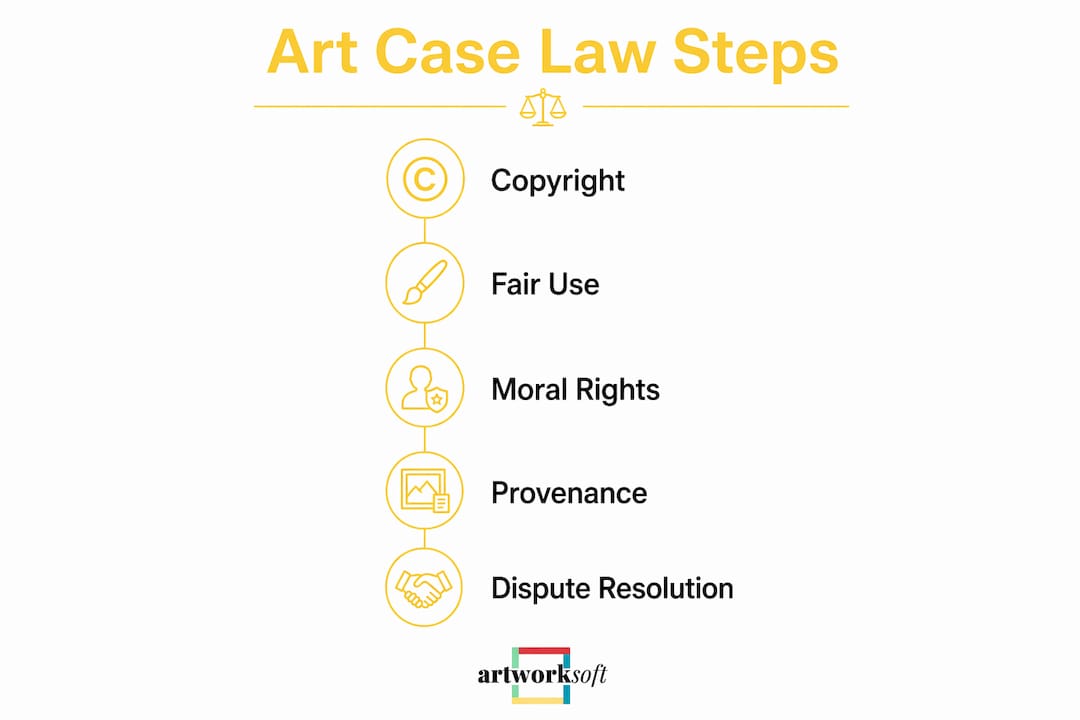
U.S. art law cases draw from copyright, moral rights, property, contract, and cultural property law. The doctrines below are the ones most likely to affect a transaction, exhibition, or ownership dispute.
Copyright and fair use
Copyright protection attaches at fixation, but registration is required to file a federal lawsuit for U.S. works and to access statutory damages and attorney’s fees. Timing matters: registration before infringement, or within three months of first publication, preserves the full range of remedies.
Fair use is the most litigated doctrine in contemporary art. The Supreme Court recently held that fair-use analysis can weigh against a transformative work when the new work shares a substantially similar commercial purpose to the original. That ruling directly affects galleries and artists who incorporate preexisting images. Cariou v. Prince, 714 F.3d 694 (2d Cir. 2013), and Rogers v. Koons, 960 F.2d 301 (2d Cir. 1992), remain the landmark appropriation art cases that practitioners cite when evaluating whether a new work crosses the line.
VARA and moral rights
The Visual Artists Rights Act (VARA) grants qualifying artists rights of attribution and integrity. Its scope is narrower than many assume. Kelley v. Chicago Park District tested VARA’s limits on site-specific works, and courts have split on whether removal equals destruction. Detailed installation records and documented intent are the practical defense.
Restitution, cultural property, and AML
Restitution claims, particularly for Nazi-era looted art, require galleries and collectors to conduct provenance research against international databases such as the Art Loss Register and Interpol’s stolen-art database. The Chambers & Partners 2026 practice guide confirms that failure to conduct adequate due diligence can result in civil liability and reputational harm. Anti-Money Laundering (AML) obligations now apply to higher-value art transactions, requiring dealers to implement customer identification and transaction monitoring programs.
UCC and contract law
Under UCC Article 2, the sale of a physical artwork is a goods transaction. Warranties of title, merchantability, and fitness attach unless explicitly disclaimed. Consignment agreements must comply with UCC Article 9 to protect the consignor’s interest against the gallery’s creditors.
| Statute / Doctrine | Core Effect | Why It Matters for Collectors and Galleries |
|---|---|---|
| Copyright Act | Protects original works at fixation; registration required for federal suit | Enables statutory damages and attorney’s fees; gating requirement for litigation |
| VARA | Attribution and integrity rights for qualifying visual art | Artists can block destruction or mutilation; galleries must track title transfers |
| UCC Article 2 | Governs sale and transfer of goods, including artworks | Warranty of title and merchantability attach unless disclaimed in writing |
| UCC Article 9 | Secured transactions and consignment interests | Protects consignors against gallery insolvency if properly perfected |
| Cultural Property Laws / NSPA | Prohibits trafficking in stolen cultural property | Due diligence on provenance required before acquisition |
Key cases at a glance:
- Rogers v. Koons (1992): parody defense rejected; sculpture derived from a photograph was infringement.
- Blanch v. Koons (2006): Koons won on fair use where the new work commented on the source image’s cultural meaning.
- Cariou v. Prince (2013): Second Circuit reversed district court; most of Prince’s works were sufficiently transformative.
- Hayden v. Koons (2025): illustrates how statute-of-limitations accrual and discovery rules can determine whether a copyright claim survives at all.
How does U.S. law treat provenance and authentication?
No U.S. jurisdiction mandates a certified authentication system. Authentication decisions rest with private experts, artist foundations, or estates, and the Chambers 2026 guide confirms that an organized provenance trail is the most reliable defense in title or authenticity disputes. The market has developed its own standards, and courts apply them when evaluating claims.
Documents that carry legal weight:
- Chain-of-title records (bills of sale, auction records, inheritance documents)
- Certificates of Authenticity (COAs) with full work identification and basis for opinion
- Condition reports and conservation/restoration records
- Loan and consignment agreements
- Import/export documentation and customs records
- Correspondence between artist, dealer, and collector
- Catalogue raisonné entries or expert opinions
A defensible COA should include: creator’s full legal name, work title and date, medium and dimensions, unique identifier or catalog number, provenance summary, the authenticator’s basis for opinion, signatures of both authenticator and owner, date of issuance, and attached high-resolution images.
Pro Tip: When vetting an authenticator, check whether their opinions have been relied on in prior market transactions or litigation, whether they are listed in a published catalogue raisonné, and whether they carry professional liability coverage. An opinion from an unverifiable source can be challenged in court and may undermine rather than support a title claim. Provenance research in other collectibles markets, such as wristwatch provenance, follows the same chain-of-custody logic.
What documentation and due-diligence steps reduce legal exposure?
Treating documentation as a proactive business practice, rather than a litigation response, reduces downstream legal costs and increases leverage in disputes.
- Photograph every work in high resolution from multiple angles; record dimensions, medium, and any signatures or markings.
- Build a provenance timeline listing every owner, sale date, price, and location from creation to present.
- Save all transactional records: invoices, receipts, auction catalogs, and written communications.
- Log condition and conservation data at each transfer or exhibition.
- Register copyrights with the U.S. Copyright Office before or shortly after first publication. Registration within three months of publication preserves statutory damages and attorney’s fees. The Copyright Claims Board (CCB) offers a lower-cost alternative forum for smaller disputes, with a damages cap suited to individual artists and small galleries.
- Run due diligence on high-value acquisitions against the Art Loss Register and Interpol databases before purchase.
Practical contract clauses to include in sales, consignment, and loan agreements:
- Warranty of title: seller represents clear, unencumbered title.
- Authentication representation: seller warrants the work is authentic and as described.
- Limitation of liability: cap on consequential damages.
- Indemnity: seller indemnifies buyer against third-party title claims.
- Return and repair obligations: conditions under which a work may be returned or restored.
Copyright registration currently has a fee for online single-work registration as per the U.S. Copyright Office fee schedule. An initial art law consultation typically incurs hourly fees depending on counsel and market.
How do art disputes proceed, and what do they cost?
Most art disputes follow a predictable progression: demand letter and negotiation, then mediation or other ADR, then the CCB or federal court if resolution fails.
| Forum / Stage | Typical Duration | Primary Cost Drivers |
|---|---|---|
| Demand / negotiation | Several weeks | Counsel time, document preparation |
| Mediation / ADR | Several months | Mediator fees, expert reports |
| Copyright Claims Board | Typically one to two years | Filing fees, limited discovery |
| Federal district court | Multiple years | Full discovery, expert witnesses, trial |
| Appeals | Additional multi-year period | Appellate counsel, briefing costs |
The largest cost drivers in art litigation are documentary discovery (especially when provenance records are incomplete), expert authentication reports, forensic testing, and jurisdictional complexity in cross-border restitution cases. Hayden v. Koons is a practical reminder that statute-of-limitations accrual can end a claim before discovery even begins, making early legal consultation worth the investment.
When to consult counsel:
- Before any acquisition above your standard transaction threshold.
- When a work’s provenance has gaps covering the period 1933–1945.
- Before signing a consignment agreement with a new gallery.
- Immediately upon receiving a demand letter or restitution claim.
Well-documented provenance limits discovery scope, reduces the number of depositions required, and often enables early resolution.
How does art-management software support legal compliance?
Collection-management software converts legal best practices into repeatable, auditable workflows. Artworksoft is built around exactly this premise: every feature maps to a documented legal need.
Feature-to-legal-risk mapping:
- Immutable provenance logs: timestamped ownership history that holds up in title disputes.
- High-resolution image archiving: visual evidence of condition and authenticity at each transfer.
- Document attachments: store COAs, invoices, condition reports, and registration receipts against each artwork record.
- Movement and location history: supports VARA claims and insurance documentation.
- Loan and consignment templates: pre-structured agreements with the warranty and indemnity clauses described above.
- Audit trails: exportable records for counsel, insurers, and customs authorities.
Illustrative workflow for a sale or loan:
- Open the artwork record in Artworksoft and confirm the provenance timeline is complete.
- Attach the current COA, most recent condition report, and copyright registration receipt.
- Generate a professional PDF report via art documentation features for the buyer or borrowing institution.
- Log the transaction or loan agreement and update the location record.
Artworksoft’s art identification and traceability tools support the kind of chain-of-custody documentation that courts and insurers expect. When a dispute arises, the platform’s audit-ready export means counsel can assemble the evidentiary record in hours rather than weeks.
A prioritized checklist for artists, collectors, and galleries
Immediate (within 72 hours):
- Photograph all significant works in high resolution.
- Start a provenance record for each work, even if incomplete.
- Register your highest litigation-risk works with the U.S. Copyright Office.
Near-term (weeks to months):
- Collect and scan historic invoices, auction records, and correspondence.
- Secure COAs from qualified authenticators for works lacking them.
- Run due diligence on high-value acquisitions against international stolen-art databases.
- Consult counsel before complex transfers, consignments, or cross-border transactions.
- Review consignment agreements for UCC Article 9 compliance.
Ongoing maintenance:
- Schedule condition reports at each loan, exhibition, or transfer.
- Export audit-ready provenance reports from your collection-management system at least annually.
- Update location and loan records in real time.
- Renew insurance valuations and confirm coverage aligns with current market values.
- Monitor restitution databases for any works with pre-1945 provenance gaps.
Key Takeaways
U.S. art case law requires artists, collectors, and galleries to treat copyright registration, provenance documentation, and contract discipline as standard operating practice, not reactive measures.
| Point | Details |
|---|---|
| Register copyrights early | Registration before or within three months of publication preserves statutory damages and attorney’s fees in federal court. |
| Provenance is your primary defense | No federal authentication system exists; a complete chain-of-title record is the most reliable protection in title and authenticity disputes. |
| Choose your forum deliberately | The CCB suits smaller disputes; federal court is necessary for larger claims but carries multi-year timelines and significant discovery costs. |
| Contract clauses prevent disputes | Warranty of title, authentication representations, and indemnity clauses in every sale and consignment agreement reduce litigation risk materially. |
| Artworksoft centralizes the evidence | Artworksoft’s provenance logs, document attachments, and audit-trail exports turn legal best practices into a repeatable, auditable workflow. |
Why “legal-ready” documentation is built into Artworksoft’s design
The legal risks described throughout this article, from VARA claims to restitution demands to copyright infringement suits, share a common thread: they are all easier to defend when documentation is complete, organized, and immediately retrievable. Artworksoft was designed with that reality in mind. The platform’s COA generation, provenance chain management, and audit-trail features are not incidental. They reflect the understanding that an artwork without a documented history is an asset with unquantified legal exposure. For galleries managing consignments, collectors acquiring across borders, and artists protecting their moral rights, the difference between a defensible position and a costly dispute often comes down to whether the right document exists and can be produced quickly.
Artworksoft: documentation built for legal readiness
Artists, collectors, and galleries who have read this far understand that legal protection in the art market starts with organized, professional documentation, not with a lawyer on retainer. Artworksoft gives you the infrastructure to build that documentation before you need it.

The platform generates professional Certificates of Authenticity, maintains timestamped provenance logs, stores condition reports and invoices against each artwork record, and produces audit-ready PDF reports at any point. When a sale, loan, or dispute requires evidence, the record is already assembled. Artworksoft’s art collection management tools are available on a free plan to get started, with paid tiers for unlimited artworks, branded documentation, and enhanced analytics. Start your free account and build a collection that is professionally managed and legally defensible from day one.
Useful sources for further research
- U.S. Copyright Office: Visual Artists — Official guidance on registration, fixation, statutory damages, and the Copyright Claims Board. The primary reference for any copyright registration question.
- Supreme Court fair-use opinion (Andy Warhol Foundation v. Goldsmith) — The 2023 decision clarifying how commercial purpose affects the first fair-use factor; required reading for galleries and artists working with preexisting imagery.
- Center for Art Law: Case Law Database — The most comprehensive searchable database of U.S. and international art law case summaries, filterable by subject (copyright, VARA, restitution, theft).
- Center for Art Law: Hayden v. Koons Case Review — Detailed analysis of statute-of-limitations and discovery issues in a recent Koons copyright dispute.
- Chambers & Partners: Art & Cultural Property Law 2026 — Practitioner-level guide covering provenance, authentication, AML, and restitution obligations across jurisdictions.
- Kelley v. Chicago Park District (Casetext) — Leading case on VARA’s application to site-specific works; useful for artists and institutions managing public or permanent installations.
- Fordham University: Top 10 Appropriation Art Cases — Accessible summaries of the landmark copyright and trademark cases involving appropriation art, from Rogers v. Koons to Cariou v. Prince.
This article provides general legal information for educational purposes only. It is not legal advice. Consult a qualified art law attorney for guidance specific to your situation, and verify current statutes and regulations with the relevant primary sources.











