


Protecting and transferring an art collection requires three immediate actions: build a defensible digital inventory with full provenance documentation, specify explicit IP directions including a termination-right strategy under 17 U.S.C. §203, and name a qualified fiduciary or trust structure with direct art experience. Christie’s advisory services frame art estate planning as a multi-generational commitment, not a one-time tax exercise. Start this week with these five steps:
- Photograph and catalog every work with title, medium, dimensions, and provenance notes.
- Pull purchase records, exhibition history, and any existing appraisals into one secure location.
- Identify whether copyright in any work was transferred by contract and flag those files.
- Draft a short letter of instruction naming your preferred fiduciary and your intentions for each major work.
- Schedule a consultation with an estate attorney who has direct art experience.
Why art inheritance and estate planning differ from other property transfers
Art is illiquid, subjectively valued, and legally dual-natured. A painting cannot be liquidated on short notice the way a stock portfolio can, and its fair market value depends on condition, provenance, market timing, and authentication, none of which are fixed. An artist’s estate contains both the physical work and the underlying copyright, and those two assets must be planned together because IP often generates long-term income and control issues that outlast the physical object by decades.
Missing documentation is the most common single point of failure in art estates. When provenance records, condition reports, or exhibition histories are absent, executors face forced sales at below-market prices, disputed authentications, and IRS challenges to claimed valuations. A collection that took a lifetime to build can lose a significant portion of its market value within months of an owner’s death if the archive is incomplete.
A long-term collection strategy must account for this from the moment of acquisition, not at the point of death.
What ownership structures work best for art estates?
| Structure | Best For | Key Pros | Key Cons |
|---|---|---|---|
| Revocable living trust | Collectors, artists | Avoids probate; easy to amend; keeps collection private | Assets remain in taxable estate |
| Irrevocable trust | Collectors with large estates | Removes art from taxable estate; creditor protection | Loss of direct control; hard to reverse |
| IP trust | Artists with active copyright | Centralizes licensing, authentication, and royalty management | Requires specialized trustee; ongoing admin costs |
| LLC held in trust | Shared family collections | Enables fractional ownership; supports leaseback planning | Setup and annual compliance costs |
| Private foundation | Major collectors, artist estates | Keeps collection intact; tax deduction at death; mission-driven | IRS compliance burden; public disclosure requirements |
For artists, an IP trust paired with a revocable living trust covering physical works gives the most operational flexibility. Collectors with large holdings often benefit from placing an LLC inside an irrevocable trust, which allows equitable distributions to heirs without forcing a sale. A private foundation makes sense when the collection has institutional significance and the family wants to preserve it as a unit rather than divide it among heirs.
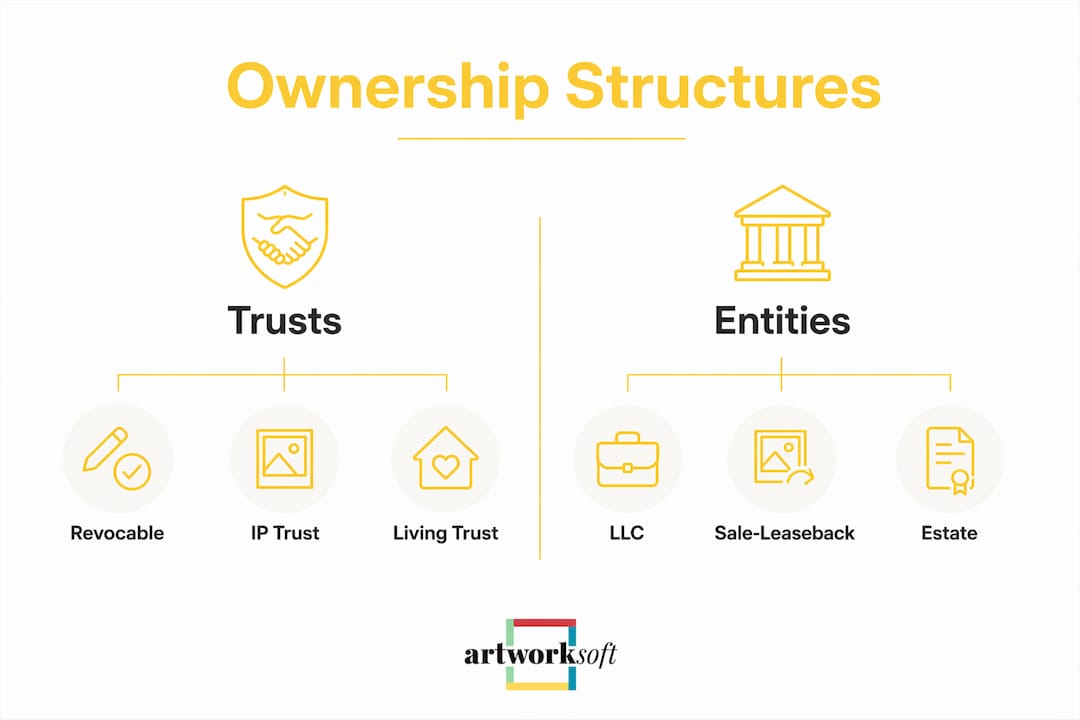
When an LLC is held inside a trust, a sale-leaseback arrangement can allow the original owner to retain possession and display rights while transferring legal ownership, which reduces the taxable estate. Foundations and IP trusts are common vehicles for consolidating management and allowing a single trustee to administer licensing and authentication decisions after death.
Pro Tip: Review your trust and will documents whenever there is a major change in estate tax law, a significant shift in your collection’s appraised value, or a new acquisition that changes the estate’s composition. A two-year review cycle is a reasonable minimum.
What do heirs need to know about copyright and termination rights?
Physical ownership of a painting does not transfer the copyright. Those are legally separate assets, and failing to address copyright explicitly in a will or trust creates immediate conflicts between heirs and any licensees or publishers who hold prior agreements.

Under the Copyright Act of 1976, termination rights allow an artist to reclaim copyright interests transferred during their lifetime, but only within specific windows: beginning 35 years after the transfer, with a five-year window to act. If the artist dies before exercising that right, it passes by statute to the surviving spouse and children in fixed proportions. The artist cannot override this statutory design through estate planning documents alone, but advance notice of termination before death can prevent the forced-heirship rules from applying.
Starter IP clause language for wills and trusts:
“All copyright interests in works created by [Artist Name], including rights of reproduction, distribution, and licensing, shall be held by [IP Trust Name / Named Trustee] and administered according to the terms of the [IP Trust Agreement dated ___]. No heir or beneficiary shall transfer, license, or encumber any copyright interest without written consent of the trustee.”
After death, authentication authority, the right to sign Certificates of Authenticity and oversee a catalogue raisonné, should be assigned explicitly to a named individual or institution. Without that designation, authentication disputes can paralyze the estate for years.
Pro Tip: Consult a qualified IP attorney before executing any copyright assignment or licensing agreement. The interaction between termination rights and existing contracts is technically complex and varies by the date of the original transfer.
How do appraisals and taxes affect art estate planning?
A defensible appraisal is the foundation of every tax position in an art estate. Without a current, credible valuation, estates face forced sales or unexpected estate tax bills because the IRS will assign its own value, often higher than the market would support on a voluntary sale.
Appraisal checklist for estate and gift tax purposes:
- Use a USPAP-compliant appraiser with demonstrated expertise in the relevant category of art.
- Obtain a new appraisal within 60 days before or no later than the due date of the estate tax return (IRS Form 706).
- For works appraised at $50,000 or more, a taxpayer may request an advance Statement of Value from the IRS under Revenue Procedure 96-15; the IRS fee is $8,400 for one to three items, plus $800 for each additional item.
- Document provenance, exhibition history, condition reports, and any prior sale records to support the appraisal.
For charitable donations, the rules differ by donor type. An artist donating their own work receives a deduction limited to the cost of materials, not fair market value. A collector donating to a public charity may deduct fair market value, provided the use is related to the charity’s exempt purpose under Section 170. At death, a testamentary transfer to a private foundation can qualify for a full estate tax charitable deduction under Section 2055(e)(4) when the contribution is “qualified,” meaning the charity uses the art in a manner related to its exempt purpose.
Art collection net worth calculations should account for appraisal fees ($500–$2,500 per work is a typical range for mid-market pieces), conservation costs, specialized storage, and fine art insurance, all of which affect the net value available to heirs.
How do physical transfers, insurance, and sale-leasebacks work in practice?
- Commission a condition report before any physical movement, signed by a conservator or registrar.
- Arrange specialized fine art transit insurance that covers the work from the moment it leaves its current location.
- Document chain of custody with a signed receipt at each transfer point, including crate specifications and climate conditions.
- Update the collection’s insurance policy immediately after transfer to reflect the new owner and location.
- File all transfer documents (bill of sale, deed of gift, trust assignment) with the collection’s central archive.
For sale-leaseback arrangements, fair-market-value documentation is non-negotiable. The sale price and lease payments must both reflect arm’s-length market rates, supported by an independent appraisal. Structures using IDGTs (intentionally defective grantor trusts) or LLCs held in trust can manage capital gains exposure and provide equitable distributions, but they require independent valuation statements and properly executed lease agreements to withstand IRS scrutiny.
Pro Tip: Keep lease payment records, bank statements, and annual independent valuation updates in a dedicated file. The IRS looks for evidence that leaseback arrangements are genuine economic transactions, not paper structures.
Which digital tools support art estate documentation?
A well-structured digital inventory with versioned provenance records materially reduces executor risk and preserves collection value. The executor’s job becomes significantly more manageable when every work has a complete digital file before death, not after.
Features any collection-management tool used in estate planning should include:
- High-resolution images with versioned condition reports
- Provenance fields with source documentation and chain-of-title notes
- IP and rights fields to record copyright ownership, licenses, and termination dates
- Exportable PDF inventory and valuation summaries for attorneys and appraisers
- Certificate of Authenticity generation with artist or estate authority designation
- Movement logs with date, location, and custodian records
- Secured access controls for named executors and fiduciaries
Artworksoft covers all of these requirements in a single platform. Its art documentation module generates executor-ready PDFs, tracks movement and loan history, stores appraisal records, and provides AI-assisted valuation fields. The digital archiving workflow allows galleries and collectors to build an executor pack, including inventory PDF, valuation summary, COAs, license history, and access credentials, and share it securely with named fiduciaries.
Which advisors should you hire, and what does it cost?
- Estate attorney with art experience: drafts wills, trusts, and IP assignments; coordinates with appraisers and fiduciaries.
- IP attorney: handles copyright assignments, termination-right strategy, and licensing agreements.
- USPAP-qualified appraiser: provides defensible valuations for IRS Form 706, gift tax returns, and insurance.
- Conservator or registrar: produces condition reports and advises on storage and transport standards.
- Fine art insurance broker: structures coverage for transit, storage, and post-transfer periods.
- Corporate trustee or experienced individual fiduciary: administers the trust, manages licensing, and oversees authentication decisions. Courts have recognized that active post-death management by expert trustees can increase long-term collection value.
Typical timeline: Months 1–2 for inventory and appraisals; months 2–4 for legal document drafting; months 4–6 for trust or foundation setup and initial transfers. Attorney fees for art-specific estate work typically range from $5,000 to $25,000 depending on collection size and complexity. Appraiser fees, conservation assessments, and insurance reviews add to that baseline.
Your 8-step art estate planning checklist
- Month 0: Begin a complete digital inventory of every work, including provenance, condition, and purchase records.
- Month 1: Engage a USPAP-qualified appraiser for all works with significant value; update fine art insurance to reflect current appraised values.
- Month 1–2: Identify all copyright interests, existing licenses, and any prior transfers that may trigger termination-right windows.
- Month 2–3: Retain an estate attorney with art experience and an IP attorney; begin drafting or updating your will and trust documents.
- Month 3–4: Execute trust documents, including IP trust if applicable; assign authentication authority in writing.
- Month 4–6: Evaluate sale-leaseback or LLC-in-trust structures for high-value works; obtain independent valuations to support any transfers.
- Month 6–9: Set up a private foundation or donor-advised fund if charitable giving is part of the plan; confirm all transfer documents are filed.
- Month 9–12: Compile the executor pack (inventory PDF, appraisals, COAs, IP assignments, trust documents, insurance certificates, access credentials) and share securely with your named fiduciary.
For the executor pack, use an art inventory audit process to confirm every work is accounted for before finalizing documents. A downloadable inventory template is available through Artworksoft’s free plan.
Key Takeaways
Effective art inheritance and estate planning requires a documented inventory, explicit IP directions, a qualified fiduciary, defensible appraisals, and a liquidity strategy in place before death, not after.
| Point | Details |
|---|---|
| Digital inventory first | Complete provenance records and condition reports are the single most important step to prevent value loss. |
| Address IP explicitly | Copyright and physical ownership are separate; name an IP trustee and address termination rights under 17 U.S.C. §203 in every estate document. |
| Defensible appraisals | Use a USPAP-compliant appraiser; works valued at $50,000 or more may qualify for an IRS Statement of Value under Revenue Procedure 96-15. |
| Liquidity structures | Sale-leaseback arrangements through LLCs or IDGTs can preserve possession while removing art from the taxable estate, but require independent valuations. |
| Artworksoft for documentation | Artworksoft generates executor-ready PDFs, COAs, movement logs, and valuation summaries that support every step of the estate transfer process. |
Why legal planning without documentation is incomplete
The estates that transfer cleanly share one characteristic: the documentation existed before the attorney needed it. Legal structures, trusts, IP assignments, and leaseback arrangements are only as strong as the records that support them. A trust that names a fiduciary but has no inventory attached to it leaves the trustee guessing. An IP assignment with no license history on file invites disputes from every party who ever received a print or reproduction right.
One anonymized case from practitioner guidance illustrates the point directly. A mid-career artist’s estate held several hundred works and active licensing agreements with three publishers. Because the estate had no centralized archive, the executor spent 14 months reconstructing provenance and license terms from scattered emails and paper files. Two works were sold at auction during that period at prices well below their appraised value because the executor could not produce clean title documentation in time. A pre-existing digital archive would have prevented both sales.
The practical recommendation is to treat documentation as a legal instrument, not an administrative task. Review both your legal documents and your digital archive on the same schedule, and update them together whenever the collection changes materially.
Artworksoft supports your art estate planning from day one
Estate plans for art collections depend on documentation that is current, complete, and accessible to the right people at the right time. Artworksoft provides exactly that: a cloud-based platform where artists, collectors, and galleries store inventory records, provenance files, appraisals, and COAs in one place, then export executor-ready reports at any point.

The platform’s key features for estate planning include exportable inventory PDFs, AI-assisted valuation fields, Certificate of Authenticity generation, movement and loan logs, and secured access controls for named executors and fiduciaries. Every document the estate attorney, appraiser, or trustee needs is already organized and ready to share. For jewelry and other tangible assets in estates, the same documentation principles apply, and Artworksoft’s structured records format transfers directly to the executor’s workflow.
Start a free plan today, or visit the well-documented asset page to see how Artworksoft maps to every stage of the estate planning process.
This article provides general information about U.S. art estate planning and is not legal, tax, or financial advice. Confirm current rules and thresholds with a qualified estate attorney, IP attorney, or tax professional for your specific situation.
Useful sources and recommended reading
- Christie’s Valuations, Appraisals and Professional Advisor Services: Expert advisory perspective on multi-generational legacy planning for collectors and artists.
- NYSBA: Estate Planning for Artists: Practical guidance on IP trusts, termination rights, and will structures for artists in the U.S.
- Moye Law: Estate Planning for Artists and Collectors: Covers the dual nature of artist estates and the importance of provenance documentation.
- Bank of America Private Bank: Art and Your Estate Plan: Practical discussion of sale-leaseback mechanics, IDGTs, and liquidity planning for collectors.
- Venable LLP: “Art Is Long, Life Is Short”: Detailed white paper on charitable giving rules, termination rights, and tax treatment of art and copyright.
- Artquest: Artists’ Estate Management: Case-based guidance on trustee duties and the value of active post-death collection management.
- Masterworks Academy: How to Get Art Appraised: Clear explanation of USPAP standards, IRS appraisal requirements, and the Statement of Value process.
- 17 U.S.C. §203: The statutory basis for copyright termination rights; every artist’s estate plan should address this provision explicitly.
- Artworksoft: Cloud-based art collection management platform for inventory, provenance, valuation, and executor-ready documentation.











