


Art lifecycle management is the structured discipline of tracking and protecting an artwork from creation through documentation, stewardship, valuation, movement, and final disposition. Every serious collection program, whether held by an individual collector, a gallery, or an institution, requires three minimum elements to function: a provenance record, a condition report, and a current insured value tied to a movement log.
- Provenance record: Title history, acquisition invoice, and any exhibition or publication references
- Condition report: Dated assessment with photographs, materials notes, and any prior treatment history
- Insured value + movement log: Current replacement cost and a signed chain-of-custody record for every location change
The fastest first step is to create a combined provenance and condition record for one artwork today and store it in a searchable, cloud-based system. That single record is the foundation every subsequent stage builds on.
Pro Tip: Start with your highest-value or most legally complex work first. Provenance gaps on a flagship piece carry the most financial and reputational risk.
Table of Contents
- What are the stages of an artwork’s lifecycle?
- What should you document at every stage?
- How do you choose the right valuation method?
- How do you conduct a condition report and prevent value loss?
- How do you manage artwork movement and chain-of-custody?
- What U.S. legal, tax, and insurance rules apply to art?
- Who is responsible for what in a lifecycle program?
- How do you implement a lifecycle program in 90 days?
- Artworksoft puts the lifecycle playbook into practice
- Key Takeaways
- Why lifecycle discipline changes how you think about art
- Authoritative sources and further reading
What are the stages of an artwork’s lifecycle?
Lifecycle discipline focuses management on provenance, condition, and governance rather than headline prices alone. The table below maps each stage to its primary risk and the documentation it demands.
| Stage | Primary Risk | Required Documentation |
|---|---|---|
| Creation | Attribution disputes | Artist statement, materials list, studio record |
| Documentation/Provenance | Authenticity challenges | COA, purchase invoice, exhibition history |
| Valuation | Insurance gaps, estate errors | Independent appraisal, FMV disclosure |
| Storage & Conservation | Value erosion from environment | Climate logs, condition reports |
| Insurance | Under/over-insurance | Policy schedule, replacement cost appraisal |
| Movement/Logistics | Damage, custody disputes | Packing spec, condition check, signed handoff |
| Exhibition/Loan | Liability, damage | Loan agreement, facility report, transit insurance |
| Sale/Disposition | Tax exposure, title risk | Bill of sale, provenance package, tax records |
| Archiving | Loss of institutional memory | Digital archive, retention schedule |
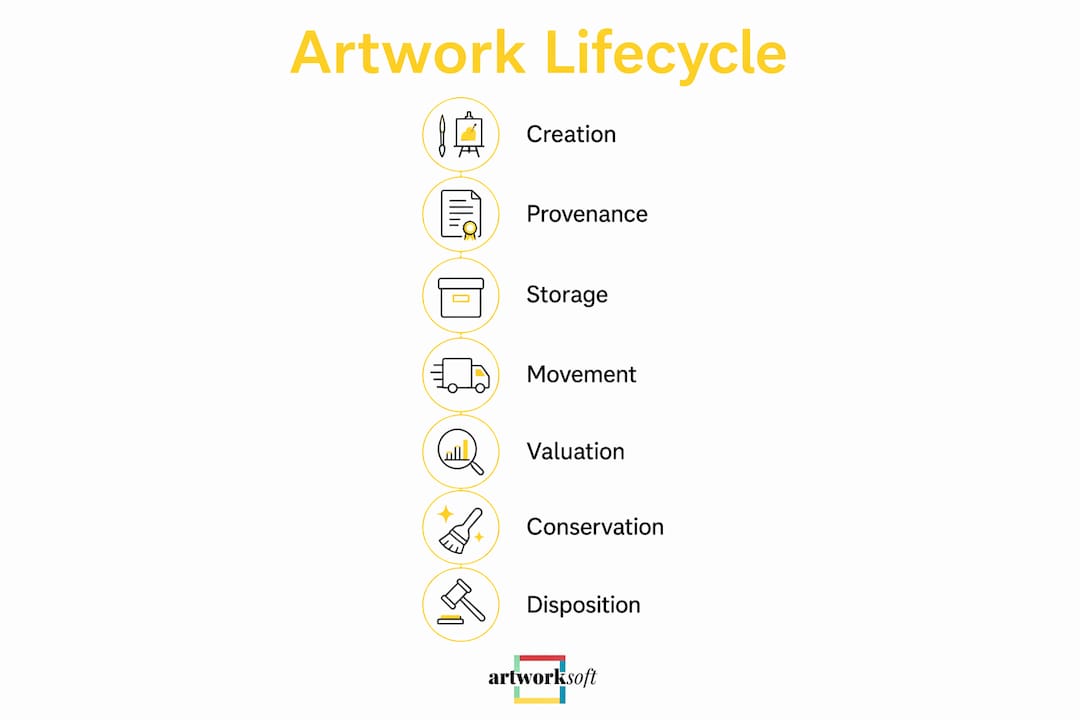
Common weak points appear at provenance and storage. Changes in scholarly opinion or catalogue raisonné updates can materially affect value, and poor environmental management between acquisition and sale quietly erodes it.
What should you document at every stage?
Thorough art documentation is what converts an artwork from a physical object into a defensible asset. The minimum required fields differ by document type.
- Provenance record: Artist name, title, date, medium, dimensions, acquisition date, seller name, purchase price, and any prior ownership history with dates
- Certificate of Authenticity (COA): Artist signature, edition number (if applicable), materials, dimensions, and a statement of originality
- Invoice/acquisition record: Buyer and seller details, agreed price, currency, date, and any conditions of sale
- Appraisal: Appraiser credentials, methodology, effective date, FMV or replacement cost stated separately, and comparable sales cited
- Loan/consignment agreement: Borrower/consignee details, loan period, insurance responsibility, permitted uses, and return condition requirements
For condition reports specifically, capture medium and support materials, measurements, descriptions of any deterioration, previous treatment history, and recommended next interventions. Photograph from multiple angles and include close-up details of any damage using consistent lighting and scale references.
At intake, the responsible party signs the condition report, assigns a unique identifier, names the digital files consistently (ArtistLastName_Title_Year_ConditionReport_YYYYMMDD), and stores master records in a searchable system with off-site backup.
Pro Tip: Digitize physical records immediately at intake. A photograph of a handwritten COA stored in a cloud system is recoverable; a paper document in a storage unit is not.
How do you choose the right valuation method?
Collectors often conflate cost, fair market value, and insurance value. An operational program must record all three separately to avoid insurance gaps and estate reporting errors.
- Fair market value (FMV): The price a willing buyer and willing seller would agree on, with neither under compulsion. Used for estate reporting, charitable donation deductions, and sale planning. Requires an independent qualified appraisal.
- Replacement cost: The cost to acquire a comparable work in the current market. Used for insurance coverage. Typically higher than FMV for unique works.
- Cost basis (accounting cost): The original acquisition price. Recorded on the balance sheet; disclosed separately from FMV for decision-making and reporting.
- Internal/comparative estimate: A market-comparables review using recent auction results. Useful for routine portfolio reviews but not sufficient for IRS reporting or insurance purposes.
For U.S. tax purposes, the IRS requires a qualified appraisal by a qualified appraiser for any non-cash charitable contribution of art valued above certain thresholds. Donations of high-value art require the full appraisal to be attached to the tax return. Always consult current IRS guidance (Publication 561 and Form 8283) and a qualified tax advisor before filing. Artworksoft’s valuation tools support structured documentation of all three value types to keep records audit-ready.
How do you conduct a condition report and prevent value loss?
Condition directly affects valuation, and a systematic reporting process is the primary tool for catching deterioration before it becomes irreversible.
- Establish a baseline: Complete a full condition report at acquisition with dated photographs
- Schedule routine checks: Paintings and works on paper: annually; sculptures and mixed-media: every 6–12 months; high-value or fragile works: every 6 months
- Monitor the environment: Target 65–70°F and 45–55% relative humidity for most media; keep UV-filtered light below 50 lux for works on paper
- Log environmental data: Record temperature, relative humidity, and light levels at each check; flag deviations
- Trigger a conservator review when you observe active flaking, mold, structural instability, or significant color change
- Document before and after any treatment: Photograph under raking light and UV before treatment; repeat immediately after and at 6-month intervals
Pro Tip: Before any conservation treatment, obtain a written treatment proposal from the conservator. That document becomes part of the permanent condition record and protects both parties if the work is later sold or donated.
How do you manage artwork movement and chain-of-custody?
Every location change is a liability event. The Movement & Logistics module in a purpose-built system captures the full chain-of-custody automatically, but the underlying process applies regardless of platform.

| Step | Action Required | Who Signs |
|---|---|---|
| Pre-movement condition check | Full condition report with photographs | Outgoing custodian |
| Packing specification | Written spec approved for medium and distance | Registrar/collections manager |
| Transit insurance | Policy confirmed and certificate issued | Collector/institution + insurer |
| Carrier handoff | Signed receipt with condition notation | Carrier representative |
| Receiving condition check | Condition report compared to outgoing report | Receiving custodian |
| Record update | Location and custody updated in inventory system | Registrar/collections manager |
For domestic moves, allow several weeks lead time for fine art carriers and insurance confirmation. International shipments typically require additional lead time to account for customs documentation, CITES permits where applicable, and import/export licensing. Cost drivers include crating, climate-controlled transport, courier fees, and insurance premiums, which typically scale with declared value.
What U.S. legal, tax, and insurance rules apply to art?
Art as an asset carries specific legal and tax obligations in the United States that differ from most other asset classes.
- Charitable donations: A qualified appraisal is required for deductions above $5,000; works above $20,000 require the appraisal attached to Form 8283. Consult IRS Publication 561 for current thresholds and appraiser qualification standards.
- Estate reporting: Art must be included in the gross estate at FMV on the date of death. The IRS may challenge estate valuations; a contemporaneous independent appraisal is the primary defense.
- Insurance: Replacement cost coverage is standard for fine art; scheduled coverage on individual works avoids blanket-policy sub-limits. Review coverage annually as market values shift.
- Cultural property and restitution: Works acquired after 1970 should carry documented provenance that confirms no illicit export under the UNESCO Convention. The Association for Research into Crimes against Art (ARCA) and the Art Loss Register are practical due-diligence resources.
- Sales tax: Rules vary by state. In many U.S. states, art sold by a gallery is subject to sales tax; resale certificates and exemptions differ by jurisdiction. Confirm with a state tax advisor.
This article is general information, not legal or tax advice. Confirm current rules with the IRS, a qualified appraiser, and a licensed attorney for your specific situation.
Who is responsible for what in a lifecycle program?
| Role | Primary Responsibilities |
|---|---|
| Artist | COA issuance, studio records, edition documentation |
| Collector | Acquisition records, insurance, valuation updates, estate planning |
| Registrar/Collections Manager | Inventory, condition reports, loan agreements, movement records |
| Conservator | Condition assessments, treatment proposals and reports |
| Appraiser | FMV and replacement cost appraisals, IRS-compliant documentation |
| Insurer | Policy scheduling, transit coverage, claims handling |
| Logistics Provider | Packing, transport, climate control, carrier documentation |
Essential policies for any institution or serious private collection: an accession/deaccession policy, a loan policy with facility report requirements, a condition reporting schedule, an access control protocol, and a written disaster response plan that identifies off-site storage and recovery priorities.
How do you implement a lifecycle program in 90 days?
| Phase | Tasks | Duration | Owner |
|---|---|---|---|
| Pilot | Select some works; create provenance + condition records; choose software | a month | Collector/Registrar |
| Digitization | Photograph all pilot works; upload to system; assign unique IDs | a month | Registrar/Photographer |
| Scale | Extend to full collection; set monitoring schedule; confirm insurance | a month | Registrar/Insurer |
| 12-Month | Governance policies; staff training; first annual condition review | Months 4–12 | Director/Registrar |
Rough cost ranges for a private collection of 50–200 works:
- Software: Purpose-built art inventory platforms range from no-cost entry tiers to several hundred dollars per year for professional features
- Photography/digitization: $25–$75 per work for professional art photography
- Conservation assessments: $150–$400 per work for a written condition report from a conservator
- Insurance uplift: Varies by declared value; budget 0.1–0.5% of total insured value annually
- Appraisal fees: $150–$350 per hour for a qualified appraiser; most collections require 4–8 hours for a written report
Artworksoft puts the lifecycle playbook into practice
Collections that have moved from spreadsheets and paper files to a dedicated system consistently report faster transaction readiness and fewer documentation gaps at the point of sale. Artworksoft is built specifically for this transition, mapping directly to every stage of the lifecycle described above.

The platform’s documentation workflows generate COAs, condition reports, and provenance logs in formats accepted in auction, private sale, and institutional reporting contexts. The Movement & Logistics module captures signed chain-of-custody records and location history automatically. The structured valuation formula records cost basis, FMV, and replacement cost as separate fields, keeping the three values distinct and audit-ready. For a small gallery managing 80 works across two locations, that separation alone eliminates a common source of insurance under-coverage.
Start a free inventory today, or review the full artwork management services to find the right implementation path for your collection.
Key Takeaways
Effective art lifecycle management requires separating cost basis, fair market value, and replacement cost from day one, then maintaining documentation at every stage that supports that distinction.
| Point | Details |
|---|---|
| Start with one record | Create a combined provenance and condition record for your highest-value work today. |
| Keep three values separate | Record cost basis, FMV, and replacement cost as distinct fields to avoid insurance and estate errors. |
| Document every movement | A signed chain-of-custody record at each handoff is the primary defense against custody disputes. |
| Schedule condition checks | Annual checks for most media; every 6 months for high-value or fragile works. |
| Artworksoft operationalizes the playbook | The platform’s documentation, valuation, and movement modules map directly to each lifecycle stage. |
Why lifecycle discipline changes how you think about art
The most persistent mistake in art ownership is treating documentation as an afterthought, something to assemble when a sale or donation is already in motion. By that point, provenance gaps are expensive to close and sometimes impossible to resolve. The collections that transact most efficiently are the ones where every record was created at the moment of acquisition, not reconstructed years later.
What fine-art advisors consistently emphasize is that lifecycle discipline matters more to long-term outcomes than the purchase price paid. A work bought at a premium with complete documentation, current condition reports, and a clean chain-of-custody is a more liquid asset than a comparable work bought at a discount with a thin file. That is not a philosophical point; it is a practical one that shows up in buyer confidence, insurance terms, and net proceeds at sale.
Artworksoft’s integrated approach, combining documentation templates, movement tracking, and structured valuation, gives collectors and institutions the operational infrastructure to maintain that discipline without the administrative burden that causes most programs to lapse.
Authoritative sources and further reading
| Resource | Relevance |
|---|---|
| Artworksoft Art Documentation | Templates and workflows for COAs, condition reports, and provenance logs |
| Artworksoft Valuation Methods Guide | Explains FMV, replacement cost, and cost basis with practical guidance |
| Artworksoft Condition Impact Guide | How condition affects value and what to document at each stage |
| Artworksoft Movement & Logistics | Chain-of-custody tracking and movement record features |
| Artworksoft Digital Archiving | File management and long-term records retention guidance |
| IRS Publication 561 & Form 8283 | Current U.S. rules for art donation appraisals and reporting thresholds |
| AAM (American Alliance of Museums) | Museum accreditation standards and collections management policy templates |
| UNESCO 1970 Convention | Baseline standard for provenance due diligence on cultural property |
For legal and tax decisions, confirm current IRS thresholds and cultural property rules directly with the IRS and a qualified attorney before acting. Museum professionals building institutional policy should consult AAM accreditation criteria alongside the lifecycle framework above.











