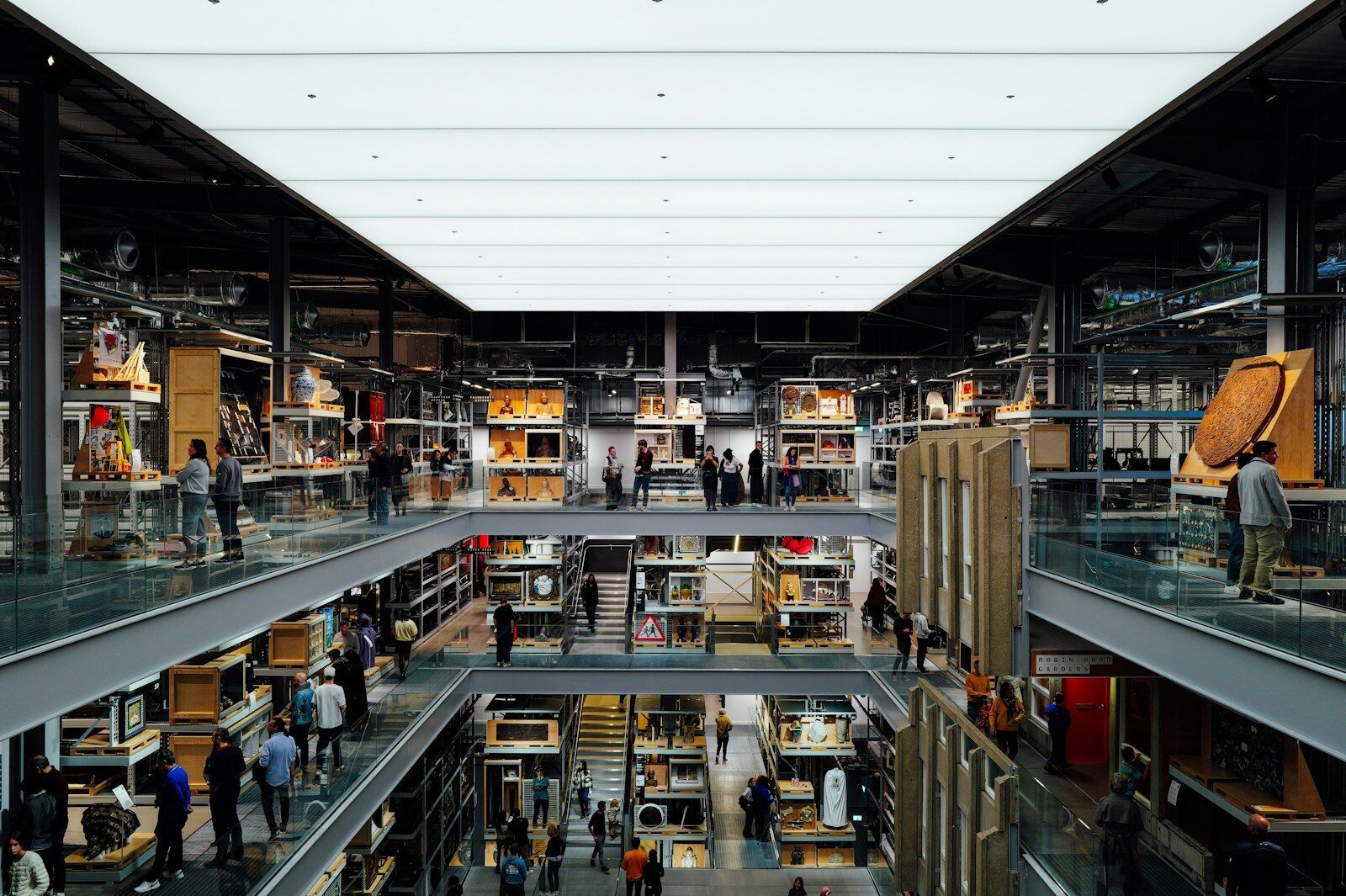

A museum collection is a deliberately managed, documented, and conserved set of artworks or artifacts held in trust for long-term preservation and access. The immediate first step for any artist, collector, or gallery: write a one-page collection policy and run a baseline inventory so every object has an accession record before anything else changes hands, moves, or deteriorates.
Scale puts the standard in perspective. The National Museum of American History manages over 1.7 million objects and 22,000 linear feet of archival documents. Cooper Hewitt’s design holdings exceed 215,000 objects spanning six continents and thirty centuries. Private collections do not need that volume to benefit from the same discipline — they need the same structure, applied at a proportionate scale.
Table of Contents
- What does a museum-caliber collection actually require?
- How to write a one-page collection policy
- How should you catalog and accession each object?
- What environmental controls actually protect your collection?
- Valuation, insurance, and legal basics for U.S. collectors
- What does collection setup realistically cost and how long does it take?
- How do you build an emergency plan for your collection?
- What do loan agreements and exhibition prep require?
- Which software features does a collection management system need?
- Key Takeaways
- The gap most private collectors never close
- Artworksoft brings museum-grade collection management within reach
- Useful sources and further reading
What does a museum-caliber collection actually require?
Every professionally managed collection, regardless of size, rests on the same structural elements. Miss one, and the gaps compound over time.
- Collection policy: A written document defining scope, acquisition criteria, deaccession rules, and ethics. Without it, collecting decisions are ad hoc.
- Accessioning: Assigning a unique, permanent identifier to each object the moment it enters the collection.
- Catalog and metadata: A searchable record for each object covering creator, medium, dimensions, provenance, and location.
- Provenance records: Documented ownership history from creation to present. Gaps reduce value and create legal exposure.
- Condition reports: Baseline and periodic assessments of physical state, with photographs.
- Conservation plan: Written protocols for environmental controls, handling, and treatment priorities.
- Storage standards: Appropriate shelving, housing materials, and climate management.
- Loans policy: Terms governing outbound and inbound loans, including insurance and condition requirements.
- Insurance and valuation: Scheduled coverage tied to current appraised values.
- Digitization: Off-site-backed digital records for every object, image, and document.
The Smithsonian notes that most of its collection is not on public display, which underlines why storage, tracking, and regular inventories matter as much as exhibition planning.
How to write a one-page collection policy
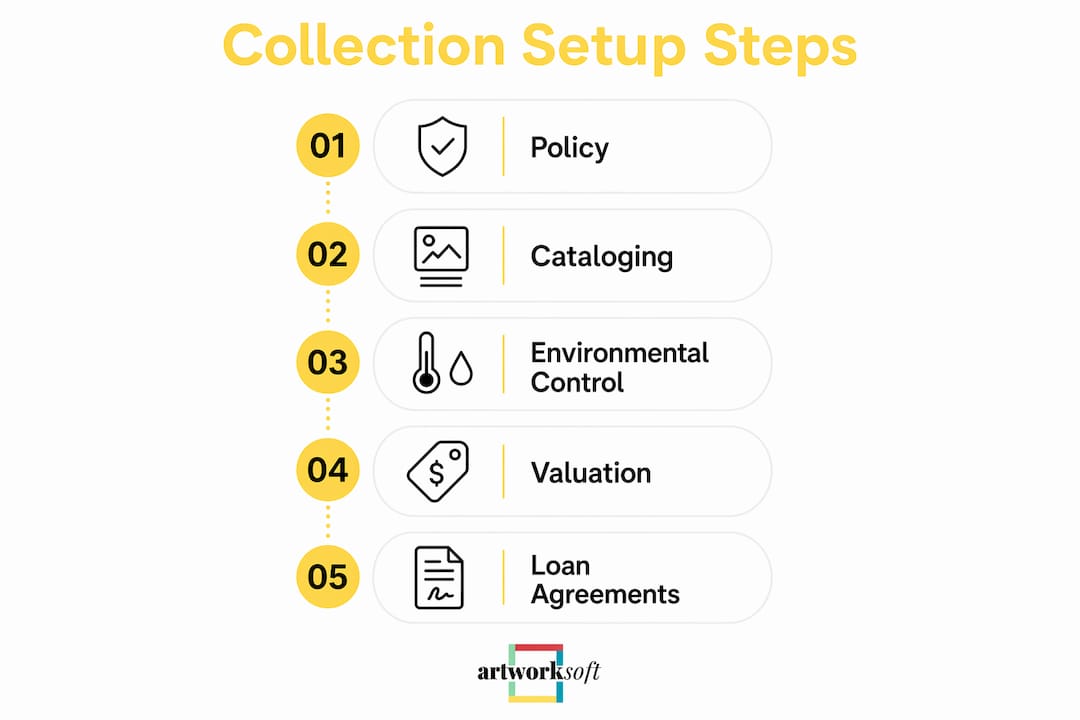
A policy does not need to be long. One page with nine defined sections is enough to govern most private collections and galleries.
| Policy Section | What to Include | Why It Matters |
|---|---|---|
| Mission & scope | Medium, period, geography, and size limits | Prevents scope creep and guides every acquisition decision |
| Collecting criteria | Quality, condition, provenance, and relevance thresholds | Sets a defensible standard for acceptance or rejection |
| Acquisition sources | Purchases, gifts, bequests, exchanges | Defines acceptable channels and flags conflict-of-interest risks |
| Deaccession rules | Conditions for removal, approved disposal methods | Protects against arbitrary or ethically problematic disposals |
| Ethics & conflicts | Disclosure requirements, cultural property standards | Aligns with AAM guidelines and U.S. import/export law |
| Loans policy | Borrower eligibility, insurance minimums, condition requirements | Protects objects and limits liability |
| Access & use | Who may view, handle, or reproduce collection objects | Manages rights and physical risk |
| Documentation & records | Required fields, record retention period, backup protocol | Ensures records survive personnel changes |
| Emergency priorities | Ranked list of objects to move first in a disaster | Saves the highest-value and most irreplaceable items |
The Whitney Museum’s collecting mission, built around intentional curatorial framing, is a useful model: every acquisition decision reflects what the institution believes should be preserved and why. Private collectors benefit from the same clarity.
Pro Tip: Set a hard collecting limit in your policy — a maximum number of objects or a dollar ceiling per year. It forces prioritization and prevents the storage and documentation backlog that undermines most private collections within five years.
How should you catalog and accession each object?
Thorough records are the difference between a documented asset and an undocumented liability. The Texas Historical Commission specifies that professional standards require acquisition history, accession number, catalog entry with photograph, condition records, conservation treatments, and location tracking.
| Metadata Field | Format / Example | Notes |
|---|---|---|
| Accession number | year.acquisition.item | Unique, permanent, never reused |
| Acquisition date & source | March 2026 / purchased at auction | Links to invoice or deed of gift |
| Title | Untitled (Red Study) | Use artist’s title; note if assigned |
| Creator | Last, First (birth–death, nationality) | Use Getty ULAN format where possible |
| Dimensions | H × W × D in inches and centimeters | Measure without frame; note frame separately |
| Medium & support | Oil on linen | Specific, not generic (“oil painting”) |
| Provenance summary | Three-line ownership chain | Flag any gap with “provenance incomplete” |
| Condition summary | Good / Fair / Poor + one-line note | Ties to full condition report on file |
| Current location | Storage Room B, Shelf 3 | Update every time the object moves |
| Rights & reproduction | © Artist Name, all rights reserved | Note any licensing agreements |
The accession number is the single critical identifier linking the physical object to its permanent record. Apply it unobtrusively — a small archival label on a non-primary surface — record it in the catalog immediately, and never reuse a number even if an object leaves the collection. Artworksoft’s artwork profile management structures these fields into a single digital record, reducing the risk of incomplete entries.
Pro Tip: Photograph every object from six angles — front, back, both sides, top, and a detail of any signature or damage — before the object moves or is treated. Those images are your conservation baseline and your insurance evidence.
What environmental controls actually protect your collection?
All objects deteriorate without active mitigation. The question is how fast. Environmental controls are the highest-leverage, lowest-cost intervention available to most collectors.
Target ranges for general mixed collections: temperature 65–70°F with fluctuation under 5°F per day; relative humidity 45–55% with daily swings under 5%. Light-sensitive works on paper and photographs require under 50 lux of visible light and zero ultraviolet exposure. Oil and acrylic paintings tolerate up to 150–200 lux but still need UV filtration on windows and display cases.
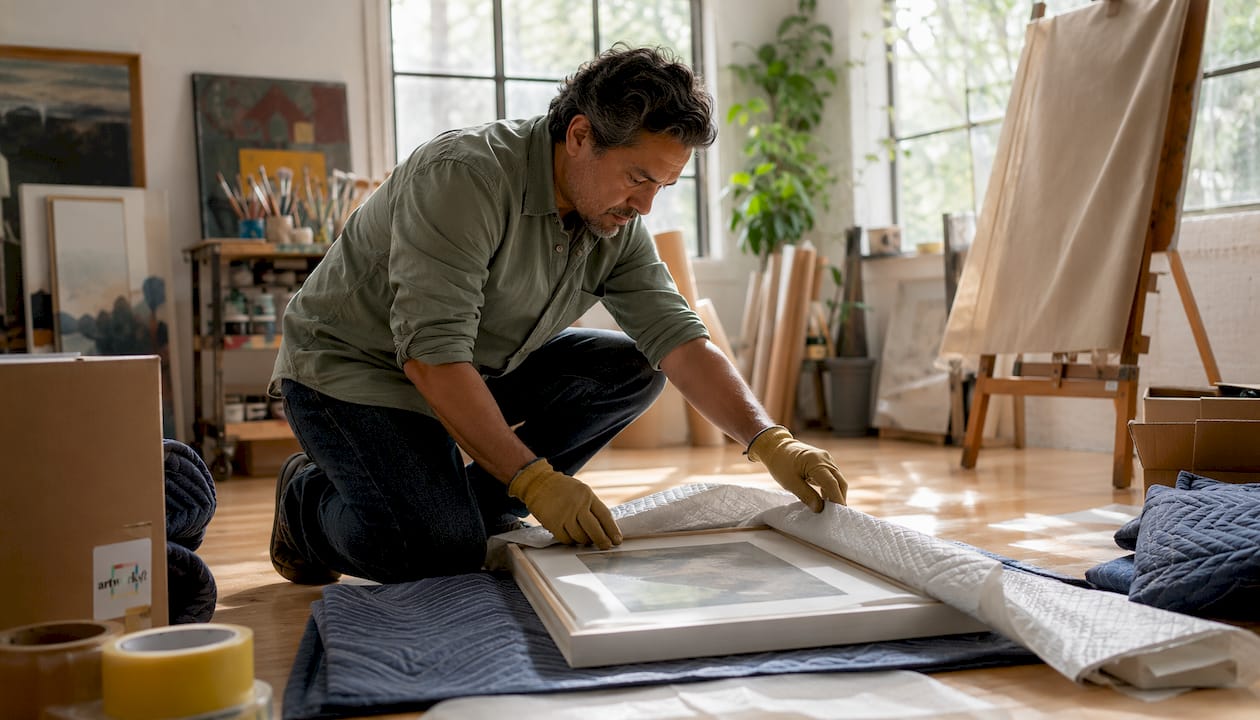
Storage best practices follow directly from THC preservation guidance: avoid wood shelving entirely, which outgasses acids onto stored objects. Use coated steel or anodized aluminum shelving lined with acid-free barrier paper. House objects in acid-free boxes, tissue, and folders. Keep everything off the floor — at minimum six inches — to protect against water intrusion and pest access. Conduct quarterly pest monitoring using sticky traps at entry points and storage perimeters.
Harvard’s renovation of the Glass Flowers gallery illustrates the long-term calculus: the museum rebuilt display cases and modernized climate control to protect 4,300 glass models representing 780 plant species. A single investment in climate infrastructure consistently outperforms years of reactive small repairs.
Pro Tip: A data-logging thermohygrometer ($50–$150) placed in each storage zone gives you a continuous record of environmental conditions. That log is evidence for insurance claims and conservation decisions.
Valuation, insurance, and legal basics for U.S. collectors
Documentation directly affects what an appraiser can say and what an insurer will pay. Three valuation methods apply to most U.S. collections:
- Comparative market analysis: Recent auction and private sale results for comparable works by the same artist. Most useful for artists with an active secondary market.
- Replacement cost: The cost to acquire a comparable object at current market prices. Standard for insurance scheduling.
- Expert appraisal: A written opinion from a qualified appraiser (ASA or AAA credentialed) based on physical examination and market research. Required for donations, estates, and major insurance claims.
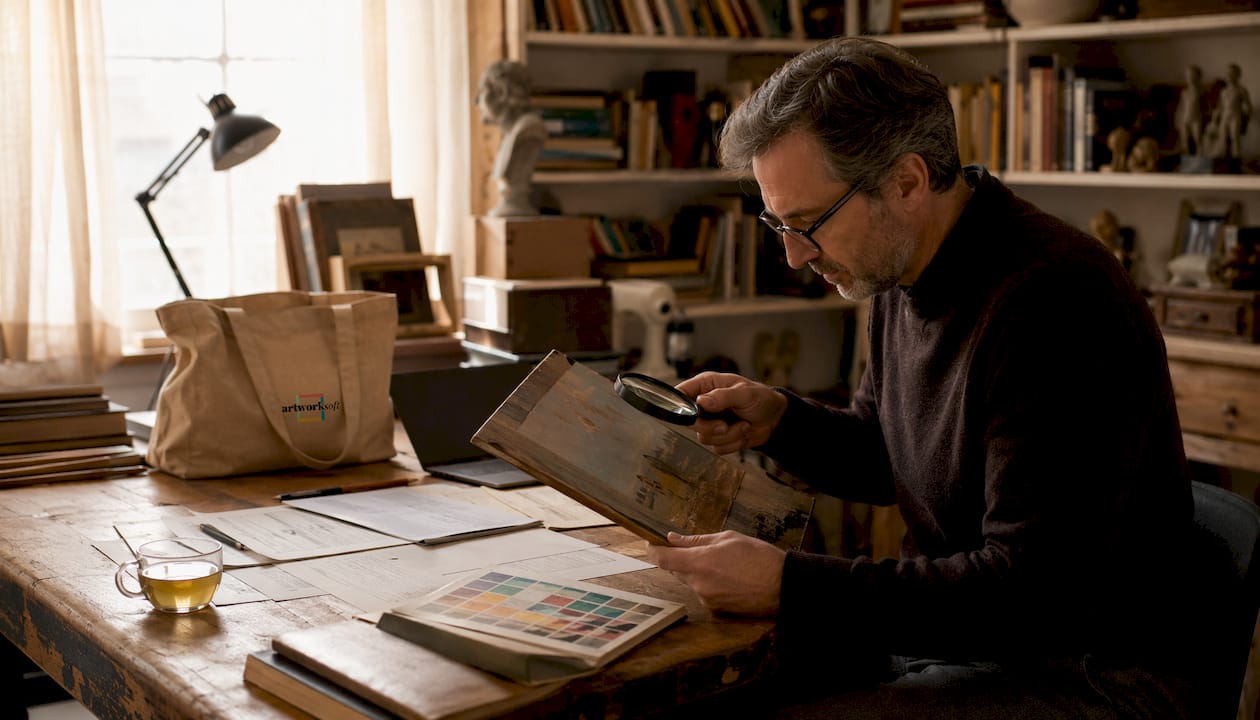
Provenance and condition affect outcomes materially. A work with a complete, documented ownership chain and a clean condition report commands a higher appraised value than an identical work with gaps. Authentication affects price in the same direction — documented authentication can shift an appraised figure significantly.
For insurance, U.S. collectors typically use one of three structures: a scheduled fine art floater added to a homeowner’s or commercial policy; a standalone collections policy for larger holdings; or transit coverage for works in movement. Underwriters generally require a current appraisal (within three to five years), a photographic record, and a written inventory. The artwork condition’s impact on valuation is a documented factor underwriters weigh when setting premiums and settlement limits.
Legal notes: title must be clear and documented before acquisition. Loans create temporary liability — specify insurance responsibility in every loan agreement. Works acquired after 1970 require provenance review under U.S. cultural property law.
What does collection setup realistically cost and how long does it take?
| Phase | Timeline | Approximate Cost Range | Key Activities |
|---|---|---|---|
| Baseline inventory | Week 1–2 | — | Photograph and list every object; assign temporary numbers |
| Cataloging & digitization | Month 1–3 | — | Enter full metadata, scan documents, set up software |
| Conservation triage | Month 3– | — | Conservator assessment of highest-risk works |
| Environmental controls | Month 3– | — | Data loggers, shelving upgrades, UV film |
| Ongoing annual maintenance | Recurring | —/year | Software subscription, quarterly checks, conservator visits |
Staffing a collection does not require full-time hires at the outset. An owner or manager sets policy and approves acquisitions. A registrar (part-time or contracted) handles accessioning, location updates, and loan paperwork. A conservator consults on treatment and environmental targets. A photographer documents new acquisitions and condition changes. Volunteers can assist with data entry under registrar supervision, provided they receive a two-hour handling and documentation training session before touching any object.
How do you build an emergency plan for your collection?
A written emergency plan, reviewed annually, is the difference between controlled salvage and chaotic loss.
- Contact list: Conservator, insurer, local fire and police non-emergency lines, and a trusted colleague who can assist on-site.
- Record location: Store a printed copy of your inventory and insurance documents off-site and in a fireproof box on-site. Digital backups should exist in at least two locations: an encrypted cloud service and a local encrypted drive stored separately from the collection.
- Salvage priority list: Rank objects by irreplaceability and value, tied directly to accession numbers. The top 10% of the collection by value should have a dedicated move-to-safety plan.
- Basic salvage steps by material: Remove water with clean blotting paper for works on paper; do not attempt to open wet books. Move paintings face-up on padded surfaces. Photograph damage before moving anything if conditions allow.
- Post-incident documentation: Photograph all damage immediately. Notify your insurer within 24 hours. Do not discard any damaged material before the adjuster inspects it.
Review and update the plan every January, and after any significant acquisition or storage change.
What do loan agreements and exhibition prep require?
Every outbound or inbound loan needs a written agreement before the object moves. The agreement must specify the loan term, the borrowing institution’s insurance obligation (typically wall-to-wall coverage at the lender’s stated value), packing and transport responsibilities, and reproduction rights.
Condition reports are required at three points: before packing, on arrival at the borrowing venue, and on return. Any new damage noted on return triggers an insurance claim process. The borrower bears responsibility for damage that occurs during their custody.
Pro Tip: Require a facilities report from any borrowing institution before approving a loan. It documents their environmental controls, security, and fire suppression systems. Lenders who skip this step have no recourse if conditions at the borrowing venue cause damage.
Chain-of-custody recording — a signed receipt at every transfer point — is the practical mechanism that makes loan agreements enforceable. Artworksoft’s movement and logistics tracking logs each transfer with date, location, and responsible party, creating an auditable chain without manual paperwork.
Which software features does a collection management system need?
A capable system for artists, collectors, and galleries must cover these functions:
| Feature | Purpose | Artworksoft Implementation |
|---|---|---|
| Accessioning module | Assign and track unique object identifiers | Structured accession records with auto-numbering |
| Photo & document attachments | Store condition images, invoices, appraisals | Multi-image upload per artwork profile |
| Condition reporting | Record and compare physical state over time | Condition fields with date-stamped entries |
| Provenance tracking | Document ownership chain | Provenance history field per artwork |
| Location tracking | Know where every object is at all times | Movement log with location and date |
| Valuations module | Record appraised and market values | Structured valuation formula with supporting fields |
| Exportable reports | Generate insurance schedules and asset reports | Asset reports exportable for insurers and appraisers |
| Certificates of Authenticity | Professional documentation for transactions | Built-in CoA generation |
| User permissions & audit trail | Control access and track changes | Role-based access with change history |
Templates to adopt immediately: an accession template (fields from the catalog table above), a condition report form (six-angle photo set plus written assessment), a loan agreement checklist, and a one-page collection policy using the table in Section 3.
Pro Tip: Run a full digital archive export quarterly and store it off-site. Software platforms change; your records must be portable.
Key Takeaways
A professionally managed collection requires a written policy, a complete accession record for every object, stable environmental conditions, and digitized records backed up off-site — all of which can be implemented incrementally without institutional-scale resources.
| Point | Details |
|---|---|
| Policy first | Write a one-page collection policy before acquiring or moving any object. |
| Accession every object | Assign a unique, permanent accession number to each work and link it to a full catalog record. |
| Stabilize the environment | Target 65–70°F and 45–55% relative humidity; use coated steel shelving and acid-free housing materials. |
| Digitize and back up | Maintain encrypted digital records in at least two locations; export a full archive quarterly. |
| Use Artworksoft | Artworksoft maps accessioning, valuation, condition reporting, movement tracking, and CoA generation into a single workflow for artists, collectors, and galleries. |
The gap most private collectors never close
The most consistent failure in private collection management is not a lack of care — it is a lack of records at the moment of acquisition. Objects arrive, get placed, and get loved, but the accession record never gets written. Six months later, the provenance is fuzzy, the condition baseline is gone, and the insurance value is a guess.
Institutional collections like the Smithsonian and Cooper Hewitt demonstrate that scale is not what makes a collection professionally managed. Discipline at the point of entry is. The accession record written the day an object arrives is worth more to a future appraiser or lender than any amount of retrospective documentation. Staff and volunteer training should reinforce exactly one rule above all others: nothing enters the collection without a record.
Artworksoft brings museum-grade collection management within reach
For artists, collectors, and galleries who want museum-quality records without building a registrar’s office from scratch, Artworksoft delivers the core workflow in a single platform. Where traditional approaches require separate spreadsheets, filing systems, and manual reports, Artworksoft connects art inventory records, condition documentation, provenance history, movement logs, and valuation data in one place.
A typical workflow: create an accession record, attach six-angle photographs and a condition report, record the provenance chain, assign a valuation, and generate a Certificate of Authenticity and an asset report for your insurer — all without leaving the platform. Artworksoft’s structured valuation formula removes the guesswork from pricing, and its movement tracking creates the chain-of-custody log that loan agreements require.
Start a free account at Artworksoft or review the full documentation and asset workflow to see how the platform maps to the standards covered in this guide.
Useful sources and further reading
Primary references used throughout this guide, organized by the topic they best support:
- Storage and handling standards: Quick Guide to the Preservation of Artifacts, Texas Historical Commission — the primary U.S. source for shelving, acid-free materials, accession number protocols, and documentation checklists.
- Institutional scale and collection scope: Collections, National Museum of American History, Smithsonian Institution — reference for understanding professional collection standards and the scale of ongoing inventory work.
- Design collection model and acquisition ethics: Design Across Time, Cooper Hewitt, Smithsonian Design Museum — useful for collection policy framing and curatorial ethics.
- Long-term conservation investment: Glass Flowers, Harvard Museum of Natural History — case study on environmental controls and case renovation for fragile collections.
- Curatorial mission and collecting intent: Collection View: Louise Nevelson, Whitney Museum of American Art — illustrates how a defined collecting mission shapes what is preserved and why.