

Blue chip artists are established, institutionally validated creators whose works consistently command top auction prices, trade with high frequency, and hold or appreciate in value across market cycles. The term borrows directly from financial markets, where “blue chip” denotes a stock of proven stability and broad institutional ownership. In the art world, the same logic applies: these are artists whose market credibility has been tested across decades, auction houses, and museum retrospectives.
The canonical roster includes Jean-Michel Basquiat, Andy Warhol, Pablo Picasso, Yayoi Kusama, Jeff Koons, Banksy, Damien Hirst, David Hockney, and Keith Haring. Each appears regularly at Christie’s, Sotheby’s, and Phillips, commands documented institutional holdings, and generates consistent secondary-market demand regardless of broader economic conditions.
For collectors and investors, that combination of liquidity, institutional validation, and price resilience is what separates investment-grade artwork from everything else in the market.
Key Takeaways
Blue chip artists are the most institutionally validated, liquid, and price-resilient segment of the global art market, and protecting their value requires professional documentation as much as careful acquisition.
| Point | Details |
|---|---|
| Definition of blue chip | Established artists with auction liquidity, museum holdings, and consistent secondary-market performance across cycles. |
| Top evaluation metrics | Prioritize liquidity (lots per year) and performance against estimate over single headline sales, per Sotheby’s multi-metric framework. |
| Market resilience in 2025 | Global art sales rose 4% to an estimated $59.6 billion; the high-end segment was the strongest performer, per Art Basel & UBS. |
| Carrying costs matter | Insurance, storage, condition reports, and transaction fees can reduce net annual returns by 0.5%–1.5% of appraised value. |
| Artworksoft for collection management | Artworksoft centralizes provenance, Certificates of Authenticity, movement logs, and AI-assisted valuation for audit-ready blue chip records. |
What makes an artist qualify as blue chip?
Blue chip status is not a single metric. Sotheby’s top 50 artist analysis combines sales value, liquidity, average prices, performance against estimate, and market momentum to assess market power — a multi-factor approach that any serious collector should replicate. Here is the checklist specialists use:
- Auction headline sales. Works have achieved significant, documented results at major auction houses. Check Christie’s published sale results and Sotheby’s for verified price histories.
- Liquidity (lots per year). A blue chip artist’s works appear at auction regularly, typically dozens to hundreds of lots annually across global sales. Thin supply signals illiquidity, not scarcity.
- Performance against estimate. Works consistently sell at or above their pre-sale low estimates. Chronic underperformance is a red flag even when headline totals look impressive.
- Museum holdings and retrospectives. Major institutions — MoMA, the Tate, the Guggenheim, the Whitney — hold works in their permanent collections and have mounted solo retrospectives.
- Gallery or estate representation. Active representation by a top-tier primary market gallery (Gagosian, Hauser & Wirth, Pace) or a professionally managed estate signals ongoing market stewardship.
- Catalog raisonné or authoritative scholarship. A published catalog raisonné is the gold standard for authentication and provenance. Its absence is a material risk for high-value purchases.
- Secondary-market consistency. Price appreciation or stability across multiple market cycles, not just one peak year, distinguishes durable blue chip value from a single speculative run.
- Institutional demand. Foundations, corporate collections, and public institutions actively acquire the artist’s work, creating a structural floor under prices.
Pro Tip: Liquidity and performance against estimate carry more predictive weight than one-off headline sales. An artist whose works sell 80% above low estimate across 50 lots per year is a more reliable blue chip signal than one whose single record sale dominates the narrative.
U.S. collectors should also note that capital gains tax treatment and sales documentation requirements apply when buying or selling high-value works; consult a qualified tax advisor and review U.S. art case law considerations before transacting.
How does blue chip differ from red chip and emerging art?
The three tiers behave very differently in terms of price stability, holding period, and buyer expectations.
Blue chip artists are stable, highly liquid, and institutionally validated. Their works trade across multiple auction houses and geographies, attract institutional buyers, and carry well-documented provenance. Volatility is lower, but entry prices are high and transaction costs (buyer’s premium, insurance, storage) are material.
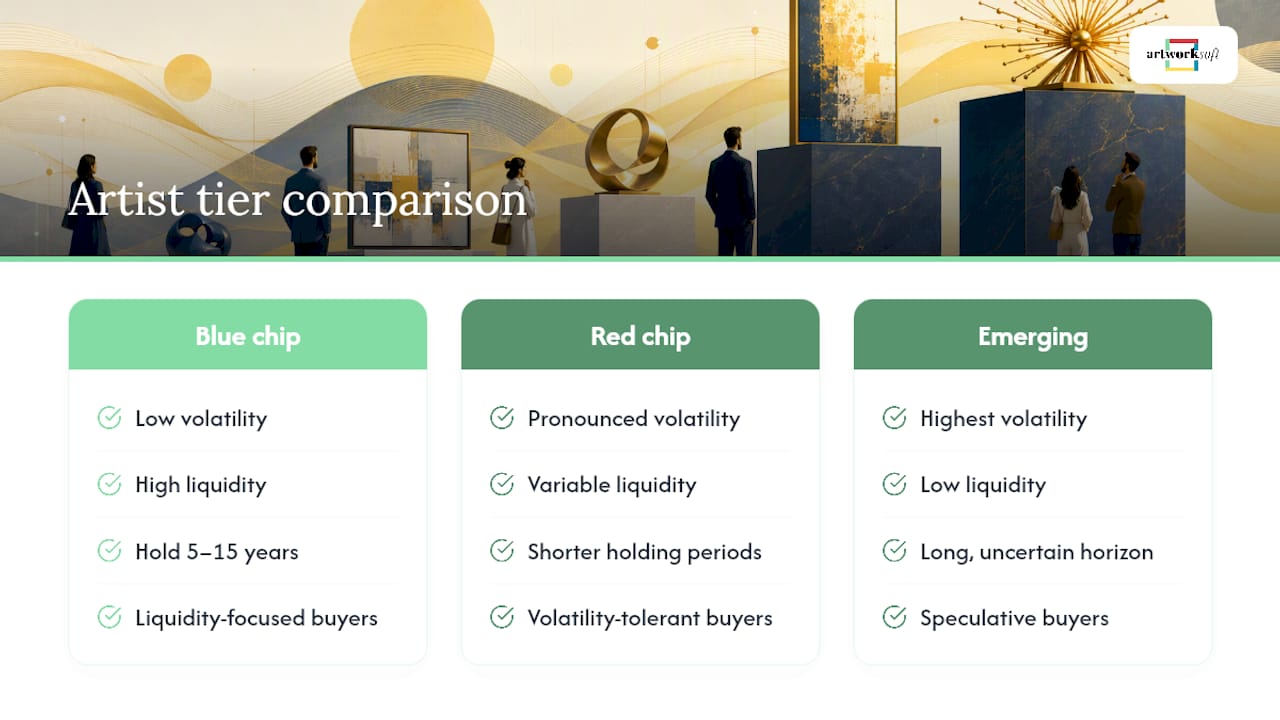
Red chip artists occupy a middle tier: high demand, often driven by gallery momentum or collector speculation, but without the decades of institutional validation that anchor blue chip prices. Their markets can move sharply in both directions. Holding periods tend to be shorter, and liquidity can evaporate faster than the hype suggests.
Emerging artists represent the earliest stage: higher potential upside, but also the highest risk of market failure. Museum acquisition and gallery representation are nascent or absent, auction records are thin, and provenance documentation is often incomplete.
Buyer expectations differ accordingly. Blue chip collectors typically hold works for five to fifteen years, budget explicitly for carrying costs, and prioritize liquidity at exit. Red chip buyers accept more volatility in exchange for potential appreciation. Emerging art buyers treat purchases as speculative positions with a long and uncertain horizon.
Representative blue chip artists collectors should know
The artists below represent the core of the established artists market across Modern, Postwar, and Contemporary categories. Each qualifies on the multi-metric framework above: sustained auction performance, major institutional holdings, and active gallery or estate management.
Yayoi Kusama’s position illustrates how methodology shapes rankings. Hiscox data reported by Japan Times showed Kusama as the highest-grossing contemporary artist for the measured period, with $80.9m in auctioned works. That figure reflects a specific sample window; her long-term auction consistency and institutional depth are what confirm blue chip status, not any single year’s total.
Damien Hirst’s trajectory from Young British Artist to blue chip name is a case study in how sustained institutional exposure builds market permanence. His Gagosian representation and the global recognition of his Spot paintings and Natural History series have created the kind of body of work recognition that underpins durable collector demand.
What recent market reports say about blue chip resilience
The blue chip segment has been the most resilient driver of global art sales through recent market cycles. The Art Basel & UBS Art Market Report 2026 found that global art sales increased year-on-year in 2025 to an estimated $59.6 billion, with public auction sales above $10 million increasing and dealer and auction improvements concentrated in high-end works. Collectors migrated toward historically validated trophy assets during periods of volatility, reinforcing the structural advantage of established names over speculative positions.
Art Basel’s trend analysis documents a structural rebalancing toward established artists and older market sectors in 2025. Dealers focused on Old Masters and Modern art saw value growth, while female artist representation in primary market galleries improved significantly — a meaningful shift in how the institutional market defines the blue chip canon going forward.
ArtTactic’s Global Art Market Outlook 2026 frames the broader recovery as anchored by trophy assets, with forward-looking forecasts pointing to continued price support at the high end and selective softness in mid-tier segments. For collectors assessing blue chip exposure, the macro signal is consistent: institutional demand for validated names remains structurally strong.
Four trends are worth monitoring in 2026:
- Structural rebalancing to established artists: Old Masters and Modern art gained market share relative to speculative contemporary names.
- Growing institutional demand: Museum acquisitions and corporate collections continue to absorb high-quality blue chip supply.
- Improved gender representation: Female artists are gaining primary market parity, expanding the pool of candidates for future blue chip status.
- Transparency and provenance expectations: Buyers increasingly require verified documentation, raising the bar for sellers who have not maintained professional records.
How collectors and investors use blue chip works
Collectors acquire blue chip works for three primary reasons: wealth preservation, portfolio diversification, and institutional cachet. The liquidity profile of a Warhol or a Picasso is materially better than that of most speculative art, and the museum-loan and lending possibilities add non-financial value that emerging works cannot replicate.
The benefits are real, but so are the costs and risks. The Art Newspaper’s coverage of the Art Basel & UBS findings notes that rising market transparency has increased buyer demand for verified provenance and digital documentation. Collectors who cannot produce clean records face devaluation at the point of sale.
Benefits:
- Lower price volatility relative to speculative or emerging art
- Easier resale through established auction channels and dealer networks
- Museum loan opportunities that build provenance and public profile
- Institutional prestige that supports estate and inheritance planning
Risks:
- Forgery and misattribution, particularly for artists with incomplete catalogs raisonnés
- Provenance gaps that surface during due diligence and reduce buyer confidence
- Market manipulation through coordinated buying or artificial price support
- Concentrated exposure to a single artist or period
Carrying cost checklist:
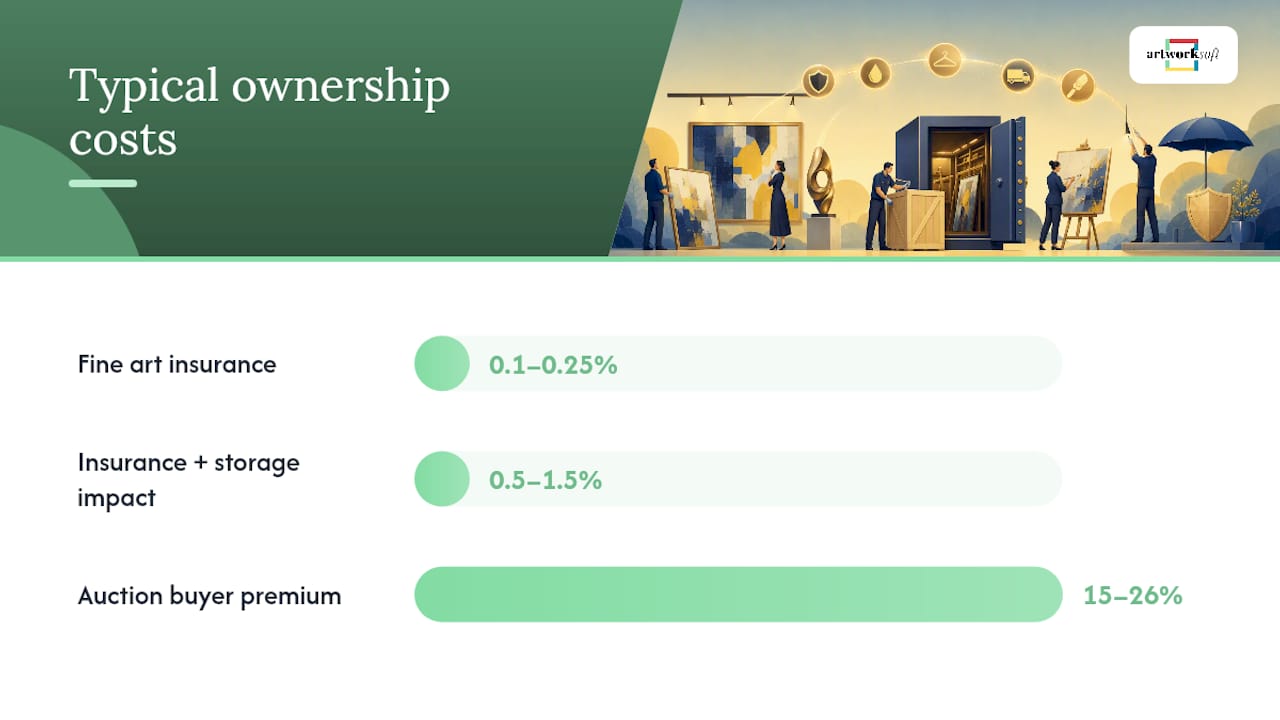
- Fine art insurance (typically 0.1%–0.25% of appraised value annually)
- Climate-controlled storage or installation costs
- Periodic condition reports and conservation treatments
- Authentication fees when provenance is questioned
- Auction house buyer’s premium (typically 15%–26% of hammer price)
- U.S. capital gains tax on sale proceeds, plus potential estate tax implications for high-value holdings — see art inheritance and estate planning guidance for collector-specific considerations
Pro Tip: Factor total cost of ownership into any ROI calculation before acquiring a blue chip work. Insurance and climate-controlled storage alone can reduce net annual returns by 0.5%–1.5% of appraised value, depending on the work’s size, medium, and location.
Understanding how artwork condition affects valuation is equally important: a work with condition issues can trade at a significant discount even when the artist’s market is otherwise strong.
How to evaluate whether an artist or work is blue chip
Use this sequence of checks before committing capital to any work presented as investment-grade.
- Run the auction history. Search Christie’s, Sotheby’s, and Phillips for the artist’s name. Look for consistent results across multiple years and sale categories, not just one record-breaking lot.
- Measure liquidity. Count the number of lots offered and sold per year across all major auction houses. Fewer than ten lots annually is a thin market; fifty or more signals genuine liquidity.
- Check performance against estimate. A healthy blue chip market shows works selling at or above their low pre-sale estimates in the majority of auctions. Use Artprice or Artnet databases to pull sell-through rates and estimate performance over time.
- Verify institutional holdings. Search the permanent collection databases of MoMA, the Whitney, the Tate, the Guggenheim, and the Smithsonian. Institutional ownership is one of the strongest independent validators of blue chip status.
- Confirm gallery or estate status. Identify whether the artist is represented by a top-tier gallery or whether a professionally managed estate controls authentication and primary market supply. An unmanaged estate is a provenance risk.
- Locate the catalog raisonné. For any work above $100,000, the existence of a published catalog raisonné is a baseline requirement. Confirm the specific work is listed and that the entry matches the physical work’s dimensions, medium, and provenance history.
- Run a provenance search. Check the Interpol stolen art database and the Art Loss Register for any flags on the specific work. This step is non-negotiable for works with gaps in ownership history.
- Commission condition and authentication reports. Before purchase, obtain an independent condition report from a conservator and, where applicable, a written opinion from the relevant authentication body or estate.
Trusted sources for each step:
- Auction records: Christie’s, Sotheby’s, Phillips (published results pages)
- Sales databases: Artprice, Artnet
- Market reports: Art Basel & UBS Art Market Report, ArtTactic
- Museum collections: MoMA, Whitney, Tate, Guggenheim online databases
- Provenance screening: Interpol stolen art database, Art Loss Register
- Authentication: catalog raisonnés, estate authentication bodies
Understanding how authentication affects artwork price is a practical complement to this checklist — authentication disputes can reduce a work’s realized value by 30%–70% depending on the artist and the nature of the challenge.
How professional collection management protects blue chip value
Professional documentation and active management materially protect blue chip value. As The Art Newspaper’s reporting on the Art Basel & UBS findings confirms, rising market transparency means buyers now expect verified provenance and digital records as a condition of purchase. Sellers who cannot produce them face discounts or failed sales.
A professionally managed collection should include:
- Provenance tracking: A complete, timestamped ownership history from the point of creation to the present
- Digital archiving: High-resolution images, condition photographs, and scanned documents stored in a secure, searchable system
- Certificates of Authenticity: Professionally generated documents that accompany every work and reference the catalog raisonné entry where applicable
- Movement logs: A record of every location change, loan, exhibition, and transport event
- Insurance-ready condition reports: Periodic assessments by a qualified conservator, formatted for insurer and legal use
- Valuation records: Documented appraisals at regular intervals, using recognized art valuation methods that align with IRS fair market value standards for U.S. tax reporting
Implementation steps. Start by assembling all existing provenance documents — purchase receipts, prior condition reports, exhibition catalogs, and correspondence with galleries or estates. Commission a current condition report for each significant work. Digitize all records and centralize them in a single system with version control and access permissions. Maintain an audit-ready transaction history that captures every sale, loan, and insurance event, including the net worth implications for your collection.
U.S. collectors must also maintain records sufficient for IRS capital gains reporting on high-value sales; the cost basis, acquisition date, and fair market value at the time of any gift or bequest are all required for accurate tax treatment.
Pro Tip: Use a dedicated art inventory system to centralize provenance, invoices, condition reports, and movement history in one place. Artworksoft provides exactly this infrastructure: Certificate of Authenticity generation, movement logs, AI-assisted valuation, and secure sharing tools for advisors and insurers — all in a single cloud-based platform.
Turning your collection into a well-documented asset is not a one-time project. It is an ongoing operational discipline that directly affects what a blue chip work will realize when it goes to market.
What blue chip art means for collectors and investors in 2026
The case for blue chip art in 2026 is grounded in the same fundamentals that have always defined the category: institutional validation, documented liquidity, and price resilience across cycles. The Art Basel & UBS 2026 report confirms that the high-end segment outperformed the broader market in 2025, and ArtTactic’s outlook points to continued structural demand for trophy assets. The macro case is solid.
What the data also shows, though, is that the definition of “blue chip” is not static. The structural rebalancing toward established artists documented in 2025 reflects a market recalibrating after years of speculative excess in younger segments. Collectors who chased red chip momentum in 2021 and 2022 are now sitting on illiquid positions. The lesson is not that blue chip is risk-free — it is that the criteria matter more than the label.
For risk-averse collectors, the practical recommendation is straightforward: prioritize liquidity metrics and performance against estimate over headline records, verify provenance before committing capital, and work with trusted intermediaries who have documented track records at the major auction houses. The documentation infrastructure is not optional. In a market where transparency expectations are rising, a work without clean records is a liability, not an asset.
Artworksoft helps you protect and document blue chip holdings
Blue chip works require the same level of operational rigor as any high-value asset class. Artworksoft gives collectors, galleries, and art advisors the infrastructure to meet that standard without the complexity of legacy systems.

The platform centralizes everything a blue chip collection requires: AI-assisted valuation, Certificate of Authenticity generation, movement and location logs, condition and provenance records, and secure sharing tools for insurers and advisors. Every document is audit-ready and formatted for professional use. For U.S. collectors managing high-value holdings, that means IRS-compliant transaction records, insurance-ready condition reports, and a complete provenance chain — all accessible from a single dashboard.
Start with Artworksoft’s free plan and see how centralized art documentation changes the way you manage, present, and protect your collection.
Sources
These are the primary sources referenced throughout this article. Each serves a specific verification or research purpose.
For collectors who want to go deeper: the Art Basel & UBS report is the most comprehensive annual benchmark for global art market data; ArtTactic provides forward-looking forecasts; Sotheby’s top 50 analysis is the most accessible multi-metric artist ranking available publicly.
- The top 50 artists | Sotheby’s
- Interpol — Database on stolen works of art
- 7 trends shaping the global art market’s recalibration | Art Basel
- Damien Hirst | Gagosian
- Yayoi Kusama was the world’s top‑selling artist last year | Japan Times
- Global Art Market Outlook 2026 | ArtTactic











